
Fear has taken up residence in my body. For months, it has followed me into my sleep and lingered through my day, fueled by the continuous onslaught of ICE operations across Chicago and in immigrant communities nationwide. People are disappearing. Some are shot in the streets. Others never make it out of ICE custody alive. How do you begin to cure the fear in the face of continuous violence?
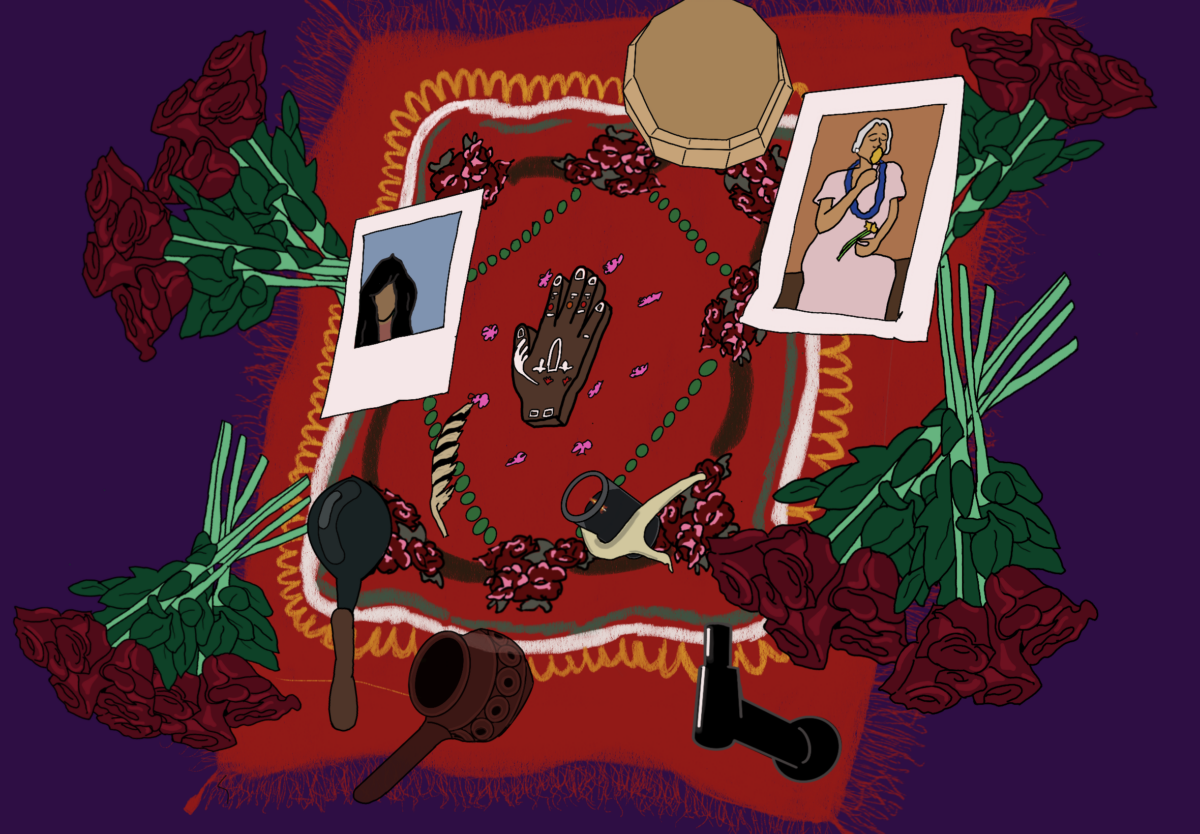
I recently drove up to Humboldt Park with my good friend Marcela Guadalupe Ramírez Aguilar for a free Susto Workshop hosted at holistic wellness studio, Spirit Science Medicine. It was facilitated by Victor Arroyo and Cristina Puzio from the Papalotzin healing collective. On the floor was a tapestry adorned with red roses, rosemary herbs and burning copal that infused the air. At the front of the room sat Victor and Cristina.
“Susto is an emotional, spiritual fright that disrupts internal balance,” Cristina explained to a room of twenty attendees. She said that in Indigenous traditions, specifically those in Mesoamerica, susto is described as the soul leaving the body due to trauma, fear, or stress, and the healing component focuses on bringing back the soul. It’s imperative to treat susto just like you would a physical injury.
On this occasion, we were going to use roses to perform a body limpia, or cleansing. For the latter part of last year, Cristina traveled neighborhood to neighborhood, from Pilsen to the East Side, offering free limpias after immigration authorities terrorized entire communities.
“I want people to have an option of how to take care of themselves during this time and not feel like they’re isolated,” Cristina said.
Cristina reaches out to local businesses and community spaces and sets up shop for the day, offering around thirty limpias in a single day. Through word of mouth and social media people show up and due to high demand, at times, Cristina has sometimes had to turn people away. This is reflective of the rising mental health struggles in immigrant communities like anxiety, stress, PTSD and depression—all things that can lead to susto.
Marcela, who is a licensed relational therapist, services families and adolescents across Chicago and has seen the impact of Operation Midway Blitz. “Of course people are going to be anxious and scared and saddened to the point of depression,” Marcela said.
Studies of policy changes made during the first Trump administration have shown that deportations and detentions have an impact on the daily lives and routines of immigrant families and long-term consequences for children, such as reduced life expectancy and impaired growth and development. For Marcela, drawing on ancestral practices aids her work as a therapist navigating a Western healthcare system that isn’t designed with marginalized communities in mind.
“The model that I am existing in is asking me to resolve it, or at least manage it, right? If you’re not managing it, it’s not effective, and that just isn’t realistic,” she said. “That’s not a humane expectation.How do I approach my clients in the context of their existing? I am wanting to expand beyond the Western modality, not because I think it’s useless, but, I am suspicious.”
Marcela said she finds the lack of cultural competence in mental healthcare troubling, and argued that rethinking healthcare through a decolonized lens is critical to truly serving community needs. One way to do that, according to her, is by abandoning individualism and embracing collective healing. It is this way of thinking that led Victor to launch the beginnings of Papalotzin.
In 2011, Victor was working as an intervention prevention counselor at Rudy Lozano Leadership Academy, an alternative high school in Pilsen. There, he implemented Indigenous teachings such as restorative practices, which produced positive outcomes in the student body. Students were losing their lives to gun violence, and Victor was helping students, teachers and staff grieve collectively. Victor left the city for a brief few years but upon his return, schools began to call again asking him to create healing corners. Before he knew it, he was asking fellow healers to join his work.
“I’m like, ‘Oh my gosh. We’ve been active for a whole year, doing a lot of beautiful things with our community, with young people, with schools and universities,’ and I asked the practitioners, who were pretty consistent in offering their healing services, if they wanted to meet to start a healing collective,” Victor recalled.
Along with Cristina, Victor founded Papalotzin with Kat and Jess Belmares. The team of healers began hosting consistent programming last year at no cost to the public. In October, Papalotzin hosted a Sanación and reiki clinic at the Chicago Park District in Humboldt Park, reaching around 300 attendees. And the work is not finished. Papalotzin keeps filling the gaps to what’s missing: an upcoming Susto workshop for men, virtual spaces for undocumented people who cannot leave their homes out of fear, and even partnerships with churches. Despite the common belief that holistic ancestral wellness can’t coexist with religion like Catholicism, which is widely practiced among Latinos in Chicago, Cristina says she often blends practices.
“I like to blend Catholicism because it’s part of my life. I was baptized. I mean, I’m not a practicing Catholic per se, I don’t really go to church, but I do take what I like from Catholicism,” Cristina said.
The rose limpias we were learning to perform at the Susto workshop was a method shared with Cristina by healer Brenda Salgado. Learning about traditional healing with roses felt especially significant that day, coming on the eve of the birthday of La Virgen de Guadalupe. Roses are symbolic to the Catholic Virgin Mary because as the story goes, she gave roses to Juan Diego to help him prove her apparition.
We used the roses to grace our entire body and in a swiping motion moved from the top of our head working down to our feet. Out loud we spoke affirmations like “may the roses help to release negative thoughts.” All of our senses were ignited as Cristina sprayed rose water and we felt the petals brush against our face. What we were doing closely resembled a ritual.
Oklahoma City–based healer Bianca Flores, known on social media as La Tarotina, uses her PhD in neuroscience to supplement her practice and explain, through videos, what happens in the brain during a limpia.
“I know we’ve been gaslit for centuries like colonization, that we can’t have our practices, but we can and they matter. If you need a rational permission slip, here you go,” said Bianca.
Bianca added that rituals light up different parts of the brain, setting off familiarity, triggering a resting state and feelings of being safe. Bianca shared a clinical trial from 2014 that looked at how the scent of fresh roses affects autonomic nervous activity. The study found that the smell of roses induced both physiological and psychological relaxation.
“Our vagus nerve is connected in our brainstem,” Bianca explained. “A lot of people, if they’re in a very heightened, fearful state, they might experience headaches, or some people, after a limpia, they’ll fall asleep. Or some people, in extreme cases, might even throw up. And essentially what this is, is your body coming back to a rest state.”
Bianca said that even the splashing of cold water, in cases like blessing items or ourselves, activates our thermal receptors leading to much slower controlled breathing. “I’m not here to debunk…. It’s actually acknowledging the fact that they work in tandem,” Bianca said, referring to science and spiritual healing.
A common thread among these healers is a commitment to decolonizing the belief that everything exists in isolation, instead drawing from and integrating teachings across elements. That approach feels especially urgent now, as communities across the country unite against cruel, racist immigration policies.
Cristina received more than forty applications for Las Adelitas de Sanación, her healing school aimed at training a new generation of healers. The pilot program, however, will accept only a small cohort. She hopes those apprentices will accompany her as she continues visiting neighborhoods affected by ICE’s brutality.
Healing our collective susto is not only needed but essential to our continued existence. Marcela explains how a limpia can ground and validate the injustices we are experiencing.
“It’s an act of love. It’s a gesture of care,” Marcela said. “There can be lightness to it. And even still, you feel the effect of somebody else wanting good for you, of somebody else wanting to lift heaviness or carry with you or be there witnessing that this is a hurt that is happening.”
Jocelyn Martinez-Rosales is a Mexican American independent journalist from Belmont Cragin committed to telling stories from communities of color through a social justice lens. She is also a senior editor at the Weekly.