
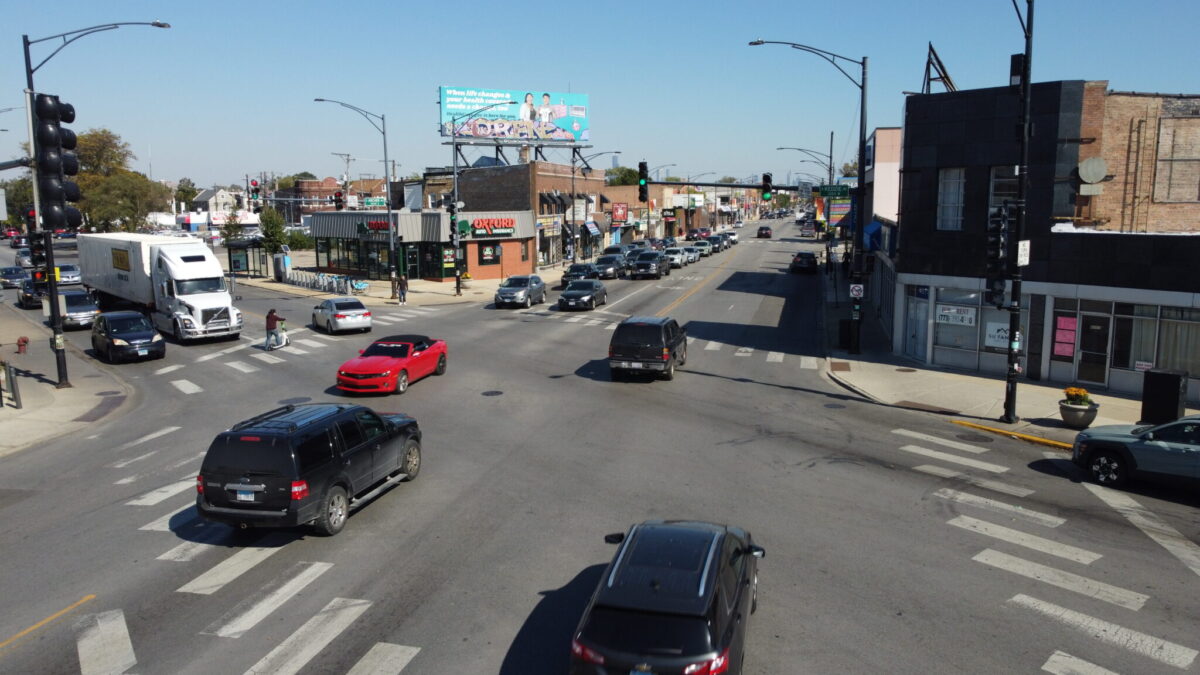
A redesign of Archer Avenue in Brighton Park, intended to improve safety and accessibility along one of the Southwest Side’s busiest corridors, has become a flashpoint for community debate and political tension.
The project, part of the city’s Complete Streets Program, has been underway for several months and includes bike lanes protected from the flow of traffic by a raised concrete curb, pedestrian refuge islands, curb extensions, and new turn lanes designed to slow traffic, shorten pedestrian crossings, and maintain parking where possible. Construction began in late 2025 and is expected to be completed in early 2026.
Ald. Julia Ramirez (12th), whose ward includes Brighton Park and McKinley Park, said the Archer Avenue project predates her time in office and reflects years of advocacy around traffic safety on the Southwest Side.
“A lot of different organizations and people wanted to build out a system where people felt safe on the Southwest Side, specifically on Archer Avenue,” she told the Weekly.
For many residents, this push is rooted in long-standing safety concerns. Alfredo Valladares Jr., a lifelong Gage Park resident and local cycling advocate, said the dangers along Archer are not new. Valladares Jr., a member of Gage Park Cyclists, said he has been riding in the area since high school and began organizing group rides in 2021 to build community and advocate for safer infrastructure. He recounted multiple fatal crashes and serious injuries involving neighbors over the past two decades.
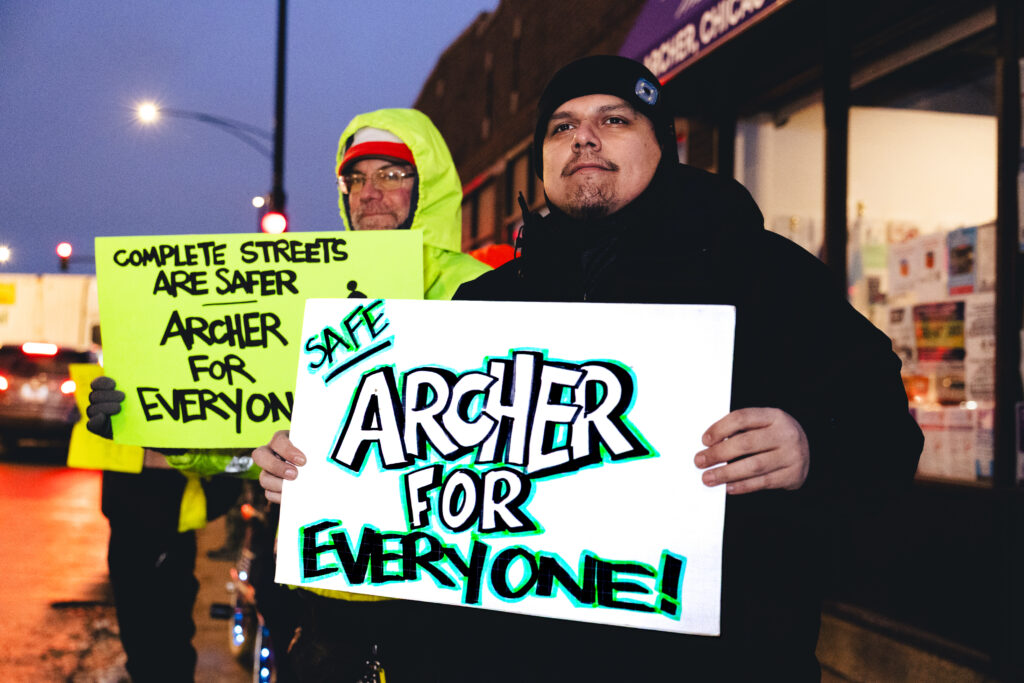
Around fifteen years ago, Valladares Jr. said a school-aged girl was struck while crossing the street with her aunt and sister at 55th Street and Fairfield Avenue. Six years ago, a neighbor’s wife was injured while she had the right of way, crossing at 55th and California Avenue. Four years ago, a bicyclist was killed at 56th and California, an intersection with only a shared bike lane painted on the asphalt, and no physical barrier, such as a raised concrete curb.
Valladares Jr. wants people to know that this project isn’t just about bike lanes, but about those who walk, too.
“People don’t feel safe crossing these streets,” he said.
According to data from the Chicago Department of Transportation (CDOT), during a community virtual meeting on the project, traffic injuries in Brighton Park outpace the rest of Chicago. Archer and Kedzie account for many of the neighborhood’s traffic injuries and fatalities. The new design addresses some of the causes of these crashes. Similar features have reduced accidents, injuries, and speeding in other projects.
City transportation officials point to similar projects elsewhere in Chicago as evidence that street redesigns like the one on Archer Avenue can reduce serious crashes. On the West Side, CDOT’s Vision Zero initiative led to safety upgrades along major corridors in Austin, Garfield Park, and North Lawndale, resulting in a thirty-nine percent reduction in people killed or seriously injured between 2021 and 2024, more than double the citywide decline.
In Brighton Park, there have been over 6,000 traffic crashes, more than 1,500 injuries, and thirteen fatalities. Compared to the average Chicago neighborhood, Brighton Park has 90 percent more traffic crashes.
As a community partner with CDOT from the beginning, transit advocacy steward Dixon Galvez-Searle of Southwest Collective described the redesign as “the first really significant protected bike lanes anywhere on the Southwest Side,” emphasizing that its benefits extend beyond cyclists.
“So if you live just a few blocks from your kids’ school, maybe you’ll feel comfortable letting your kids bike to school, or walking with them—trips you wouldn’t have felt safe doing before. If the project achieves that, it’s a boon for quality of life in the neighborhood.”
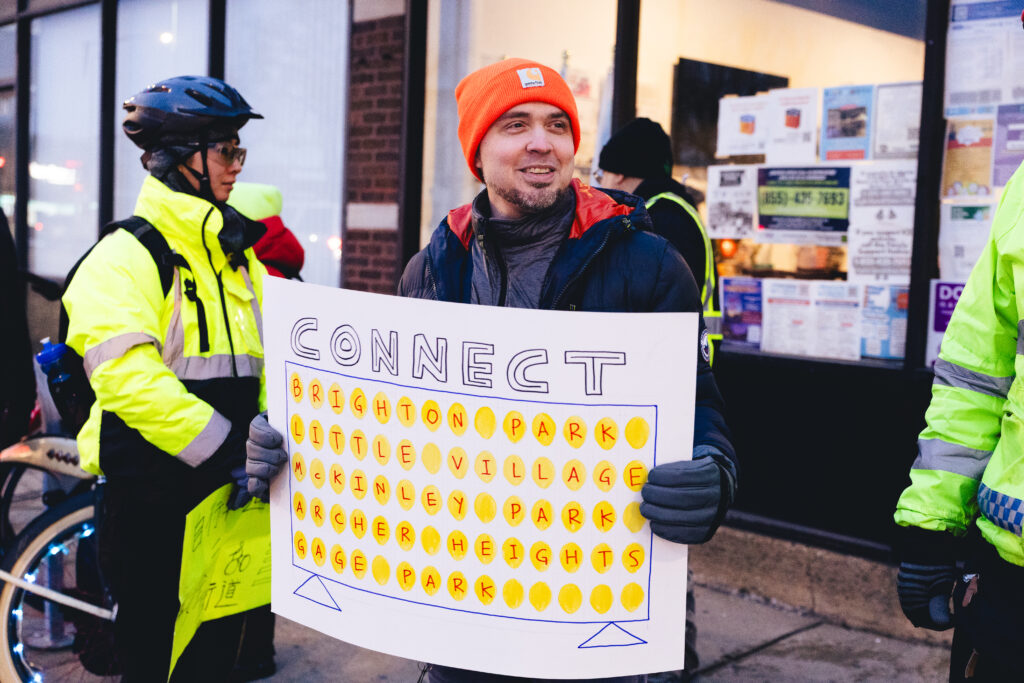
At community meetings, city transportation officials have said the project was shaped by extensive community engagement. CDOT conducted surveys, public meetings, and outreach that revealed strong interest in walking and cycling. Valladares Jr. said the findings reflected what many residents already knew.
Yet the redesign, and especially its bike lanes, have drawn vocal opposition, some of it explicitly political. Protests outside Ramirez’s office that started in December 2025 not only raised concerns about parking loss, traffic congestion, and emergency vehicle access—issues the project addressed—but also carried messaging aimed at unseating Ramirez and Mayor Brandon Johnson.
The Weekly obtained two mass text messages and a press release sent by the Urban Center, a pro-charter school advocacy organization that has been active in campaigns opposing progressive elected officials.
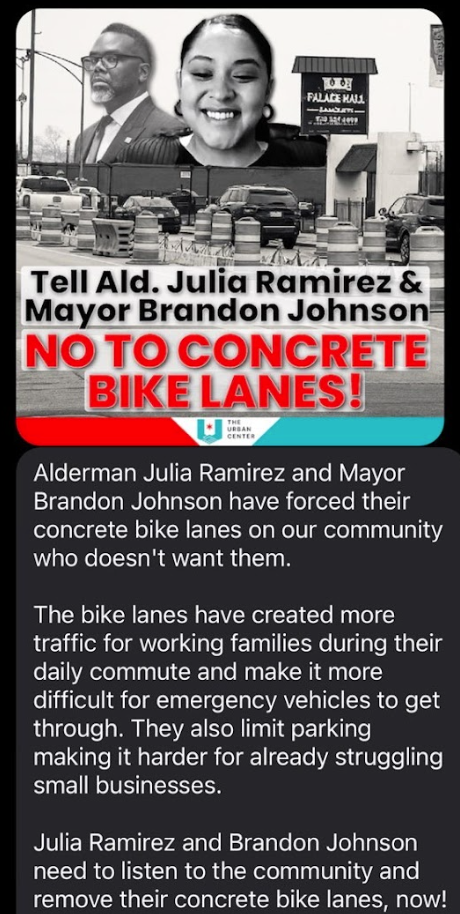
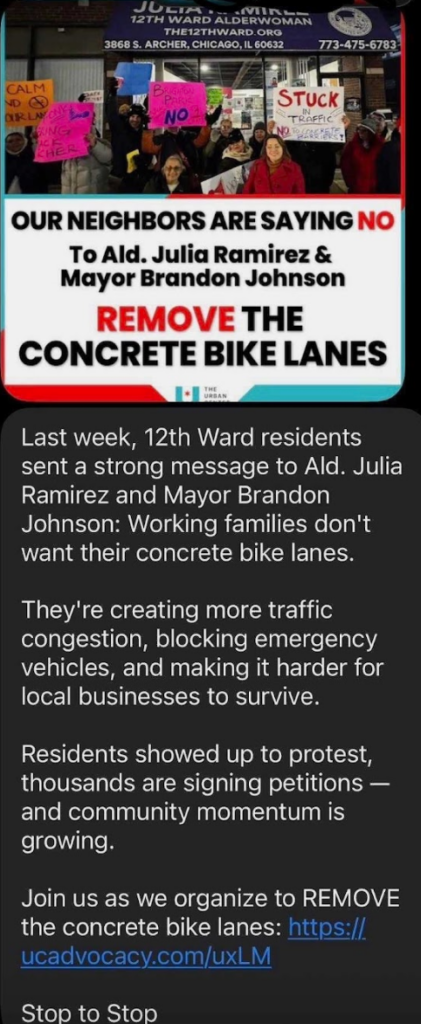
Screenshot of mass texts from Urban Center sent to community members.
Both texts carry the organization’s logo and teal-and-red color scheme, and use nearly identical talking points. One message says in part that Ramirez and Johnson “have forced their concrete bike lanes on our community who doesn’t want them,” claiming the lanes increase traffic, limit parking, and make it harder for emergency vehicles to get through.
The group opposing the project says it is not against bike lanes in general, but specifically opposes the installation of concrete‑protected lanes along Archer Avenue.
But research suggests that painted bike lanes alone can be less safe than having no lane at all, while protected lanes, like those planned for Archer, provide real safety benefits for cyclists and pedestrians.
Additionally, CDOT noted the project includes intersection designs, left-turn lanes, striped medians, and other features that give emergency vehicles space to maneuver, turn, and pull over when needed.
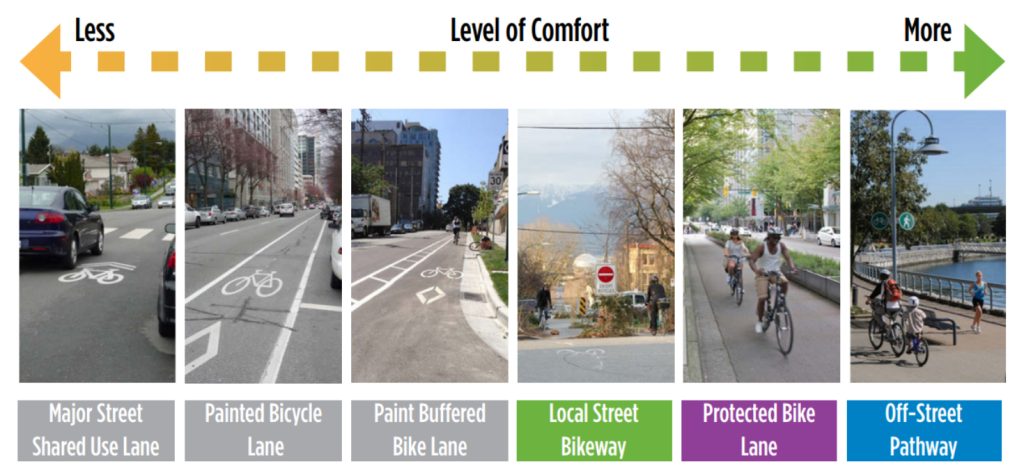
Another similarly states that “working families don’t want their concrete bike lanes” and encourages recipients to join Urban Center’s campaign to remove them, providing a link to the group’s advocacy site. Both texts explicitly name Ramirez and Johnson, signaling that the messages go beyond infrastructure concerns and are being used as a political tool.
A December 8 press release promoting a rally outside Ramirez’s ward office opposing the bike lanes listed contact information for Bobby Sylvester, vice president of Urban Center, and Claudia Zuno, listed as “Brighton Park Community Resident.” The release stated that “Brighton Park community residents will rally in protest of the concrete bike lanes,” citing concerns about rush-hour traffic backups and emergency vehicle access.
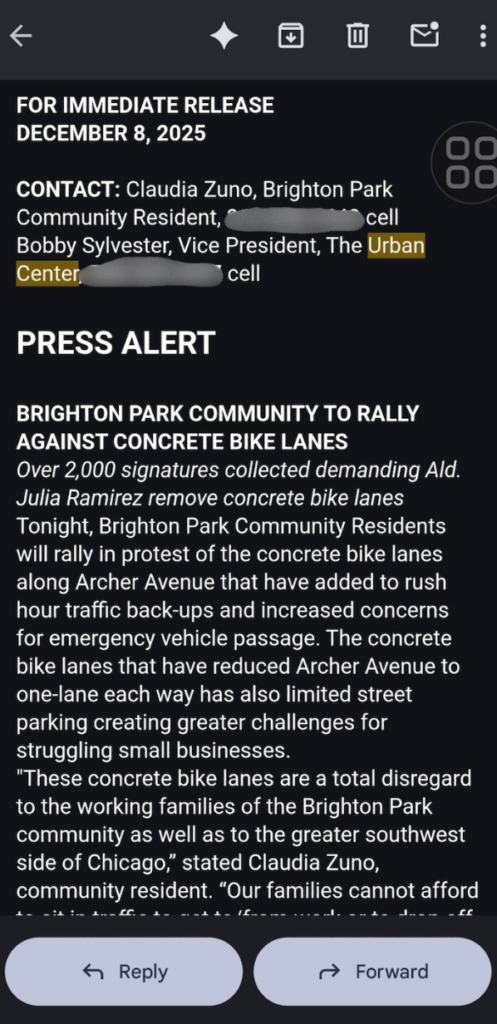
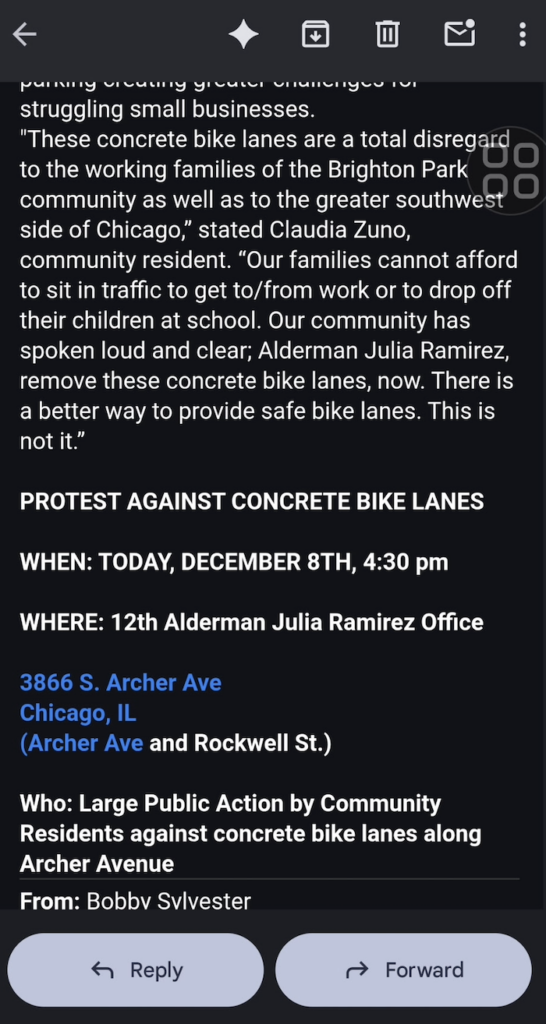
Screenshot of Urban Center’s press alert opposing the Archer Avenue concrete bike lanes was sent to Brighton Park residents.
Discussions have circulated about a potential challenge to Ramirez, including the possibility of Zuno running in a future election.
When asked whether her involvement in opposition to the Archer bike lane was connected in any way to plans to seek elected office or support a challenge in the 12th Ward, Zuno told the Weekly, “If this is not a wake-up call for [Ramirez] to change course and genuinely listen to the people she represents, then it is a clear opportunity to step forward and advocate for the true interests of the 12th Ward community.”
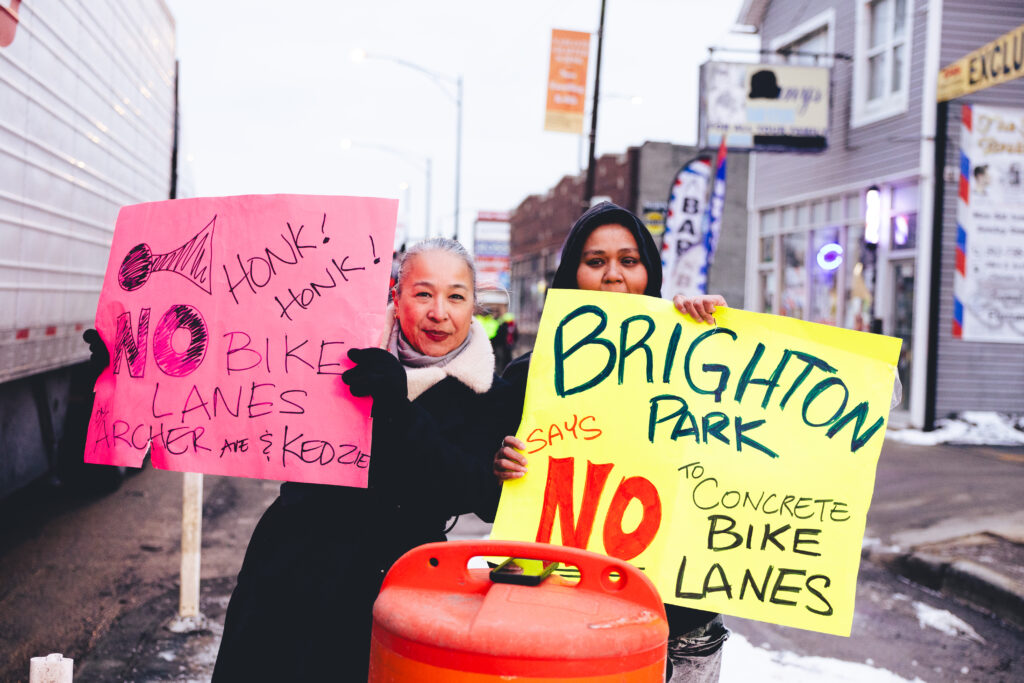
Former School Board candidate Eva Villalobos has also emerged as a visible organizer of rallies opposing the Archer bike lanes.
On a GoFundMe page soliciting donations, Villalobos describes the group as a response to what she characterizes as decisions being “forced” onto the community without transparency or meaningful resident input. While the group states it is “not against cyclists,” the fundraising appeal casts the bike lane project as driven by political agendas rather than safety concerns, and urges supporters to “hold leaders accountable” when elected officials move forward despite opposition.
In 2024, Villalobos received more than $25,000 from the Urban Center during her unsuccessful Chicago School Board candidacy.
Urban Center is led by former UNO Charter School CEO Juan Rangel and is affiliated with Paul Vallas, the former Chicago Public Schools CEO who lost to Johnson in the 2023 mayoral runoff.
Rangel ran UNO, the nonprofit that opened many charter schools in Little Village and other Latino neighborhoods. He grew up in the area and over decades built connections in politics and city government. Under his leadership, UNO expanded rapidly, but he surrounded himself with family and political allies, and the organization’s finances were complex and opaque. Parents and critics complained that the schools sometimes prioritized growth and influence over students. In 2013, after investigations and lawsuits, he resigned.
Urban Center’s involvement in local politics extends beyond messaging about the Archer Avenue project. Records from state election filings show Urban Center Action, the organization’s super PAC, raised hundreds of thousands of dollars in the 2024 Chicago school board cycle and has spent on field work, mailers, text messaging and other campaign activity aimed at supporting or opposing specific candidates.
In 2025, The Triibe reported that Urban Center’s political action committee sent mass texts criticizing Johnson and several progressive alderpeople over the City Council’s vote on a controversial “snap curfew” ordinance. Political analysts say these efforts are often aimed at building a base and shaping elections long before candidates formally announce campaigns, illustrating how common neighborhood frustrations can be used in a larger strategic effort.
Similar tactics—coordinated messaging and rallies—are now appearing in Brighton Park over the Archer Avenue project.
Rangel told the Weekly community residents came to Urban Center with the issue, and that it is merely a response “to the community,” not the other way around. When asked about issues being leveraged in elections, specifically any backing for Zuno, he framed political consequences as a natural byproduct and not a goal, but not a problem either. “If leadership emerges out of their actions or our support, that’s not a bad thing.”
When asked about Urban’s Center’s broader political influence, Rangel downplayed its role in elections, describing the organization’s work as focused on “the issues and how the community reacts to these issues.”
Although Ramirez has been on maternity leave for the past two months, she has stayed engaged with community concerns through calls, emails, and virtual one-on-one meetings. Her office coordinates a monthly small business meeting on the first Monday of each month with the McKinley Park Development Council. At the most recent meeting, protesters attended, causing disruptions, including yelling and unauthorized recording, that prevented the agenda from being completed and required security to be called.
“I think that we should push ourselves to see the benefit, even if it is an added few minutes of traffic, or the go around to find that parking spot,” Ramirez said. “It’s ultimately worth it because of creating accessibility for other people.”
Jaime Groth Searle, the executive director of Southwest Side Collective, who also has a background in marketing, said the opposition Facebook posts raised early red flags for her. She began noticing that different opponents on the platform, at protests, and even among some business owners were repeating the same phrases about emergency vehicles, small businesses, and traffic congestion.
“It was different people, but saying the same things,” Groth-Searle said, adding that the repetition resembled what, in marketing, is known as a project briefing: a set of prescribed talking points and responses to anticipated pushback.
Groth-Searle also pointed to the role of Facebook’s “digital creator” tools, which reward engagement and can incentivize emotionally charged content. In her view, some participants appeared to be capitalizing on the controversy to build online followings, while others were simply expressing genuine frustration creating, intentionally or not, fertile ground for political groups to amplify and steer the narrative during an election cycle.
“We need to name the thing,” she said, describing how anger and frustration around a real inconvenience can be harnessed and redirected for political ends and cautioned against interpreting the visibility of the protests as evidence of broad opposition.
“I think if it were nice outside and people had better things to do, this would be such a non-factor.”
When Valladares Jr. found out about the weekly protests outside of Ramirez’ office, he decided to attend them with his own group of supporters.
But he said tensions escalated after members of his group began attending and that during one protest, one of the rally organizers attempted to “rip my sign out of my hand,” prompting a police officer to intervene and separate the groups.
Valladares Jr. said police have been present since the start of the protests, but began strictly enforcing physical separation after confrontations increased, with officers now stationed between the two sides to prevent further incidents.
He said he’s gotten threats through Facebook Messenger and TikTok, some implying potential physical harm. In one instance, a person referenced having delivered food to Valladares Jr.’s home via Uber Eats months earlier, an interaction he described as particularly unsettling.
In another instance, he said: I’ve had threats telling me that they’ve been following me since the beginning, that this is bigger than I think, and that I just need to leave it alone. I don’t know what they mean by that.”
Julie Wu, a resident of McKinley Park in the 12th Ward, has been attending the weekly bike lane protests since early December 2025. Wu said she initially wasn’t planning to get involved, describing herself as “not the most politically active person.” But after seeing a Facebook post encouraging supporters to show up, she decided to attend and has returned nearly each week to ensure her side is represented.
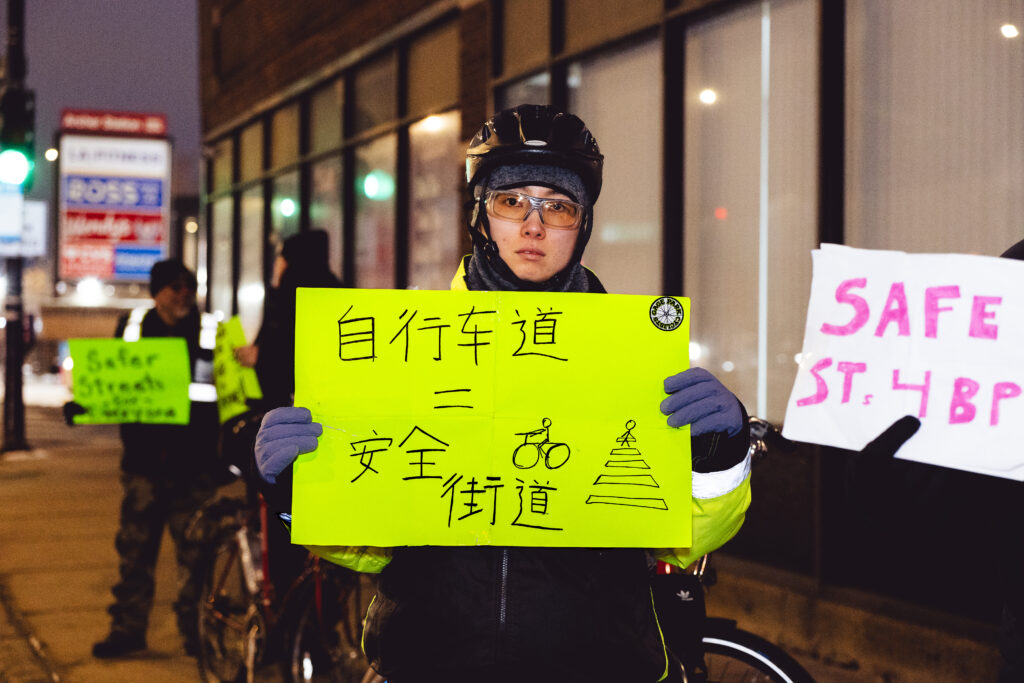
At the protests, Wu said she observed tactics aimed at swaying supporters. On multiple occasions, opponents handed out flyers for the “Archer Guardians”, while pretending to be on the pro-bike side or filmed attendees under the guise of friendly engagement. These experiences, coupled with the political messaging circulating online, reinforced her understanding that the fight over bike lanes isn’t just about infrastructure—it has become a proxy for broader political debates in the ward.
Her involvement is also deeply personal. In the winter of 2022, she was hit by a car while riding a Divvy bike on Archer Avenue near Hoyne. Though she avoided serious injury, she called the incident “pretty scary,” highlighting the street’s unsafe design. “So if I’m in danger, I think about how much danger there could be to children and elderly people and people who are maybe not able-bodied,” she said.
While pro-bike lane advocates continue to emphasize safety for pedestrians and cyclists along Archer Avenue, the opposing side has become entangled with organized political messaging tied to Urban Center, highlighting how local infrastructure debates can intersect with broader election campaigns.
“A lot of people are being used,” Valladares Jr. said. “They’re angry, but they’re not always being told what the project actually does. And that anger is being turned into something political, instead of a real conversation about safety.”
Alma Campos is the Weekly’s lead reporter and immigration project editor.
When Keys to the City Don’t Work
CityKey ID is meant to provide access but some Chicago residents say they face barriers and discrimination.
Jury Acquits Chicago Resident of Murder-for-Hire Plot on Border Patrol Commander
The defendant, Juan Espinoza Martinez, was detained by immigration agents after being found not guilty and faces deportation.
City Council Pauses on Curfew, Bans Some Hemp Products
An updated curfew ordinance designed to curtail youth gatherings was sent to committee for further consideration.
I am a disabled senior. I used to shop Archer Ave stores. I now shop were I can park near the store. There is no parking for Brighton park library, once the lot is filled. I find parking in dollar tree lot to go to the library. I find myself going down side streets and alleys to avoid Archer Ave. How is this helpful to disabled seniors. I fell trying to cross your concrete barrier to cross the street. No one asked or consul me or my neighbors if we want to add 15 – 20 minute drive down Archer. Where is handicap parking