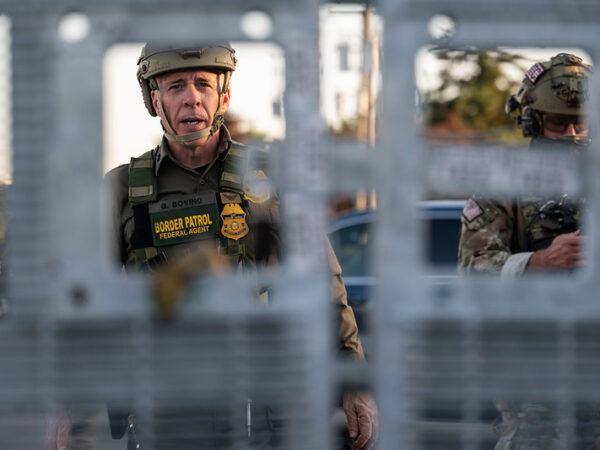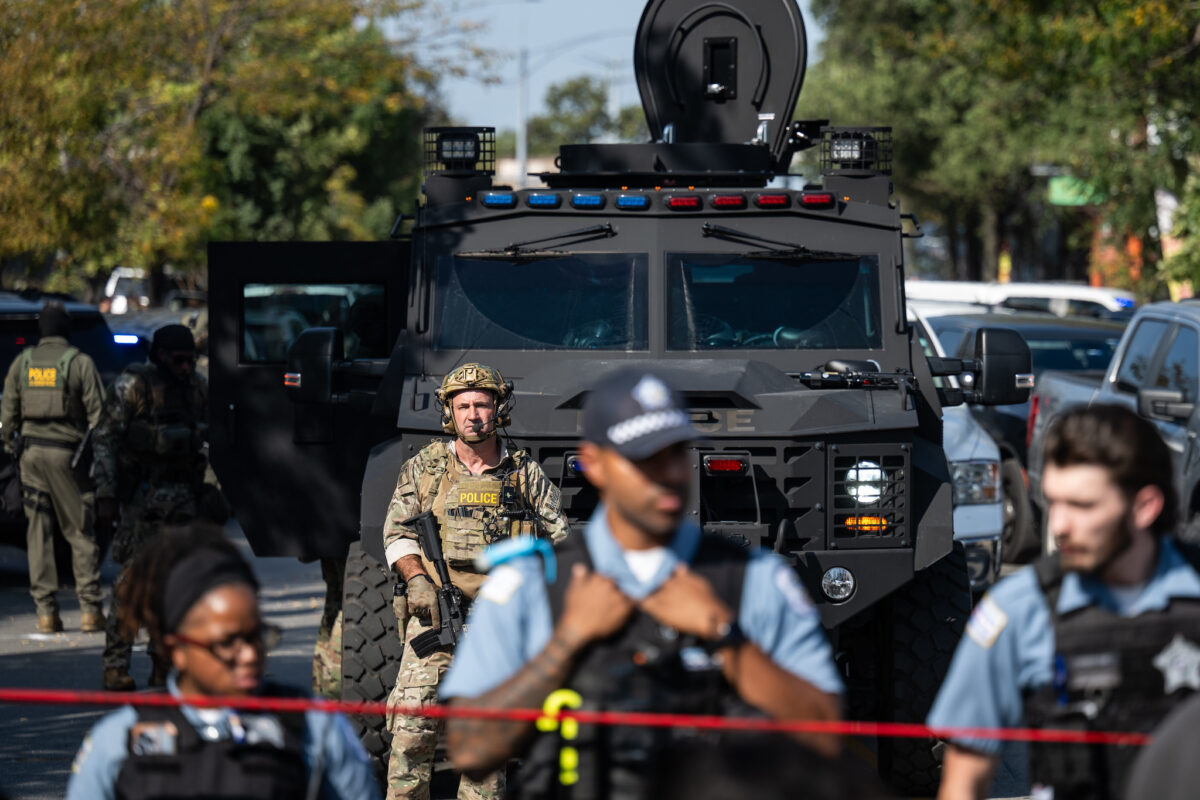
On October 4, Border Patrol agent Charles Exum shot Chicago resident Marimar Martínez, a U.S. citizen who’d joined a group of rapid responders who were following Exum and other immigration agents on the Southwest Side. Then he bragged about it.
“I fired 5 rounds and she had 7 holes. Put that in your book boys,” Exum wrote in a text message that was made publicly available in court documents in November.
The texts came out in court as the Department of Justice (DOJ) prepared to take Martínez and a man named Anthony Ian Santos Ruiz to trial on charges they’d assaulted or impeded federal officers. The Department of Homeland Security (DHS), which oversees Immigration and Customs Enforcement (ICE) as well as Customs and Border Protection (CBP) and Border Patrol, deemed them “domestic terrorists” in an October 4 press statement. The department claimed Martínez and Santos Ruiz used their vehicles to ram Border Patrol agents’ own vehicles in Brighton Park on October 4, while eliding how Exum shot Martínez multiple times as “defensive fire.” The DOJ released a statement on October 5 announcing charges against the pair.
Less than three weeks after Exum’s text messages were made public, and Exum appeared in court, federal prosecutors moved to drop the case. District Judge Georgia Alexakis dismissed it with prejudice on November 20.
Now, even more material from the case is set to be released publicly. Alexakis said in a court hearing Friday morning, February 6, that she would largely grant Martínez’s motion to modify a protective order the court placed on material relevant to her dropped prosecution including additional text messages sent by Exum, body camera footage from other agents on the day he shot Martínez (Exum did not have his body camera on at the time), and images gathered from Flock surveillance cameras in Chicago.
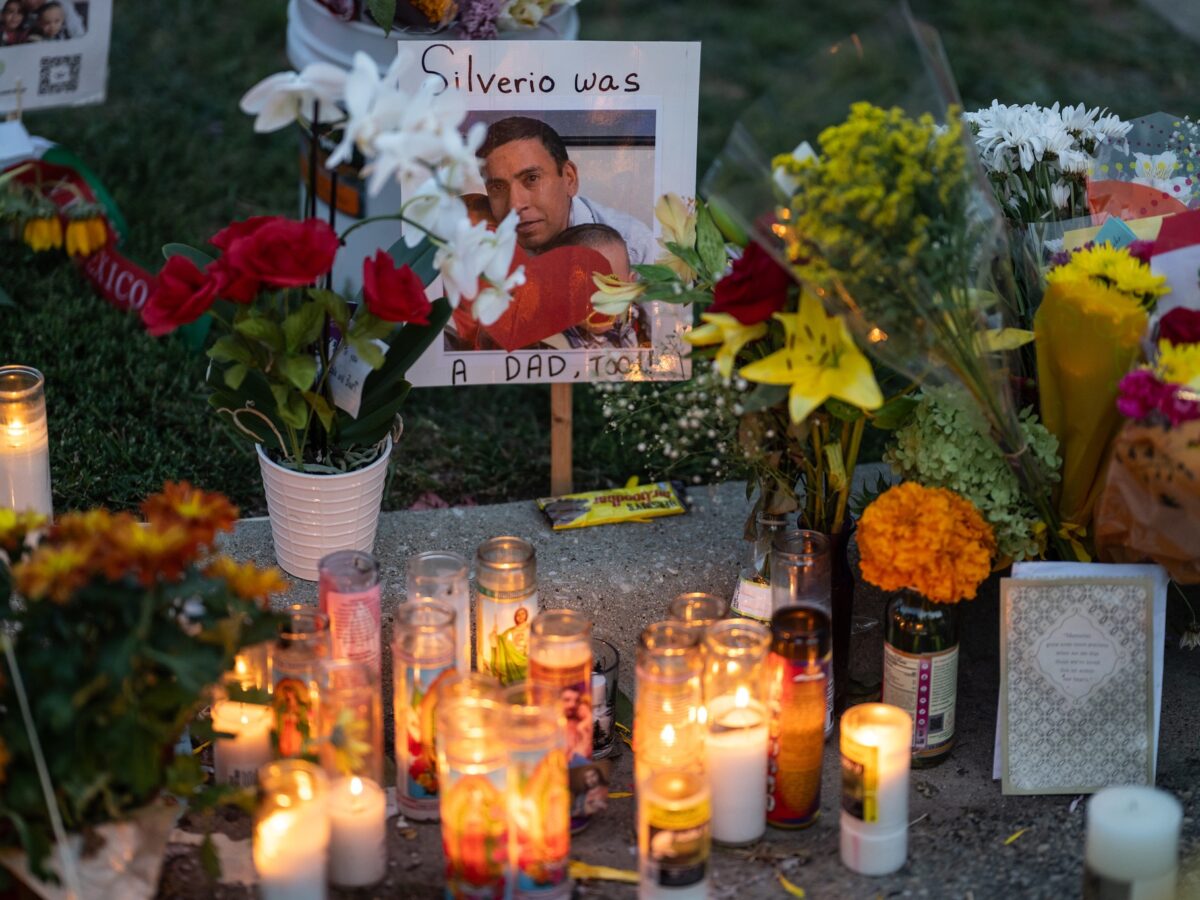
“Now we’ll pull the curtain back and you guys can see how the government itself responds to the interaction with these agents in the moments after one of these shootings happens. I think that’s important for people to see,” Christopher Parente, Martínez’s attorney, told the press after Alexakis made her ruling on Friday, referencing the DHS killings of Renée Good, Alex Pretti, and Silverio Villegas González.
Martínez filed the motion to modify the protective order in the last week of January. The filing states her desire to inform the public “regarding how DHS responds in cases where their agents use deadly force against U.S. citizens,” and to counter the federal government’s ongoing accusation that she is a terrorist.
“Despite voluntarily dismissing the charges against Ms. Martínez, high ranking government officials continue to maintain that the sum and substance of the facts alleged in Ms. Martínez’s indictment are accurate,” the motion states. “To this day, Ms. Martínez is described as a ‘domestic terrorist’ who ‘rammed federal agents with [her] vehicle’ on the website of the Department of Homeland Security.”
Martínez echoed both desires when she spoke at a bicameral (though not bipartisan, for no Republican lawmaker attended) February 3 Congressional forum on DHS agents’ violent actions in Washington DC.
She testified before Democratic senators and representatives along with Luke and Brent Ganger, the brothers of Renée Nicole Good, whom ICE agent Jonathan Ross shot and killed in Minneapolis on January 7; Aliya Rahman, a Minneapolis resident and U.S. citizen with a brain injury whom federal agents violently pulled from her car and detained while she was headed to a health appointment on January 13; and Daniel Rascon, who along with other family members was violently confronted by armed federal agents in southern California over two separate days last August. In one of those encounters, while Rascon and his in-laws were driving, an agent shot at their car.
Martínez offered prepared testimony and fielded follow-up questions from the assembled lawmakers. She said what she wanted most from the government was an admission of wrongdoing.
“Just a, ‘sorry, you’re not a domestic terrorist.’ That’s it,” she told Democratic California Rep. Ro Khanna during the hearing. “That’s all I want, that’s all I’m asking for. For them to admit that they were wrong.”
At press time, DHS’s statement labeling Martínez a terrorist remains viewable on its website, and a spokesperson for the department signaled it was unwilling to recant that label.
“DHS stands by our press releases and statements,” a DHS spokesperson told the Weekly. “The facts of what happened did not change.”
On Friday, Judge Alexakis ordered the parties to confer over modifications to the current protective order. Parente told press he would meet with government attorneys over the weekend and not to expect the newly modified order, nor any new materials it would unseal, before Monday, February 9.
Alexakis’s ruling came after both Martínez’s counsel and the DOJ filed competing arguments over her motion. The DOJ first claimed that Alexakis lacked jurisdiction to rule on the matter, as media organizations had their own notice of appeal on access to sealed materials pending before the Seventh Circuit Appellate Court. Assuming—correctly—that Alexakis wouldn’t buy this argument, they then urged the judge not to modify the protective order regarding text messages Exum sent his wife, brother, and coworkers, which were included in the discovery for Martínez and Santos Ruiz’s aborted trial.
The DOJ lawyers argued the messages had “no bearing on the key basis” of Martínez’s motion, and would “serve only to further sully Agent Exum, his family, and co-workers.”
The government also sought to keep sealed images captured by license plate reader cameras and Flock security cameras around Chicago, claiming they were “law-enforcement sensitive.”
The government argued the images, if publicized, “may reveal the location of numerous Flock and LPR cameras that are utilized by law enforcement, thereby causing harm to future law enforcement investigations and potentially compromising public safety.”
Martínez replied in a separate filing last Thursday, again stating that she wished to combat the government’s narrative, not compromise law-enforcement interests. And as to whether the text messages Exum sent would further “sully” him, Martínez’s counsel responded that he had already sullied himself.
“Agent Exum sent these messages in the minutes, hours, and days after the shooting” the reply filing states. “These are his words. To the extent they would ‘sully’ his reputation more than his previously disclosed disgusting text messages already have, it is a fully deserved self-imposed sullying.”
Alexakis largely sided with Martínez. The judge allowed Exum’s text messages to be released, provided redactions were made to protect third parties like his wife and the name of another federal agent he messaged. She barred the release of the images captured by license-plate-reader cameras, citing concern they could bring undue attention to uninvolved individuals. She noted Flock cameras are already located in public, and readily searchable online.
“You can google ‘Flock cameras’ and get a pretty good idea of what you would be looking for,” Alexakis said.
Martínez did not speak to the press Friday, but Parente emphasized that it was the recent DHS killings in Minneapolis that spurred her to seek the release of her case materials.
“It wasn’t until the killings of Mr. Pretti and Ms. Good that this came up. It’s because we know, sort of, what it looks like behind the curtain, and it’s scary,” Parente said.
Martínez did voice her desire for justice for the families of those killed by DHS agents when she addressed lawmakers last week, saying she felt the need to speak for the victims who no longer can.
“If there’s no justice for the people,” she said in her closing remarks, quoting the Mexican revolutionary Emiliano Zapata, “let there be no peace for the government.”
Dave Byrnes is a Chicago-born independent journalist covering the Trump administration’s anti-immigrant blitz. He lives in Lincoln Square, but is a lifelong White Sox fan.