
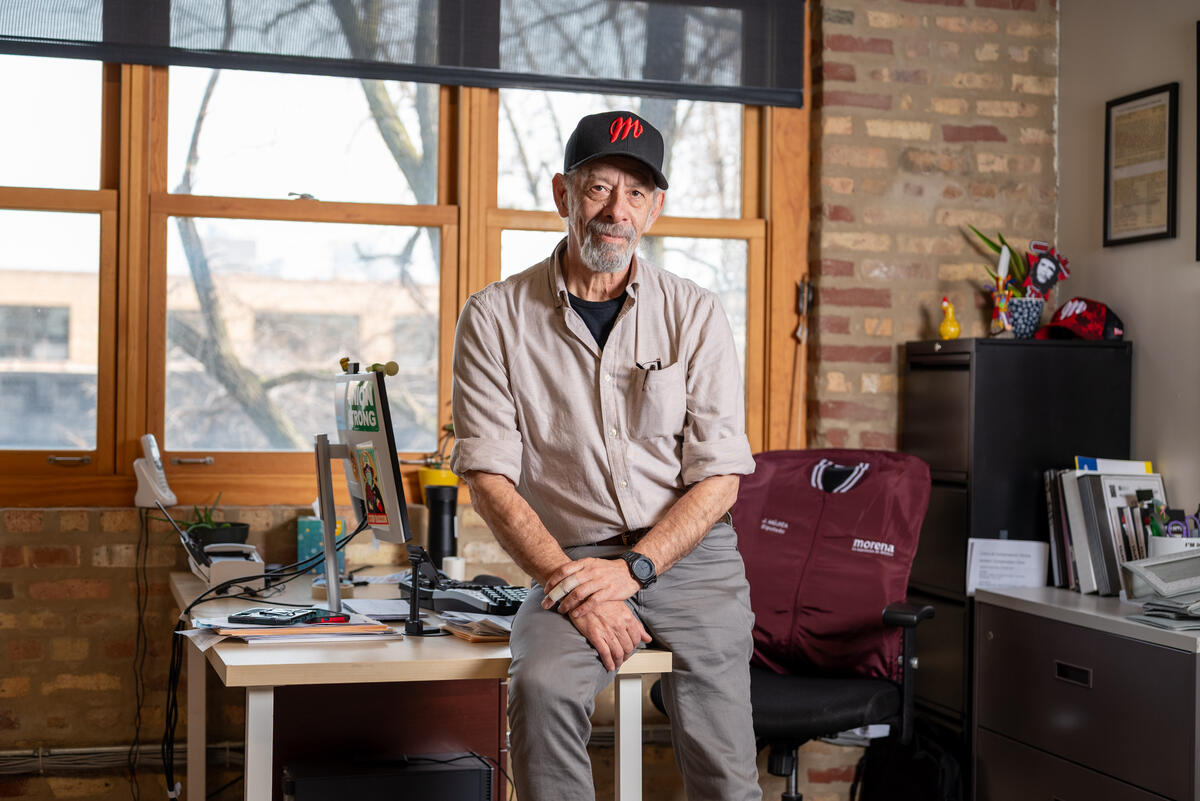
In Chicago, a city with a long history of labor organizing, where entire industries depend on immigrant labor, violations aren’t the exception, they’re routine: missing paychecks, shifting schedules, injuries that never get reported.
Jorge Mújica, a labor rights organizer, has spent decades listening to those stories.
He’s been doing this work for more than 50 years. He started in Mexico’s industrial zones, organizing factory workers and building unions in places where there were barely any protections. More than 30 years ago, he moved to Chicago and kept doing the same work. He was among the first in the city to offer labor rights education in Spanish. He has also been part of major immigrant rights mobilizations, including the 2006 “Day Without Immigrants” marches that brought hundreds of thousands into the streets and the ones already being organized for this May.
Workers find their way to him in different ways: through a relative, a coworker, a Facebook message. Sometimes it’s someone he helped years ago or someone who doesn’t even know if what they’re experiencing is illegal, they just know something isn’t right.
Over the years, he has helped recover millions of dollars in stolen wages. But the results aren’t always consistent, and the process is slow. Cases drag on, sometimes months and at times for years. For Mújica, the problem isn’t complicated: people work, and they should be able to live with dignity. When that doesn’t happen, he says, it comes down to something basic; who has power, and who doesn’t.
In this conversation with the Weekly, he explains what rights workers actually have, how those rights play out in practice, and why fear continues to shape people’s lives on the job.
This interview has been edited for length and clarity.
How long have you been working on labor rights?
My whole life, more than 50 years. Here at Arise I’m about to hit 14 years, but I started doing this in Mexico, right out of school, working with Mexican unions in the industrial areas of Mexico City.
It’s called the Vallejo Azcapotzalco industrial zone. Think of something like Bedford Park. In Bedford Park maybe 500 people live there, but 15,000 workers work there. A typical industrial zone. I worked there with General Foods workers, with auto workers. Then in my own job, I went to work at a publishing house, at the time the biggest in Latin America, Fondo de Cultura Económica and I organized the union there myself.
Later we created a nonprofit, the Center for Occupational Health, to advise workers on hygiene and safety issues, focused specifically on that. There was nothing like Occupational Safety and Health Administration (OSHA), let’s say—no limits, nothing.
So we did a lot of that work, and then I came here to do the same thing, work on health and safety with Latino workers in the United States. Back then there was already a need to do all this work in Spanish, and nobody was doing it. When I got to Chicago, there were no worker education organizations except unions, and they only educated their own members.
I started doing workplace health and safety education at the Chicago Lung Association, but they shut the program down because they said we should only talk about not smoking at work, not about organizing “illegals.”
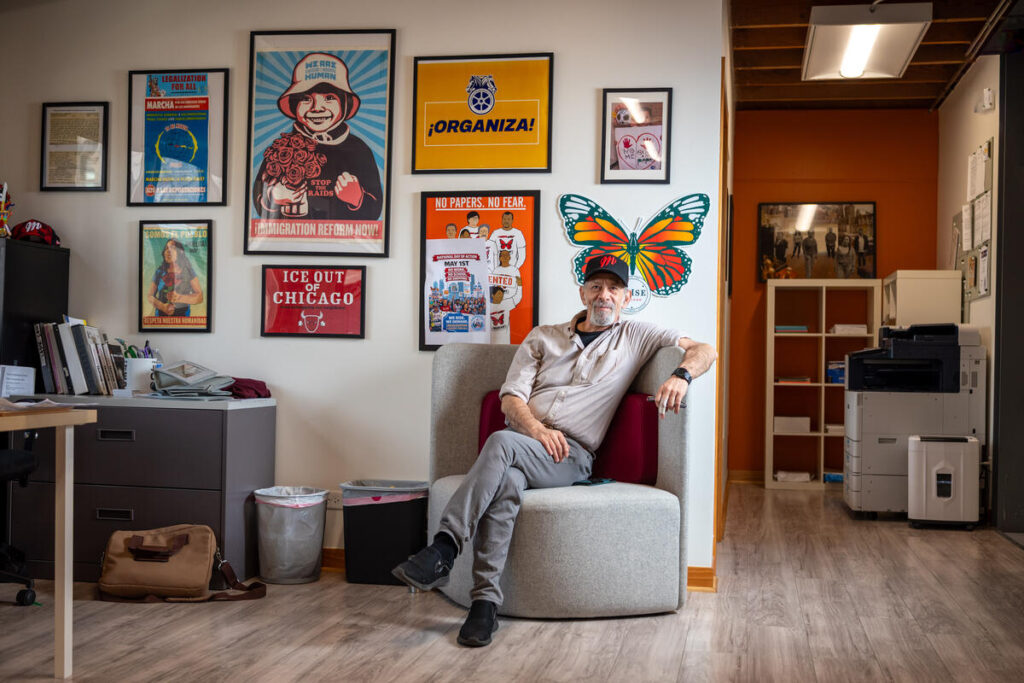
You’ve been doing this work for more than 50 years. What has kept you in it?
Stubbornness?
Well, the fact that there are always injustices, and I’ve learned they can be fought and that I can teach people how to fight them. As long as there’s something to fight, we’ll keep going.
If you have a full-time job, you should be able to live. You shouldn’t be going hungry, or struggling to pay rent, or unable to feed your kids. A job should be enough to live with your family. And it isn’t, because of employers’ greed. It isn’t, because all they think about is making money, not distributing it.
What are the most common ways employers take advantage of undocumented workers in Chicago?
The fact that employers know a worker is undocumented and abuse that. That’s what we see most often, employers telling workers that because they don’t have papers, they don’t have rights. That because they don’t have papers, they’ll be paid in cash, below minimum wage. We see that all the time.
But being undocumented shouldn’t matter.
What kind of results have you seen from this work?
Arise has recovered about $10 million in unpaid wages, stolen wages. Sometimes it’s small amounts, $500, $800. Sometimes it’s hundreds of thousands. I had a case close to $250,000 for car wash workers.
There was retaliation against workers who wanted to organize at a gym. They were fired, illegally. Fired for trying to organize. It’s illegal to fire someone for talking about wages or making demands, and in that case we recovered $1 million in lost wages.
We just finished a case—$150,000 for three workers in Bedford Park. Same thing, illegal firing. It came out to about $50,000 for each of them.
There are workers scheduled seven days straight. That’s not the biggest harm, but it’s illegal. In those cases, the Department of Labor basically gives the employer a slap on the wrist, a $100 fine each time. So it’s not big money, but it’s about enforcing the law. That one took about six months. Pretty fast. The car wash case took nine years.
Why did it take so long?
Because it went from the federal Department of Labor to the Illinois Department of Labor, then to the state attorney general, then to court, then to bankruptcy court. And bankruptcy court took nine years.
What are the most important labor rights workers should know, regardless of immigration status?
The first thing is: no labor law distinguishes between citizens and non-citizens. None. No law says “undocumented worker.” A worker is a worker, period. Everyone has the same rights.
Not having papers does not mean you don’t have labor rights.
Can undocumented workers report wage theft or unsafe conditions without risking immigration consequences?
All laws apply to all workers. Most laws prohibit retaliation if you try to use them.
If I ask for sick days and the employer denies them and threatens to punish me, that’s retaliation. Any worker is protected from that.
Now, in reality, that’s not always what happens. You might have to fight your firing, and fight for your sick days, and fight for unpaid hours. But that’s true for any worker, not just undocumented ones. Anyone can be fired unless they have a union.
In Illinois, an employer cannot threaten you with your immigration status. They have no right to bring that up to stop you from exercising your rights. If you ask for sick days, they can’t say, “undocumented workers don’t get sick days.” That’s illegal twice over; denying the right and threatening you.
But you also have to remember: an undocumented worker technically does not have the right to work. They are not authorized to work. So an employer can fire you and say, “you’re done,” and you don’t have recourse for that alone. That’s not discrimination. The discrimination comes if it’s retaliation.
What should someone do if their employer threatens to call ICE or uses immigration status to intimidate them?
For something to count as retaliation, you have to have done something first. If you were just quiet and the employer says something, that’s not retaliation. If you told the employer you were going to report them, or demanded they follow the law, or filed a complaint and then they act against you, that’s retaliation.
If I ask for overtime and they say they won’t pay me because I’m undocumented, that’s two violations. One for not paying overtime, and one for threatening me. But I have to act first.
Do undocumented workers have the right to minimum wage, overtime, and workers’ compensation if they’re injured on the job?
All workers in Illinois have the right to workers’ compensation. Of course they have the right to minimum wage, overtime, tips, everything the law says. Especially workers’ comp; it doesn’t matter what your status is.
But that’s Illinois. If you cross into Indiana, you lose that. Each state handles workers’ comp differently, and there they do consider immigration status.
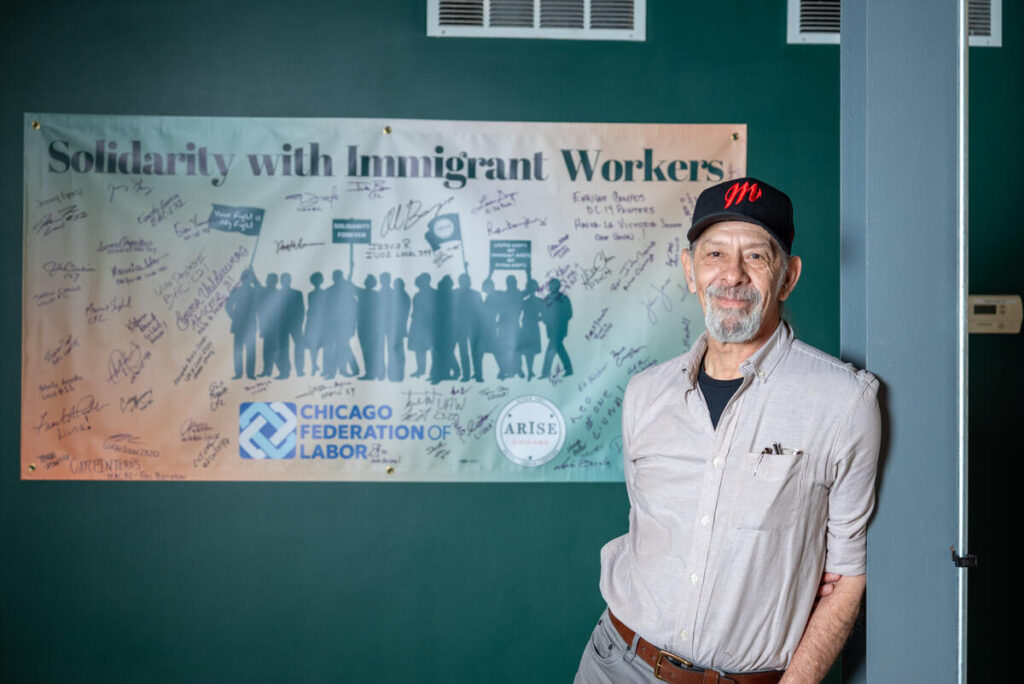
Credit: Tonal Simmons
Where can workers go if they’re facing abuse?
They can go to government agencies. The Department of Human Rights for discrimination. The Department of Labor for wage issues. They can also go to worker centers like us, Arise Chicago. We educate workers, support them, organize them.
They can go to unions. A union is a permanent organization that makes sure the law is followed and fights for better conditions. We always try to start with education.
How does that education process work?
Workshops. Workers call and say, “I have a problem,” and instead of spending an hour on the phone one by one, we tell them: come to a workers’ rights workshop next Wednesday. Sometimes we get people working seven days straight. We adjust the workshops to what people need.
What advice would you give workers who are afraid to report abuse?
The law doesn’t protect fear. There’s no law that protects scared workers. The law protects workers who take action. If you file a complaint, you’re protected from retaliation. But you have to act first. You can’t stay silent and then later say you were retaliated against. That doesn’t work. You have to act and you have to act collectively. Individual rights aren’t always protected. Collective rights are.
What are the consequences of staying silent?
If workers stay silent, they end up getting fired with no way to fight it. If they complain, protest, demand, then they gain legal protection. The law doesn’t protect fear. It protects action. If you stay silent, your problems don’t go away.
What policy changes would better protect workers?
Make labor violations crimes. Wage theft should be a crime with jail time, depending on the amount like any theft. New York has moved in that direction. Here, we haven’t. And we would need prosecutors who actually enforce it.
In Illinois, how are labor violations like wage theft classified legally?
They are classified as a debt. The employer incurs a debt because the worker has worked and hasn’t been paid. Forget it. Failure to pay is one of the biggest problems we have when it comes to wage theft, because in the United States, stolen wages are treated as a debt, and you can’t send an employer to jail for it, no matter how much they’ve taken. If I decide not to pay my workers, they can accuse me, there’s a trial, the judge orders me to pay them and I still don’t pay. Then what? Make me.
You mentioned that many people work full-time and still can’t live. What does that do to people over time?
Work is dangerous for your health. That’s why since 1886 people said: eight hours of work, eight hours of rest, and eight hours for whatever we want. That’s still the idea.
You shouldn’t spend your life working, living in misery, and dying like that.
Alma Campos is the Weekly’s immigration reporter and project editor.