

The first rule of a glass shop is cold glass looks just like hot glass,” said Tessa Troutman, Dino Rigoni’s neon-bending apprentice.
There’s four of us sitting around a table at Dino’s home in Munster, Indiana: Dino, Tessa, my friend Ashley, and me.
Troutman, a trained glassblower and welder, met Dino through her dad, who grew up with him on Chicago’s South Side. For the last six years, she’s driven 40 minutes every Friday to Munster, Indiana, to learn the sign-making trade.
We’re drinking coffee after eating the pasta Donna Rigoni, Dino’s wife, made for us. (“It’s what I do,” she says. “Donna puts up with my eccentricity.” Dino chuckles in response.)
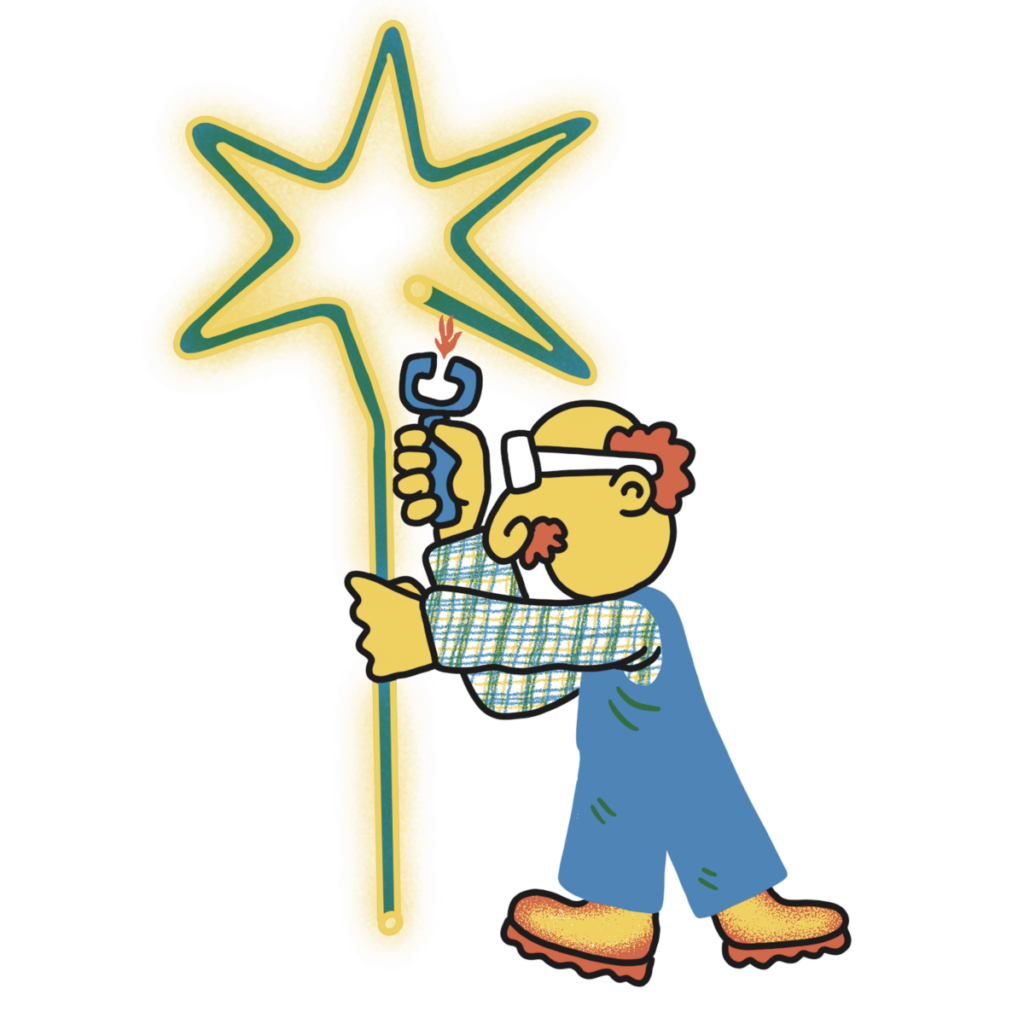
Dino’s been bending light since 1986. He grew up in Roseland, where his uncle had a sign-painting business in the basement of the family’s two-flat. When a beloved neon sculpture that Donna gifted him broke, he took it to a neon shop to have it repaired. (“You were there from the start,” Dino says to Donna—and she jokes back, “If only I knew.”).
Serendipiditously, the store owner needed someone to help out on neon jobs, and directed Dino to a neon-bending program in Tennessee. His uncle encouraged him to pursue it, saying it was a good craft; he knew there were few people doing it, yet he knew there was still demand.
Since then, Dino has had a hand in shaping countless neon signs, including the original Blue Cross Blue Shield neon sign on the Prudential Building (“We had a helicopter lift them and put them in place”); the historic Cadillac Palace Theatre, also downtown (“That was a 150 foot long sign. So we were out there in the middle of December, I think, which was so cold, the wind was coming off the lake, and when you’re up that high, the snot was frozen on my face”); and a dozen or so Buca di Beppo restaurants. I ask if he can estimate how many neon signs he’s made. He thinks for a second, kind of stumped, and tries to count. “God, I don’t know. No, I couldn’t.”
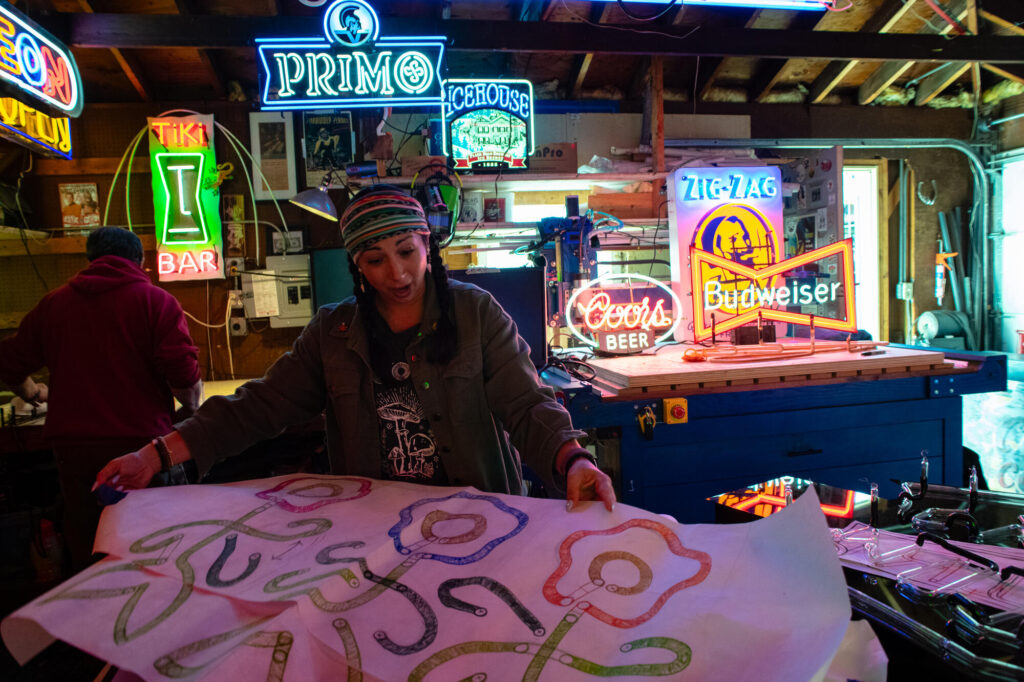
Apprentice Tessa Troutman holds papers containing flower designs for a neon sign. Credit: Ashley Lane 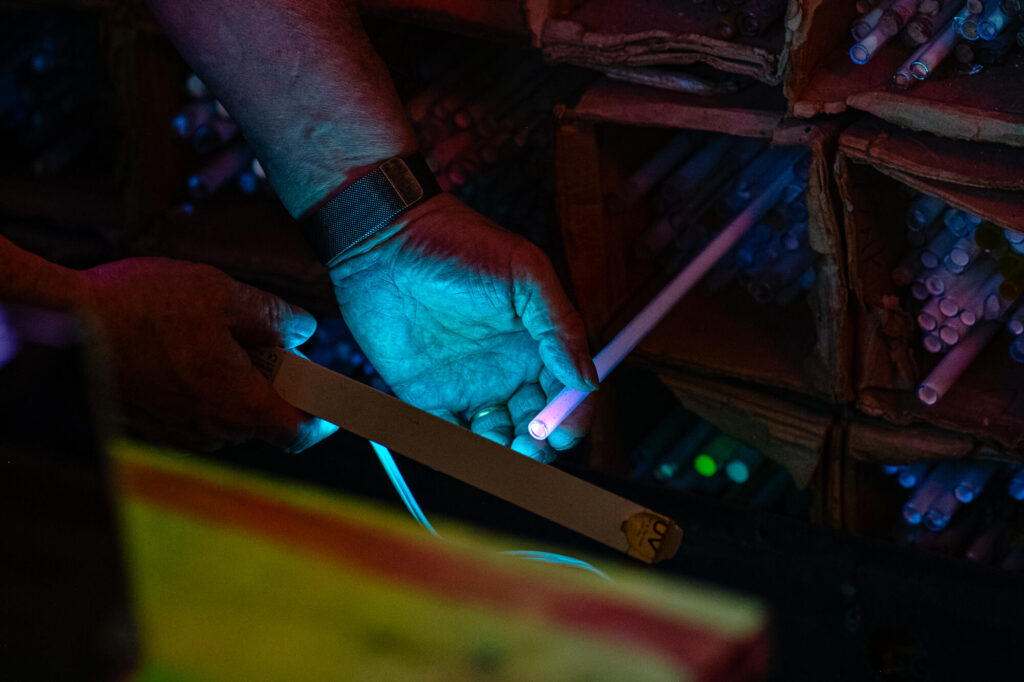
Dino Rigoni pulls out a glass tube. Credit: Ashley Lane 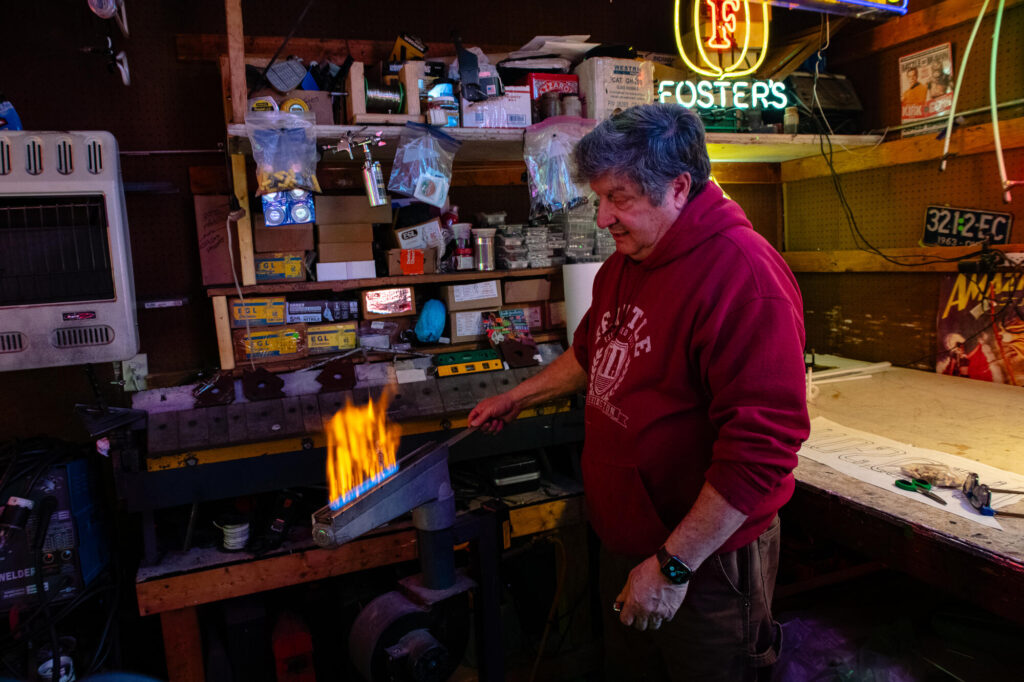
Neon bender Dino Rigoni in his garage studio in Munster, Indiana. Credit: Ashley Lane 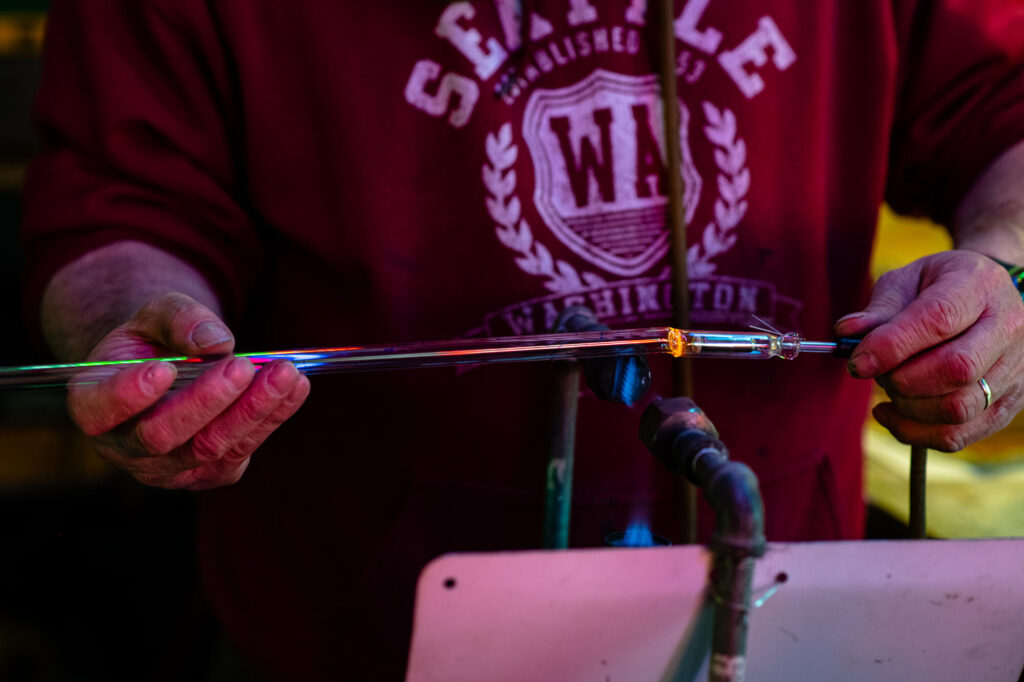
Dino Rigoni demonstrates how to melt and shape glass. Credit: Ashley Lane 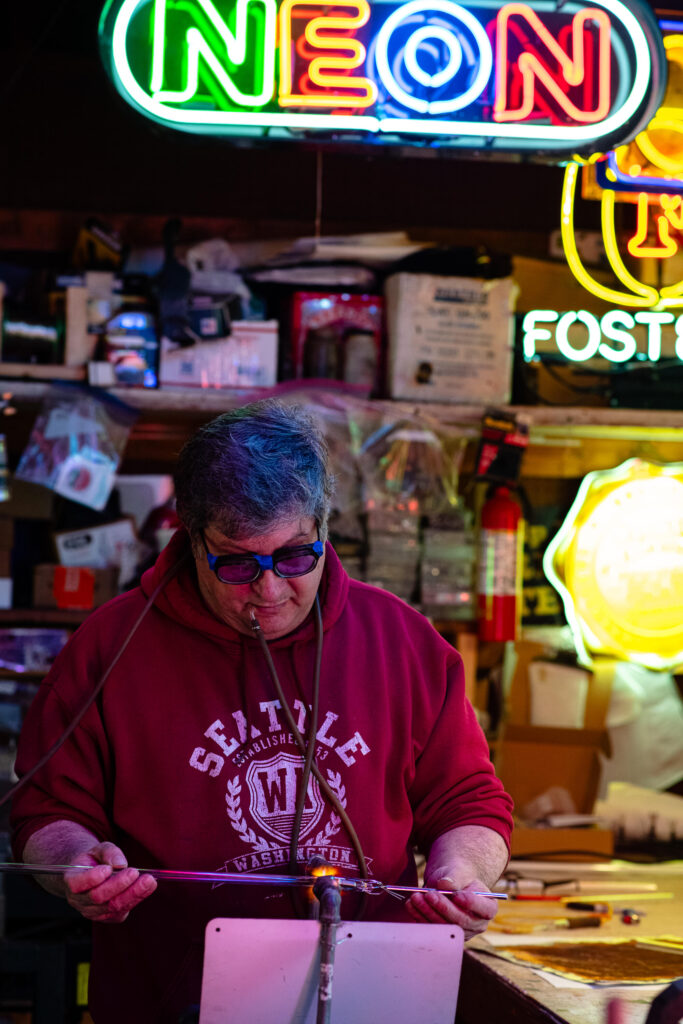
Neon bender Dino Rigoni in his garage studio in Munster, Indiana. Credit: Ashley Lane 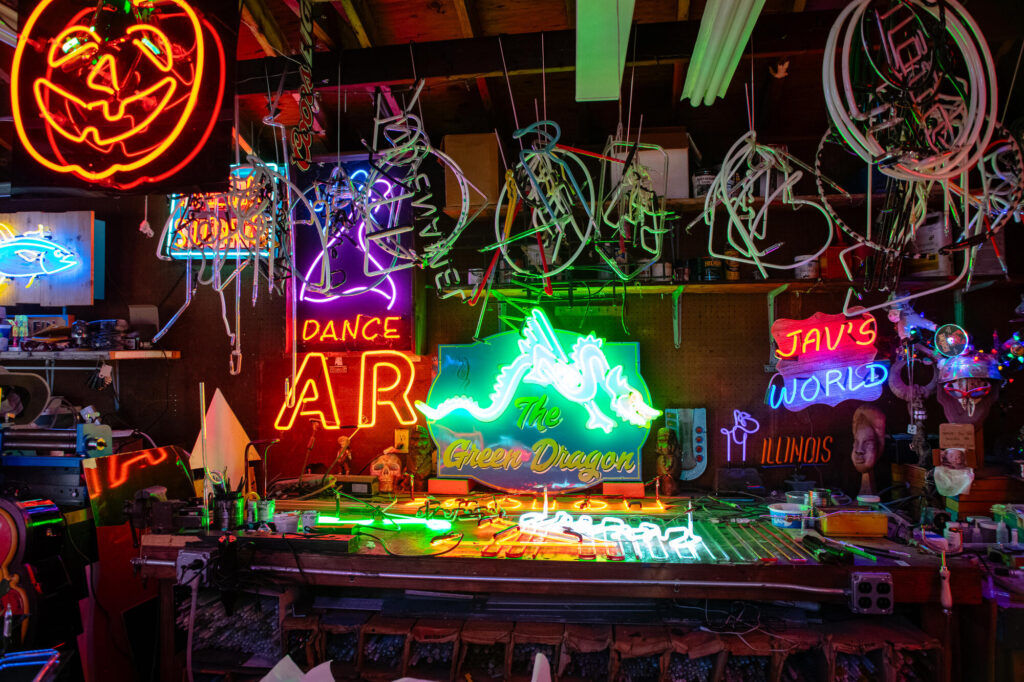
A collection of signs in Dino Rigoni’s studio. Credit: Ashley Lane 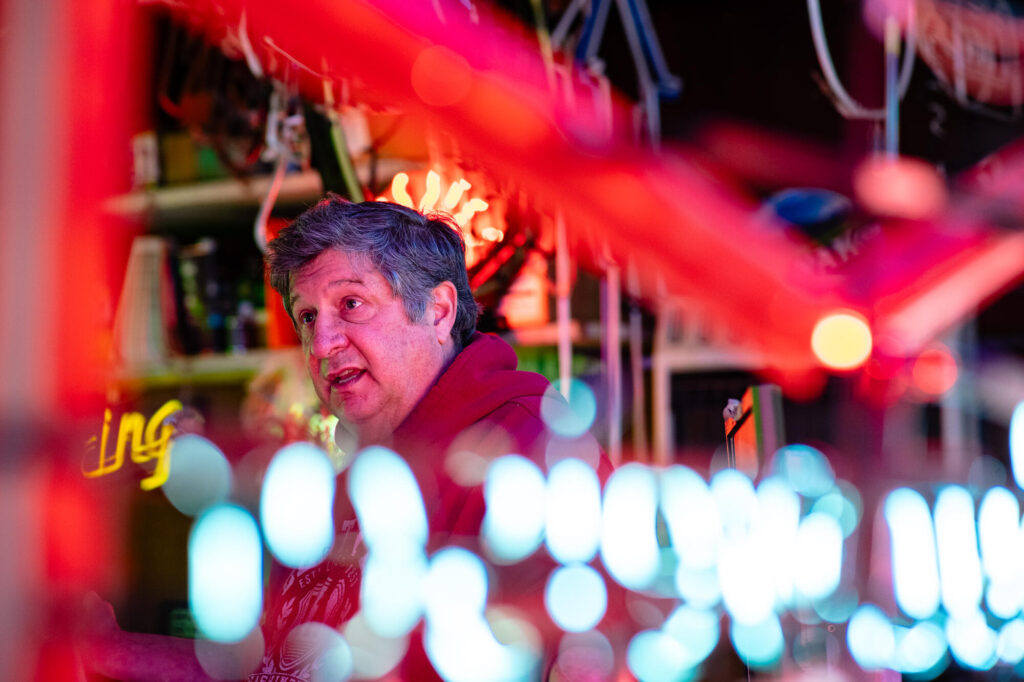
Neon bender Dino Rigoni in his garage studio in Munster, Indiana. Credit: Ashley Lane 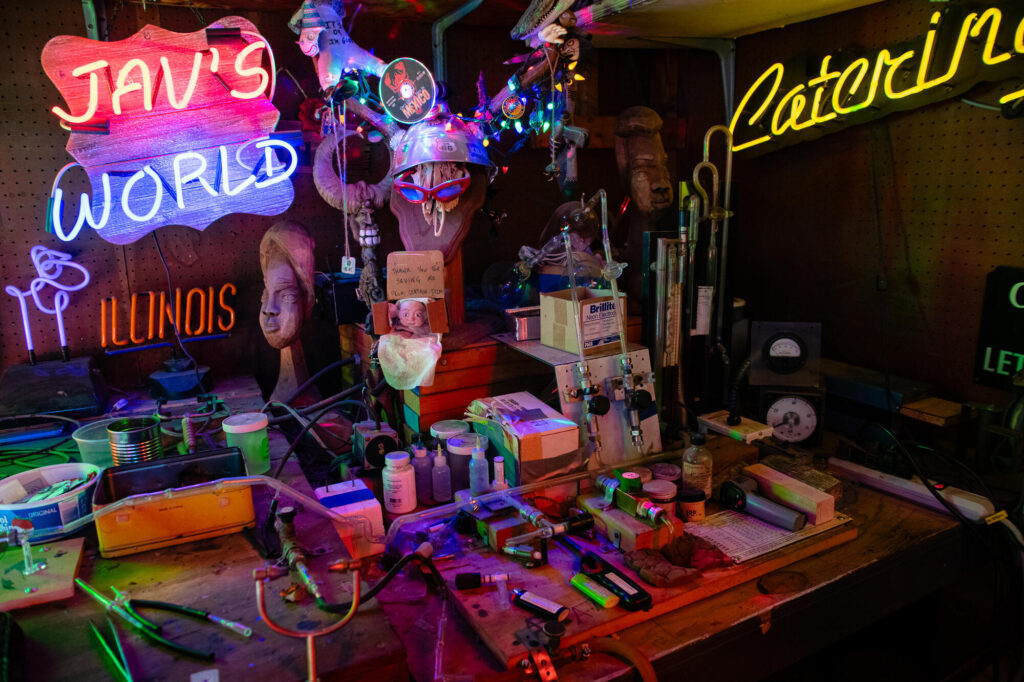
A collection of neon bending tools in Dino Rigoni’s garage studio in Munster, Indiana. Credit: Ashley Lane 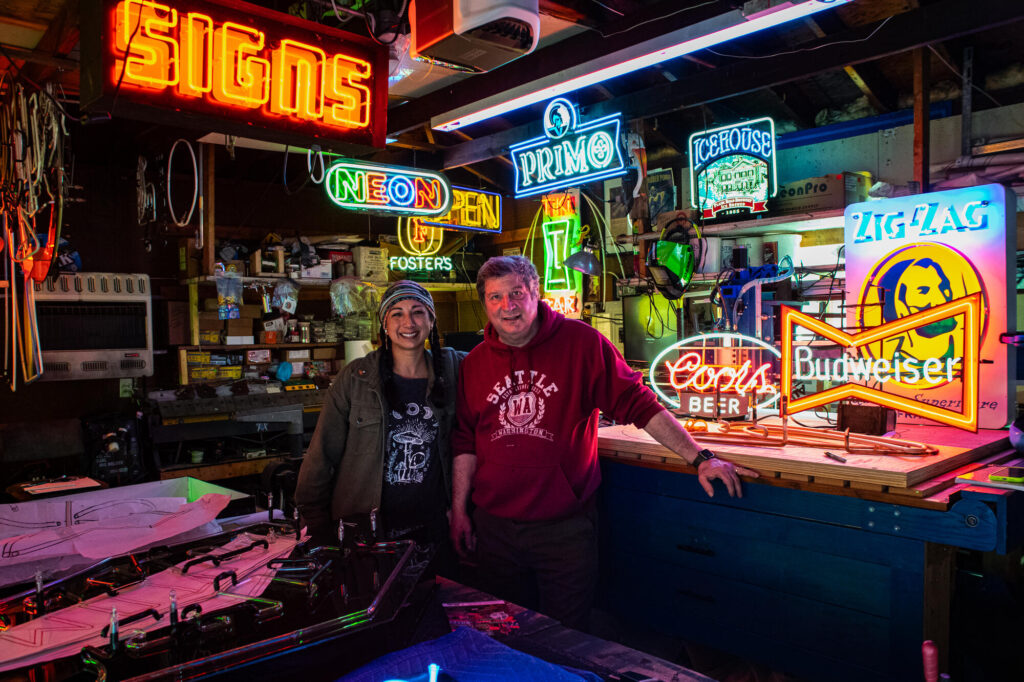
Dino Rigoni and his apprentice, Tessa Troutman. Credit: Ashley Lane
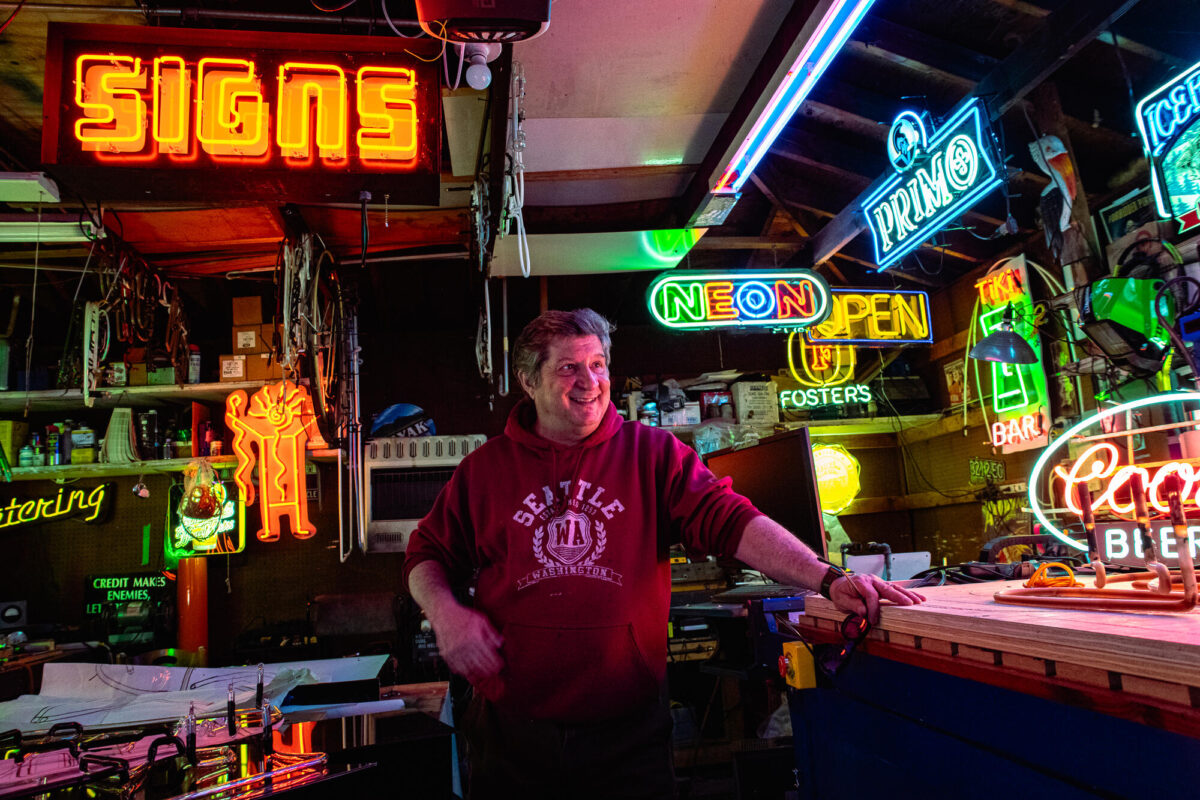
Dino’s mostly retired now and takes commissions, doesn’t advertise. When he takes us back to his garage studio, the whole place is illuminated with neon signs (though Dino insists it’s “not very lit up right now,” because he’s sold so many signs). There, he shows us the fundamentals of bending: hold a glass tube above a fire, wait for it to slacken from a solid to a more versatile goo, and then bend. “First you learn how to cut the glass, weld it back together, then you learn those eight bends until you’re really good at them. And then you start working your way through the ABCs.”
Tessa shows us how the plotter, a sketch of the final design, is written backwards. You essentially have to write backwards—with glass, over fire—to make it legible on finish. “It looks deceptively easy to do,” Dino says. “It took years before I was finally like, ‘oh, okay, I could show people.’” From my vantage point, it does not look deceptively easy.
Neon signs once embellished towns with carnivalesque ruby reds and uranium greens (“It was actually mildly radioactive,” Dino warns). Argon has a lavender hue, which a bit of mercury vapor can brighten up. There was more variety between the 1920s and 1960s, when neon was at the peak of its popularity. Today, however, it’s harder to get these colors, because there’s simply less demand, Dino and Tessa say.
Still, when I ask him what most people don’t understand about neon, he and Tessa have the same exact response: that it’s not LED: “LEDs try, but they don’t have the same light. People have such nostalgia for it.”
“I’ll never get rich, but it’s nice to have a little thing that a machine can’t take and copy,” Dino says.
“Every piece of neon you see, someone had to pick that up and make that by hand. Someone had to bend that up. It’s not a machine that made it…and they can’t.”
Ciaran Eubanks is an artist and writer based in Chicago, IL.
Known Dino a short time, but what a great dude! Does killer work!!
Dino is a wonderful artist and the wisest person I know!
I’ve known Dino for many years.
He’s not only ultra-talented, he is one of the most intelligent, fun and kind people I’ve ever known.
Dino is the master Neon Maker!! He’s keeping my collection of Neons Glowing!! Thank You Dino👍
He truly is the Michelangelo of glass sign making!
How can I get a hold of Dino?
Please message me at 331-643-0297.
Wedding coming up and would like to get a neon sign made with last name.