
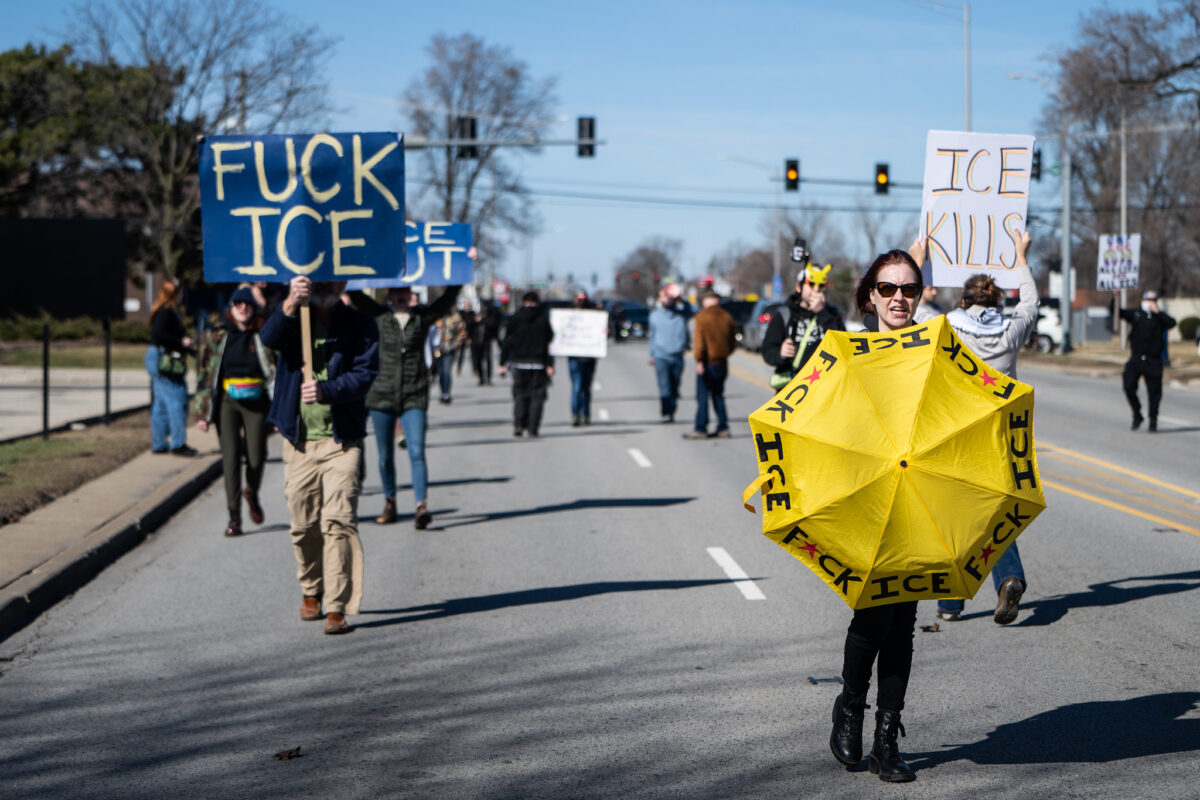
W hen Border Patrol agents who took part in Operation Midway Blitz left Chicagoland last November, then-Assistant Homeland Security Secretary Tricia McLaughlin asserted “we aren’t leaving Chicago.” The same day, reporters with the Sun-Times warned a government source told them that federal immigration agents may return in strength come spring.
But as McLaughlin said, they never really left.
High-ranking Border Patrol officer and former Midway Blitz commander Greg Bovino made good on McLaughlin’s promise in mid-December, when he and federal immigration agents conducted two days of chaotic raids through Chicago and multiple suburbs, arresting more than a dozen people. As 2025 came to a close, he again threatened Chicagoland.
“If you think we’re done with Chicago, you’d better check yourself before you wreck yourself.
Don’t call it a comeback; we’re gonna be here for years,” Bovino said in a December 30, 2025 social media post.
Now spring has come, and while agents with Immigration and Customs Enforcement (ICE) and Customs and Border Protection (CBP) aren’t yet here in the numbers seen in the fall, Chicagoland communities are still feeling their impact.
“While the overall operation has clearly scaled back since last September, October, and November, ICE remains in the region and is continuing to abduct neighbors on a daily basis,” Brandon Lee, a spokesperson for the Illinois Coalition for Immigrant and Refugee Rights (ICIRR), told the Weekly.
ICIRR tracks reports of federal immigration agents’ activity and maintains a family support hotline for those impacted by immigration detention. Lee said the hotline continues to receive calls every day. According to data ICIRR has collected since the start of the year, Lee said, federal agents’ presence in Chicagoland is below that seen during the fall, but higher than before Midway Blitz began.
Unlike the high-profile, chaotic raids carried out by large groups of Border Patrol in the fall and winter, activity lately has been more targeted, lower profile, and faster moving, according to a representative with the rapid response and immigrant rights advocacy group Organización Hijos de Migrantes who goes by Logos. He said encounters sometimes only last a few minutes and are carried out by smaller groups of ICE agents.
These tactics may be less disruptive, Logos said, but it also makes it harder for rapid responders and the community at large to respond to them.
“Per day we’re averaging anywhere from two to six [reports of abductions],” Logos said. “And with ICE tactics it’s harder to respond to.”
DHS declined to comment on just how many agents it has active in the Chicago region, citing “operational security.” Lee similarly declined to share specific data ICIRR’s team had collated, but said the level of reports of abductions by federal immigration agents has remained consistent since the start of the year.
“March hotline data is not out of line with previous months so far. Daily tracking is roughly the same as February when we ended the month with over 2,800 total calls,” Lee said. “As of now we can categorize the level of ICE presence in the area as being higher than what it was pre-’Midway Blitz’ with regular reports of abductions throughout the region, but still below the level of September, October, and November 2025.”
As in last fall, heavily Latine suburbs and communities across Chicago’s Southwest Side continue to be hotspots. Lee cited Brighton Park and the surrounding area in Chicago, and the suburbs of Bolingbrook, Cicero, Berwyn, Oak Park, Melrose Park, Elgin, Aurora and Wheeling.
Since the start of this month, suburbs where Chicago area rapid response teams have reported agents detaining people include Naperville, Cicero, Joliet and Oak Park. Agents’ presence in Chicago has been reported in Back of the Yards, the West Loop, West Lawn and North Lawndale.
The recent Oak Park detention occurred the morning of Friday, March 20, near the office of Illinois Senate President Don Harmon. According to one rapid responder, a vehicle was left behind at the scene. John Patterson, a spokesperson with Harmon’s office, said staffers “saw what appeared to be the latter part of a traffic stop happening about a block east” of the office. Patterson said Harmon didn’t see the detention itself, but did witness other vehicles driving away.
“What we think we witnessed was a reminder that the federal presence in our communities has not ended,” Harmon said in a prepared statement. “Everyone needs to remain vigilant and look out for our neighbors.”
The Oak Park incident tracks with the recent ICE tactics described by Hijos de Migrantes, which maintains a social media page with a daily running tally of reported abductions by federal agents in Chicagoland.
Logos also said that while ICE agents seemed to focus on early mornings during the winter, with spring coming, they have been moving their activities later into the day. Traffic stops and blocking in cars are a common tactic, they said, echoing the scenario Senate President Harmon’s office described.
The change in tactics comes after ICE and Border Patrol agents shot and killed two 37-year-old U.S. citizens, Renee Good and Alex Pretti, in Minneapolis this past winter, sparking national outrage and fueling calls for ICE to be abolished.
In the fallout from Operation Metro Surge in Minneapolis, Greg Bovino, Tricia McLaughlin, and ultimately Homeland Security Secretary Kristi Noem all left their positions, with so-called “Border Czar” Tom Homan stepping in to fill the leadership gap and Republican Oklahoma Senator Markwayne Mullin tapped to head up the Department of Homeland Security (DHS), which administers ICE and CBP.
President Donald Trump told NBC in February that “maybe we could use a little bit of a softer touch, but you still have to be tough.”
On top of the public backlash, DHS and the Department of Justice have also taken multiple losses in federal court since November, resulting in immigration detainees ordered free, limits placed on agents’ use of force and improved conditions at the ICE processing facility in Broadview.
Some of these losses have faced subsequent challenges from the government; earlier this month the Seventh Circuit Appellate Court vacated the preliminary injunction in the class action brought by press and clergy, which resulted in use-of-force restrictions on federal agents. But other court rulings, notably a November 5 order from District Judge Robert Gettleman, which mandated better conditions and access to legal counsel at the Broadview facility, have stuck.
Gettleman issued his order, initially only meant to last two weeks but now extended “until further order of court,” in a class action that immigration detainees brought against the federal government in October over the allegedly inhumane treatment they suffered inside the Broadview facility. Prior to November 5, Broadview detainees reported being held in unsanitary, overcrowded conditions, being pressured to sign legal documents they didn’t understand, and not being given sufficient food or water. Pablo Moreno González, a former detainee serving as a class representative in the case, testified on November 4 that he was held in a room in the Broadview facility with 150 other people.
The facility is central to deportation efforts in the Chicago area. Given Illinois laws that bar state facilities from being used for civil immigration enforcement, it is one of the only places agents can take Chicagoland detainees for processing before they are moved elsewhere.
The U.S. Attorney’s Office in Chicago argued in court filings that granting the class’ demands for better detention conditions, including clean holding areas, more bedding and more floor space per detainee, would hamper local deportation efforts.
“Ultimately, the laundry list of demands would limit defendants’ ability to manage short-term detentions and, if granted, effectively halt the ongoing enforcement of immigration laws in the region,” the U.S. Attorney’s Office wrote in a filing two days before Gettleman issued his order largely favoring the detainee class.
When two Catholic priests and a nun went to deliver eucharist and ashes to the Broadview facility on Ash Wednesday—the fruits of another court victory—they did not report 150 people held in one room like Moreno González did. In fact they found no one was being held in the facility at all when they arrived.
People are still being brought to the facility, however, and some are now being arrested when they arrive for immigration check-in appointments.
Lee confirmed ICIRR was aware such detentions were taking place.
“While we don’t have a total number on this, we know that it is a tactic that ICE is using right now,” he said, adding ICIRR was working with rapid response groups and the immigrant advocacy group Sanctuary Working Group to set up accompaniment for people called to the facility.
Danielle Berkowsky, an attorney with the MacArthur Justice Center, one of the law firms representing the class of Broadview detainees, further confirmed the trend of people being detained at Broadview check-ins. Like Lee, she said she didn’t have an exact figure, but added she considered it a “significant number.” Berkowsky said the MacArthur Justice Center attorneys had also gotten word of arrests happening during check-ins at the ICE Chicago Field Office at 101 W. Ida B. Wells Drive.
“I have a few people I spoke to who said… ‘I’ve been here for several years, I filed for asylum, I have an appointment or a court date scheduled, I come to Chicago every year for my check-in, and I came here and they arrested me,’” Berkowsky said. “These are people who have work permits, who have all sorts of paperwork in order, they’re attending their check-ins.”
She further made reference to an ICE agent reportedly telling a detainee that, due to a policy change, they would remain in custody until a judge could see him. It’s unclear what policy exactly may be at issue, though in February, a panel of the New Orleans-based Fifth Circuit Appellate Court issued a landmark ruling which held that those who entered the United States without inspection can be held in mandatory detention without bond.
Berkowsky urged those called in for a check-in at the Broadview facility to have their affairs in order, to have an attorney’s phone number ready if possible, and to have any necessary medication handy. She also urged those who are detained to ask for a private legal call, one of the conditions mandated in Judge Gettleman’s order.
“Part of our case is that there should be— there is—a private room with a phone call that is not monitored, so you should be able to use that room and have a private confidential legal call upon request,” Berkowsky said. “They’re not gonna offer it, so if you’re in there, request it.”
Despite the continued presence of federal immigration agents in Chicagoland and the tactics they are pursuing on the street and in immigration processing facilities, Logos said Hijos de Migrantes has lately learned of more incidents where community members are able to evade their grasp.
“They’re getting sloppy… people are able to escape more,” they said. “I think they get into this period where they’re just desperate to make arrests.”
ICE agents were also deployed to airports across the country last Monday amid an ongoing partial government shutdown over funding for DHS, which administers the Transportation Security Administration. Dozens were sent to O’Hare, with a nebulous set of responsibilities.
Dave Byrnes is a Chicago-born independent journalist covering the Trump administration’s anti-immigration campaign. He currently lives in Lincoln Square but is a lifelong White Sox fan.
Traqueros de Chicago: Museum Exhibit Takes Mexican Labor History Out of the Shadows
The exhibit highlights early railworkers and boxcar camps that formed on the South Side in the 1900s.

Neighbors at Work: The People Powering Rapid Response Networks
Rapid responders in Minneapolis and Chicago take on many different roles to protect their communities.

Healing Susto Amid ICE Violence
As immigration enforcement terrorizes communities, Chicago healers turn to ancestral practices to heal collective trauma.