

This article was published by City Bureau, a nonprofit journalism lab reimagining local news. Support City Bureau’s Civic Reporting fellowship by becoming a recurring donor.
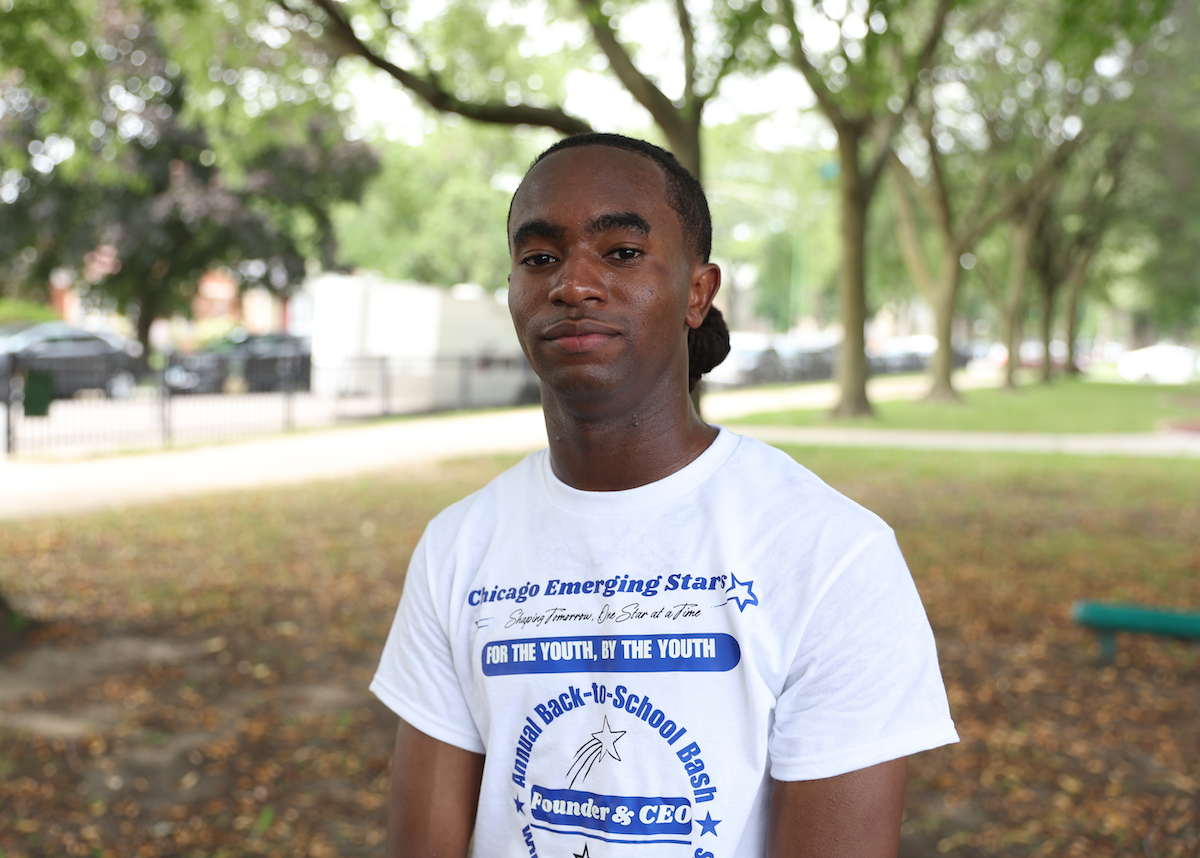
Jaqueza Thomas has always had an entrepreneurial spirit. At 15, he spent his high school days launching a clothing line, building a business while studying at Hansberry College Prep in Auburn Gresham on Chicago’s South Side.
In the first year of the COVID-19 pandemic, amid a surge of gun violence in Chicago, Thomas suffered a devastating loss when his cousin Kentray Young, 26, was shot and killed. The young rapper’s death motivated Thomas, now 21, to shift from apparel to community advocacy.
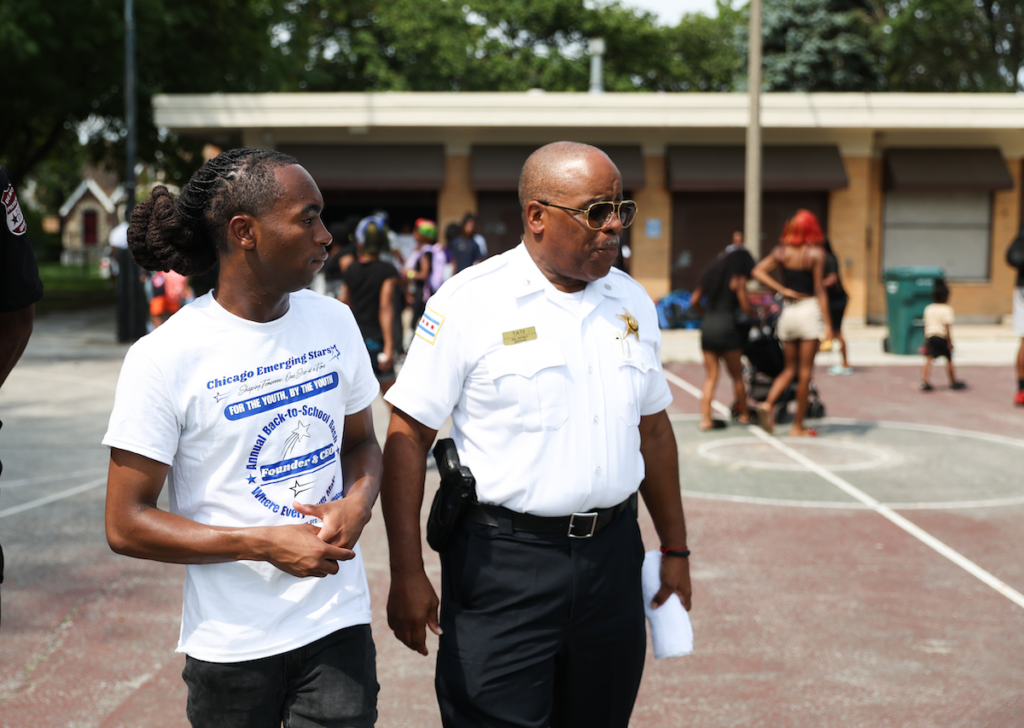
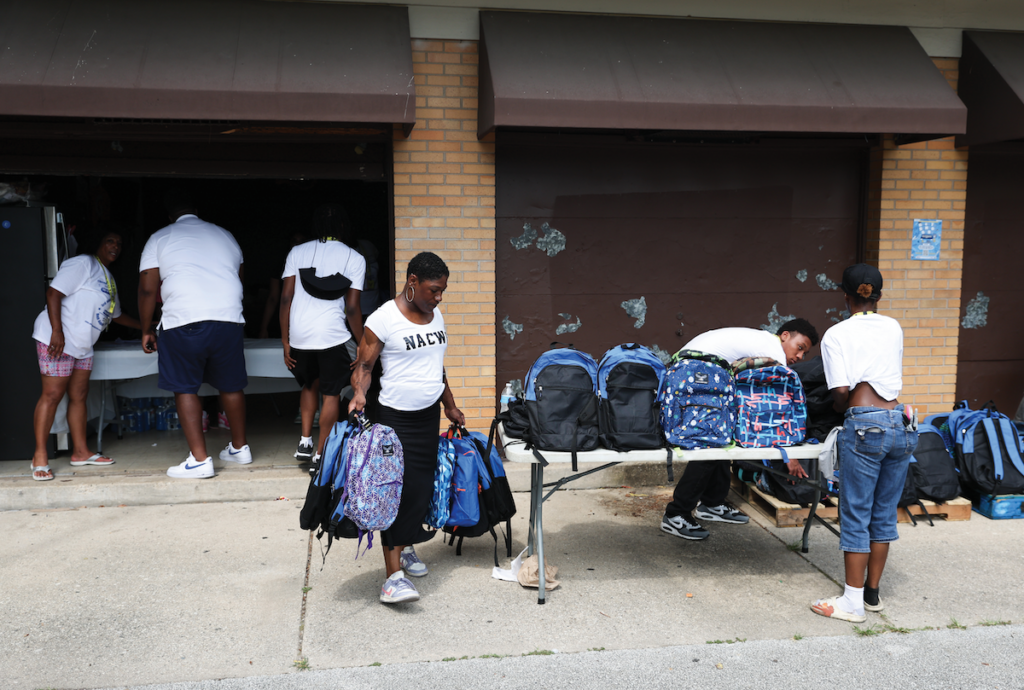
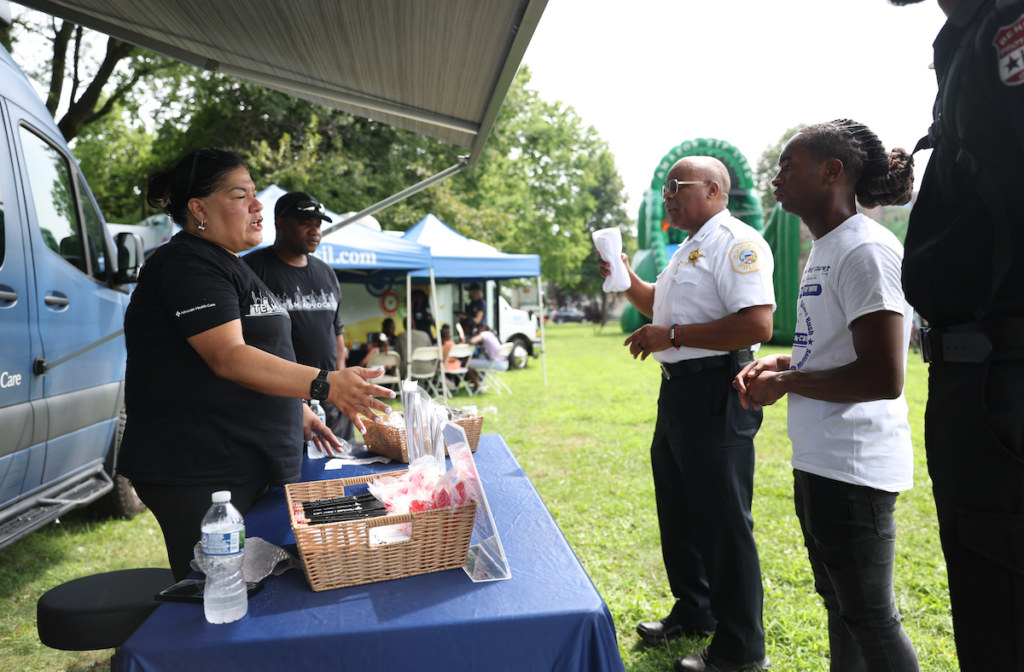
He joined the Mayor’s Youth Commission at 18, and he co-led its community safety working group. He also launched a series of pop-up events, like his annual Back to School Bash, which began as a way to hand out free school supplies and quickly ballooned to include free haircuts, barbecue, snow cones, face painting and a resource fair. Over last summer, Thomas formalized his efforts, incorporating his nonprofit Chicago Emerging Stars to focus on programs and mentorship for youth 7-24 years old.
He’s among young Chicagoans who are losing hangout spots and increasingly shut out of Chicago’s recreational areas, but are taking it upon themselves to build the in-person connection they crave.
Young event planners are springing up around Chicago to counteract negative societal pressures that often result in them being treated like a nuisance in places promoted as being meant for them—shopping centers, movie theaters, parks. They face limited affordable space access and preconceived ideas of what group fun looks like due to their age, they told City Bureau.
In response, they are organizing to create their own stress-free places to gather and socialize—no adult supervision required.
“Sometimes the most radical thing you can give a young person is rest, safety, or someone who simply just listens,” said Thomas, who lives in Chatham. “For this organization, I want to be a listening ear to every young person who could come across us, because that’s mental health work, too.”
Why Youth Should Help Create Chicago’s Third Spaces
Inside The First Presbyterian Church of Chicago in Woodlawn, teenagers from across the city circle up to start a quick pre-planning summer meeting. There’s an agenda passed out detailing whose job it is to greet visitors, lead games, engage introverted youth with conversation, and serve the food.
After everyone’s in agreement, the greeters head outside the communal room.
Those young organizers, part of the Youth Action Project and known to one another as Yappers, are wrapping their program’s first year by launching a series of youth-led, pop-up third spaces. The program is part of the Chicago Peacebuilding arm of the Pennsylvania-based American Friends Service Committee, a Quaker-founded nonprofit organization dedicated to advancing global peace, economic justice, immigrant rights and alternatives to policing and imprisonment.
“We realized a lot of third spaces kind of got shut down,” said Alex Abdelia Mejia, a 17-year-old Yapper from West Lawn. “There are very few places that teens can go without paying and be able to speak as loudly as they want; even at parks, some parents will look at teens weirdly. It’s just so bad.”
The Peacebuilders went to work trying to find available event space to transform into a temporary youth third space. The first event took place June 27, 2025 at The First Presbyterian Church of Chicago in Woodlawn.
While the use of temporary pop-up spaces does have some setbacks, it allows both organizations to broaden their reach across Chicago. That was a factor youth identified as a priority pretty early into the launch of the Youth Action Project in November 2024.
“The young people, pretty consistently, said they wanted these spaces to be pop-ups all across the city because things are so concentrated on the North Side or … held in spaces that, honestly, are not that welcoming to young people,” said Peacebuilding fellow August Funk. “So they wanted to have their spaces in a more community-oriented, less carceral space that young people would feel comfortable coming to.”
To foster welcoming spaces where teens can be themselves, all Youth Action Project events are restricted to youth and Peacebuilders—no other adults allowed. Peacebuilders also do their best to stay in the background, Funk said.
“This process has been a reminder about the importance of long-term relationship building. Just because [an adult] has some type of title and training doesn’t mean anything,” Funk said. “You are a lot more likely to talk to your friend or your auntie or someone that you really know.”
According to Mejia, “hanging out in a group and not even causing trouble should not be as hard as it is.” With a group of 13 friends, it’s hard to find spaces large enough to get together. They mostly hang out at each other’s houses, although when it isn’t too hot in the summer, they’ll visit a nearby Chicago beach, she said.
The pop-up events provided them another alternative. Yappers chose Friday nights, when many of them are free and looking for something to do. They spread youth-led events through different pockets of the city with the hopes of attracting as many youth as possible.
“Imagine you’re like, 16, 17, 18, you just got off of work, and you’re so tired but you’re [still feeling like], ‘Oh my God, I want to go somewhere, and I want to go somewhere fun,’” said Eisha Ali, a 19-year-old Yapper. “And you look up on Instagram [and see us], you’re like, ‘Oh my God, I can go there.’”
Mental health focus
Chicago Emerging Stars and the Youth Action Project are both backed by young people who were in middle or high school when the COVID-19 pandemic hit.
Organizers of both groups said they remember feeling anxious, citing stress and technology fatigue for negatively affecting their social lives.
“Mental health is one of the biggest unspoken [crises] in my community, because we carry so much. Too often we are told to just be strong or push through it,” he said. “That’s why, in everything we do … we want to center joy and belonging. Because mental health isn’t just about crisis responses; it’s about everyday care, love, and being seen.”
When AFSC Peacebuilders created the Youth Action Project, they didn’t know mental health pop-ups would be one of their youth-led projects top priority.
“We knew we wanted to do youth-centered work, and were struggling to land on some strategic decisions, because we wanted that decision to be made with young people actually involved in the process. So we came up with Y.A.P. as a necessary next step,” Funk said.
Asia Smith, director of the Chicago Peacebuilding program, said the Yappers were linking mental health to the lack of third spaces and places to learn socialization skills way before the City Council proposed a snap curfew ordinance in April.
The controversial proposal would have given the Chicago Police Department the authority to disperse groups of unaccompanied youth by calling a curfew that could be enforced within 30 minutes. The City Council passed the ordinance in June, before Mayor Brandon Johnson ultimately vetoed it in July.
“The snap curfew [proposal] kind of solidified the need for these spaces. I think it really reinforced to the youth why they wanted to do mental health pop ups,” Smith said.
The first class of Yappers, 16 to 21 years olds chosen in fall 2024 and paid a stipend to create youth-led programs, quickly connected the dots between teen mental health and a lack of community spaces.
“We feel that it’s just been so different since before COVID,” Mejia said. “Socializing has been not as normal. People don’t just meet people anymore, and it’s very hard to like branch out.”
Stumbling blocks
There have been challenges in establishing their spaces as youth-led organizations—among them, being taken seriously and having to rely on some adult guidance to get up and running, Thomas said.
“There have been times when venues wouldn’t take me seriously or would require levels of documentation that felt nearly impossible to obtain on my own. Event insurance, in particular, can be a major hurdle for youth-led initiatives,” he said, “because the systems in place aren’t always built with us in mind.”
Over the years, he has built relationships with local schools, churches and parks, “people who truly see the impact of what we’re doing and want to support it,” he said.
Thomas had to make sure his setup was legally sound when launching a youth-led, youth-driven nonprofit—and that meant having adults involved.
Chicago Emerging Stars has seven board members; three, including Thomas, are 24 or younger. Illinois requires board members to be at least 18 years old, but Thomas hopes to launch a youth diversity board of 14 to 19-year-olds who would help ensure the organization is meeting the needs of Chicago youth.
Some of Thomas’ events have benefitted from adult collaboration. The Witherite Law Group paid the park district permit fee for his second Back to School Bash at Nat King Cole Park in 2024.
Still, it’s critical that adults facilitate without getting overly involved, Thomas said.
“[Adults can] support without control and open doors, but don’t gatekeep,” he said. You have adults who would like to support students, but they also want to control you and be with you every step of the way, too. Please just help guide us without overshadowing, and believe in us and let us lead.”
The Yappers are also trying to be realistic about what is feasible for young leaders.
“I feel it’s definitely a teenager’s job to say they want this space. But to have [adult] resources is most necessary,” Ali said. “I don’t think this space could have come together if we didn’t have [the young adults]. All we knew was we had a dream, and some people wanted to make the dream happen.”
Capacity can also be a significant issue. Derrick James, the director of outreach, at Building Brighter Better Futures in North Lawndale, says their mixed space work development and event programming space is a popular spot for the young people. It is a simpler intake process to provide safety measures but is usually too full to be marketed as a place any teen can go anytime.
“We are looking to expand right now, because we don’t like turning away kids,” James said. “The majority of things we do here is free or we pay you, and we are excited for the space we have created and the work we get to do, but even we can only do so much.”
Aging Out and Planning Forward
Both groups are looking ahead as current members transition out of their roles.
“It’s fulfilling when you see a project you’ve put time and energy in to succeed,” Ali said. “I see way more third spaces being birthed, and to be a part of [starting] one of them, it’s really nice.”
Thomas has aged out of the mayor’s youth commission and started his junior year at the University of Illinois Chicago last fall. He focuses on running his nonprofit when he’s not in class. He wants to shift leadership roles at his organization, rotating out board members with younger participants once they turn 18.
Now under the Chicago Emerging Stars umbrella, Thomas hosted his third Back to School Bash at Nat King Cole Park in August 2025. He estimates they served hundreds of youth and families based on how many backpacks and school supplies they distributed, as well as how many attendees showed up for supplies, free haircuts, barbecue, and activities.
“Doing [the event] as a nonprofit brought more structure, more youth leadership, and a deeper connection to our year-round mission. It wasn’t just a one-day event anymore; it felt like part of a bigger pipeline of mentorship, resources, and belief for young people across the South and West Sides,” Thomas said.
In November 2025, the organization also hosted its second Thanksgiving Turkey giveaway in Auburn Gresham, giving out all 350 turkeys in under 45 minutes. In 2026, the group is continuing its work through pop-up service days, school-based mentoring, and youth-led community projects.
“I’m looking forward to stepping into my power in a deeper way, not just as a youth advocate, but as a systems-changer,” he said. “More than anything, I’m excited to keep building … pathways for the next generation to dream bigger, lead sooner, and know they don’t have to wait to be taken seriously.”
Leona Towner is a journalist with a background in television news. She has worked at Fox News Network in Washington, D.C., WZZM-13 in Grand Rapids, Michigan, and for WGN-TV as an assignment editor. She participated in City Bureau’s Civic Reporting Fellowship program in Spring 2025.
It is encouraging to see young people creating spaces for themselves. That kind of community building makes a real difference.