

Definition Theatre’s keerah, an ambitious debut from playwright and actor Netta Walker, chronicles the turbulent romance, and subsequent fallout, between the young Black poet Ciara (played by Walker) and Irish writer Cormac (Beck Nolan).
The pair meet, as young literary types do, at the restaurant in Chicago where they both work unglamorous survival jobs. Though Ciara initially rebuffs the attempts of her best friend and manager Lucy (played energetically by Cat Christmas) to set her up with the charismatic busser Cormac, the next scene reveals the two flirtatiously debating classics and reciting sonnets. A moment that could, in less capable hands, provoke eye rolls feels completely natural to the characters in keerah. Their lofty references fly from Joyce to Shakespeare, broken up with slang and Malört shots. The dialogue in these first scenes is quick and clever, if a bit indulgent at times. But in a story about young writers, a bit of self-indulgence is practically required.
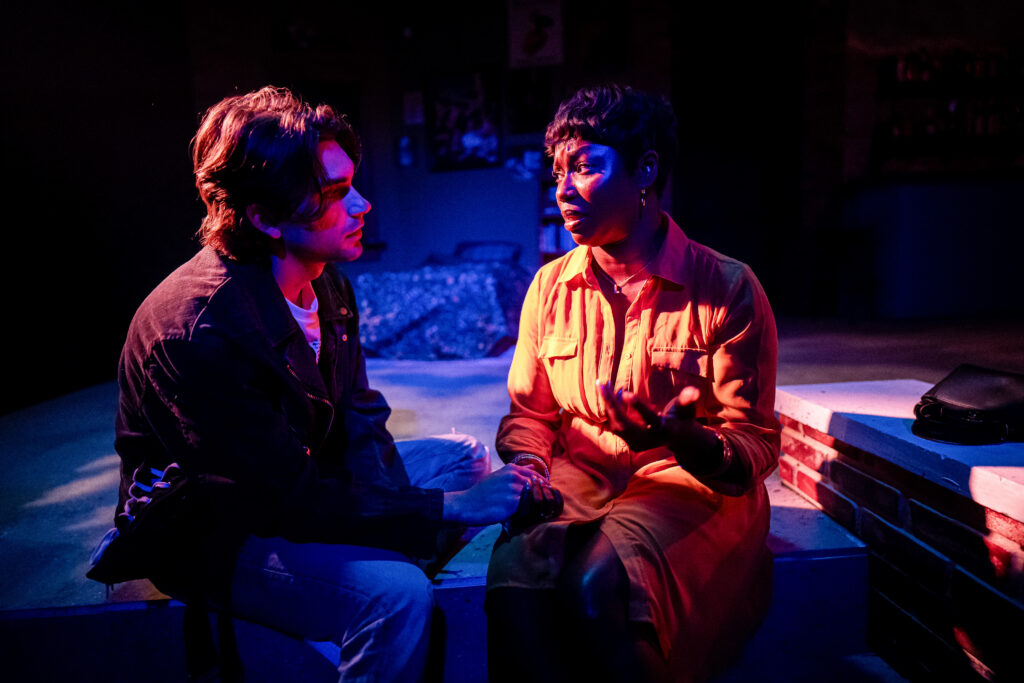

We spend the rest of the first act witnessing the couple’s near-obsessive young love become compromised by increasing moments of cold distrust. A cleverly choreographed montage sequence shows a growing distance between Ciara and Cormac as they hide their wounds from each other. It reveals the problem we’ll spend the rest of the play working through: that mastery of language cannot stand in place of true vulnerability and communication.
As Ciara and Cormac’s connection weakens, a romance deepens between Cormac’s open-hearted best friend Finn (Jacob Coggshall) and Lucy, serving as a less-tortured foil to their friends’ dramatic tryst. This side plot, while charmingly acted and enjoyable to watch, ends up fizzling out with little payoff.
The second act opens after a significant time jump, and a meta reveal casts the events of the first act in a new light. Without divulging too many specifics, the world Ciara and Cormac meet in seven years after their dalliance is fundamentally different to the one depicted in the first act. It’s a chance for them to finally meet each other honestly as adults, with all the baggage that implies.

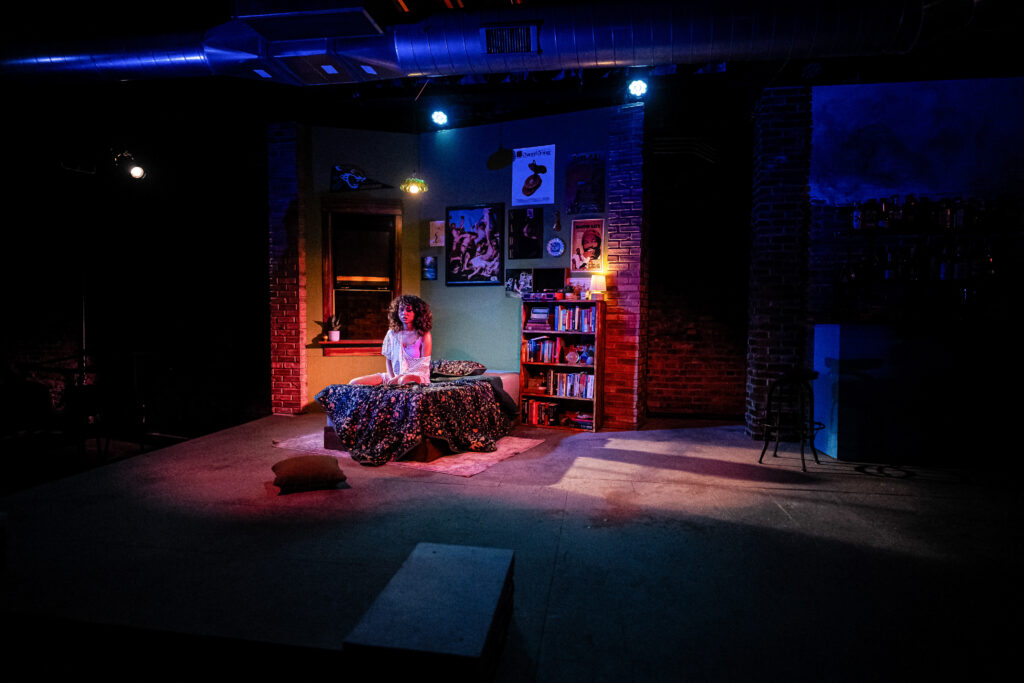
All this brooding plays out against a simple yet functional backdrop from scenic designer Isa Noe—an aesthetically cluttered bedroom, a sleek bar, and a streetlamp standing in for a handful of outdoor locations. Thoughtful lighting designed by Garrett Bell swings from sultry and vibrant, or warm and intimate, to cold and unforgiving in accordance with the lovers’ emotions. The sound design by Aaron Harris Woodstein is particularly memorable; cinematic ambiance punctuated with carefully selected needle drops in the first act gives way to stark silence in the second act as reality sets in for the characters.
McKenzie Chinn’s direction keeps things moving at a satisfying clip—quick and zippy when the couples are in tune with each other, dotted with agonizing silences when they aren’t. Under Chinn’s direction, the entire cast gives memorable performances, led by a magnetic Walker, who plays Ciara with equal parts prudence and passion. In Walker’s voice, Ciara’s often heightened language feels at home, flowing from her with ease. Nolan’s Cormac is a roguish idealist, more sensitive than he would like to let on, and the actor pulls off the desperation required by the play’s second act with finesse. Supporting players Christmas and Coggshall round out the cast with spirited performances, injecting levity into the doomed love story.


Keerah falters when it stretches its wings too far, trying to touch on one too many hot-button topics and cluttering its themes. Ciara herself might rightfully label it Icarian. And there are certainly cuts that could be made to the show’s lengthy runtime of about two and a half hours. The language, while beautiful, feels too in love with itself at times, lulled into sleep by its own musicality, replete with darlings begging to be killed. Some of the obstacles the lovers face require a healthy suspension of disbelief when dropped into a modern story where smartphones exist. None of these issues, however, can diminish the pure pleasure of the dialogue when it’s at its best. Walker’s love for language is on full display here; the characters speak about literature with a reverence typically reserved for the ardently religious. I found myself giddily swept up in their dizzying banter, and moved by their poetry.
Keerah is an effective, if at times over-ambitious, story about the fictions we tell ourselves and the obstacles we build in the way of connection. Lively and deeply romantic, its charms outweigh its faults. Recommended viewing for lovers of literature, lovers of culture, and lovers in general. If nothing else, you will step out of the theatre with an urge to read poetry.
keerah. Definition Theatre, 1160 E. 55th St. Through June 28. Thursday–Friday, 7:30pm; Saturday–Sunday, 3pm. $29–$45; $15 students. (312) 469-0390. definitiontheatre.org
Kendall Kaminsky is a freelance writer and theater artist based in Chicago. This is Kendall’s first piece for the Weekly.