

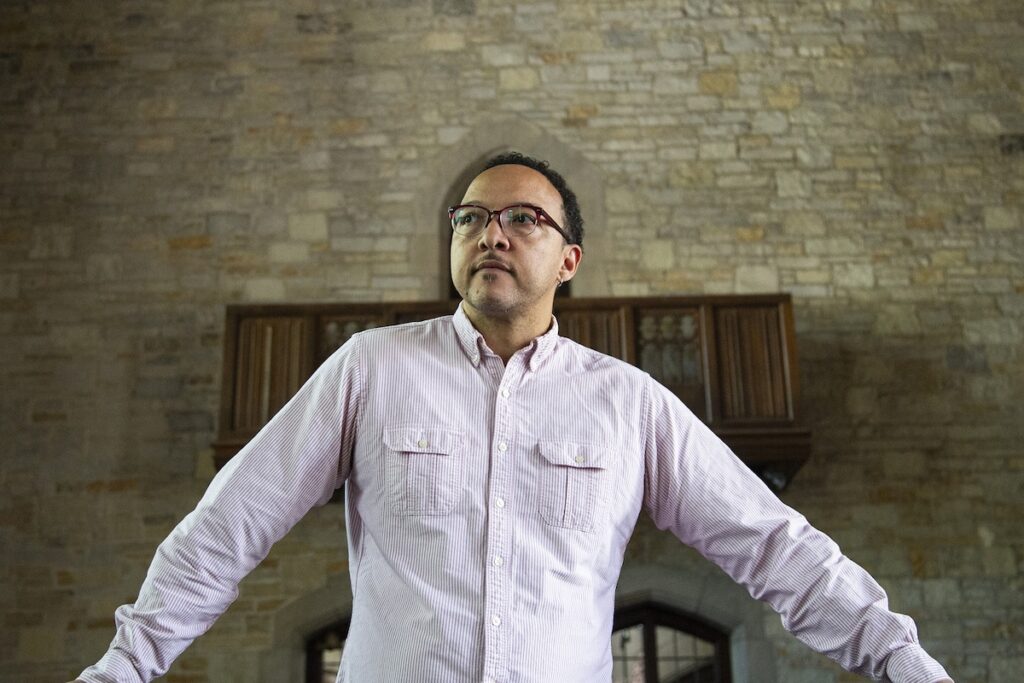
For Rev. Julian DeShazier, issues around public health and accessible care on the South Side of Chicago are deeply personal.
A Washington Park native and senior pastor at University Church in Hyde Park since 2010, DeShazier’s care for community health stems from attending funerals for family members who passed away “unnecessarily,” from preventable conditions, due to challenges accessing care on the South Side.
His uncle and his aunt from a pulmonary embolism, passed away in their 50s, from heart disease and a pulmonary embolism, respectively. A friend, who was in his early 20s, died after suddenly collapsing on his porch.
His work as a pastor has been impacted by these experiences. DeShazier views his role as not only supporting the spiritual health of his church community, but also their physical and mental well-being. For example, he routinely follows up with members to make sure they are keeping track of doctors visits and self-care.
DeShazier’s interests—and his commitment—resulted in a historic feat when he and other community activists, notably the grassroots organization Fearless Leading by the Youth, helped to spearhead the reopening of the University of Chicago Medicine Adult Trauma Center in May 2018, which university leadership shuttered in 1988.This closure left South Side residents without a Level 1 trauma center—which offer the most comprehensive care—for three decades.
Despite this community marker, South Side residents still face wide disparities in health care compared to residents in other parts of the city. These gaps will likely widen due to the impending federal overhaul of the Medicaid program.
“This ‘access’ piece is really a major part of how I operate in the world,” DeShazier said, “and access to health care is just something that’s a glaring challenge for us on the South Side right now.”
As the health-care ecosystem braces for uncertainty and increasing demands, Chicago-area health-care practitioners project that upcoming federal cuts and new provisions for Medicaid eligibility will create an influx of emergency room visits by people without insurance. Experts also predict that preventable health conditions will be exacerbated due to these budget cuts.
Although the main provisions for Medicaid eligibility will not go into effect until next year, practitioners are already anticipating negative outcomes.
“This is another example of a major weakening—a crumbling—of our medical care infrastructure,” said Dr. Linda Rae Murray, a faculty member at the University of Illinois Chicago’s School of Public Health, and the previous president of the American Public Health Association. “We are underestimating the impact.”
Signed into law on July 4, 2025 by the Trump administration, the “One Big Beautiful Bill” Act, or H.R.1, would reduce federal Medicaid spending by an estimated $1 trillion between 2025 and 2034, according to the Congressional Budget Office.
The estimation of federal spending cuts vary. According to RAND, a nonprofit, nonpartisan research organization, federal Medicaid spending will be reduced by $665 billion between 2025 and 2034. But according to the Kaiser Family Foundation (KFF), an independent, nonpartisan health policy research center, federal medical funding will be reduced by an estimated $911 billion within that timeframe.
The bill not only targets Medicaid, but also the Affordable Care Act, a national health care reform law signed in March 201—dubbed “Obamacare”—that makes affordable health insurance more accessible to all adults in the U.S.
On the state level, Illinois is bracing for the impact of these cuts. According to the Illinois Department of Healthcare and Family Services, close to a half a million residents could lose their coverage, and between $26 billion to $51 billion in federal funding for Medicaid could be cut within the next decade.
Dr. Lauren Smith, chief medical officer at Cook County Health, projects emergency rooms will experience a larger volume of uninsured sicker patients due to upcoming Medicaid cuts, which will add more strain on the emergency system.
She said that patients who are experiencing minor injuries or illnesses may experience longer wait times because limited numbers of doctors and nurses would be treating sicker patients.
In lieu of this, Smith fears the health-care ecosystem will revert back to the time before the Affordable Care Act, where about 48 million Americans were uninsured, according to the U.S. Department of Health and Human Services.
“We can only turn so fast,” Smith said.
Murray concurs. As emergency rooms see higher numbers of sicker patients, she expects the pressures on hospitals to affect everyone, not just those cut from Medicaid.
“If you’re sitting there with so-called ‘good commercial insurance,’ and you think you’re untouched by these Medicaid cuts, that’s a mistake,” Murray said. “As people get sick and as the system is stressed, it can reflect on you.”
Two new provisions for Medicaid eligibility will go into effect in Illinois on January 1, 2027. The first mandate enacts work requirements: adults ages 19 through 64, and adults with dependents 14 and older, will need to prove they have worked or volunteered 80 hours a month, are enrolled in school part-time or have a monthly income that is not less than the federal minimum wage multiplied by 80 hours.
Certain groups will be exempt from work requirements. According to The Centers for Medicare and Medicaid Services, these groups include former foster care youth, American Indians and Alaska Natives, parents and guardians of a dependent child 13-years-old and under, medically frail, pregnant or eligible postpartum coverage and more.
Most adults on Medicaid are already working without employment requirements, according to data from KFF. Out of a total of 26.1 million Medicaid adults under 65, 44% are working full-time, 20% are working part-time and 12% are not working because of caregiving. Only 8% reported they are not working due to retirement, inability to find work or other reasons.
The lasting effects of work requirements have already been seen in the past few years. In June 2018, Arkansas became the first state to implement work requirements for Medicaid eligibility. Adults ages 30 through 49 were required to work 20 hours a week, or to participate in “community engagement” activities, according to the peer-reviewed journal Health Affairs.
About 18,000 adults had lost coverage before a federal judge put the policy on hold, less than a year later. According to findings in the journal, the requirements did not increase employment over the duration of the policy, and led to “serious problems” of uninsured individuals paying off medical debt and delaying care.
The second provision increases the frequency of Medicaid re-eligibility enrollment for ACA expansion adults—adults who are single, childless, nondisabled, and under 65-years-old—from once a year to every six months. It will also reduce the timeframe for retroactive coverage.
Dr. Selwyn Rogers, the founding director of the UChicago Medicine Trauma Center, said redetermination processes for Medicaid are “not trivial,” and rife with bureaucratic paperwork that can lead to potential interrupted coverage.
“Everytime someone gets interrupted in their Medicaid—or any insurance—coverage, they often have to make decisions about how they will spend their remaining cash flow,” he said.
To Smith, more frequent redeterminations will add even more stress to the process. She projects the higher frequency of re-evaluations will deter people from receiving care, because they won’t be able to jump through bureaucratic hurdles every six months.
“It’s putting in unnecessary barriers,” she said.
Chicago experiences wide health disparities between the South and North Side of the city. According to data from the Chicago Health Atlas, morbidities that are more prevalent on the South Side include heart failure and coronary heart disease hospitalizations, cancer diagnosis rates, adult obesity, and diabetes-related hospitalizations.
Medicaid coverage is also the highest on the South and West Sides. According to the Chicago Health Atlas, in neighborhoods such as Englewood, Fuller Park, Washington Park, and Grand Crossing, about half of all residents are covered by Medicaid. In West Side neighborhoods such as Austin, Humboldt Park, North Lawndale, and West Garfield Park, coverage ranges from about 38% to about half.
On a community level, DeShazier said he’s had conversations with his parishioners who’ve said they’ve struggled navigating Medicaid and different managed care organizations. Through these one-on-ones, DeShazier has gauged some of his community’s frustration with the process.
“Folks are like, ‘I’m trying my best, and it does not feel like the people who can help me actually want to help me,’” DeShazier said. “This becomes another brick in the wall of an argument that this nation, essentially, doesn’t care about.”
Rogers projects that those who are most “economically challenged” will feel the full effect of upcoming cuts, and that there’s no doubt the cuts will exacerbate the health disparities on the South Side.
He fears that as people are cut from their medical coverage, they will make rash decisions by forgoing any costs of preventive care in place of other costs such as rent, food, or transportation. As this happens, illnesses that may have been acute and preventable could become more serious, leading to people only seeking care when they are sicker.
Murray said that as the U.S. cuts people from health insurance, it’s inevitable that some people will die. In a broader sense, she views the cuts as a larger “ideological battle” around the future of publicly funded health care in the country.
“We are taking the position that we have no interest; we gain nothing by making sure our neighbors are healthy and that our neighbors are safe,” she said. “Cutting Medicaid is not simply an attack on the poor—it’s an attack on the entire nation.”
Cook County Health has been taking precautions in preparation for the cuts. Smith said they are monitoring changes at the federal and state level “day-by-day” to ensure that Illinois residents are up to date with important information.
Cook County Health also runs CountyCare, which is the county’s largest Medicaid health plan, and serves just under 400,000 individuals, according to Smith. Through the end of July, CountyCare will be hosting in-person redetermination events across the Chicago area to help individuals prepare for Medicaid redeterminations.
Additionally, Cook County has created a “Medicaid Impact Working Group”—a coalition of over 60 health care providers, advocates, community organizers, and businesses—to help counter the impacts of H.R.1 through outreach and other resources.
Smith said as the project has taken shape, she’s heard that other states have looked to the program for inspiration.
“We’re doing this locally, and I think it’s gaining traction,” she said. “I’m really excited about the things that we’re doing in that space.”
Matt Brady is a freelance journalist from the Chicago area. He has written for The Daily Herald, the Evanston Roundtable, South Side Weekly, The Fulcrum, and Illinois Latino News. He is the Copy Desk Chief of the Columbia Chronicle, the student newspaper at Columbia College Chicago.