
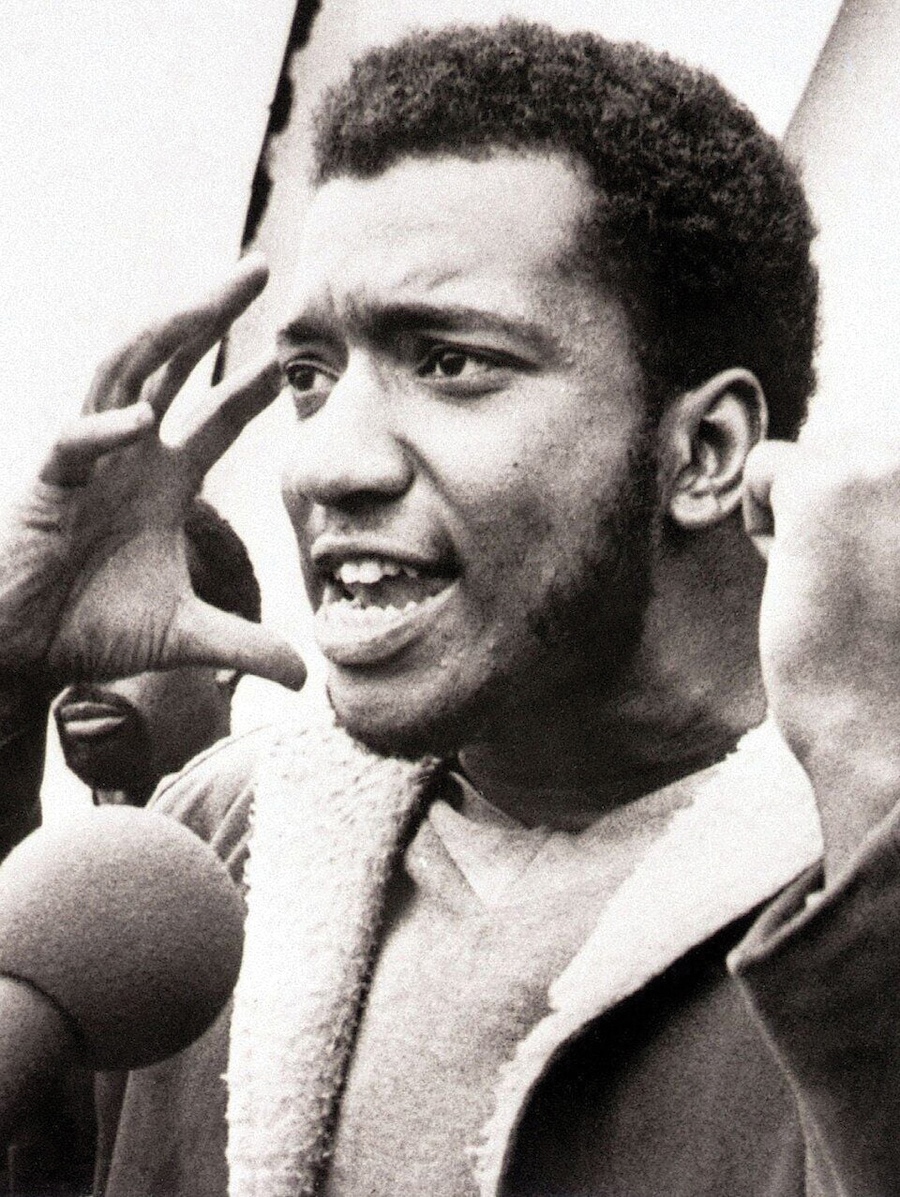
Before dawn on December 4, 1969, then-Cook County State’s Attorney Edward Hanrahan sent a squad of police officers into a Black Panther Party apartment on the West Side. Officers opened fire with rifles, a submachine gun, shotguns, and handguns, killing Illinois Black Panther Party Chairman Fred Hampton and fellow party member Mark Clark and wounding four other Panthers.
Within hours, Hanrahan held a news conference and falsely claimed the officers had been met with a fierce shootout. Police left the apartment unsealed afterward, allowing Panthers and lawyers from the newly formed People’s Law Office to get inside and gather evidence, including a bloody mattress and a door panel that would later undercut Hanrahan’s account.
More than five decades later, civil rights attorney Flint Taylor sat down with former U.S. Representative Bobby Rush and former Illinois Black Panther Party member Ann Campbell-Kendrick to discuss that raid and its long aftermath, the subject of the first part of Taylor’s new book, “The Conviction Machine: Prosecutors, Politicians, and Police Violence in Chicago.”
Rush called it the “only assassination on American soil carried out for political reasons by the United States government that we can prove beyond the shadow of the doubt.”
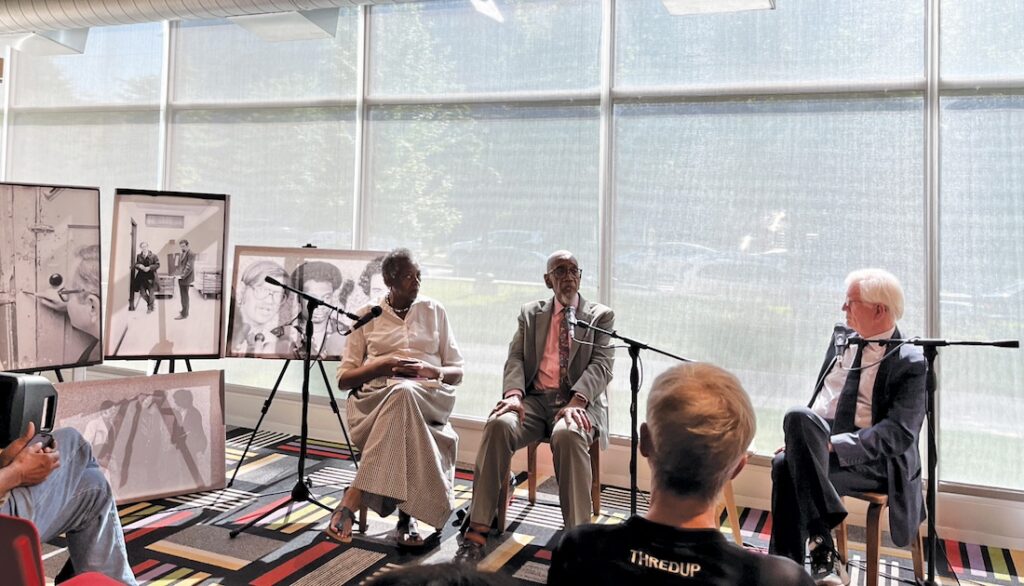
On Tuesday, July 14, the three spoke to a small audience that included several former Panthers, as well as Taylor’s legal colleagues at the Seminary Co-op Bookstore, 5751 South Woodlawn Ave.
Taylor and Rush have known each other since the days after Hampton’s death, when Rush, then a young Panther leader, worked with the People’s Law Office attorneys to sue over the killings.
Rush called the People’s Law Office “a group of young white lawyers who had the courage and the insight and the motivation to stand shoulder to shoulder” with the Panthers and other groups pushing for civil rights. He described his bond with Taylor and other former Panthers in the room as “steeped in blood,” saying their friendship was “unbreakable.”
Campbell-Kendrick, who joined the Black Panther Party in Chicago in 1969 after growing up in Mississippi, recalled the morning of the raid. She and other Panthers were living in a communal apartment on the South Side and woke to helicopters overhead before learning what had happened on the West Side. Campbell-Kendrick later became a nurse and health-care advocate. She said the party’s platform, which called for access to food, shelter, and self-defense, had drawn her in after she heard Hampton speak.
Rush said he spent the day of the raid with Hampton’s fellow Panthers, following news of the killing on the radio and later helping identify Hampton’s body at the morgue. He said his first thought was to ask how many police officers had been hurt, reasoning that Hampton would never have allowed officers into the apartment without a fight unless he had been incapacitated.
“There was no way that you were going to kill Fred Hampton without knowing that you were in a vicious battle,” Rush said.
Taylor said an inquest later showed Hampton had a large amount of a sedative in his system at the time he was killed. Years later, court records showed the sedative was likely administered by FBI informant William O’Neal.
Much of the discussion centered on how Hanrahan and the Chicago Police Department pushed a false story that the raid had been a shootout between police and the Panthers. Taylor said Hanrahan held news conferences displaying weapons and photographs from the crime scene rather than those turned over to the crime lab, and later staged a reenactment for a local television station. Taylor recounted how what prosecutors described publicly as bullet holes in a doorframe, meant to show Hampton had fired at officers, were later shown to be nail heads.
Both Taylor and Rush credited organizing by the Panthers and the Black community with helping remove Hanrahan from office. Thousands of Chicago voters, including many lifelong Democrats, crossed party lines to vote him out in 1972 following his acquittal on obstruction of justice charges by a judge backed by Richard J. Daley’s political machine. Taylor said that defeat helped set the stage for Harold Washington’s election as Chicago’s first Black mayor a decade later.
Asked what lesson he hopes readers will take from this episode of history, Taylor said he hoped readers would learn the importance of seeking the truth and holding government officials accountable.
“As a lawyer, your major battles are in the courts, and the battles that you fight are for transparency, are to get the evidence in these major cases that show government misconduct, and then to fight to make them public, because the other side first fights against the production of this evidence,” he said.
Even after evidence is obtained, Taylor said, attorneys working for the government sometimes try to keep it under protective order, so lawyers must fight to get it entered into evidence at trial, which makes it public and available to the press. Taylor and his colleagues took that approach during the civil trial over Hampton’s death, entering hundreds of documents related to the FBI’s COINTELPRO program into evidence so reporters could access them.
“As political movement lawyers, we also have an obligation not only to fight for that evidence, but to talk about that evidence, teach about that evidence, write about the evidence, and speak about the evidence, and to help, along with movement people, reshape the narrative, because those in power are going to continue to tell those lies until and unless you fight to change that narrative,” he said.
Taylor also pointed to the Commander Jon Burge torture scandal, also chronicled in the book, as an example in which he and others were able to transform the public consciousness. From the early 1970s through the early 1990s, Burge and his Midnight Crew of police detectives tortured more than 100 people—mostly Black men—into confessing to crimes many did not commit. But the revelation “of systemic and racist police torture that spanned over 20 years” only came to light after defense lawyers, organizers, and independent journalists poked holes in the official story of Burge as a decorated Vietnam veteran and police commander helping catch and convict the Wilson brothers, two supposed cop killers.
“It not only implicated the highest levels of the police department, but also the mayor and the prosecutors, both of whom at various times carried the name Daley,” he said.
Taylor continues to pick those kinds of fights. In 2024, the People’s Law Office joined a lawsuit alleging the CIA and other government agencies played a significant role in Malcolm X’s assassination. The case is ongoing.
Flint Taylor, The Conviction Machine: Prosecutors, Politicians, and Police Violence in Chicago. $14.97 (paperback). Haymarket. 352 pp.
Max Blaisdell is the staff writer for the Hyde Park Herald.