
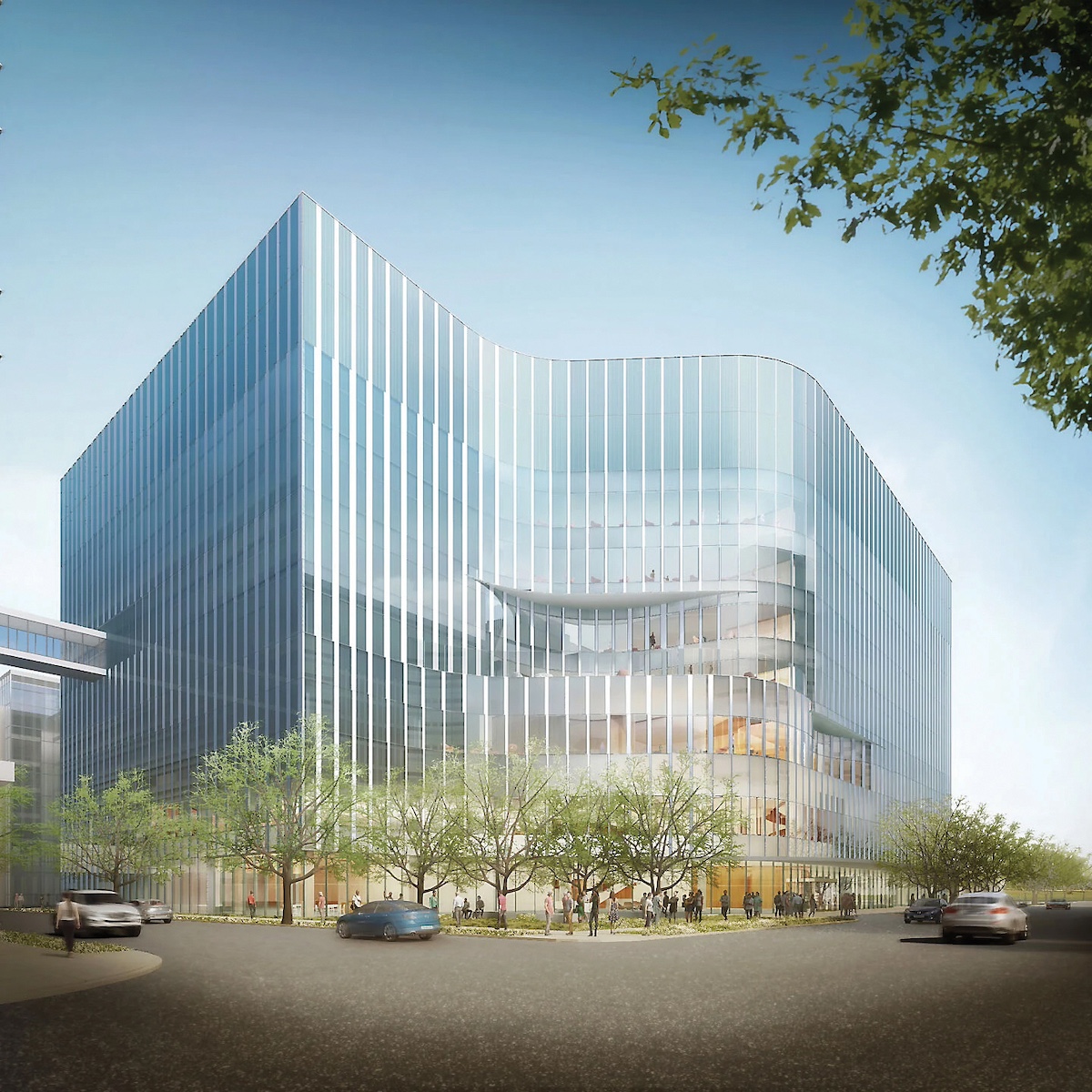
The University of Chicago Medicine’s new cancer center is on track to open next spring, officials told South Side residents on Tuesday, July 14, marking the final stretch of a yearslong project to bring comprehensive cancer care to a community where death rates from the disease are nearly twice the national rate.
The AbbVie Foundation Cancer Pavilion, a 575,000-square-foot facility located north of 57th Street between Maryland and Drexel avenues on the Medical Center’s West Hyde Park campus, is scheduled to welcome its first patients in April 2027. It will be Illinois’ first freestanding facility dedicated exclusively to cancer care, according to UChicago Medicine.
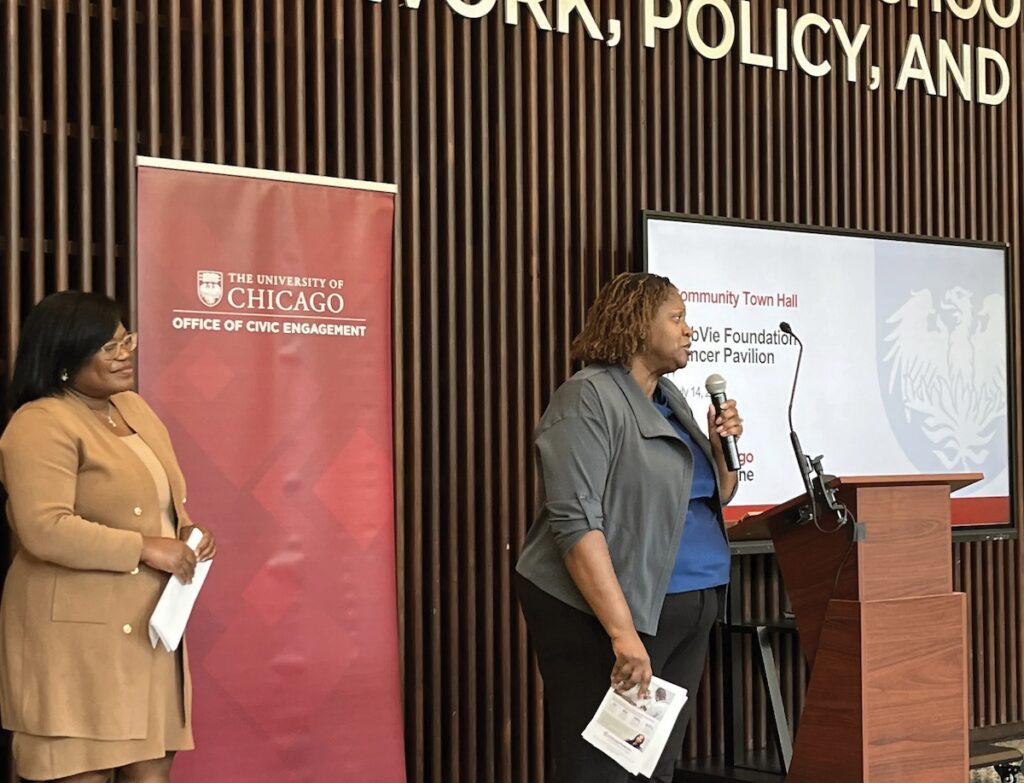
UChicago Medicine officials laid out the specifications for the $815 million project during a community meeting at the Crown School of Social Work, 951 East 58th Street. The event featured Dr. Mitchell C. Posner, chief clinical officer of the new cancer center, Kimyatta Washington, vice president and chief administrative officer of cancer services, and Catina Latham, senior vice president for community health transformation and chief equity officer.
Construction on the cancer center broke ground in September 2023 after a state board approved the project. Its cost grew from an initial estimate of $633 million to $815 million, supported in part by a $75 million donation from the AbbVie Foundation after which the center is named.
UChicago Medicine officials said the need for the facility was rooted in stark health disparities. Cancer is the second-leading cause of death on the South Side, according to UChicago Medicine’s 2022 Community Health Needs Assessment. Latham said the need assessments, conducted every three years, repeatedly identified cancer as a top concern, along with the difficulty of finding nearby screening and treatment.
“We learned from this study that people needed access to care, people needed screenings so that they could find and detect cancer early. People needed help with insurance costs and navigating the entire healthcare system, and so we wanted to respond to those needs,” Latham said.
About 56% of South Side patients left the area for care and 67% of cancer patients left for inpatient treatment specifically due in part to capacity constraints at UChicago Medicine.
“When I come in every morning and see that building going up, I know that my neighbors, my family, will be able to have access to world-class care and not leave our community,” Latham, who lives in Bronzeville, said. “That’s so important.”
The pavilion will house 80 inpatient beds, 90 consultation rooms, and 67 chemotherapy infusion bays. Washington said the building was designed with “shelf space” that would allow the hospital to expand capacity to as many as 124 beds if demand exceeds the available space. In response to a question as to whether that would be enough space, she said that “many of the therapies that before we thought needed to be in the hospital are actually shifting to the outpatient setting.”
The facility will consolidate cancer services now spread across five buildings on the medical campus and will include an Oncology Rapid Assessment Clinic designed to let patients undergoing treatment bypass the emergency department when they develop fevers or uncontrolled pain. A parking deck bridge will connect directly to the second-floor clinic.
Washington said the first floor will function as a community space open to anyone, whether or not they have an appointment, with acupuncture, access to social workers focused on prevention and screening education and also a teaching kitchen.
“It’s important to teach patients how to eat well while undergoing treatment,” she said. “But it’s also important to understand how we should eat today in order to try to prevent cancers.”
Patient and family amenities will include private rooms with sleeper sofas, showers and laundry facilities, along with video-visit technology for families who cannot be present in person.
The building will serve adult cancer patients only. Pediatric oncology will remain based at Comer Children’s Hospital, though Washington said the new center will work with Comer to draw a “bridge between our two programs” as the latter sees a rise in early onset cancer cases.
The UChicago Medicine Ralph Lauren Center, funded in part by a $25 million grant from the Ralph Lauren Corporate Foundation, will open its first location at UChicago Medicine Ingalls Memorial Hospital in Harvey this year, Washington said, with a second location inside the new pavilion when it opens in 2027. The center is intended to expand screening, prevention, and patient navigation services.
Posner said expanding access to clinical trials will be a cornerstone of the new center, and that patients enrolled in trials receive the best care and experience the best outcomes.
“There have been bad things that have happened in the past, but clinical trials in this day and age are very different,” he said.
Trials are also important, Posner added, because they “can improve care today and shape the future for generations to come.”
UChicago Medicine already has the highest rate of enrolling minority patients in clinical trials in the country, Posner said, and is considering moving toward a model in which “you don’t have to opt in for a clinical trial, you actually have to opt out.”
UChicago Medicine officials also addressed concerns about the cost of care amid coming changes to Medicaid eligibility that are expected to result in an estimated 330,000 Illinoisans losing coverage. Latham said the health system is preparing to help patients understand the changes and find coverage, and Washington pointed to the system’s broader community benefit spending, which included more than $900 million on the South Side.
But some attendees pressed UChicago Medicine officials on whether that spending was making enough of an impact. Dr. Byron Brazier, pastor of the Apostolic Church of God in Woodlawn, said the university has struggled to show residents the tangible effects of its spending.
“It’s really important that you all communicate exactly what you’re doing,” he said.
Latham agreed.
“We need to do a better job of messaging the impact that we’re having,” she said. “That is something that we’re working on.”
Max Blaisdell is the staff writer for the Hyde Park Herald.
How they get all that money? Yet they let other hospitals close for lack of money.
My wife dr.willetta g. Johnson was treated at u of chicago for brest cancer outstanding team i m so gratful to them we lhave lived in hyde park for 35 years also. God bless