
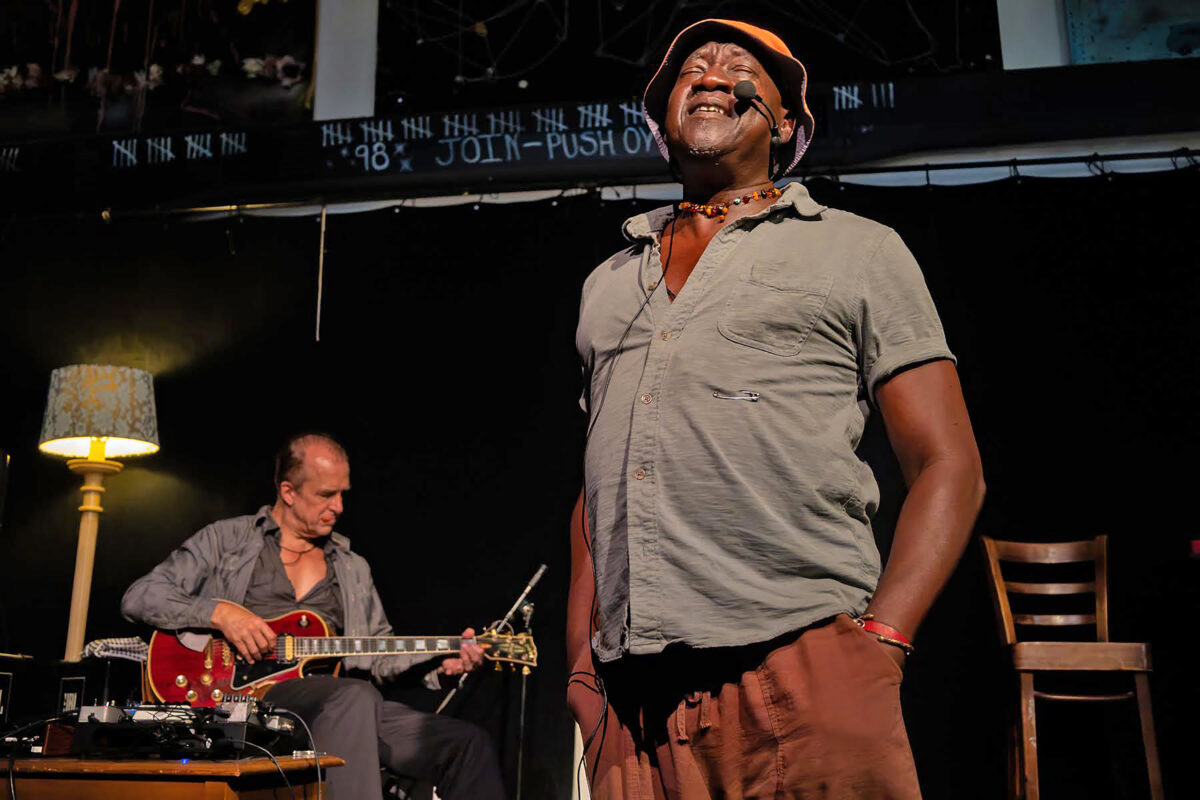
As patrons entered Theatre Y on a late summer evening, the sweet, gentle smell of incense met them at the door, a calm counter to the hushed rush of street traffic outside. The space was arranged like a small cabaret lounge, its tables decorated with white, flameless tealights facing a semicircular stage surrounded by black curtains. The stage was lit, but the seating area remained dim, like the shaded side of a building after the sun had moved around it.
Founded in 2006, Theatre Y operated in Lincoln Square before moving to North Lawndale in 2022, where the group transformed a 1927 storage facility (now a designated Chicago landmark) into a community-rooted, free-admission performance hub. Driven by a mission to stage revolutionary plays and performances, the ensemble pushes the boundaries of stage presentation, radical collaboration, and civic engagement.
At the end of August, Theatre Y held a two-day release party for Controlled Burn, the new record by Marvin Tate. Calling Tate simply a poe’ and performer narrows the scale of what the Lawndale-raised artist does. Now in his 60s, he’s performed and recorded for years as bandleader for Marvin Tate’s D-Settlement; collaborated with visual artist Theaster Gates and singer Corinne Bailey Rae; shown his visual art at Chicago’s Intuit Art Museum; and most recently, served as artist in residence at Theatre Y, where he’s led community programming.
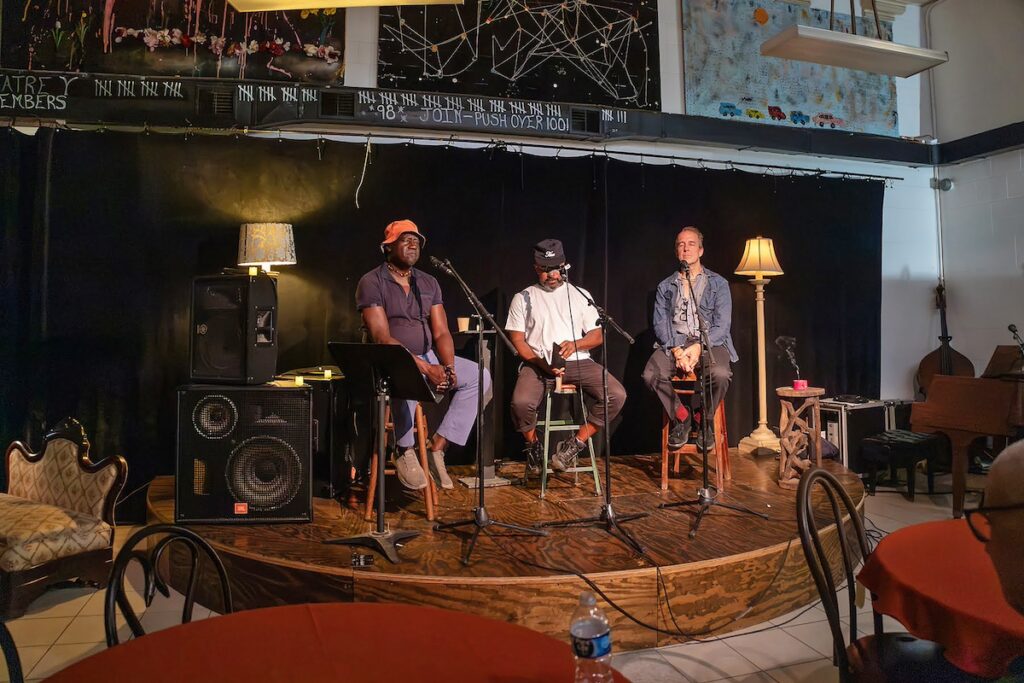
On Friday, August 28, after an introduction from Amalgam Music founder Bill Harris, Tate took the stage alongside two frequent creative partners: LeRoy Bach, his collaborator on Controlled Burn, and Chicago music mainstay Ben LaMar Gay, who facilitated the evening’s conversation.
The format was simple: we listened to the record on vinyl, one side at a time. After each side played, Gay guided Tate and Bach through the tracks, asking about how the recordings came together.
It was an unusual way to hear a record. The music came first, followed by the stories behind it, and we listened alongside the people who made it. Bach stated, “I’ve listened to every song on this album probably 50 times, at least.” Yet there he was, listening again.
In the grooves of Controlled Burn, you can hear an ancestral line running from Muddy Waters to Saul Williams. My immediate impulse was to imagine Waters as Tate’s father and Williams as his son—an absurd timeline, given Tate was barely thirteen when Williams was born, but one that fits the distorted, larger-than-life geography of his music. Tate occupies the middle space of that impossible household, bridging the slow-burn gravity of the blues with the sharp kinetic electricity of contemporary poetry.
Tate’s voice is plainspoken throughout—direct, no hedging, a quality that traces back to the Chicago poetry slam scene he came up in during the ’90s. On “Up at 6,” he calls out a list of names over a backing as solemn as a going home service in a Baptist church. On “Robin,” a woman sings in unison with him from beginning to end, almost a cappella, over something grave and unhurried. Underneath, barely audible, runs the faint sound of something like a film projector. A third voice filters in for a line or two, heavy with bass—and something in Tate’s voice turns hopeful before settling back.
Bach’s instrumentation works like an organ under a sermon—there, listening, responding to what Tate says rather than simply backing it, never loud enough to compete with the words, but never quite neutral, either. Depending on the song, that response turns ominous, or ambient, or something closer to a hymn.
When the first side ended, Gay opened with, “When’s the first time you guys experienced or witnessed fire?”
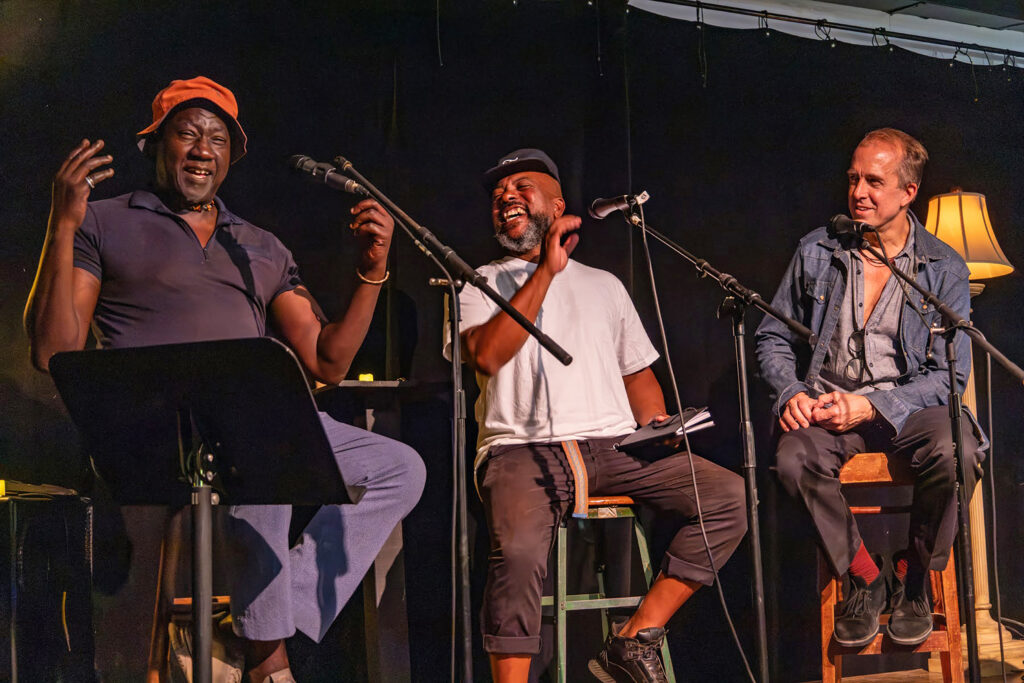
Tate answered with a story about playing in his mother’s closet with his twin brother Melvin. He lit a firestick. “That’s when I first ever saw fire, and I started it,” he said.
When asked about the title Controlled Burn, Tate shared the story of the time he and his wife were walking in a South Side forest preserve and came upon a cloud of blue smoke. He described the scene as dreamy, with patches of smoke moving “like spirits.” His wife, whom Tate said “has a deep vocabulary with nature,” identified it as a “controlled burn.”
“I was like, ‘That’s a great fucking title!’”
He liked the title for its metaphor and for what it stood for—what it “engulfed,” an entire vibe, a state of mind.
Bach took the idea further. He recalled that one of Tate’s potential album titles years ago had been Things to Do, a reference to Tate’s habit of making lists. For Bach, Controlled Burn also described what Tate does with his words, expressions, and experiences: he has to burn the stuff off, get it out, let it do its thing and move on so that something new can rise up. Check everything off the list, Bach suggested, so you can make a new one.
Controlled Burn carries Tate’s name alone, but it is hardly a solitary endeavor. The album was made with Bach, whose musical relationship with Tate stretches back more than thirty years. More broadly, the record reflects Tate’s relationship with the world around him. Family, friends, and lovers enter the work, sometimes directly and sometimes as impressions or traces.
On Saturday, August 29, poet Kenyatta Rogers opened the program before Tate and Bach returned to the stage. Tate performed selections from Controlled Burn alongside readings from his book 4th Shift, published by Agita Publishing.
Tate foraged through sheets of paper placed on a music stand in front of him. Later, he held a copy of 4th Shift in his hands and recited from it, bending and folding the book as if he were wringing the words from it.
Tate’s stool sat on the same floor as the audience, while Bach played from the low wooden semicircular platform about a foot above us.
The incense had dissipated. The record had been played, discussed, and played again in another form.
Theatre Y, 3611 W Cermak Rd. www.theatre-y.com
milo bosh is a Chicago-based photographer and writer whose work considers Black visual and performance culture, portraiture, and the experience of looking. He is a recipient of the 2026 Threewalls RaDLOW 3.0 fellowship and unrestricted award.