
Early voting is underway across all of Chicago’s 50 wards for the November 3 midterm general elections. Chicago residents will not only have the chance to vote on candidates for the U.S. Senate, the U.S. House of Representatives, and the Illinois governor, but a host of statewide offices that could impact our neighborhood resources, safety, education, roads, waterways, and more.
The Weekly sat down with two Chicagoans who are making it easier for progressive residents to cast informed votes about the issues that matter to them, especially on the South and West sides.
Raeghn Draper is a co-author on Girl, I Guess, a “Jewish, Black, queer, trans, [and] nerdy” voter guide founded by Stephanie Skora and Ellen Mayer in 2018. The casual but incisive guide provides readers with “the dirt” on each candidate up for state and local election, encouraging them to participate in elections without sacrificing their values.
Tatyana Najee is a co-creator of Girl, We Know, a Black woman-led election guide launched this year to bring Black women’s voices into the conversation about Chicago’s political future. Created with Kiki Bryant and Crystal Gardner, the guide breaks down federal congressional races, Illinois General Assembly races, Cook Country races, Chicago Board of Education elections, and judicial elections.
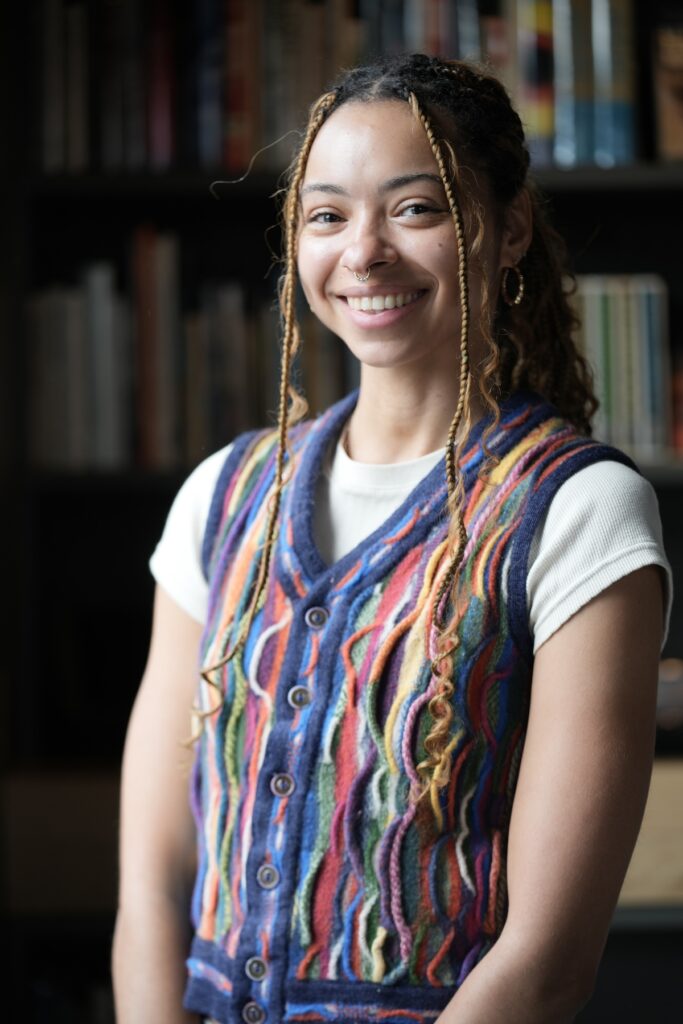
Raeghn Draper is a queer, Black, non-binary community organizer based on Chicago’s West Side. With over 12 years of restaurant experience, they weave a working-class perspective throughout their work. Raeghn is the co-author of the Girl, I Guess voting guide, a storyteller, and a digital strategist who crafts compelling language that breathes life into powerful experiences and campaigns. They are passionate about advocating for hospitality workers and challenging toxic industry structures.
Ellie Gilbert-Bair: How did you get involved in Girl, I Guess?
Raeghn Draper: I was invited by Stephanie [Skora] to write for Girl, I Guess. Steph and I met on the train back from the “Muslim Ban” protests that were happening at O’Hare in 2017. She was sitting with a friend of mine, and I complimented her sign.
Stephanie started the guide with a friend of hers, [Ellen Mayer], and then that friend stepped back, and Stephanie did it by herself for a while. Stephanie knew that I was a writer, and asked, about two years ago now, if I wanted to co-write the guide with her. Hesitantly, I said yes. At first, I was like, “I don’t know, not really my thing.” But here I am.
Why the hesitation?
I don’t like politicians. I don’t care for electoral politics. I am a community organizer. I really believe and invest a lot of time in the power of local communities—small interconnected ecosystems of folks supporting one another—and I think it was a little bit of my [inner] anarchist coming out. Like, “Oh, this all needs to be burned down.”
I do believe in local politics. I do believe, especially in local electoral politics, so some of that has shifted. I still do strongly dislike politicians, but my belief in community power and in people organizing does lean into local electoral politics. I think we have a lot of power and opportunity there.
How do you see the relationship between community organizing and local electoral politics?
I really love community organizing because it helps people understand that they are powerful and they are capable. Sometimes, we look at activists and organizers as these superheroes that are trained up in a special way, who have these superpowers that the average person can’t tap into. That is the farthest thing from the truth. The average person is incredibly skilled and capable of changing their surrounding circumstances, especially when working in partnership with their neighbors, with their neighborhood group. I really see [organizing] as helping people understand that they are powerful, especially when they’re working together, and to have more of a vested interest in the wellbeing of themselves and the people around them.
I think local politics is one of the quickest ways that you can demonstrate to people that they’re powerful. In local campaigns, you can really see how a couple of votes can turn an entire area, ideally in the way you want it to go.
Since being on the guide, I’ve really been able to witness the power of our words in shaping certain races, and in folks’ enthusiasm—of, “Oh wow, when we do this together as a collective, we can actually change things.” So that has definitely shifted my view on local electoral politics, but I see them as one of the tools that communities have to flex their power.
The 2026 midterm general election guide is almost 100 pages! Fill us in on the labor that goes into making it.
It’s a real labor of love. [Steph and I are] two really stubborn Earth signs who love a project! Usually, we wait until ballots are finalized, and from there, we’ll create an outline of everyone who is on the ballot—not just our ballot, but across Cook County and the surrounding suburbs.
Then, we’ll go in and pick our races. I personally have a vested interested in
covering races of areas that I live in, or of folks with shared identity with me—so I’m usually taking the areas that are predominantly Black, or that intersect with my other interests. Stephanie does cover the judges on her own; bless her heart and her fast typin’ fingers.
It is a lot of computer time, a lot of scouring the internet, going over websites, social media platforms, deep Google searches of these people, looking through relations—Facebook or social media. Then we present a draft, and we provide each other edits. If there are points where we need support or we don’t agree, we talk about it. But for the most part, when we take a section, we allow that person to lead how they want to talk about it. There’s been a couple of times that Stephanie and I disagree, but even if we do, there’s a trust in each other and each other’s values.
The guide has a unique, playful voice. Tell us about how you see the role of fun in keeping folk engaged in politics.
I would not be able to do it if it wasn’t fun. It’s a lot, like you said—100 pages. I feel, sometimes, like I’m in school again when we have to write it. But I get to poke fun of some of these politicians and their gossip, and their mess, and their controversy. I get to poke fun at their badly designed websites and their really horrible headshots. That keeps me entertained and energized to keep going.
As a community organizer, I engage a lot in play and games to get involved. Community power is very serious—these are our lives. These policies, these elected positions—they affect our taxes, our ability to pay our bills, our ability to get to and from work. So, this isn’t to take any of that lightly. But I feel like this push for everything to be over-professionalized creates a barrier between folks who understand this world and the average person. And I am really invested in tearing that wall down and making sure that the average person not only can understand but wants to engage.
Some of us don’t want to read a boring research paper. We want to read something that sounds like chatting with my girls and spilling the tea. As political writers, it’s also our job to keep the reader engaged, and keep our community wanting to get involved. It’s only strategic to get creative with those solutions.
I get really excited about voting time, because, having written the guide for a couple years, I am now getting more familiar with the lore, with the gossip of some of these people. I have politicians that I really don’t like, and have had to write about them for years because they’ve stayed in their positions. So the petty Taurus in me is like, “I can’t wait to vote against you.” So I’m bringing a little bit of that energy not only into this, but also into our municipal [elections] that are coming up in February.
You identify as a “progressive” voter guide. What makes up that identity—what are some of the non-negotiables, and what are some of the things that you’re more flexible about?
As progressives, we care about climate justice, gender justice, racial justice, and connections to community organizing. As a labor babe myself, I care a lot about workers’ rights, so I’m often looking for connections to labor or union groups in my research of a candidate. Stephanie brings the background of being an anti-Zionist Jew and also a transgender woman, so she is definitely scouring around LGBTQ issues, specifically around trans rights, as well as Jewish people. But as an anti-Zionist, she’s also looking for people’s stance on Palestine.
Where we have hit a bit of a push and pull with some of our audience is our stance on Palestine. We don’t cover federal races as much, because it’s a different kind of cesspool. But our stance when it comes to federal politics is that folks take a stand for Palestine—call it what it is, a genocide—and support a right to return for Palestinians. That is rare and far between for a lot of our federal races.
Locally, it’s a little different. There aren’t as many opportunities for our local politicians to do something in their role as elected officials that will affect the people of Palestine. So for us, our litmus test is involvement with the local police department. So statements like “Blue Lives Matter” or receiving funding from the Fraternal Order of Police—those are things that are red flags for us, as well as funding from AIPAC-aligned folks, [the American Israel Public Affairs Committee], or funding from Republican groups. Even if a person is looking like they align with us and the values, if the money is coming from suspicious places, we’ll give a side-eye in our evaluation.
How do you follow the money?
For elections taking place in the state of Illinois, we use IllinoisSunshine.org. There, you can look up any individual that’s running for elected office in the state and see where their money is coming from. It tracks [the name and employer of anyone giving more than $150], so smaller donations aren’t [itemized]. But you can follow these people. If I show up as a donor for one of these politicians, you could then click on my name and then see who else I donate to. That’s a way that we can sometimes find these Republican trails or police-supporting trails.
All elected officials have to report their fundraising and campaign dollars quarterly. So, the Illinois State Board of Elections is another place you can go. That one moves a little bit slower.
Who is the guide for?
The guide is for folks who want to understand how their local politics are working, folks who want the way that they vote to be aligned with their values and progressiveness, and folks who want a more comprehensive picture of who their [elected officials] are outside of just being a Republican or Democrat. We include descriptions on what every elected position does—like the Metropolitan Water District—and invite the reader without any jargon to understand how [these officials] impact their lives. I think, for a lot of us, this kind of education is missing from most of our schooling.
There are a lot of awesome voter guides out there, and I would encourage people to reference multiple sources before they make the decision. But Stephanie, especially, holds such a wealth of historical knowledge when it comes to Chicago’s political system, and how the machine and political relationships feed into why people are voting a certain way, and why these people get their seats. It’s a little bit of gossip, a little bit of spilling the tea, and I think it can make it really fun and accessible to other people.
Are there any races you’re keeping an eye out for this election?
There are a couple. The school board race is a mess! But I think that’s a place where our vote has a lot of impact. I think, especially in districts that have a lot of folks who don’t show up to vote, that’s where the opposition is going to be sneaking in their candidates. It’s really, really important to be talking to our neighbors, talking to our friends and our cousins, folks who live in some of these areas, to encourage them to vote.
We have so much power when it comes to the judges, because nobody votes for judges. You know, who was ever taught to vote for judges, and what do they even do? But it’s a fantastic opportunity to get some really corrupt, morally obtuse people out of one of the most powerful positions over our everyday lives—how people are being sentenced, and how they are fined, and how they are criminalized. So I would definitely encourage people to vote for their judges.
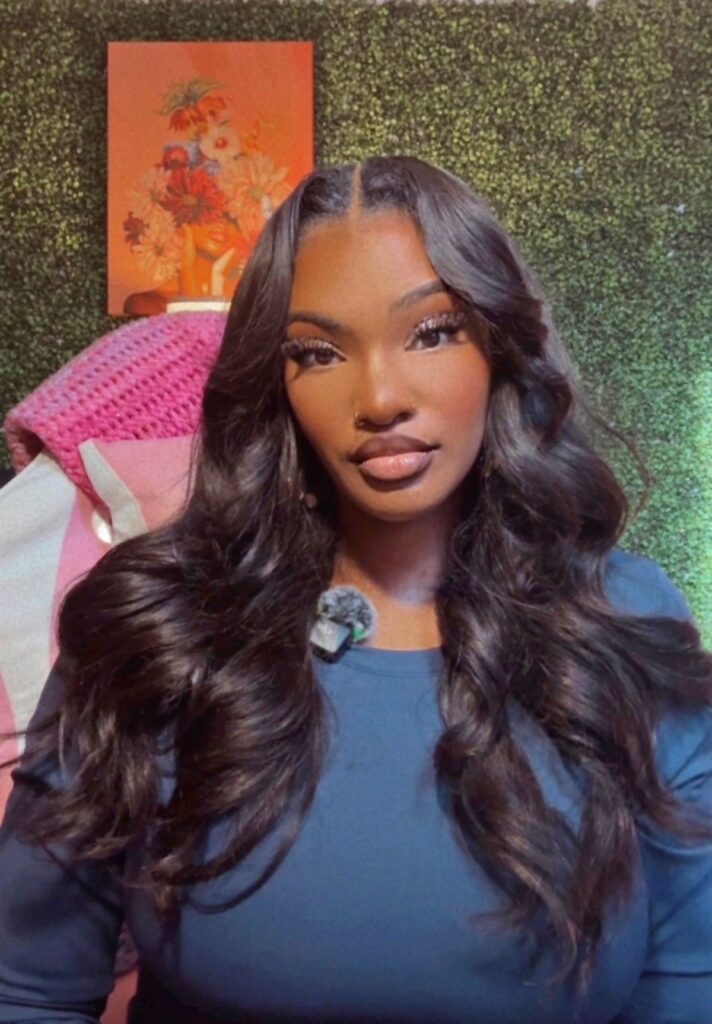
Tatyana Najee, known as MermaidTM, is a Chicago-based political commentator, content creator, and community advocate dedicated to civic education, political accountability, and amplifying Black voices. Through her digital platforms, media appearances, and grassroots organizing, she breaks down complex political issues, challenges systemic inequities, and empowers communities to become more informed and engaged in the decisions that shape their lives.
Ellie Gilbert-Bair: On your social media pages, you’ve covered all things Chicago politics—city council meetings, voter registration information, even a series on Chicago’s “alderman problem.” How do you choose what to cover?
Tatyana Najee: I like to cover the things that I know are going to directly affect our communities and our neighborhoods. I think voting in this midterm election and the municipal elections that are going to be coming up [in February] is very important, so I want people to understand how to register to vote, how to know where your polling location is, things like that.
I like to focus on both a federal level and a local level—I think both are required to make the changes that we wish to see in this country. On a federal level, I do a lot of work speaking to elected officials. I try to bridge the gap between the people and the politics.
As far as Chicago’s local politics, I wasn’t paying much attention until I saw what happened last year in the budget meeting, with the fight about the corporate head tax.
Editor’s Note: The corporate head tax, officially the “Equitable Employer Tax,” was a failed 2026 proposal by Mayor Brandon Johnson to tax large corporations a monthly fee per employee that works in the city, with an offset credit for employees in disinvested areas. Johnson revived it this year in his “Fair Share Budget” spending plan.
I went to the original budget meeting [in 2025] to see the mayor’s proposal—it is something that I align with because I align with progressive policies that are going to actually help out our communities. So to see it be shot down by the City Council made me think, “oh wait, what’s going on here?” I did a little bit of research. I made a rant about how I felt about the fact that that was shot down … so that’s where things kind of popped off.
We’re about to be smack dab in the middle of budget season, which means the reason why I started my series is coming back up again. So I’m hyper-focused on seeing how everyone is moving and what they are deciding to do, and if they are voting against their constituents.
What do you see as the role of social media in engaging voters?
There’s actually been studies that have been done recently that shows that [a majority of adults in the U.S.] are getting more of their news, and just basic information, from social media than they are from traditional media or legacy media.
I’m just a regular person. I mean, I’m from Queens, New York. I am a regular girl, but I know how to have a conversation. And so when I make my videos, I try to make them informative, but also not give people anxiety. I try to keep them at like a minute and 30 seconds so that you can actually sit there, watch it for a second, and then you can scroll. And within that minute and 30 seconds, maybe two minutes, you got packed with information but didn’t feel like you were packed with information.
Our generation—Generation Z—faces a lot of anxiety over the state of the world, and a lot of informational fatigue. Does that resonate with you, personally?
Oh yeah, it absolutely does. I’m gonna just tell you—every day, it’s something. Especially with this administration, every single day you wake up, it’s something new that’s happening. I try my best to ground myself in—I guess we call it “hopecore” [a digital aesthetic that celebrates life and inspires optimism, counteracting doomscrolling]. I try to look for the positives in things and hope for the best as much as I can. But also, I know that because [we get fed] so much information, sometimes we have to filter out what is just fluff and get to the nitty gritty, so that we are able to make the decisions that we do.
I actually feel like our generation is more solution-oriented than other generations. I don’t want to fight anybody, but I think that our generation really looks for solutions. When I give out information, I try to give it out as “Hey, this is the problem. This is how we fix it.” That’s where the “Chicago doesn’t have a mayor problem. Chicago has an alderman problem.” series came from.
When I am giving out this information, I try my best to make it as simple as possible for people to understand. … I feel like if we are able to get the information in a way that’s easily understandable, then it makes people want to make more educated decisions moving forward.
You just launched the Girl, We Know Black Chicago election guide with Kiki Bryant and Crystal Gardner. What did you prioritize when making this guide?
We wanted to make something that would really reflect our day-to-day lives—being Black women dealing with this political climate. [We focused] on the South and West Sides, because these are historically disinvested neighborhoods. There are a lot of times where policy and legislation that [isn’t spoken about in mainstream media] affects our neighborhoods the most. So, by focusing on the South and West Sides, and Black and Brown communities and minority-led communities, we will hopefully be able to open up other people’s eyes to seeing what happens in these communities as well. Chicago is a very segregated city. Some of the issues that people may face on the North Side are not the same issues that people may face on the West Side or South Side. I think there’s space in this political climate for both issues to be addressed.
What is one thing you want folks to really understand this midterm season?
I think the main thing that I want people to see is political influence, following the money. There have been allegations about me saying that I am being paid to do this work [by political candidates], when in actuality I am not. When you watch how people start to move when education is being given [to constituents], and how monetary value is involved, I think that’s the most important thing. You have to watch how people move.
Ellie Gilbert-Bair is the Weekly’s assistant managing editor.