
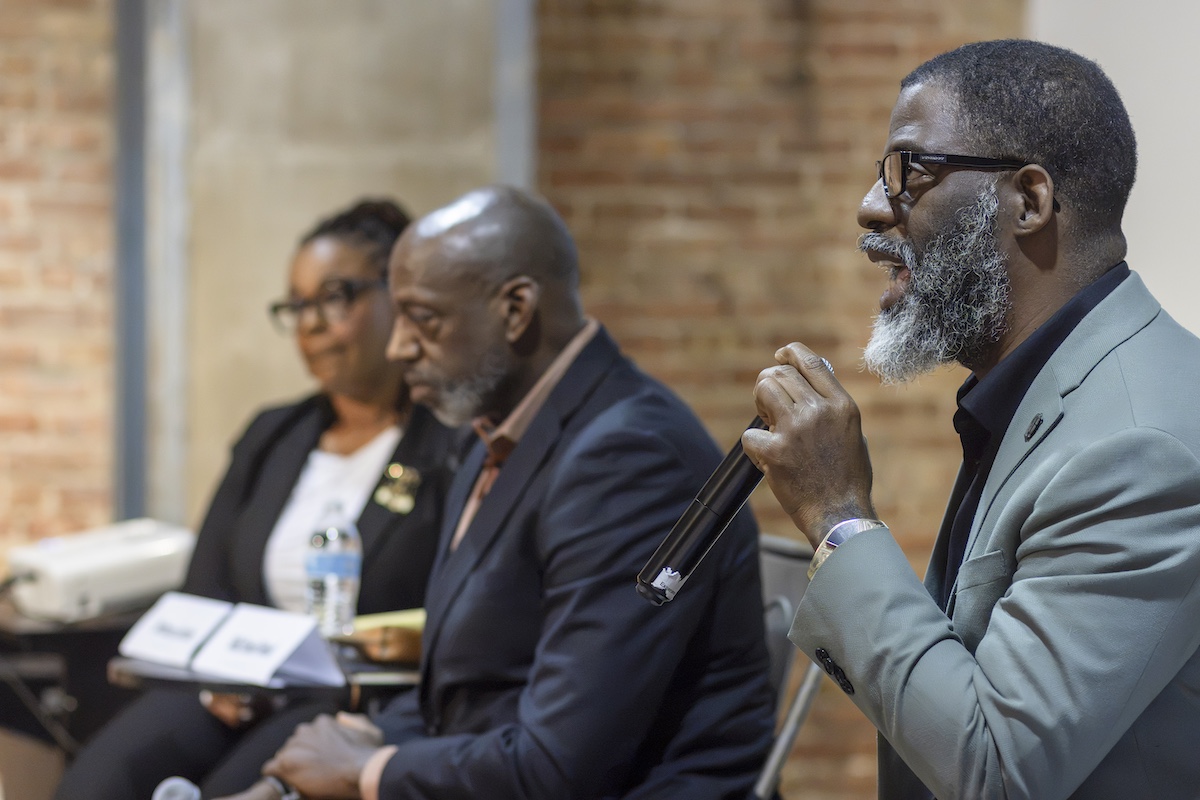
More than 120 people gathered at the Experimental Station in Woodlawn on Monday, October 26, to hear from four South Side candidates running in next week’s elections for the Chicago Board of Education, the first in which every seat on the 21-member Board will be filled by voters.
“Public Schools Are a Public Good: South Side Candidate Forum” featured contenders from two subdistricts: 6B, which stretches from Lakeshore East through the South Loop and Greater Grand Crossing; and 10A, which includes South Shore, Woodlawn, Hyde Park, Kenwood, and parts of South Chicago, Douglas, and Oakland.The forum was co-hosted by South Side Weekly alongside the Hyde Park Herald, Chalkbeat Chicago, the League of Women Voters of Chicago, and the Chicago Black Voter Project.
Michael Neal, a Bronzeville pastor and nonprofit leader, and Brittany Kimble, an attorney and CPS parent, are running to fill the seat for subdistrict 6B. Che “Rhymefest” Smith, a sitting board member, and Tameka Walton, a social worker and local school council member, are competing in subdistrict 10A.
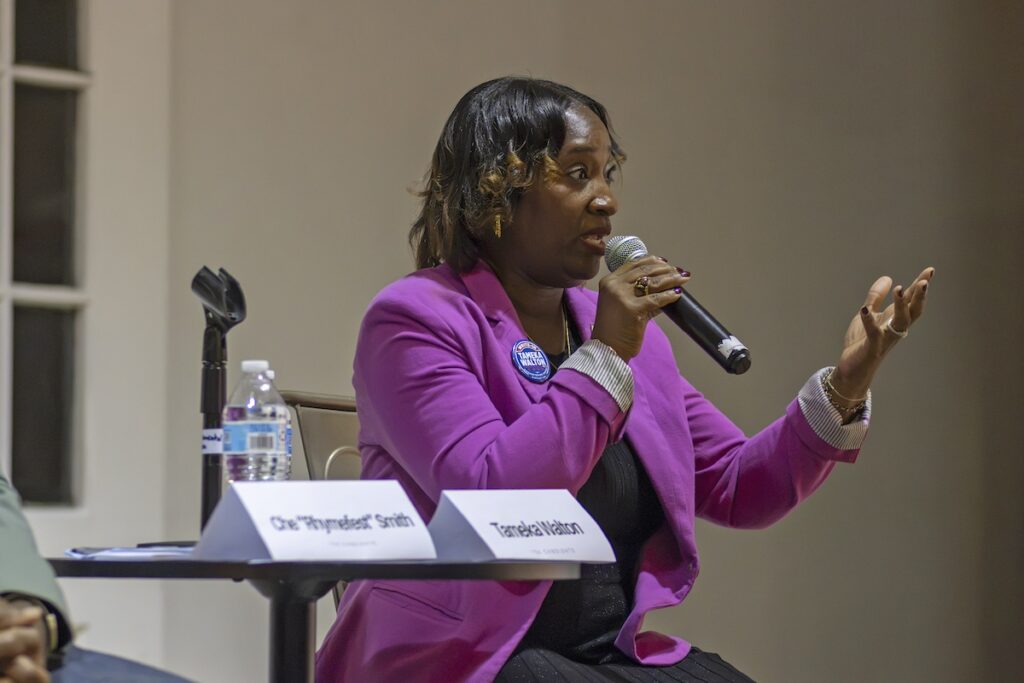
Attended by local community council leaders, parents, and current and retired teachers, who sat shoulder to shoulder, the forum was moderated by Remel Terry, president of the Chicago Westside Branch NAACP and the Community Commission for Public Safety and Accountability. It featured prepared questions from representatives of local community organizations, including Chicago Black Voter Project, Chicago Votes, the National Panhellenic Council, and the Greater Southeast Community Action Council. A rapid-fire yes-or-no round followed, before closing out the forum with questions from the audience.
Candidates vary on the school closure moratorium
The current moratorium against school closures, put in place by the Board in 2024, and due to expire next year, has been a recurring hot topic in these elections. CPS enrollment fell to just under 305,000 students this fall, which is a drop of more than 11,000 from last year and about 20% less than a decade ago. The largest declines are on the South and West sides, according to the community representative who posed the question. When asked about this issue, three candidates—Walton, Kimble, and Neal—said they would vote to extend the moratorium.
Walton said an extension “allows us to come up with a plan,” and recalled interning in CPS’s Family and Community Engagement Department when the district closed 50 schools. “I understand what that did to families as it relates to transportation, as related to safety,” she said, calling closures “the absolute last option.”
Kimble said CPS “had a whole lot of time to decide what they wanted to do with under-enrolled schools,” and proposed that under-enrolled South Side schools pool offerings the way Walter Payton and Jones share a swim team.
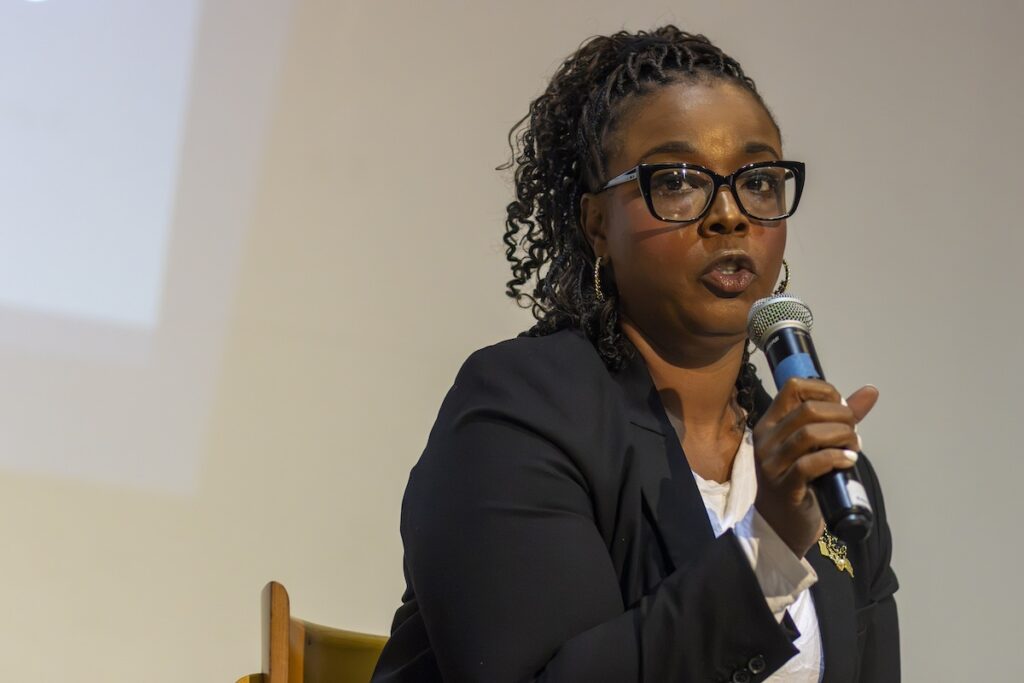
Neal said he would vote for the moratorium “only because CPS has done a horrible job of taking care of their previous portfolio,” and criticized “people making decisions from downtown, and they’ve never been to Roseland, never been to Pullman.”
Smith was alone amongst candidates in signalling he would not extend the moratorium, prompting audible and largely negative, audience reactions. “I am not open to extending any moratorium on conversations about facilities,” he said. “It costs us 400 million dollars a year to take care of 622 buildings. It would cost us 14 billion dollars to repair all of the buildings.”
He added that “no decision happens with a board member alone,” and that the superintendent, data, parents, and community input all shape closure decisions. However, Smith and Neal did find common ground about preserving a future for Woodlawn Community School, a small elementary school that may fall below enrollment thresholds. “It’s small and mighty,” Smith said.
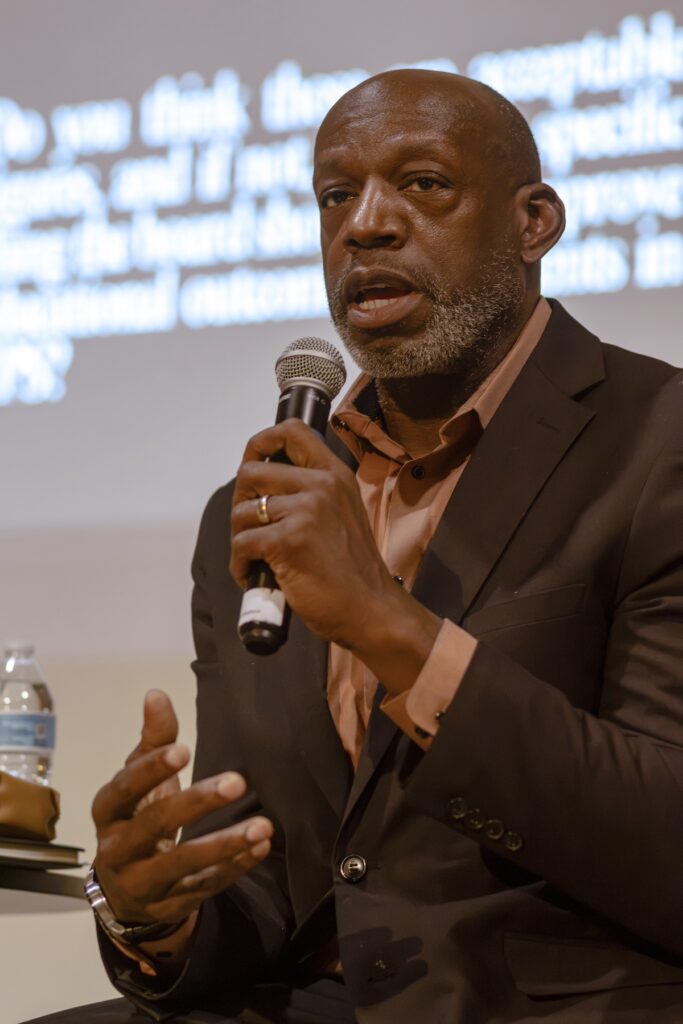
When asked about state results showing 42% of CPS students in grades 3-8 are proficient in reading and roughly 27% in math, all four candidates said these outcomes were not acceptable.
“If I only showed up and did 42% of my work, I would be fired,” Kimble said, advocating school-by-school approaches. Smith said results vary by school, adding “When you look at that percentage rate,you’re looking at Black boys. That’s who’s not passing these tests.” Smith and Walton pointed to the continued value of the Black Student Success Plan, which came up repeatedly. Neal called for a robust volunteer program that includes community members and parents, stating that “the job of teaching and education belongs to all of us.”
Enduring financial challenges for CPS: what to do?
Renee Byrd, vice president of the National Panhellenic Council, noted CPS’s roughly $10 billion budget and deficits of half a billion dollars or more in recent years, and asked candidates about how they would address these financial challenges. On closing the gap, all four candidates agreed Springfield should pay what CPS is owed by the state—tallied at 1.6 billion in 2025, $400 million more than in 2024—but their remedies differed.
Kimble said CPS must “spend less than you have” and borrow less, adding, “You can’t tell me with less than $10 billion that we can’t educate 300,000 students. It’s basic math.” Kimble also praised Superintendent Dr. Macquline King, Ed.D and said her budget, “although it was not favorable or passed,” could have yielded more stability. Neal said CPS should press the state for promised funding, while improving cooperation among the mayor, governor’s office, and legislators, and seeking other forms of revenue. Walton, on the other hand, said she would “follow the money trail” on contracts and vendors, and cited studies she said show closing schools doesn’t save money. Walton added she would work to build relationships in Springfield.
Smith said King brought forth a balanced budget before a roughly $150 million gap opened, and that “the same people who sabotaged this budget” had earlier pushed a high-interest loan. While Smith did not name individuals, he said this pressure occurred two years ago. His own proposals included an updated state funding formula pursued with other districts and public-private partnerships.
Rapid-fire questions round, and questions from the audience
Before the yes-or-no round, Smith said, “I’m just concerned about how they’re worded,” in reference to the questions that would be asked. A forum organizer replied that the questions were “reflective of the folks you all will represent,” and had been written by constituents.
All four candidates supported most of the initiatives discussed in the rapid-fire “yes-or-no” portion of the forum, including requirements for civics classes, evidence-based literacy instruction, expanded resources for diverse learners, a district-level plan to improve attendance, and fully implementing the Black Student Success Plan’s five-year goals. Kimble, Neal, Smith, and Walton also support maintaining current CPS policies to protect students disproportionately affected by new federal policies, including Black students, undocumented students, and LGBTQ+ students.
The candidates were split on other questions. Kimble and Neal do not support new taxes for millionaires, to increase funding for public schools; Smith and Walton do. The question also exists on Chicago ballots this election as a non-binding referendum.
While Kimble, Neal and Walton expressed support for these measures, Smith said no to directing more resources to historically under-resourced schools through expanded community schools, and abstained from providing an answer on expanding restorative justice as an alternative to exclusionary discipline. Smith also abstained from supporting a moratorium on generative AI in CPS, while Neal abstained from prioritizing protection of school workers in budget cuts.
Cassie Cresswell, who leads Illinois Families for Public Schools, asked Smith if he was committed to an AI moratorium, noting that Kimble and Walton had signed a pledge to protect human-centered education. “I am committed to protecting our children from the abuse and exploitation of AI,” Smith said, adding it was “hard for me to answer wholesale questions until I speak to our superintendent.”
A Hyde Park resident and former CPS teacher, Yvonne Jeffries, asked the candidates how the board could address poor teacher attendance. Smith said attendance should be tied to pay levels in union contracts: “Period… showing up is something that we have to discuss at contract time, and it should not be taboo.” Kimble said, “we have to care about their mental health,” and Walton, citing Black teacher retention on the South and West sides, said “it’s low because they’re burned out. The system has done that.”
Ryan Greenlaw, 5th Ward aldermanic candidate, asked whether they would expand trade programs and keep school buildings open after hours in response to concerns about teen takeovers. Walton favored expanding the community schools model. Kimble said young people she’d spoken with at takeover meetings wanted to be “free, not destructive,” and she wasn’t sure open buildings would solve it. “What you’re saying, Britt, is correct,” Smith answered. “Children do want to create their own spaces.” Neal said, “We don’t get to sit back and complain when we’re not actually at the table, or we’re not out there in the streets with them.”
Kenneth Newman, co-founder and sports youth advocate for the Hyde Park/Kenwood Community Action Council (HPKCAC), asked the candidates if they would build athletic facilities in neighborhoods without them. Kimble said she could not commit to it in her first year because “I need to make sure my kids can read.” Smith described a deteriorating field behind Corliss and told Newman, “Come help me out, bro… We’re volunteers [there],” as the room laughed. While Walton agreed that this is “a high priority,” she said it ranked behind other objectives for her.
Kristian Parker is a photographer and freelance arts and culture journalist. She’s passionate about sharing stories that are meaningful and authentic.