
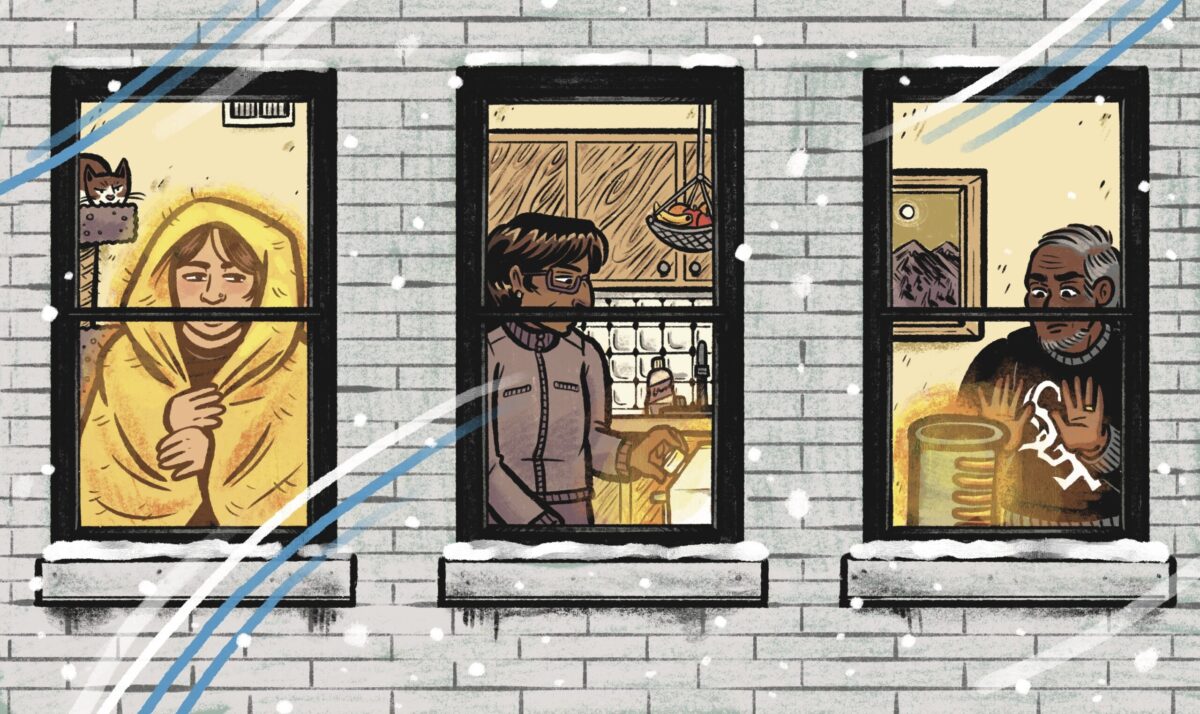
In December, twenty-seven-year old Daniela Silva experienced her first Chicago winter without heat.
After moving to the city with her partner and twelve-year old son last February from Bolivia by way of a shelter in San Antonio, Texas, they began renting a unit in a four-story apartment in South Shore. (“Daniela Silva” is a pseudonym the Weekly is using at her request).
Before the heat was cut off, Silva alerted the owners about water leaks that occurred when the heat was turned on. In response, they told her that they would shut off the heat and that she would need to purchase her own heaters.
As temperatures plummeted, the family burrowed under layers of blankets to stay warm, and it became challenging to cook.
“Because we weren’t eating properly, I didn’t have milk in my breasts because I wasn’t eating well,” Silva said. “It was the cold that prevented me from doing anything.”
“My son was getting thinner, because we only had tea or coffee with bread and an egg. That’s how we survived,” she said.
While the heat eventually returned, the water leak came back as well, resulting in the living room ceiling partially collapsing. “That’s how the madness began,” Silva said.
“Suddenly water started pouring down and hit the table, making my phone fly. That night, I really couldn’t sleep because I was in the final stages of labor,” she said. “I was scared. I was really afraid something would happen to my children, especially.”
When she notified the person collecting her rent, she was told that the owners were informed and they would come to meet with her.
But no one ever showed up.
Silva and her family eventually moved in January, after enduring a collapsed ceiling and water leaks in their freezing apartment for a month.
When asked why she had not reported the landlord, Silva said she was afraid of retaliation, including possible eviction.
“I didn’t know what might happen if I reported it. Besides, I came to live there because I had nowhere else to live,” Silva said.
In Chicago, the city’s heat ordinance mandates that landlords keep apartment temperatures at a minimum of 68°F from 8:30am to 10:30pm and 66°F from 10:30pm to 8:30am from September 15 to June 1. For each day they’re not in compliance, landlords are fined $500 to $1,000 per violation.
The Residential Landlord and Tenant Ordinance (RLTO) also provides various tenant protections. Under RLTO, tenants are able to withhold a portion of their rent or terminate the lease if the landlord fails to supply heat within a given period after providing a written notice. Tenants can also find substitute housing or buy heaters and deduct the cost from their rent.
However, many tenants in Chicago still struggle to access adequate heat in the winter every year.
Over the past two heating seasons, between September 15, 2024 and February 10, 2026, tenants made about 5,500 calls to the City of Chicago regarding inadequate heat to 311 City Services. Between September 15, 2024 and February 3, 2026, the City issued more than 800 violations for breaches of the heat ordinance.
Heat issues disproportionately impact residents of low-income communities, who are already experiencing housing insecurity and other financial strains. About half of the calls and 63% of violations occurred in low-income neighborhoods (defined as Census tracts where at least a quarter of the population live below 125% of the poverty line).

These issues are also concentrated in majority-Black neighborhoods that have faced decades of segregation and disinvestment. Around half of the calls and 65% of violations were in majority-Black neighborhoods, even though about 30% of the city consists of majority-Black census tracts.
Since 2021, about ninety-five properties have had at least three repeat violations. The top violator during this period is a property at 5947 S. Indiana Avenue in Hyde Park, owned by St. Edmund’s Manor LP, with eight violations. Three were logged in 2021, one in 2022, three in 2024, and one in 2025, according to documents reviewed by the Weekly.
In an emailed response to the Weekly’s questions, a former property manager at St. Edmund’s Manor wrote, “We acknowledge that we had heating problems in 2023 that resulted in our replacing the boiler at a cost of $24,500 on or around October 2023.”

Tenant advocates say a major part of the problem is lack of maintenance.
“Not only are you [with low-income] more likely to live in a building that has an older or malfunctioning heat system, but you are more likely to have what some people call ‘landlord of last resort,’” said Jonah Karsh, a community organizer at the Metropolitan Tenants Organization. “There’s nowhere else that I can afford to live, so I’m living with the slumlord that not only knows there’s no heat, [but] they don’t want to do anything about it.”
Evelyn Vargas, an organizer for the Autonomous Tenants Union, a tenant-led, volunteer collective based in Albany Park, said that heat is one of the problems tenants call the union about. “One issue that they’re calling us about is actually just a symptom of the larger problem, which is that often landlords felt like they could get away with anything.”
Tenants who face limited options often turn to portable heaters for supplemental heat, which are a major fire hazard during the winter. Chicago’s Heat Ordinance specifies that portable space heaters and cooking appliances, among other heat sources, cannot be used to meet the temperature requirements. Heating has to be provided with a permanent space heating system, such as radiators or warm-air furnaces.
According to data the Weekly obtained from the Fire Department via a public-records request, there have been five fires linked to space heaters during the past two heating seasons since September 15, 2024. One occurred in April 2025, when a five-year old girl and a woman in Woodlawn suffered burns and smoke inhalation, according to the Sun-Times.
Faye Porter, who lived in the same Hyde Park apartment building for fifteen years, faced persistent heat problems and wound up getting space heaters.
“There were a lot of things that were going on with my health,” Porter said. “It had a lot of a lot to do with heating.”
Cold homes are linked to significant health issues, especially for the elderly. Studies have linked cold indoor temperatures to a higher risk of hypertension, respiratory and cardiovascular diseases, and mental illnesses such as depression and anxiety.
“When you’ve got a cold apartment, you tend to heat the body as much as you can, which restricts your movement, and it restricts your engagement with your home,” said Rebecca Wright, a historian at Northumbria University who examines the intersection of heat and poverty.
“Your home feels very different when you’re cold, you just cuddle up under something. And obviously that has a dramatic impact on what you do,” she said. Heat is also a matter of personal autonomy. “If you can’t turn your heat up in cold weather, your landlord doesn’t want to pay for the bills, then they don’t have that control.”
Tenant advocates say that landlords sometimes install locks on thermostats or shut off the heat completely.
“It’s like putting someone in a cooler. Depriving people of heat is actually a form of torture,” said John Hieronymus, an organizer with Tenants United, a South Side tenants rights group. “If you have no control over the heat in your apartment, you are just sitting there freezing, not knowing what you can do to solve the problem other than complaining to your landlord, and if your landlord isn’t responsive, I see it as a form of violence.”
City inspectors might also visit when the tenant is not home, sometimes resulting in case dismissals.
“People get very discouraged, because you get tired of calling 311, you get tired of calling the Department of Buildings,” Porter said. “You get tired of being told lies because they’re not going to do it.”
One way the city could protect tenants would be to publish a rental registry that shows buildings’ recent violations, said Sam Barth, a supervising attorney at the Law Center for Better Housing, a nonprofit law firm focused on supporting lower-income renters.
A rental registry could also help tenants know who their landlords are, potentially allowing for greater accountability. In Chicago, 16% of multifamily rentals and 34% of larger apartment buildings are owned by LLCs, whose owners can remain anonymous.
Rental registries already exist in cities such as Jersey City, Minneapolis, and Portland, Maine.
Advocates also say that proactive inspections can improve living conditions. In Chicago, regular inspections only take place for certain kinds of subsidized housing. For private rental units, inspections are sent in response to complaints.
Metropolitan Tenants Organization advocates for the Chicago Healthy Homes Ordinance, which would require routine apartment inspections. Ald. Rossana Rodríguez Sánchez (33rd Ward) and five other alderpeople introduced the ordinance in December 2022, but it failed to pass.
“Landlords get away with what they do when it comes to heating because they can. The city of Chicago does not make them comply,” Porter said. “[Tenants] have to know their rights. They have to learn the residential landlord–tenant ordinance. And then they have to get rid of some of that fear, because that’s what landlords bank on.”
Those experiencing difficulties in getting adequate heat in their residences can call 311 or find more information on the City of Chicago website here.
Jinny Kim is a data reporter and graduate student studying computer science and public policy at the University of Chicago.