
Cook County residents will cast their ballots in the 2026 primary election through March 17 for a range of federal, state, and county elected officials, including judges, deciding which party nominees will appear on the November general election ballot. This year, residents will choose their next Cook County Board president and, in some districts, their commissioner—both for four-year terms with no term limits. But what does the Cook County Board do?
The county can be an esoteric branch of government to understand. With the primary approaching, the Weekly looked into the positions of Cook County Board president and the Board’s 17 commissioners to understand what powers these electeds hold.
What powers does the Cook County Board hold?
The Cook County Board of Commissioners is the governing board and legislative body of the county. It is composed of 17 commissioners elected by the residents of their respective districts, each containing roughly 300,000 people. That’s a lot of commissioners compared to counties of similar populations nationwide; Cook County is the only one of the five most populous U.S. counties with more than five members on its governing board.
In addition to passing legislation to enact policy and run the county government, Cook County commissioners serve on various committees and subcommittees and represent the interests of the constituents in their respective districts. But we shouldn’t think of them as alderpeople for the county, according to University of Illinois Chicago professor emeritus and former Chicago alderman Dick Simpson.
“Commissioners don’t intervene in how court cases are handled, and they don’t intervene in who gets care at Cook County Hospital in the same way an alderman might intervene over getting a pothole fixed,” Simpson told the Weekly. Instead, he said, commissioners might reach out directly to department heads or to the Board president, to accomplish an aim more informally.
This year, seven commissioner seats have contested races for the Democratic nomination, while in the Republican primary, only one commissioner seat drew more than one candidate. Five districts will have a contested race in the general election.
The Cook County Board president, elected by voters from the entire county, is the county’s chief executive officer. The Board president presides over the typically monthly meetings of the Board, approves or vetoes Board ordinances and resolutions, presents an annual budget for approval by the commissioners, and can themself directly introduce legislation. The Board president also supervises the offices and departments that provide services to residents and run county operations, such as the Bureau of Finance and the Department of Human Rights and Ethics; appoints people to serve on boards and commissions and to administer county affairs; and negotiates on behalf of the county with governmental units and the private sector.
Besides the Board president and commissioners, Cook County government is run by 10 other elected positions—these include the assessor, county clerk, sheriff, treasurer, and more—many of which are up for election this year. Additionally, there are appointed and independent agencies within the county system, such as the Office of the Independent Inspector General and the Cook County Public Defender. Although the other electeds control their own areas of the county government independently for the most part, the Cook County Board sets or approves the budget for all of them.
What does the Cook County Board oversee?
Cook County is the only Illinois county that has adopted home rule, which means that it may exercise any power or perform any function relating to its government and affairs, such as regulation, licensing, borrowing money, and levying taxes, as long as it’s not specifically limited by the state.
One of the most salient examples of this power was the county’s2016 increase of its sales tax by one percent, which, at the time, gave Chicago the highest combined sales tax rate in the country—and which helped the county close a projected budget gap this last budgeting cycle.
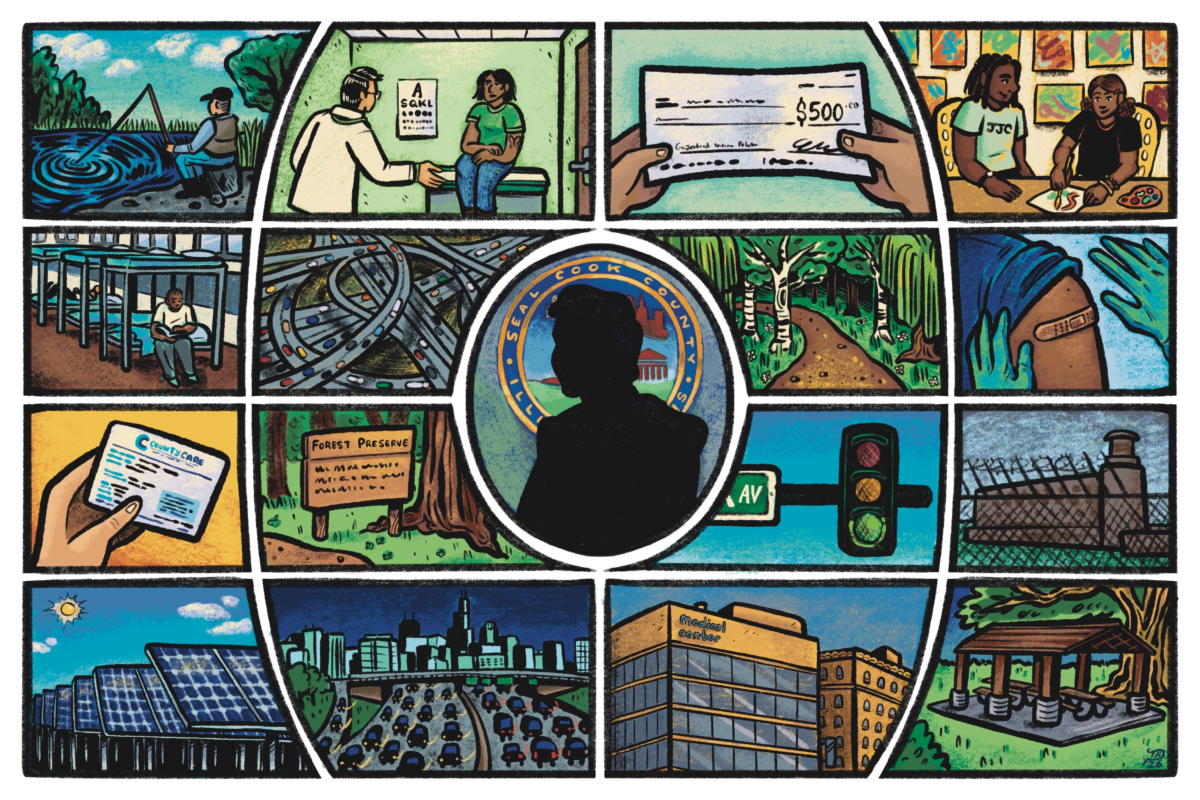
The Cook County Board president’s policy roadmap provides a good overview of what types of things the Board president and commissioners oversee. The county’s goals mainly fall into one of six buckets: health and wellness, economic development, safety and justice, climate resiliency, infrastructure and technology, and good government practices. Broadly speaking, the Board president oversees the county’s public health and hospital systems, criminal justice system, forest preserves—about 70,000 acres of natural areas and open space—transportation infrastructure, more than 20,000 employees, and a roughly $10 billion annual budget. Cook County is the nation’s second-most populous county, after only Los Angeles County.
In October, current Cook County Board President Toni Preckwinkle, who has held the office since 2010—the longest tenure for a Board president—proposed a balanced $10.12 billion budget for fiscal year 2026, later approved by the Board. The county budget is funded primarily by revenues generated through Cook County Health (for example, from Medicaid managed care revenue and patient fees), property taxes, home rule taxes (including sales tax), fees, and federal grants, such as American Rescue Plan Act funds. Healthcare and public safety together made up 74% of the total budget, with the Health Fund alone comprising more than half of the total budget.
Nearly 400,000 Cook County residents are members of CountyCare, a Medicaid managed care plan launched in 2012 that provides no-cost health coverage, and more than 300,000 people visit the county’s two hospitals, John J. Stroger Jr. Hospital and Provident Hospital, and its health centers and clinics annually. The Cook County health system has received particular attention this election cycle, as the county is bracing for as much as $400 million in losses in the coming years as people are losing their health insurance—due to the federal government instituting new work requirements, more frequent checks on qualifications, and reduced or eliminated subsidies on Obamacare plans—or are not able to pay after visiting the hospitals or clinics.
The county has also invested significant funds into grants for violence prevention and reduction and youth criminal justice reform. One such program is the Juvenile Justice Collaborative, a joint program between Cook County government and service providers that provides access to trauma-informed care and community-based services for youth who have experienced or are at high risk for exposure to violence or trauma. Preckwinkle also advocated for the passage of the state-level Pretrial Fairness Act, which passed in 2021 and went into effect in 2023, making Illinois the first state to eliminate cash bail.
Other Cook County government initiatives in recent years have included the Cook County Small Business Source, which connects small business owners with guidance and recovery grants; the Cook County Promise Guaranteed Income Pilot, which provided $500 in monthly cash payments to 3,250 low-to-moderate income families for a period of two years (and money was allocated in the 2026 budget to make the program permanent); the county’s first power purchase agreement for renewable energy in partnership with Constellation and Switch Current Energy; investments of $44 million in behavioral health services via the Stronger Together Initiative; and opening a new Center for Hard to Recycle Materials.
What are counties, anyway?
Counties, as a governmental entity, date back to the 1600s.
“If you take counties as a general entity in the United States, they have not changed as quickly as other forms of local government,” Christopher Goodman, associate professor of public administration at Northern Illinois University, told the Weekly. “Cities, for instance, do significantly more things than they did 100 years ago.”
In some cities, like Philadelphia and New York, the county and city have been consolidated, making the county essentially obsolete, and the city government administers both functions. Other places, such as LA County, have kept the separate structure of the county, similar to Cook County.
In Illinois, there are three different forms of government for counties: the township form, commission form, and county executive form. Cook County is the county executive form, one of three in the state.
What this means is that the Cook County Board president runs the executive branch of the county and also presides over legislative matters in the commission. This is not the case in the township form—the most common form in Illinois, used by 85 counties—where the Board president helms the legislative branch, and the executive side is run by a separate administrator, typically an appointed official. This also differs from mayoral power in Chicago, where the mayor is the head of the executive branch. The mayor runs City Council meetings, but they are not formally a member of the Council and cannot introduce legislation. (They can, however, get around this by having someone on City Council introduce legislation on their behalf, Goodman noted.)
“There is that tension of, you are on one side adopting policies, or involved in adopting policies, and then on the other side you’re also in charge of implementing those policies,” Goodman told the Weekly. “We usually split those functions apart for accountability reasons.” He added that many counties nationwide elect their board president from among the board’s own members, whereas in Cook County, residents are the ones making this decision.
The Cook County Board president is typically a full-time position, whereas commissioners can be, though often are not. Some, for example, are also practicing lawyers. According to the Cook County Office of the President, a Cook County official, elected or appointed, may pursue another job in addition to the role, but they are required to disclose any other employment or change in employment to the Cook County Ethics Director and the Board of Ethics within 30 days. Preckwinkle has none currently listed. The current salary for commissioners is $102,170 a year, while the Board president has a salary of $204,340. Some commissioners’ meeting attendance has been called out in the course of the campaign cycle, with some challengers promising they would hold only the job of commissioner if elected.
Over time, the number of Republicans on the Cook County Board has waned, with only one currently on the Board: 17th District Commissioner Sean Morrison of Palos Park, who is not running for reelection.
Simpson said that today there is also “much tighter control” of finances by the Board president and the chairman of the Board’s finance committee (currently John P. Daley), with few amendments to the budget once it is presented. “That’s not to say that commissioners aren’t important in advocating for [the] needs of their section of the county, and that they don’t come up with ideas that eventually get adopted by the county,” Simpson told the Weekly.
Cook County Board primary candidates
Prior to Preckwinkle’s election as Cook County Board president in 2010, she served as 4th Ward alderperson for 20 years, and before that, as a high school history teacher, an economic development coordinator for the City of Chicago, and the executive director of the Chicago Jobs Council. Since 2018, she has also chaired the Cook County Democratic Party.
Preckwinkle, 78, announced that she would be running for reelection last March, citing potential impacts of federal decisions as a reason she wants to remain in the role. “With a new administration at the helm in the federal government causing chaos and uncertainty, now is not the time to step aside from this important work,” she wrote in a campaign email. In October, she signed an executive order banning the use of Cook County–owned property and resources by Immigration and Customs Enforcement (ICE).
In her reelection campaign, Preckwinkle has pointed to her strong track record of fiscal responsibility. During her tenure, she has closed deficits of hundreds of millions of dollars, erased more than $820 million in medical debt for residents, never raised the county’s portion of property taxes, and funded the county’s pension fund around 66%, which is more than double that of the city’s four major pension funds. Under her leadership, the country has received four bond rating upgrades since 2021, while the city is in significant and mounting debt.
In her last run for reelection for Board president in 2022, Preckwinkle won by almost 69% of the vote against Republican candidate and former 2nd Ward alderperson Bob Fioretti.
Challenging her in the Democratic primary this election is longtime 42nd Ward alderman Brendan Reilly, 54. Reilly got his start in politics as an aide to former Illinois House Speaker Michael Madigan—who was convicted of bribery and corruption charges in 2025—and worked as an AT&T executive before his election to the 42nd Ward seat in 2007. Reilly is one of the more conservative Democrats on City Council; for example, in 2020 he endorsed Republican Patrick O’Brien over Preckwinkle’s former chief of staff Kim Foxx in the race for Cook County state’s attorney.
Also running for Cook County Board president this year are Libertarian candidates Michael Murphy and write-in Justin Tucker and Republican write-in candidates Max Rice and Eric Wallace.
Reilly has criticized Preckwinkle over property tax system delays—property bills have gone out late, forcing school districts to take out loans—and has said he will end the county’s contract with Tyler Technologies, which has been working to upgrade the technology behind the property tax system. Preckwinkle responded that she’s one of several people working to oversee the tax system.
Reilly has said the county should have prepared for Medicaid cuts more aggressively. County leaders said they did by instituting staff cuts and freezes and setting aside reserves. He also wants to ensure the county isn’t absorbing costs from nonresidents.
As for the Cook County commissioner races, commissioners whose districts overlap with the South Side include the 2nd District’s Michael Scott, the 3rd District’s Bill Lowry, the 4th District’s Stanley Moore, the 5th District’s Dr. Kisha McCaskill, the 7th District’s Alma Anaya, and the 11th District’s John P. Daley. Of these South Side races, only the 2nd and 5th Districts are seeing challenges to the incumbent.
In the 2nd District, Scott is being challenged by activist and perennial candidate Democrat Andre Smith. In the 5th District, McCaskill is being challenged by Democrat Kiana Belcher, a trustee for the Village of Dolton, and the winner of the Democratic primary will face Republican candidate Richard Nolan, who has previously run for Thornton Township Supervisor.
Zoe Pharo is a writer and fact-checker based in Chicago. She grew up in Durham, North Carolina, and studied political science and international relations at Carleton College. She is a former staff writer for the Hyde Park Herald and editorial intern for In These Times, and she currently freelances for Chicago Documenters and South Side Weekly. She last wrote for the Weekly about residents’ experiences at a newly combined, city-run temporary shelter in Hyde Park.