
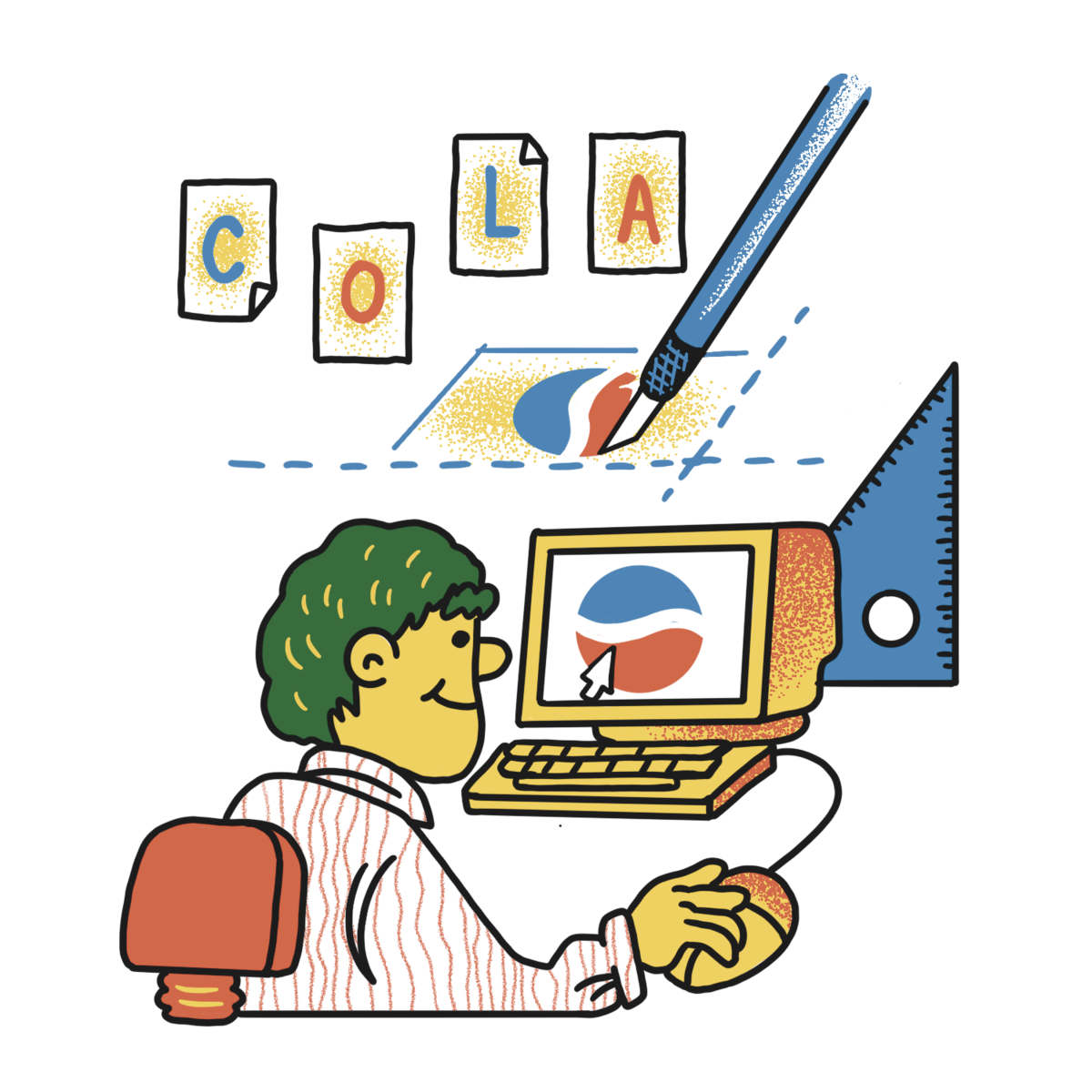
This February, the staffs of South Side Weekly and Hyde Park Herald said our goodbyes to our long-time layout editor and production manager Tony Zralka, who retired after 45 years in the business. For the last few years at the Weekly, and since 1999 at the Herald, Zralka has nimbly put together the layout of each print paper, fitting text, photos, and ads together like puzzle pieces before sending it all to the printer.
For the Weekly, the process takes place over the course of a day and almost entirely via computer. Like Zralka, our new layout editor, Mel Dempsey, sets up the paper using Adobe InDesign, and includes ads created and sent in by South Side businesses. After text and visuals are set for a story, a PDF proof is shared via Slack, which we also use to send back edits and feedback. At the end of the day, a final file is uploaded to our printer’s server, and two days later, the Weekly is hitting newsstands across the city.
In Zralka’s telling, the job has changed dramatically in the last few decades. When he started in 1981 at the Daily Southtown as Layout Artist, his job was to design from scratch the ads going into the paper.
“The salesman would come in with a piece of paper that could have a rudimentary layout to it or just copy, and they would say, ‘Put something together,'” he said. “Those days you could use clip art books, or a lot of times we would actually have to produce a piece of art ourselves.”
Zralka said the layout department would receive three or four clip art books every month, filled with a variety of images they could cut out and use in ads.
There was one problem with using the books: unlike digital clip art, the images were a set size. If he needed an image of a banana or a soda can to be a little larger or smaller to fit the layout of the ad, Zralka sent the image to the camera room, a separate department, with instructions to resize by a specific amount, like 150%. People in the camera room would capture the art on camera, and resize the image while developing the film.
In the composing room, people cut out all the text and visual elements to paste them out on a board. Then, a secretary would type all the raw copy up before sending it to the type setter. “And then once all that was done, they would take it to the large copier, and they would copy it, and then the next morning, that proof would go out to the salesperson,” Zralka said. “And this is all hand delivered, nothing electronic. You’d have to have a driver to come in and pick up an envelope.”
The process took about a week, from initial copy to being placed into the right edition of the paper. “And then all the pages of the editorial, the ads, everything would be down on a board, and it would go back to the camera room, and they would shoot the negatives, process the plates, and the plates would go to the press,” he said.
All in all, a single full page grocery ad “could easily go through 10 people’s hands,” Zralka said.
That began to change in the 1990s and into the 2000s. Copy machines that could enlarge and reduce images were one of the first major changes Zralka remembers. Soon, the Mac followed, and design programs like QuarkXpress and Adobe PageMaker, the predecessor to InDesign, allowed Zralka and his colleagues to create more layout independently, without the need for multiple departments.
“When you become more efficient, you need less and less people,” Zralka said. He estimates there used to be 40 to 50 people involved in putting together a newspaper; nowadays you can make do with just a few.
“The salesman would come in with a piece of paper that could have a rudimentary layout to it or just copy, and they would say, ‘Put something together.'”
Tony Zralka
For a while, at least, drivers were still integral to the process, delivering pieces of the layout between departments and later to the printer. “We went from [using floppy disks] to these discs that would store 100 megabytes, which is like today, it’s nothing, right?” he recalled. “We could only get the color pages on those then. Then finally, things got to the size where we could get everything on CDs.”
Amidst all the change, for Zralka the most challenging part of making ads was just “not to make it look like the next guy’s,” he said, pointing out that more than half a dozen grocery stores might have ads in the same paper.
“The most fun were probably, I hate to say it, the liquor store ads,” he said. “Those guys were more open to something wackier, as far as the theme goes. There was all that competition with the liquor stores, so they were more open to something that would catch your eye vs. the other guy’s ad.”
But more fun than the job itself were the people Zralka worked with. “The business, even then, was filled with characters. You could enjoy your job because you could do some wild and crazy things while you were working,” Zralka said. “Joking around, bouncing ideas off each other. Somebody wants something and you can’t visualize it, you’d get stuff out of the clip art books and do crazy shit with it. And for the most part everybody got along.” To this day, he remains friends with someone he worked with 40 years ago.
Adam Przybyl is the Weekly’s interim editor-in-chief.