
This reporting was supported by the International Women’s Media Foundation’s Women on the Ground: Reporting from Ukraine’s Unseen Frontlines Initiative, in partnership with the Howard G. Buffett Foundation. Tetiana Burianova contributed reporting.
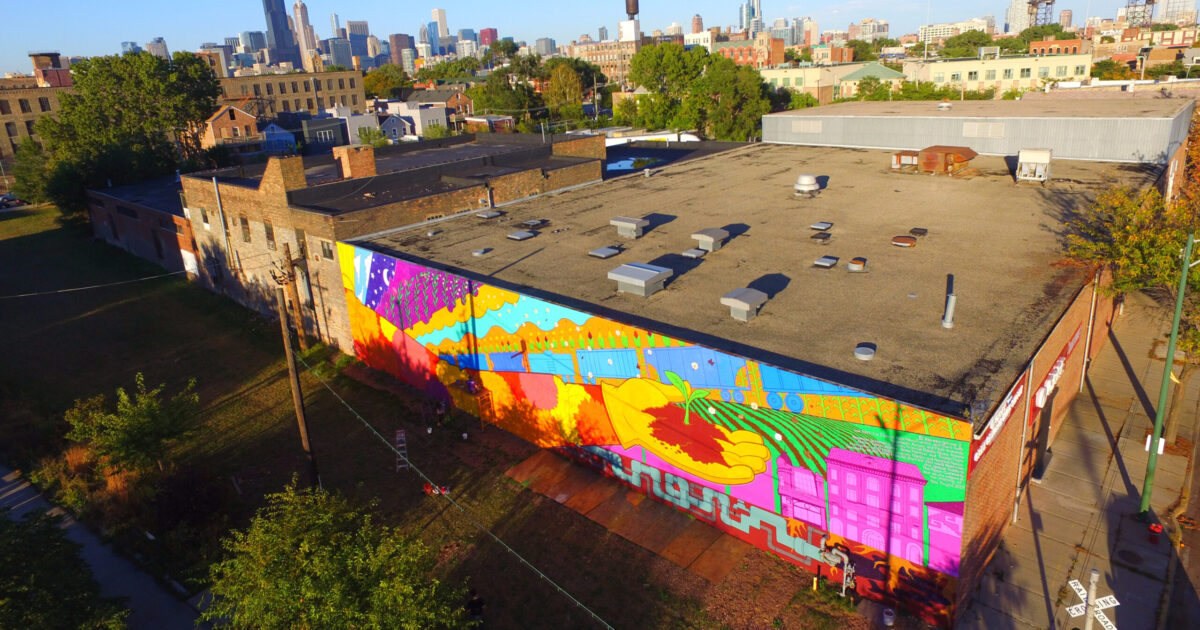
In 1968, amid nationwide anti-war and civil rights movements, Chicano artist Mario Castillo picked up his paintbrush and headed to the Urban Progress Center on 19th and Halsted. The two-story building’s side wall had been exposed by the demolition of the one next door, creating yet another blank brick canvas as the city razed ‘blighted’ buildings in the name of urban renewal.
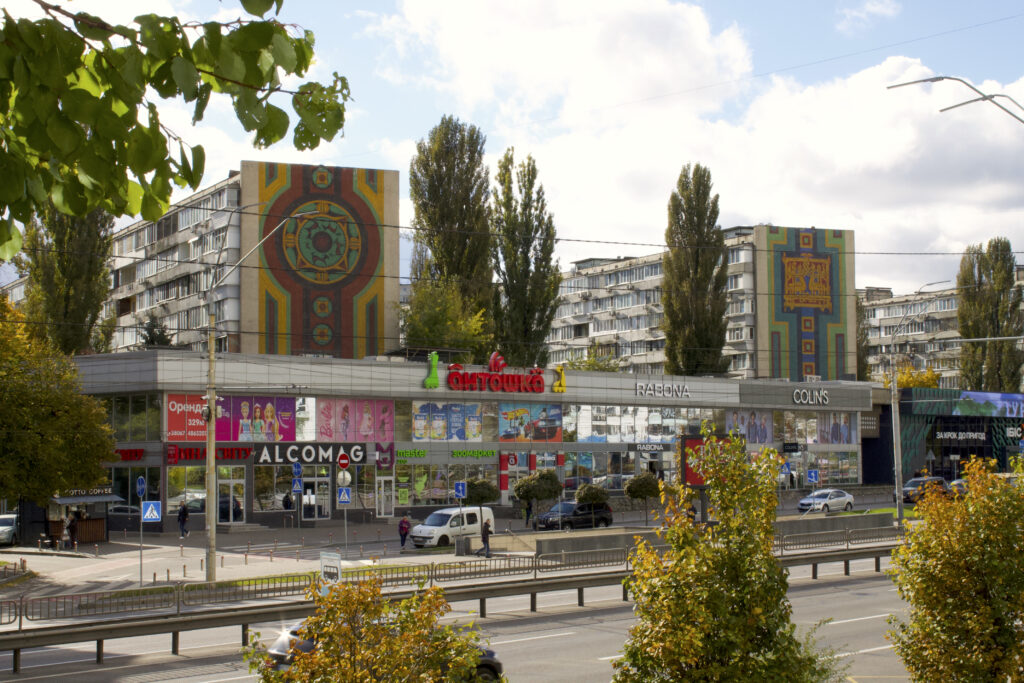
That same year in Kyiv, then the capital of a Soviet-ruled Ukraine, artist Ivan Lytovchenko was also staring at a wall. He would soon begin working on the first of six eight-story-tall mosaics that would adorn a row of residential buildings lining Peremohy (‘Victory’) Avenue, as commissioned by the Communist Party of Ukraine.
During the 1960s and ’70s, Chicano muralists and Ukrainian mosaicists were turning public space into colossal works of art. Through symbols, motifs, and colors drawn from folklore, artists used large-scale images as identity statements during a time when their cultural heritage faced suppression. Fifty years later, their stories have lessons for Chicago artists struggling to preserve expression in the face of federal defunding and threats to freedom of speech.
When Diana Solis was twelve, she watched Castillo and his crew paint his mural, Metafísica (Peace), widely considered the first Chicano outdoor mural in the United States. Patterned forms recalling feathered serpent Quetzalcoatl, Los Ojos de Dios, Indigenous motifs from the Pacific Northwest, and well-used paisley, peace sign and yin-yang symbols float in negative space around an orb as if to fertilize the central “egg” of peace.
“You have to realize that the murals were not just like ‘let’s do mere decoration.’ The murals were also a sign of protest, a protest against the Vietnam war,” Solis said, now sixty-nine and an established multi-disciplinary artist in Pilsen.
In 1968 alone, the US government spent $699 billion dollars (adjusted to 2024 dollars) on the Vietnam War, while domestic conditions languished for many, such as Mexican American communities living through low-wage farm labor under poor conditions, police brutality and harassment, and cultural erasure in schools and media. The term “Chicano” (once a derogatory term) became a self-chosen identity for many, including muralists like Castillo, who had a sense of pride in their Mexican roots and their American experience.
Castillo, a graduate of the School of the Art Institute of Chicago, was the first to apply Mexican muralist traditions to contemporary Chicano activism in America. He worked without much funding (what was funded came directly from Pilsen residents as opposed to a corporation or organization) and without any government approval.
“They would paint what they felt and what they knew. [And] that was going to be a protest and resiliency against forms of oppression,” Solis said. “It was a form of organizing done by the everyday and regular person.”
Though she was trained and first worked as a professional photographer, Solis pivoted to creating public art in her later career because it felt like a more democratic way of working.
“In public art, you have these larger displays of art that people would walk by, sit by, around the corner from their house,” she said.
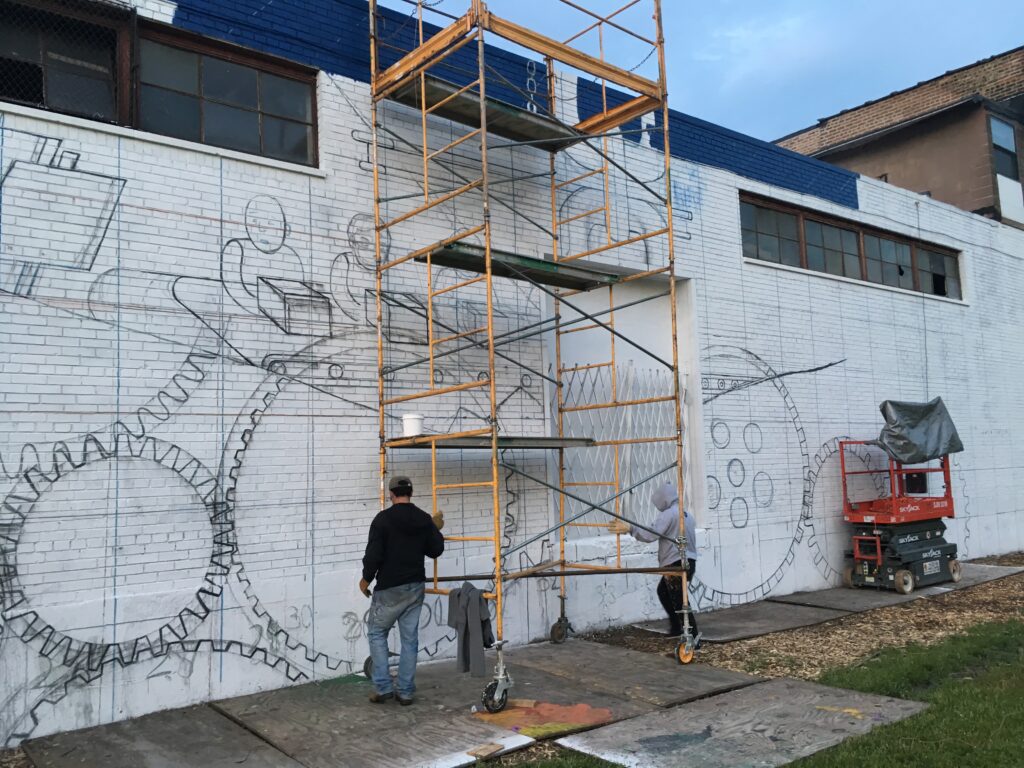
A large-scale mural also needs to be a group effort. Like Castillo, Solis recruited teenagers from the neighborhood and paid them to help construct the works.
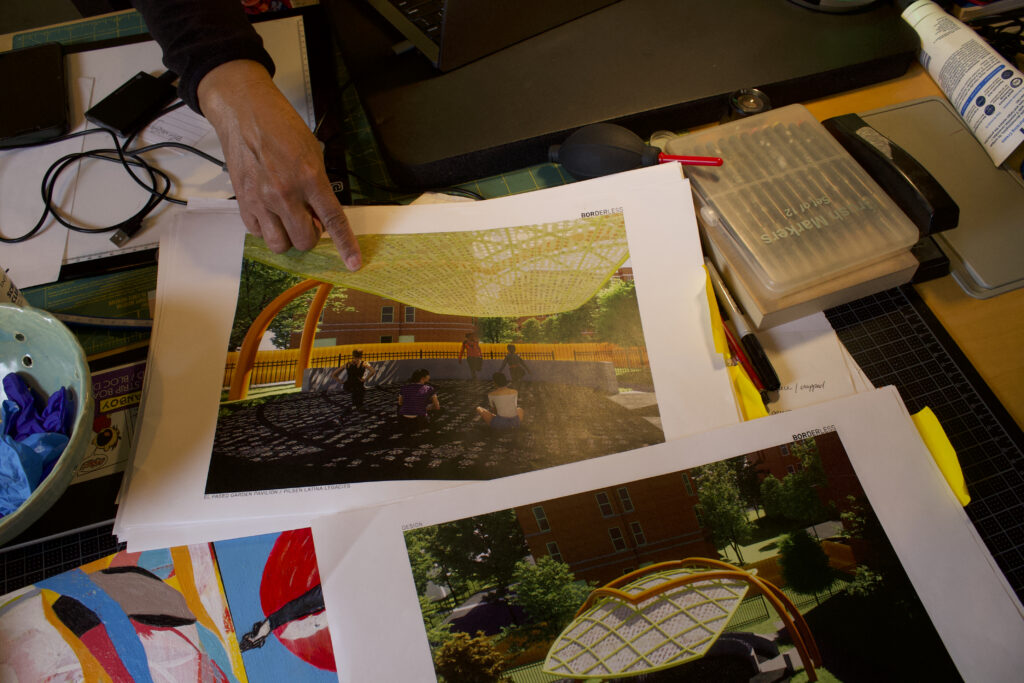
The original Metafisica no longer exists. A few years after its completion, someone cut a window and door into the wall, and eventually it was sandblasted completely, going the way of many public art works that succumb to graffiti, demolitions, or the natural elements. But its legacy is seen in the work of Pilsen artists today. Solis’ upcoming work in El Paso Community Garden is the Pilsen Latina Legacies pavilion monument, designed in collaboration with the community and Teresa Magaña, Hinda Seif, and Deliliah Salgado. When the sun shines on the awning, a pattern hits the ground resembling Mexican paper cutspapel picado.
While the Chicano murals were personal expressions, the political climate of the Soviet Union forced Ukrainian monumental artists to align with state agendas.
During Soviet rule of Ukraine from 1922 to 1991, the political control of arts and culture was violent. In 1924, Ukrainian painter and monumentalist Mykhailo Boychuk opened an art studio in Kyiv after studying in Vienna and Paris. But the Communist regime deemed his formalist style, which drew from Ukrainian folk art, an obstacle to Soviet identity.
“The Soviet Union [was] trying to erase all cultural identity of Ukraine”” said Yevgen Nikiforov, a documentary photographer who has catalogued over 5,000 Soviet-era mosaics in Ukraine.
By the 1930s, almost all artists from Boychuk’s school, including himself, were executed in a wave known as the “Executed Renaissance.” Monumental art subsequently disappeared from Ukraine until the 1960s, when huge amounts of public money were spent to brighten up the hastily constructed sprawl of gray, monotonous housing blocks known as ‘khrushchevkas,’ named after Soviet leader Nikita Khrushchev’s policy to end a severe housing shortage.
The Soviet government poured money into mosaics—images made from thousands of small pieces of stone, tile, and glass. Mosaics have been embedded in Ukrainian culture for centuries; during the Byzantine Empire’s rule of the region, they glittered from the domes of Eastern Orthodox cathedrals. The Soviets liked mosaics for their durability. Unlike paint, state propaganda made from mosaics wouldn’t fade or chip during the brutal winters.
During the 1960s, state-funded artists received prestigious commissions, steady employment, studios, and apartments. In exchange, they submitted every proposal for approval. Approved commissions followed hard rules: no religious themes, no capitalist imagery, no abstraction or anything non-representational. Everything had to celebrate Communist ideals of optimism, labor, collective spirit, science, and industry.
During this period, Ivan Lytovchenko, born 1921, created technically masterful state-commissioned mosaics across Ukraine, and found subtle ways to embed Ukrainian folk motifs within approved designs. The medium itself offered flexibility—mosaics’ pixelated form, made of thousands of rough pieces, lent itself to geometric abstraction.
“When you work with such hard material as stones, there is space for some experiments,” Nikiforov explained, pointing to an almost-abstract mosaic from the 1970s in his book Decommunized: Ukrainian Soviet Mosaics. Communist authorities, he said, still considered that mosaic close enough to socialist realism.
The Soviets allowed some Ukrainian heroes, like the 19th-century poet Taras Shevchenko, to be depicted because they could be reframed as fighters for the working class.
But it was a dangerous game. Rebellious artists who expressed Ukrainian nationalist identity—known as ‘Sixtiers’ (Shistdesiatnyky)—were labeled enemies of the people and arrested, sometimes killed.
These monuments all required a team of architects, steel makers, smalti makers, illustrators, and scaffolding. Soviet rules prohibited crediting individual artists, and works were presented as collective efforts.
“Can you imagine [cutting] glass? This is a very hard job,” said Natalia Lytovchenko, Lytovchenko’s daughter and also an accomplished monumental artist.
Despite expensive materials, technical standardization, and physical durability, the mosaics didn’t resonate with communities the way Pilsen’s murals did. Nikiforov himself walked past six of Kyiv’s largest mosaics daily during his university years and never noticed them.
“Probably it’s their destiny to be like part of this white noise of the city, covered with advertisements,” he said.
Over time, many mosaics have fallen into disrepair. When Russia annexed Crimea in 2014, the Ukrainian government passed a “decommunization law” which called for removal of all remaining Soviet symbols and monuments. Some have been pulled apart by Ukrainians resentful of reminders of Soviet times, which was marked by mass starvation, political persecution, and suppression of Ukrainian identity.
For Nikiforov, Ukrainian identity during those years defies simple narratives. “It’s not only a mosaic, it’s not only propaganda, but art of Ukrainian artists firstly,” he said. He dedicated his book to proving that these mosaics are a valuable, interwoven part of Ukrainian culture.
Since Russia’s full-scale invasion of Ukraine in 2022, the question of what these mosaics mean has become even more charged.
It’s unknown how many of Lytovchenko’s and Natalia’s own mosaics are still standing. Several are now in Russian-controlled territory and subject to near-constant airstrikes and drone attacks. Due to Russia’s restriction of internet and mobile access, it’s difficult for information to get in or out.
Yet something unexpected happened in Mariupol that heartened Nikiforov. Russian forces shelled a restaurant and badly damaged the 1967 mosaic work of Alla Horska, a Sixtier and dissident who was allegedly murdered by the KGB. It was titled Boryviter and depicts a falcon in flight. The Ukrainian group ROZETKA created a replica to display in Kyiv’s central square. Over a thousand fragments of a second copy were also sold to fundraise for the dream of someday restoring the original artwork in a liberated Mariupol, which has been Russian-occupied since 2022.
When faced with total loss and threats to Ukrainian identity, more Ukrainians have begun valuing these art pieces as expressions and keepers of their identity.
Even when originals are destroyed, people revive them in other ways, teaching the techniques to new generations as Solis and Natalia do, recreating them in another mural, or documenting them for digital archives like Nikiforov.
For decades, Natalia has protected and championed her father’s surviving works and sketches, exhibiting them throughout the world, including in the United States. Today, she teaches at Boychuk Academy (Mykhailo Boychuk Kyiv State Academy of Decorative and Applied Arts and Design), named after the same founder who was executed. Her curriculum is old school: students start with studying and copying the Byzantine masters.
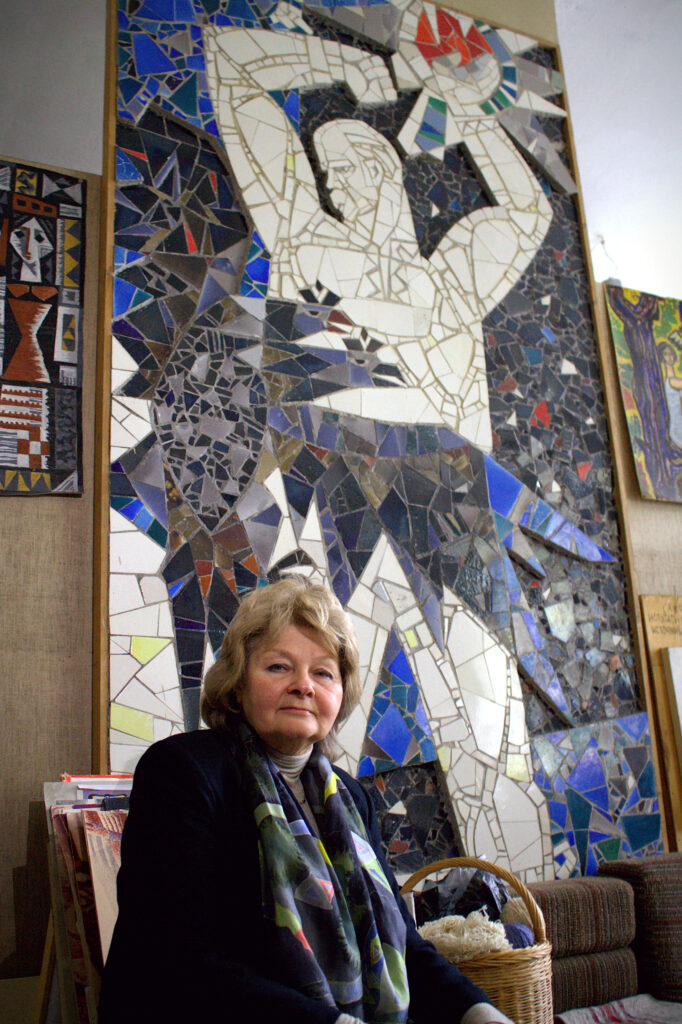
“We have to study a lot of Ukrainian [ornamentation] and you receive a lot of information. [Eventually] you wouldn’t need to have to copy this. You’ll have it inside, in your heart,” Lytovchenko said. She is hoping the war ends soon so that Ukraine can begin reconstruction, which she believes will create more jobs for her students.
In Pilsen, Metafisica may be gone, but the numerous newer murals still stand.
“[Murals are] still happening. We’re still strong in terms of creating culture and venerating our culture and commemorating our culture through murals in Pilsen,” said Solis.
That momentum is being tested. The Trump administration has cut funding to progressive arts organizations, including Chicago’s Department of Cultural Affairs and Special Events, and intensified immigration enforcement in communities like Pilsen. Solis recognizes what’s at stake, but chooses to not stay silent.
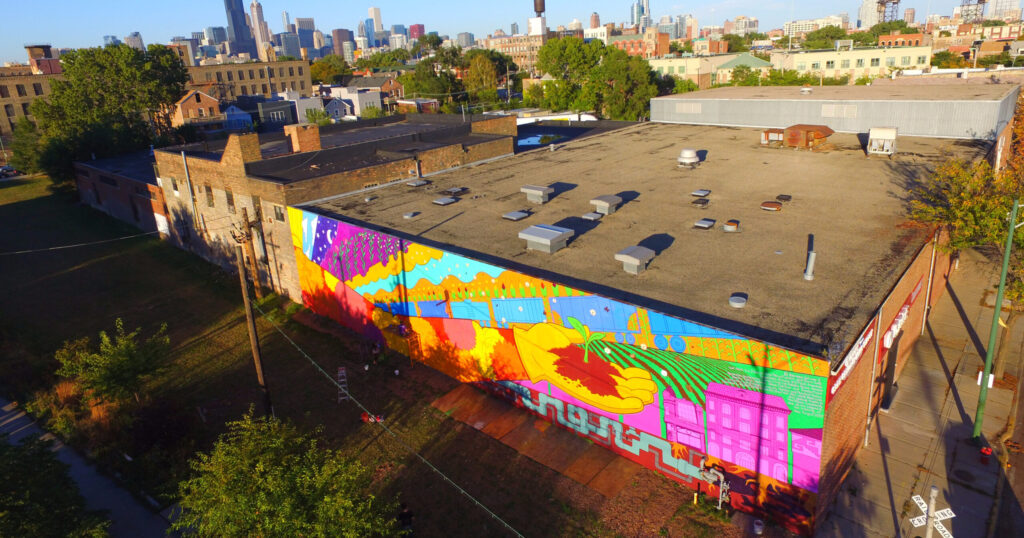
“If we stop or tend to hole ourselves up in our studios to be safe and not say anything about what’s happening, it’s still going to affect us,” Solis said. “If we decide we’re not going to say anything and just go along with it, then it’s really going to disappear.”
Wendy Wei is an independent journalist and audio producer covering migration and interracial solidarity. She is the Investigative Project on Race & Equity’s training coordinator.