
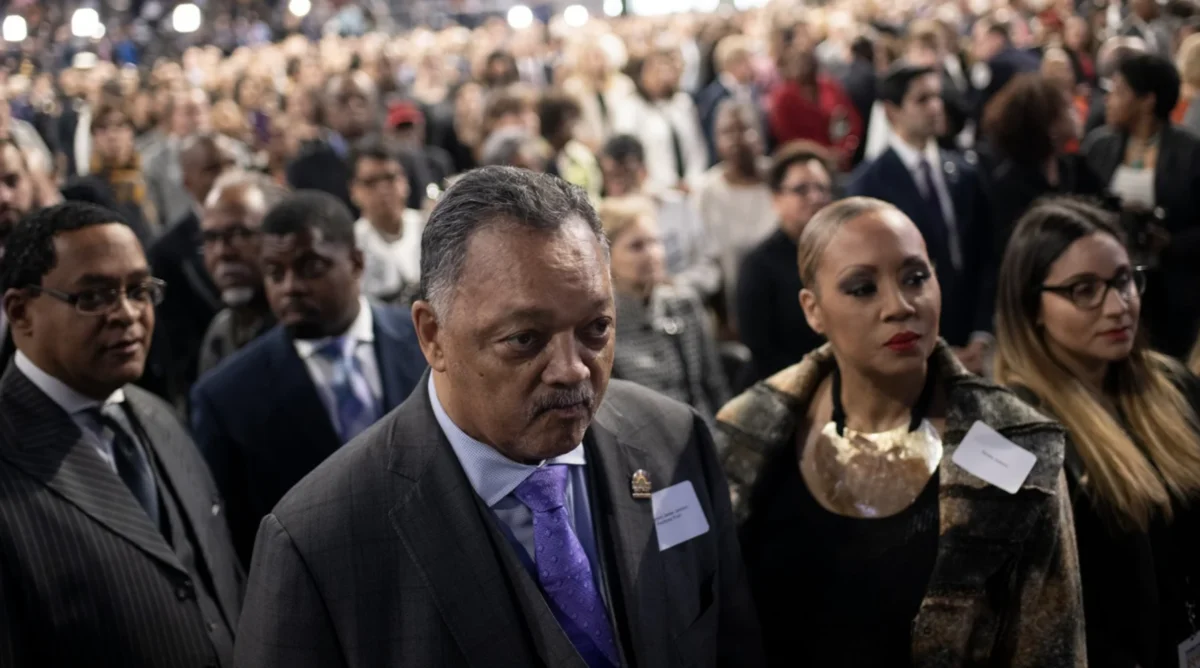
This story was published in the Hyde Park Herald.
Rev. Jesse Jackson Sr., the impassioned voice of a “rainbow coalition” of the poor and dispossessed, a two-time presidential candidate and a civil rights icon who rose to become one of the country’s most influential Black political figures, died at his home February 17 with family close at hand. He was eighty-four.
“Our father was a servant leader—not only to our family, but to the oppressed, the voiceless, and the overlooked around the world,” his family said in a statement. “We shared him with the world, and in return, the world became part of our extended family. His unwavering belief in justice, equality, and love uplifted millions, and we ask you to honor his memory by continuing the fight for the values he lived by.”
Jackson had been dealing with Parkinson’s disease since 2017 and was diagnosed last year with progressive supranuclear palsy, a rare and severe neurodegenerative condition. He was briefly hospitalized in November.
He rose to national prominence after Rev. Dr. Martin Luther King Jr.’s assassination in 1968 and ran for president twice, long before former President Barack Obama’s election in 2008. While he didn’t match King’s commanding stature or Obama’s ultimate political triumph, through the combined strength of his rhetoric, energy and ambition, Jackson became a moral and political force all the same.
Jackson was born Jesse Louis Burns in 1941, in Greenville, South Carolina. He was the son of Helen Burns, a sixteen-year-old high school majorette and sharecropper’s daughter, and her married next-door neighbor, a thirty-three-year-old ex-boxer who took no part in Jackson’s upbringing. Burns married Charles Jackson in 1943, and Charles formally adopted Jesse in 1957, giving Jackson his surname. Jackson had said the taunts he endured in his boyhood over his out-of-wedlock birth propelled his aspirations.
After excelling as a student and athlete at Greenville’s all-Black Sterling High School, Jackson enrolled at the University of Illinois Urbana-Champaign on a football scholarship. But he soon transferred to North Carolina Agricultural and Technical State University in Greensboro, a historically Black institution where he became student body president and fell in love with Jacqueline Lavinia Brown, whom he married in 1962.
Stunned by the beating of demonstrators in Selma, Alabama, he organized fellow students at the Chicago Theological Seminary, where he had enrolled after graduating from Greensboro in 1964, to travel south and join the protests. There, marching for voting rights, he met King and joined the Southern Christian Leadership Conference (SCLC).
In 1966, King tapped Jackson to lead the Chicago chapter of the SCLC’s Operation Breadbasket, an economic justice campaign that mobilized Black churches to pressure businesses to hire and promote Black workers. Jackson was with King and other civil rights leaders when King was fatally shot in Memphis in 1968. His conduct in the immediate aftermath, including appearing at a Chicago City Council memorial with what he said was King’s blood on his shirt and stating King died in his arms, drew criticism from members of King’s inner circle, who disputed his account of the moments after the shooting.
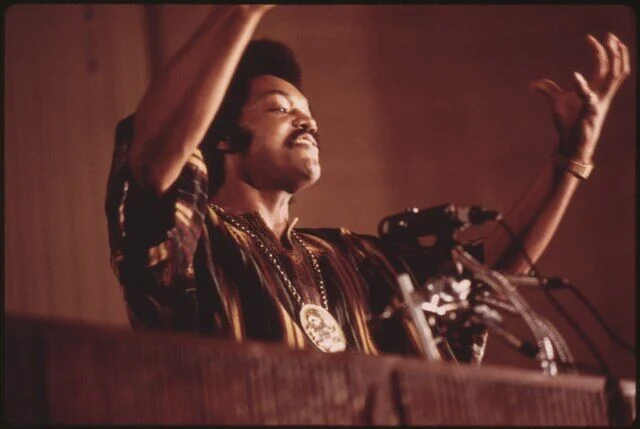
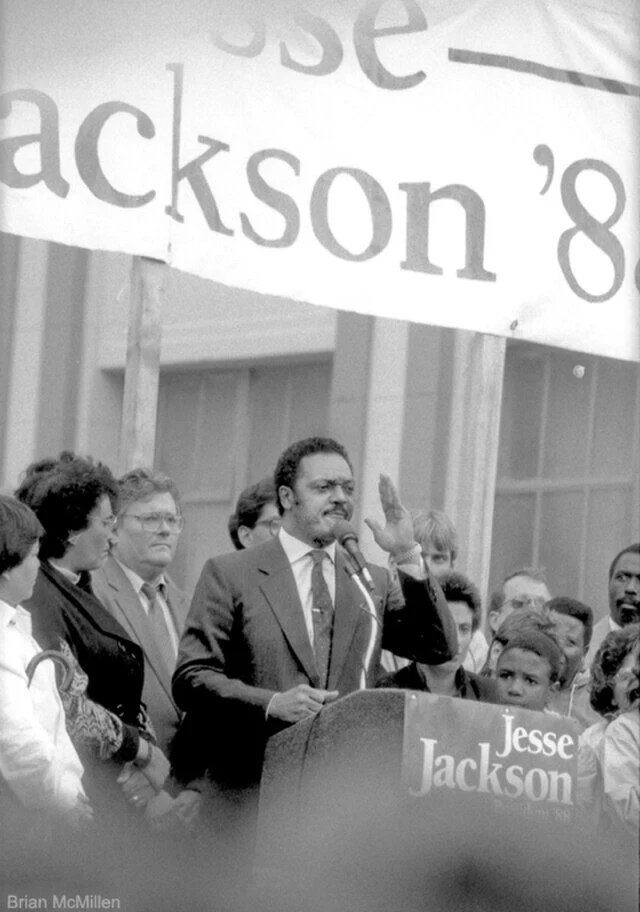
In 1971, after disputes with the SCLC’s new leadership, Jackson founded Operation PUSH (People United to Save Humanity), operating out of a former synagogue at 920 E. 50th St. in Chicago’s Kenwood neighborhood. Through PUSH-led boycotts and negotiations, he pressured major corporations, including Anheuser-Busch and Coca-Cola, to invest in Black communities and hire minority workers.
Jackson later merged Operation PUSH with his National Rainbow Coalition, which sought to unite Black voters with labor, farmers, immigrants, the poor and other marginalized groups around shared economic concerns—a vision that reshaped Democratic coalition politics for decades and helped power his presidential bids. The merger created the Rainbow PUSH Coalition, which remains headquartered in Kenwood.
Jackson’s presidential campaigns in 1984 and 1988 announced to the country that a Black candidate could be a serious contender for the country’s highest office. (Shirley Chisholm, a congresswoman from Brooklyn, was the first Black presidential candidate in U.S. history, but failed to garner much support in the 1972 Democratic primaries.)
Running on a populist agenda that challenged Reagan-era policies, Jackson called for full employment, universal health care, expanded social programs and greater domestic investment, arguing that workers, farmers and the poor of all races shared common economic struggles.
In 1984, fueled by Black voters he had helped register in historic numbers across the South, Jackson garnered 3.2 million primary votes, about 18 percent of the total. In 1988, his progressive grassroots campaign earned nearly 7 million votes, winning thirteen of fifty-four contests, including a landslide over eventual nominee Michael Dukakis in Michigan.
Though he never secured the nomination, Jackson changed party politics. After the 1988 campaign, he helped push the Democratic Party to replace its winner-take-all delegate system with proportional allocation, a rule change that would later benefit Barack Obama’s 2008 campaign.
Jackson’s galvanizing speech at the 1984 Democratic National Convention in San Francisco remains one of the towering pieces of American political oratory. In it, he described America not as a racially homogenous blanket but as a quilt of “many patches, many pieces, many colors, many sizes, all woven and held together by a common thread.”
“The white, the Hispanic, the Black, the Arab, the Jew, the woman, the Native American, the small farmer, the businessperson, the environmentalist, the peace activist, the young, the old, the lesbian, the gay and the disabled make up the American quilt,” he said.
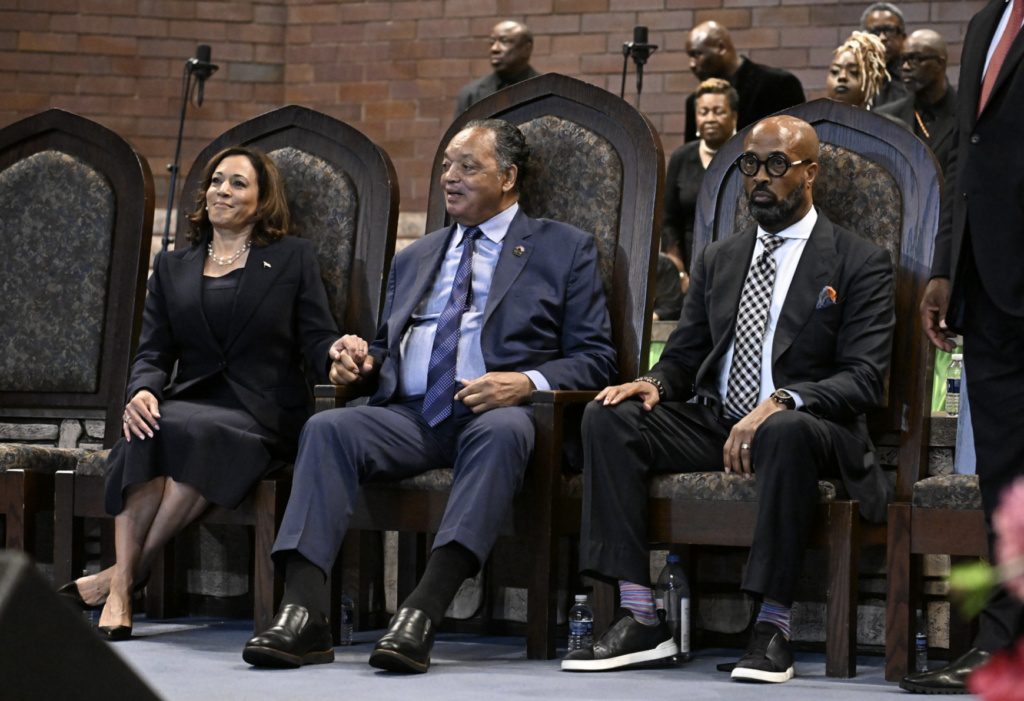
Jackson concluded his 1988 convention speech in Atlanta by shouting “Keep hope alive!” four times, which would become his organization’s signature catchphrase.
In recognition of his public service, Jackson was awarded the Presidential Medal of Freedom in 2000.
Jackson was also a fixture of Chicago civic life for more than half a century, living with his wife in the South Shore neighborhood and making the city his base even after brief stints in Washington, D.C.
Two of his sons, Jonathan and Jesse Jackson Jr., would end up back in Washington as congressmen representing South Side districts, but Jesse Jackson Jr. would resign from Congress while under federal investigation in 2012 for misusing $750,000 in campaign funds. In the waning days of the Biden administration, Jackson sought a pardon for Jesse Jackson Jr., comparing his son’s plight to that of the president’s son, Hunter Biden.
Mayor Brandon Johnson, who credited Jackson with encouraging his own rise from a Chicago Teachers Union organizer to public office, called him “an architect of the soul of Chicago” when Jackson stepped down from leadership of Rainbow PUSH in 2023. His third son, Yusef, now runs the organization.
“Through decades of service, he has led the Rainbow PUSH Coalition at the forefront of the struggle for civil rights and social justice. His faith, his perseverance, his love, and his relentless dedication to people inspire all of us to keep pushing for a better tomorrow,” Johnson said.
Even after Jackson’s health began to deteriorate in the late-2010s, he remained publicly active. He spoke at demonstrations following the 2020 killing of George Floyd in Minneapolis and was arrested in Washington in 2021 while protesting Republican efforts to restrict voting rights. As recently as Christmas Day 2024, he was shaking hands with inmates at Cook County Jail after the Rainbow PUSH Coalition’s annual holiday service there. Jackson was also an outspoken supporter of Palestinian rights, for decades amplifying calls for Palestinian self-determination and calling for a ceasefire amid Israel’s recent war on Gaza.
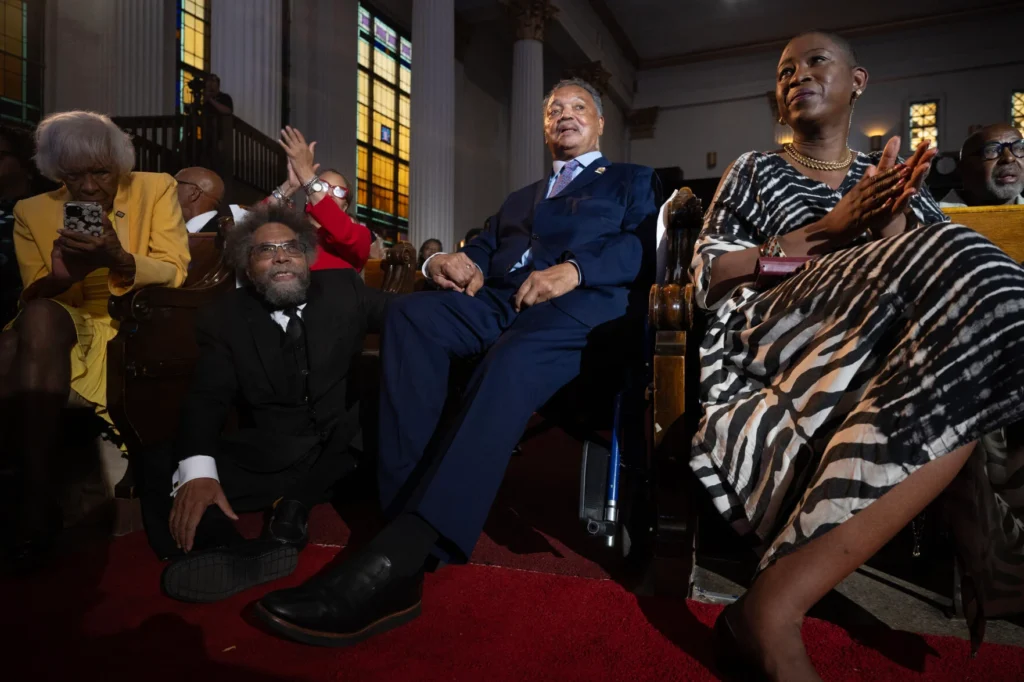
Following news of Jackson’s death, Barack and Michelle Obama released a statement on X commending Jackson for his lifetime of public service.
“For more than sixty years, Reverend Jackson helped lead some of the most significant movements in human history,” the Obamas said. “He was relentless in his belief that we are all children of God, deserving of dignity and respect.”Jackson is survived by his wife, Jacqueline, his children Santita, Jesse Jr., Jonathan, Yusef, Jacqueline and Ashley, and his grandchildren. Public observances will be held in Chicago, with final arrangements to be released by the Rainbow PUSH Coalition at jessejacksonlegacy.com.
Max Blaisdell is a staff writer at Hyde Park Herald.