
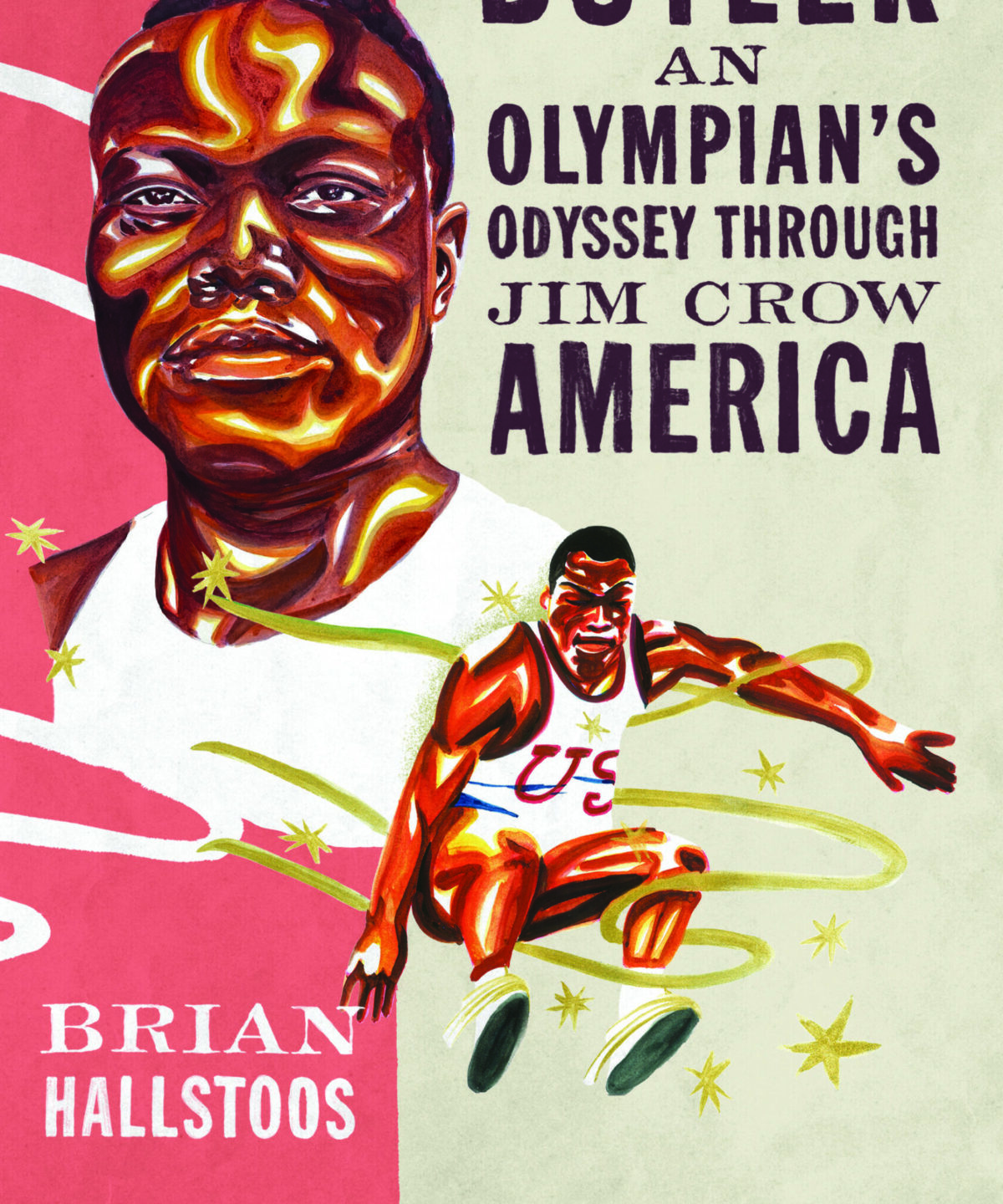
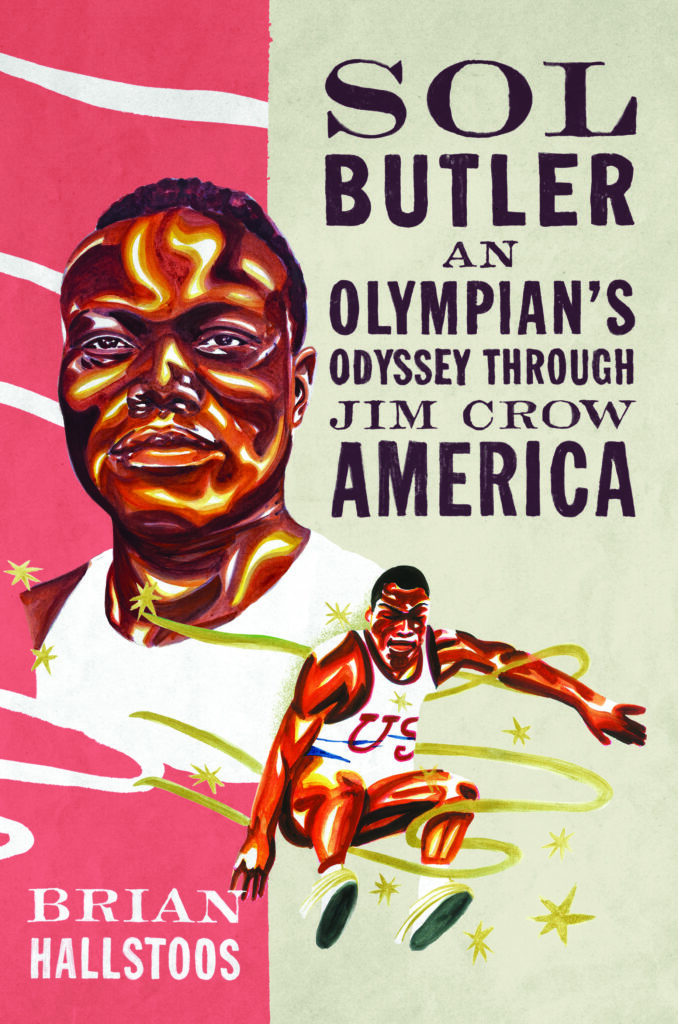
Perhaps the most telling sentence in Sol Butler: An Olympian’s Odyssey through Jim Crow America is the first one: “In 1919, only days after being shackled by younger classmates in a college prank that evoked the specter of American slavery, Sol Butler began a journey that would bring him international fame.”
That summer, Butler headed off to Paris to represent the United States in the Inter-Allied Games, his ankles still sore from the shackles that had to be sawed off before he could compete for the nation in which his father had been a slave.
As upside-down as it might seem, that first sentence does reflect the world Butler lived in. But a lot happened along the way. Although he continued to pursue personal athletic success as his abilities diminished with age, he moved beyond impressive achievements in athletics to a broader impact on his community, especially coaching, mentoring, and counseling boys and young men in Chicago.
But that came later. First came his Olympics appearance.
The Inter-Allied Games (or, as they were also known, the Military Olympics) were founded to keep World War I allies busy and motivated while they waited to return home after the Great War. Butler had great success. “He leaped to a commanding first-place finish in the broad jump,” Hallstoos writes. “Already a Midwest celebrity, Butler quickly became known around the world.”
A year later, in qualifying for the U.S. 1920 Olympics team, Butler set an American record in the broad jump. But sensing an opportunity, the Olympic Committee then told Butler to “make one try for the world record,” Hallstoos notes, quoting a Boston Globe story. “He couldn’t refuse,” Hallstoos continues, “and the one extra jump proved to be fateful: Butler pulled a tendon, an injury that would cast a long shadow over his first and last Olympics.”
The injury did a lot more than cast a shadow. It blotted out the sun, ultimately preventing Butler from even completing the 1920 Olympic trials in Belgium. In his first attempt, he landed badly and he “lay on the ground writhing in pain,” according to the New York Tribune. After passing up all the rest of his jumps to try one last time, the Baltimore Afro-American wrote, “His best effort was a bunny hop of not more than ten feet.” The New York Herald had the final word: “The American champion collapsed and retired crying.”
It was a tremendous disappointment for a highly accomplished athlete like Butler, who became a sensation early in his life, once scoring seven touchdowns in a high school football game.
But he pressed on throughout his career, playing against and coaching all-Black, mixed-race, and female teams in several sports. George Halas, as a player-coach of the Chicago Bears, for example, was a competitor and later a business associate. Butler clearly attempted to leverage his fame as an athlete into an entrepreneurial business career and had some success.
We don’t know from the book that Butler crossed paths with the legendary Abe Saperstein, founder of the Harlem Globetrotters, but their paths were similar in at least one way: they were both “barnstorming” the Midwest with their respective basketball teams around the same time. Butler had founded and trained the all-female Harlem Globe Trotterettes. He also served as manager and coach of other female teams.
The book was fittingly published last month, just in time for this year’s Black History Month. In 228 pages of narrative and 1,028 notes across seventy-six pages of back matter, University of Dubuque (Iowa) history professor Brian Hallstoos relates what seems to be nearly all of what happened in unrelenting detail. The publisher describes the book as the “story of a Black athlete’s canny use of mainstream middle-class values and relationships with white society to transcend the athletic, economic, and social barriers imposed by white supremacy.”
A gifted athlete and diligent student-journalist from Hutchinson, Kansas, Butler had studied his sport and in high school even published a book with his brother, Ben, in 1915. Three Years of High School Athletics contains photos of races with instructive captions, hinting at the post-performance career he would have as a manager and coach. Here the brothers explain how to win a fifty-yard sprint: “Give every ounce of strength from the very start, hurling yourself at the tape when nearing the finish.” For the hundred-yard dash, then known as “the century,” the start “should be as quick as possible [and] the chest muscles should be relaxed until within fifteen yards from the finish.” The winner in each photo looks a lot like Sol.
Butler made the most of other talents as well: songwriter, singer, dancer, actor, and social activist, to name a few. They brought him into contact with such notables as Louis Armstrong and Paul Robeson, a Black superstar performer in his own right, who most famously starred in the original Broadway production of Showboat. Butler also appeared in at least one movie with Mae West, in 1935.
Hallstoos uses these details (and an abundance of research) to tell Butler’s story in meaningful and imaginative ways, with a goal of communicating the Black experience Butler lived. Each of the eleven chapters, including the Warm-Up (introduction) and the Cooldown (conclusion) opens with a few bars of a musical score—“musical epigraphs,” Hallstoos calls them—to “evoke the cultural landscape Butler occupied in ways that words cannot.” Hallstoos sees them as testifying to “the strength, depth, and richness of African American culture.”
They also pay tribute to the importance of Butler’s life outside athletics, especially music and stage performances. After the bombing of Pearl Harbor in 1941, for instance, Butler wrote the song “We Are Ready Uncle Sam” with well-known Black vaudeville singers Alberta and Alice Whitman.
Butler’s violent death in a shootout at a Chicago liquor store and bar, Pappy’s, at the corner of 47th St. and Cottage Grove Ave., came about because of his character and sense of responsibility.
Pappy’s was just a few blocks north of Washington Park, which Hallstoos describes as “near the heart of Black Chicago’s business and entertainment district.” A reporter for the Windy City Chatter wrote that Pappy’s was “one of the most popular spots on the south side” because it boasted “two of the nation’s top bartenders,” one of whom was Sol Butler. He was still a draw, and still, in the eyes of one South Side writer, a champion.
On November 30, 1954, a wintry, hazy Tuesday night, a drunk man “stumbled in” and began harassing two women, one a waitress. Butler, Hallstoos writes, echoing the now-quaint-sounding language of the times, “reprimanded” him and “asked him to leave,” according to witnesses. The man vowed to return and, to everyone’s surprise, did just that a few minutes later. He “kicked the tavern door open and began firing a .45 automatic at Butler,” striking him in several places, including his chest. Butler then “grabbed a revolver … and returned fire” along with another bartender. They “shot [the man] several times.”
Both Butler and “the crazed gunman” died the next day, Butler at Provident Hospital and the shooter at Cook County Hospital. At fifty-nine, and despite “daily confrontations with injustice,” Sol Butler—the Olympian, the sportsman, the humanitarian—had come to rest.
Brian Hallstoos, Sol Butler: An Olympian’s Odyssey through Jim Crow America. Paperback $27.95. University of Illinois Press, 2026. 304 pages.
Scott Pemberton is the Weekly’s public meetings editor.