
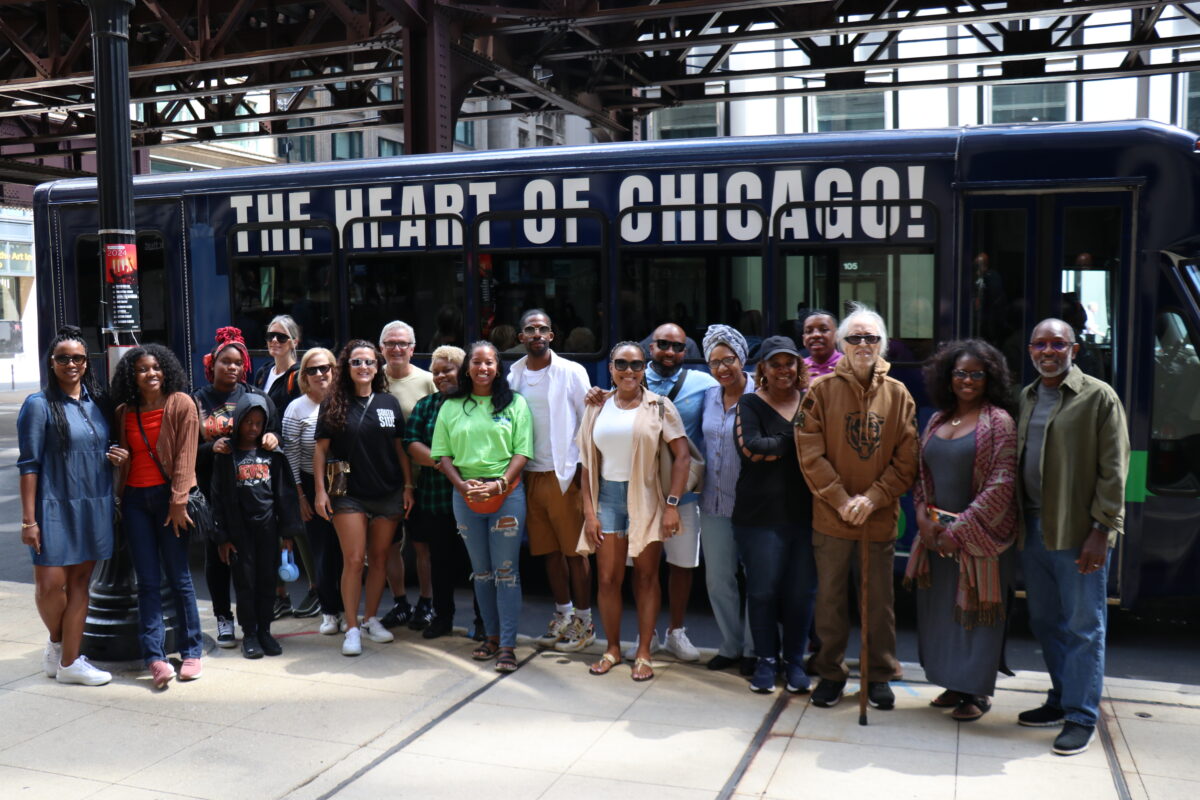
When Angela Dugan founded South Side Tours, she wasn’t just launching a business—she was creating a moving oral history project on wheels. Since rolling out its first official tour in August 2024, Dugan says South Side Tours has hosted about fifty more, introducing mostly out-of-town visitors to the neighborhoods, landmarks, and cultural history that rarely make it into mainstream news cycles and day-to-day narratives.
With a background in television production and inspired by a family trolley ride for her grandfather’s ninetieth birthday, Dugan has built her tours around real voices and real stories. Riders hear firsthand accounts of South Side history as the tour bus moves through historic corridors like Bronzeville, Woodlawn, Washington Park, and Back of the Yards, turning each stop into a living timeline of the Great Migration, Black culture, and community.
The tours start downtown at the Palmer House Hilton, then travel south past major cultural landmarks—from Quinn Chapel to the Obamas’ home, Emmett Till’s house, and the former Robert Taylor Homes. In this Q&A, Dugan talks about how a birthday trolley ride turned into a mission-driven business, why oral history is at the heart of her tours, and how she’s using storytelling to change perceptions of one of Chicago’s most culturally rich areas—the South Side.
This interview has been edited for length and clarity.
How would you describe South Side Tours, and how did it get started?
I would describe South Side Tours as if you’re seeing the South Side through the eyes of those who lived it. I spent years interviewing South Siders and had been ideating South Side Tours for over a decade. I got the idea and the push to do it in 2014, but I was working as a vice president of a production company, and I was living in L.A., so it was just something that I was going to do one day.
And so marrying the thought of showcasing the people from the South Side and telling their stories with the tour really didn’t become a part of the plan until I actually moved back to Chicago in 2021.
I was separately putting my family’s stories on tape so that we could have them, and I realized it’s so much better to hear them tell their stories than me regurgitating their stories. I just wanted people to leave the tour and feel like, “Okay, I just hung out with a couple of South Siders for an hour or two, and they’re some cool folks.”
What inspired you to create South Side Tours?
The inspiration came from a multitude of places, but I would say the seed was planted with Isabel Wilkerson’s book, The Warmth of Other Suns. I read that when it came out in 2010, and it took me longer than usual to read. I was reading this book and coming to work, and I was angry. I had to put it down and read it gradually.
What I loved about the book was it reminded me of the stories of my family. We’ve always talked about the Great Migration; I’ve spent summers in the South. My family is from Louisiana, Alabama, and Arkansas. It was really cool to read this book where these different stories were woven together with the history of the times as well.
There was a section of Isabel’s book where it talked about how the lynchings in Florida were just so gruesome compared to the rest of the South. And so to have my granddad, who lived in Alabama during that time, say, ‘Yeah, we went to Florida once, but you always knew you didn’t want to stay in Florida long,’ just things like that.
I went to college in New York, then came home for a summer, worked on Obama’s first campaign, and then right after the election, I moved to L.A. to start my career, or continue with my career. And whenever I would come to Chicago, I would just see how much things were changing, and the things that my dad used to say growing up, because every car ride with him was a South Side tour. Now I’m coming home, and I’m like, “Wait, what happened to Moo & Oink and everything?”” That was the seed, and it just continued to grow.
So for my grandfather’s ninetieth birthday, my mom was like, “Okay, we’re gonna throw him a party, rent an event space.” And I’m like, “Mom, grandad can barely walk. Let’s just—” and I don’t know where this came from, but I said, “Let’s rent a trolley and let’s go around to the places that were special to him in his life,” because I did know that being older, memories become even more important.
I had a friend from L.A. in town, and she came with us, and she said, “You need to turn this into a business.” She said, “I don’t even know your grandfather, and I’m scared of the South Side, but now I feel better about the South Side.” That was 2014 when that happened, and I was like, “Okay.”
What’s the tour bus like? Is it handicap accessible?
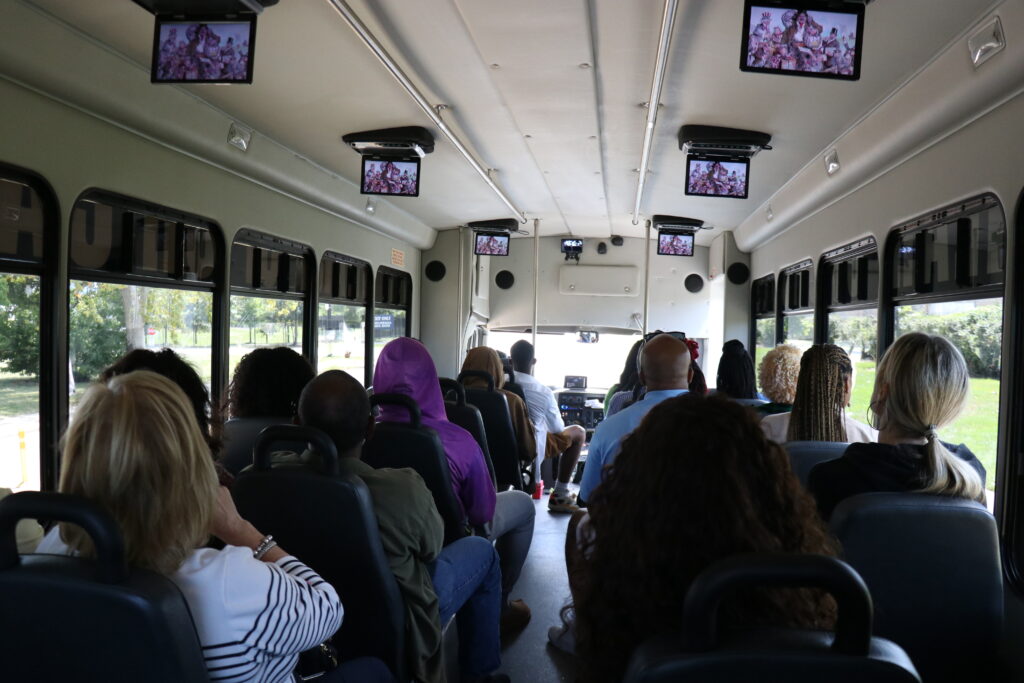
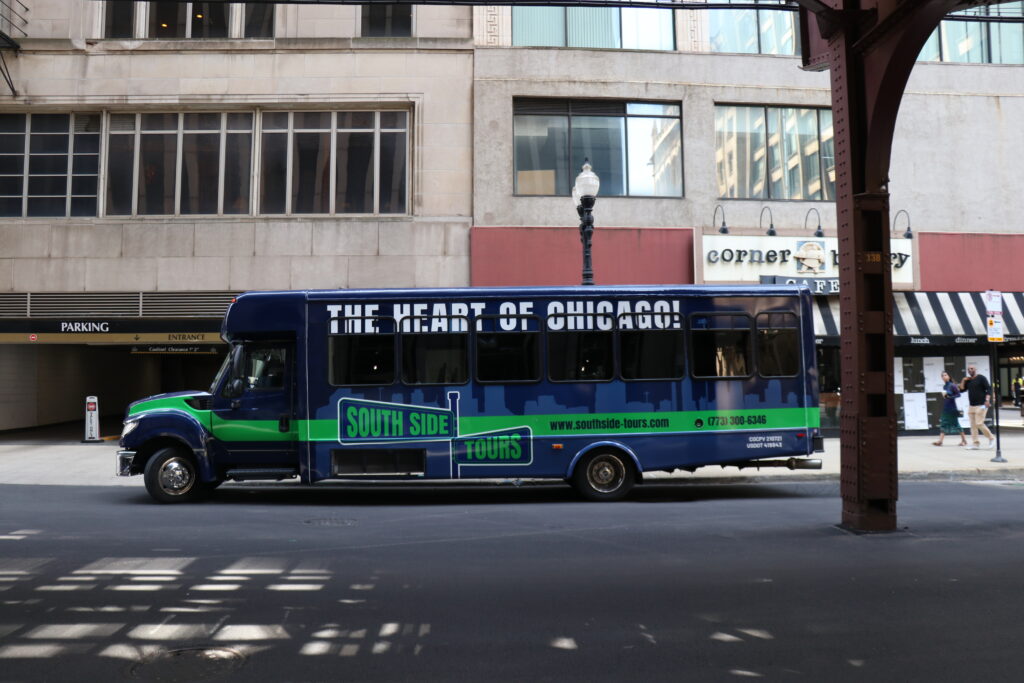
The bus seats thirty. I max the tours out between twenty-four and twenty-six because we have a wheelchair lift. We’re ADA compliant.
We have technology on the bus where, depending on where you are GPS-wise, it will trigger a story or a video. So when we ride down 63rd, you’ll hear people talking about growing up in Woodlawn in the ’60s.
When we go through Washington Park, that’s when people kind of talk about the Bud Billiken and being on the South Shore Drill Team and things like that.
Where does the tour go?
That tour started in front of the Palmer House. The demographic was people like my friend that day—people who are afraid of the South Side, people who aren’t from Chicago [and] don’t really know anything about the South Side. I wanted to catch them where they were, and I know they’re downtown. So we start at the Palmer House.
As we make that drive down Wabash to get to Quinn Chapel, you meet a series of people telling you about their story, which is mainly the Great Migration story, and of course, we give a nod to the Natives who were here prior to Jean Baptiste Pointe DuSable coming. So by the time you get to the South Side, you kind of have an idea of this Great Migration that brought so many of us to this part of the city.
And so we go through Bronzeville. From Bronzeville, we go to Kenwood. We go past Elijah Muhammad, Louis Farrakhan, and Muhammad Ali’s homes. We go up the 53rd Street commercial corridor, pointing out all those businesses, talking about the University of Chicago, and kind of their history in the area. Of course, we go past the Obamas’ house—that’s everyone’s highlight. That tour was like two hours and forty-five minutes.
From there, we go through Washington Park, through Woodlawn, to Emmett Till’s house. We go past Parkway Gardens. And I love seeing people’s faces when we talk about Michelle Obama living there, what that land used to be—a whites-only amusement park. And we go past the old Robert Taylor Homes, which is probably my favorite, because that’s where you really hear from people who lived in the Robert Taylors and what it was like. I have a woman who represents a family that was one of the first families, and then someone who was there twenty years after her, and their experiences are completely different.
Then from there, we go past the stockyards, through Bridgeport, and come back around and see Comiskey Park and back to the Palmer House.
How do you choose your tour stops?
The oral history informed my route. What I had people talking about, that was very profound, informed that.
My grandfather was a butcher in the stockyards, and I also interviewed a family that grew up in Back of the Yards in the 1950s, so I kind of interwove those stories together. I don’t know how much people catch it, but based on the conversations we have after the tour, I think they do.
I’m always trying to draw parallels between then and now, because the stockyards are just so interesting to me—the evolution of Back of the Yards, the stockyards, and how it’s similar to workforce culture in Chicago today. You have different ethnic groups working together in the same industry. That really mirrors what we see now, and of course, you want to make sure you hit the hotspots like the Obama home and Comiskey Park. So that’s really how the route came together.
Would you describe this as a family business?
My father passed away last year, and I’m so glad he got to experience the tour before he passed. He’d be like “Is Chicago that interesting? Is the South Side that interesting? Is that interesting for a tour?” But, I mean—yes. Now that I’m thinking about it, it is a family business. Even if everybody ain’t on payroll, they’re chipping in.
What is typically the reaction of people after they’ve gone on one of your tours?
One of my favorite reactions to date was this couple from Houston. The husband said the South Side is so green. He really had an outburst because he [was like] “I didn’t know the South Side had trees.” It’s just crazy. And, several people have said just how green it is, how beautiful the homes are, the buildings [and] the two-flats especially when we go through Woodlawn. People can really appreciate them, and they compare them to the Greenline Homes. They’re not even from here, but they’re like, “What are these Greenline Homes? We don’t want them. They need to do what is already here, you know?” So, they definitely appreciate it. But the biggest thing is that they cannot believe how beautiful it is when we go down State Street, through Washington Park, and past the Robert Taylors—then we have a lot of conversations about food deserts. People notice the difference.
Would you say that the majority of the tour goers are not from Chicago?
Absolutely, yes, they’re from the South. And it’s so interesting, because the Great Migration is talked about so much. I forgot that there were people who stayed. There are so many people who come from the South who never heard of the Great Migration. And I’m like, what? But they’re like, “I’m fourth-generation Floridian.” So they’re from the Carolinas, Texas.
I would say Texas is probably my number one—huge shout out to Houston. I’m always getting people from Houston. But yeah, mainly from the South, and I love it. They’re people who intentionally want to see where Black people live, and that’s how I grew up. My dad was an Air Force vet, but didn’t fly by the time I was born, and we drove everywhere. And I remember everywhere we’d go, we’d do the touristy stuff, and then he’d stop people on the street and say “Hey brother, where do Black people live?” That’s how I get it.
What’s been your biggest challenge?
The biggest challenge is marketing—devoting the time to marketing. Marketing isn’t the challenge, but it’s a beast all on its own, especially now, living in a time where content creation is essential for business.
And then myself, as a trained TV producer, that’s just a whole other conversation. Not to sound foofy, but the thought of, okay, we’re going to shoot something, edit it, and post—we spend three months on one episode. So I’ve had to adjust.
I’m sitting on tons of footage because whenever I bring people on, I don’t like the way they do it, and I’m like, “Alright, I’m doing it myself.” But when you’ve got to do it yourself—you’re writing the scripts, you’re doing the tour routes—the biggest challenge is devoting the time that marketing and social media need.
And also letting go. Releasing some of those responsibilities.
What would you like the takeaway to be for people who go on your tours?
I don’t want to paint a picture like the South Side is perfect, but it’s worth it. It’s how I explain it to people: you have affluent areas of a city, you have middle-class areas, and you have areas that have a greater concentration of crime than other areas. This is a city.
Most people from cities don’t have a hard time understanding the South Side. But for instance, my friend who did my grandfather’s tour way back when—she was from L.A., and I had to give her a little speech because she was afraid of the South Side. But I think it was when we were driving through Beverly, and she was like, “This looks like a movie set. You have to tell people that this exists.”
And of course, when we went through Woodlawn, and I think we went to some parts of Englewood, she was like, “Okay, so this is what I know the South Side to be from TV.” But it’s some of everything.
Even the places where people feel it’s harsh, there is so much history. Your favorite artist is from here. That’s the thing. Everyone wants to applaud what comes out of the South Side through the artistry and creativity, but this is what makes them who they are as artists.
So it’s really about gaining an appreciation and an understanding—not just “Yes, we’re going to see some nice things,” but also gaining an appreciation for the places that aren’t as affluent, knowing how they got there. When people learn about restrictive covenants and redlining, they realize it wasn’t by accident. It was by design.
One of my last questions is, what’s new? Any neighborhoods or new tours planned?
Neighborhoods—I can’t think of any off top that would be new, but we have a food tour coming that I’m actually super excited about, the South Side food tour. So that’s when we come back up in the spring. I really want to debut it when there’s no snow on the ground, so I could also get really great footage. I want to have it out there by April, because it’s done now and it’s ready. And I know my restaurant partners are kind of like, “Okay, when are we doing this?”
How can someone find out more about South Side Tours?
Go on our website and subscribe because our email newsletters give a wealth of info too. Our website is www.southside-tours.com. We are also on TikTok at @southside_tours, same with Instagram and Facebook.
Just in time for Valentine’s Day, South Side Tours will host its “South Side Night Out” bus tour on February 14, 2026. The bus departs at 7 p.m. and returns at midnight. The cost of the tour is $25 plus tax, and tour stops will include Social Sip Bar & Grill, Park Manor 75, and W. Hideaway Lounge. You must be at least twenty-one years of age to participate. Tickets can be purchased on their website.
Dierdre Robinson is a writer and accounting manager in Chicago. She has a BA in Journalism from Michigan State University. She last wrote about the Toro Nagashi Lantern Ceremony for Best of the South Side for the Weekly.