

PJ spent the first night in his new jail cell cleaning it.
“They gave us a broom, so we swept ourselves,” he said. “They gave us some stuff in the spray bottle, but it really was no real good stuff… So we just used our soap. We cleaned the walls, the window area. The bunks had little stuff caked up on them. We cleaned our bunks, cleaned the floor… with our own towels.”
PJ was glad to clean a cell that was dirty but “wasn’t too bad.” In another building of the jail PJ recounts seeing “gooey stuff caked on the walls” and “feces on the floor, on the wall, and stuff like that, spit everywhere.” But in this cell, PJ and his “cellie” (or cellmate) used the broom and spray bottle provided by the jail, but mostly relied on hygiene products they bought from the commissary, such as a towel and hand soap to get their living space clean.
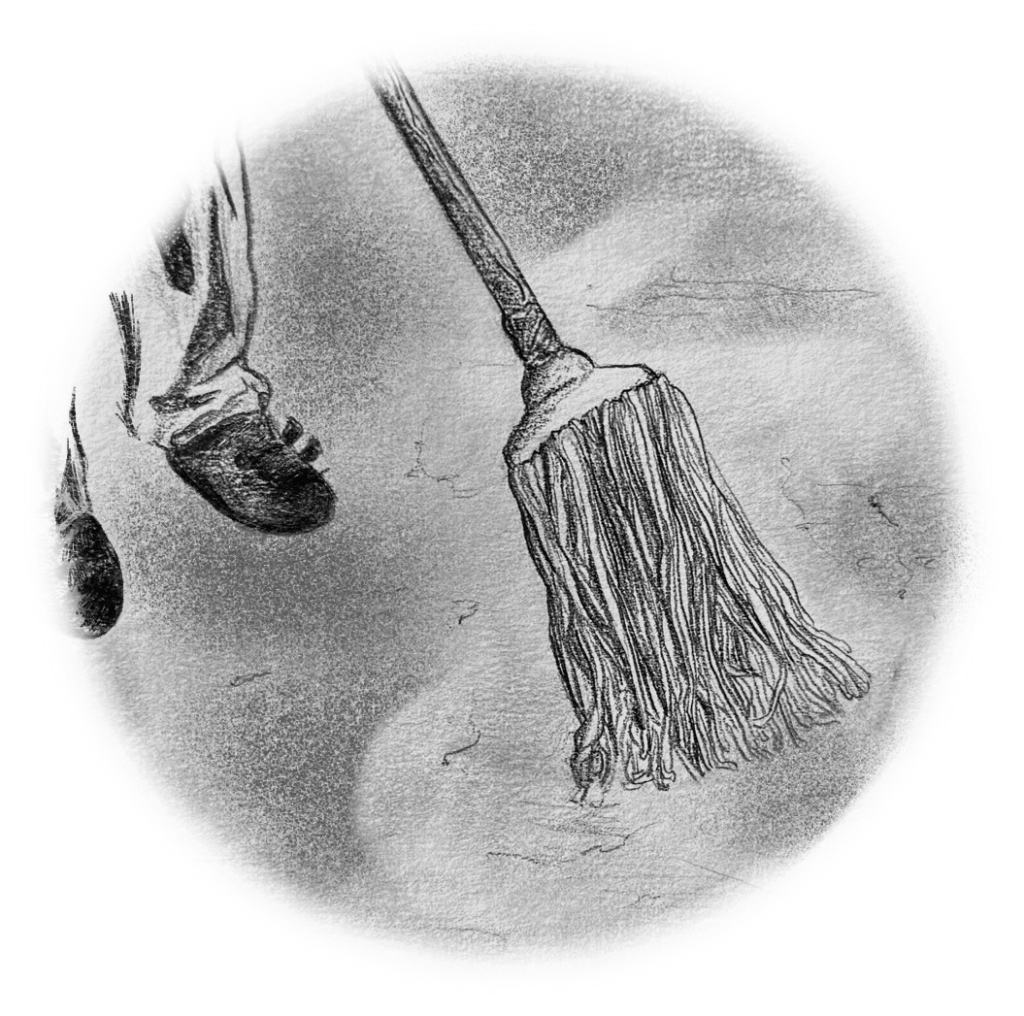
PJ and his cellie were cleaning their two-person cell, which is connected to a forty-eight-person tier. The tier—also called “living unit” or “deck”—is a floor in the jail including cells and a shared “dayroom” living area and bathroom. People are sorted into tiers according to criteria including age, security level, and program access.
Just over 6,000 people are currently incarcerated in the Cook County Jail. Insiders spend part of their time cleaning the jail, their living space. Reporting insufficient supplies, some insiders use their own money, time, and ingenuity to clean the tier.
CLEANING POLICY
The information handbook the Jail provides to incarcerated people says: “You have the right to a clean and sanitary living environment.”
It goes on to state insiders are personally responsible for keeping their cells and common area clean, warning that, “Failure to keep a clean cell can attract bugs and rodents and create an unsanitary environment that could expose you and others to diseases.”
Every insider is tasked with cleaning their cell, but one person on each tier, an “inmate worker,” is assigned the additional responsibility of keeping the common areas in the tier clean. Jail policy states that the “inmate worker” has access to a cleaning cart with supplies including cleaning spray, disinfectant, mop bucket, broom, floor squeegee, four clean rags, gloves, and one deck brush. According to the jail insiders who spoke with the Weekly, correctional officers will also occasionally use their discretion to let other insiders use a vinegar spray bottle to clean, which aligns with jail policy.
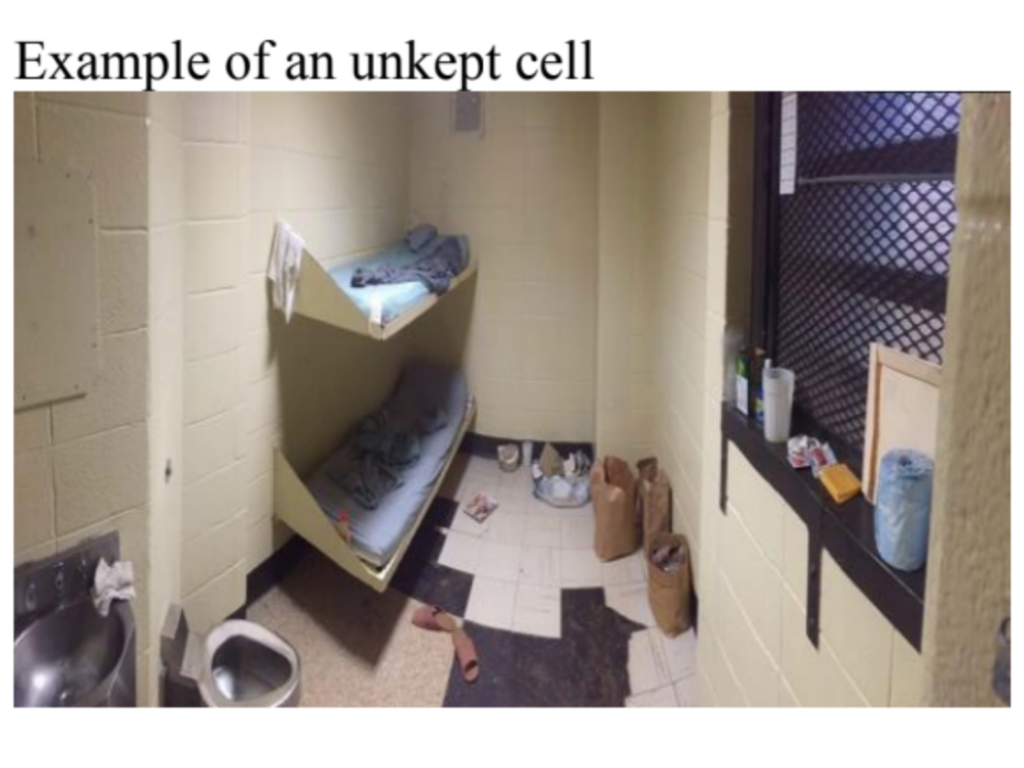
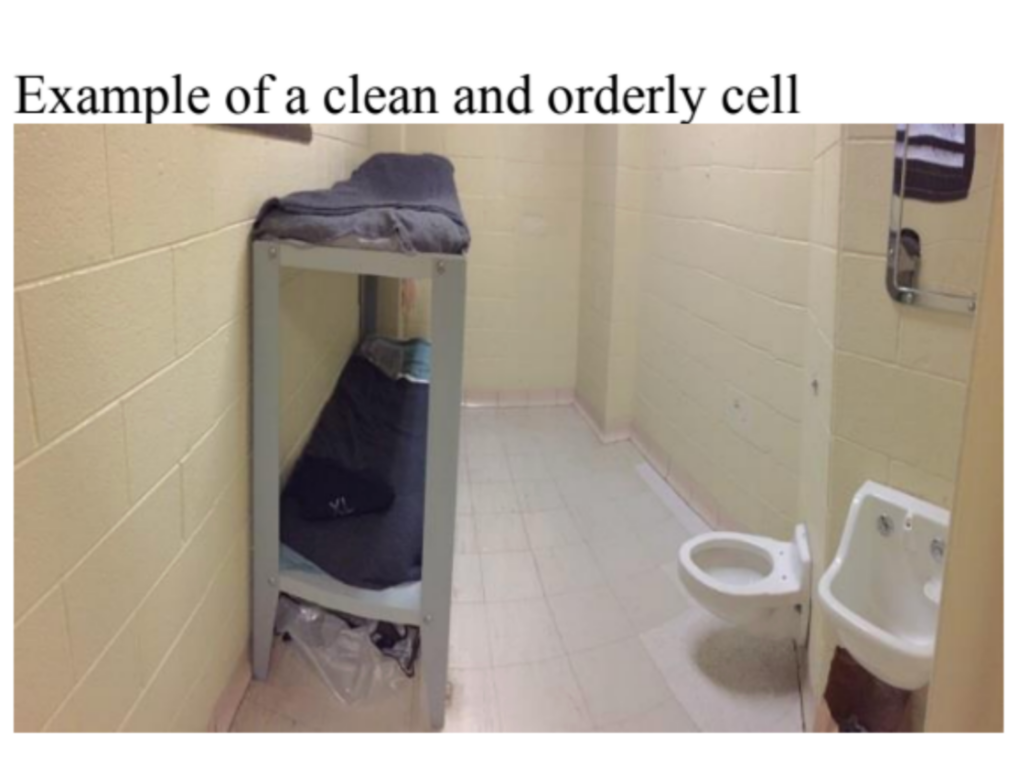
Jailed workers are supervised by sheriff sanitation officers who oversee and inspect the cleaning in their respective divisions of the jail. Sanitation officers supervise how living areas like tiers are cleaned, as well as large, communal rooms called holding cells where incarcerated people who are being moved for court dates, doctor appointments, or on their way in or out of the jail are kept. Incarcerated people employed as building workers are responsible for cleaning holding cells. The incarcerated workers on every tier, four civilian janitors, and supervising sanitation officers are responsible for cleaning the nearly 5 million square feet of Cook County Jail, whose buildings combined are bigger than the area from Millenium Park to Buckingham Fountain downtown.
For Kenan, who has been incarcerated for nearly four years, the cleaning supervised by the sanitation officer and jail-provided cleaning supplies aren’t enough.
“Vinegar water, what does vinegar clean for real for real?” said Kenan. “Vinegar don’t take the mold off the showers. Vinegar not really gonna keep the stains and stuff from off the floor. It’s not gonna make the tier smell any better. You can’t clean up too much with vinegar.”
To clean, Kenan shops at the commissary, spending his own money on cleaning supplies.
COMMISSARY CLEANING SUPPLIES
Jail insiders purchase anything from food to clothing from the commissary while they’re incarcerated, typically with money sent to them by loved ones on the outside. Insiders are permitted to spend up to $125 per week on commissary.
Kenan and PJ don’t know one another, but they described similar strategies for cleaning with commissary purchases.
“Once you wash your body with [the Dove soap] a couple times, it gets real small,” Keenan said. “And you just put it in a cup of water and let it dissolve. Now you keep it in a cup, and you shake it up, get sudsy. That’s what you sweep your floor with, mop your floor with.”
PJ said, “I like to get my floor real soapy when I clean up.”
“It’s not even a regular-size Dove,” Kenan said. “It’s like they shrunk it or something, but there’s probably three washes in a shower there. Then it’s gone.”
In 2025, jail insiders spent around $430,000 on over 159,000 bars of soap, according to a Weekly analysis of documents obtained via a public-records request.
After PJ gets the floor “real soapy” with bar soap suds, he uses a towel purchased at the commissary to scrub the floor.
“Imagine the hotel floor towel, you know, the little ones,” Kenan said. “Not the face type but the little floor towel, foot towel. These are the only towels we can buy. And these towels cost $8.”
PJ uses commissary towels rather than the mops provided by the jail for sanitary reasons. “You don’t want to use the mop once you put that mop on the floor in a shower, bathroom, or the day room floor, or if you put that mop in two, three people’s cells, you ain’t the first person to get that mop,” he said. “We don’t use the mops because once they hit one or two cells, that mop is dirty. They’re disgusting. So we choose our towels.”
Raymond Youngblood understands the importance of cleanliness in jail. Before working as a janitorial shift leader at a Cook County health clinic on the West Side, he spent over twenty-one years incarcerated. He spent his last two months incarcerated in Cook County Jail.
Youngblood explained that to prevent cross-contamination, it is important that mop heads are specific to their area. For example, bathroom mops should not be used outside of bathrooms.
The same goes for towels. Towels at the medical facility are color-coded to indicate use for toilets or sinks. Using a towel on multiple surfaces risks taking bacteria from bathrooms or handwashing into other spaces.
While hospitals and jails expect different levels of cleanliness, these standards are important for any high-volume facility attempting to avoid cross-contamination. Due to insiders being kept in close proximity, infections can spread through them quickly, and disease can be transmitted to surrounding communities by guards and people who’ve been released. In the first months of 2020, Cook County Jail was the country’s COVID-19 hotspot.
A CCSO spokesperson said that “mops are replaced daily,” alongside “the cleaning solutions necessary to disinfect and clean all floors and other surfaces. The tiers are also provided brooms to use in common areas outside the bathroom to avoid cross-contamination.” The spokesperson added that “fresh towels are issued at least twice weekly and additional replacements are available upon request.”
Yet multiple insiders spoke to towels being scarce in the jail, so much so that they use rags multiple times, on multiple surfaces, past the point when the provided and commissary-purchased towels are dirty.

“Why are we donating our towels?” asked Kenan. On his tier, people use commissary purchases and personal property to clean their cells and shared living spaces, tables, chairs, and bathrooms. “Why are we donating to the deck so the deck can get clean? Why are we ripping up our t-shirts so we can wipe off the bathroom stalls and tables?”
Each washcloth costs $2.49 and each towel costs $7.69.
In 2025, insiders spent over $23,000 on 8,484 washcloths and more than $38,000 on over 4,500 towels, according to our analysis.
| Commissary Cleaning Items | Number Bought by Insiders in 2025 | Amount Spent by Insiders in 2025 |
| Ivory Soap | 81,772 | $214,965 |
| Dove Soap | 50,690 | $144,819 |
| Towel | 1,364 | $33,403 |
| Washcloth | 7,407 | $20,357 |
PJ and Kenan avoid using the shared brooms, too.
“We don’t even like using a broom because they sweep the day room with the broom, sweep the bathroom with the broom. Sometimes sweep the shower with the broom. And after that, you don’t want that on your floor,” said PJ.
In place of a broom, PJ uses cardboard off the back of a notebook. He uses the cardboard to sweep the floor first, then uses a towel to mop. To clean his cell, Kenan said, “I got a book […] a crossword book. So I turned that into my broom.”
WHAT IT MEANS TO BE CLEAN
“I to keep a cleaner vibe,” Kenan said. “I ain’t gonna say I live here. I stay here. I’m being housed here. This is where I’m being forced to stay. But this is the area that we are, and we wake up and go to sleep in, and some of us would like it to be clean.”
Youngblood struggled with the mess while incarcerated. He never adjusted to the smells, such as “old poop,” which were distracting to him and made it harder to work.
“You getting up, everything thrown everywhere, you just sitting there,” he said. “Your thoughts don’t even come out right; the way you process things don’t even come out right.” Youngblood adapted by cleaning with supplies bought from commissary and employing strategies to clean himself and his cell learned through trial and error and from other insiders. “I got the knack of cleaning every single day I wake up,” he said. “[If] I get up and clean myself up and it smell good, then I can work out comfortably, I could think comfortably. You refresh.”

“When I came home? Oh my God,” he said “I’m just walking down this aisle with all these choices, smelling these things, vanilla and lemon…. When I’m stepping into these stores, it’s like heaven, I promise you. It’s like heaven because you’ve been deprived, right? You’ve been deprived.”
Micah Clark Moody is a PhD candidate in Sociology at Northwestern University. She has investigated pretrial jailing systems in Michigan, Los Angeles, and Chicago.
Harley Pomper is a PhD student in social work at the University of Chicago. They organize across jail walls to report on carceral injustices and political repression.
Thank you for this article. Is there something deeper here? The soap, towel, and facecloth manufacturers are making a good buck off the insiders. If I understood the article correctly, it appears that the jail is not providing the proper cleaning supplies (just vinegar and water); therefore, the insiders must buy their own soap and towels, which generates additional revenue for the soap and towel vendors.