
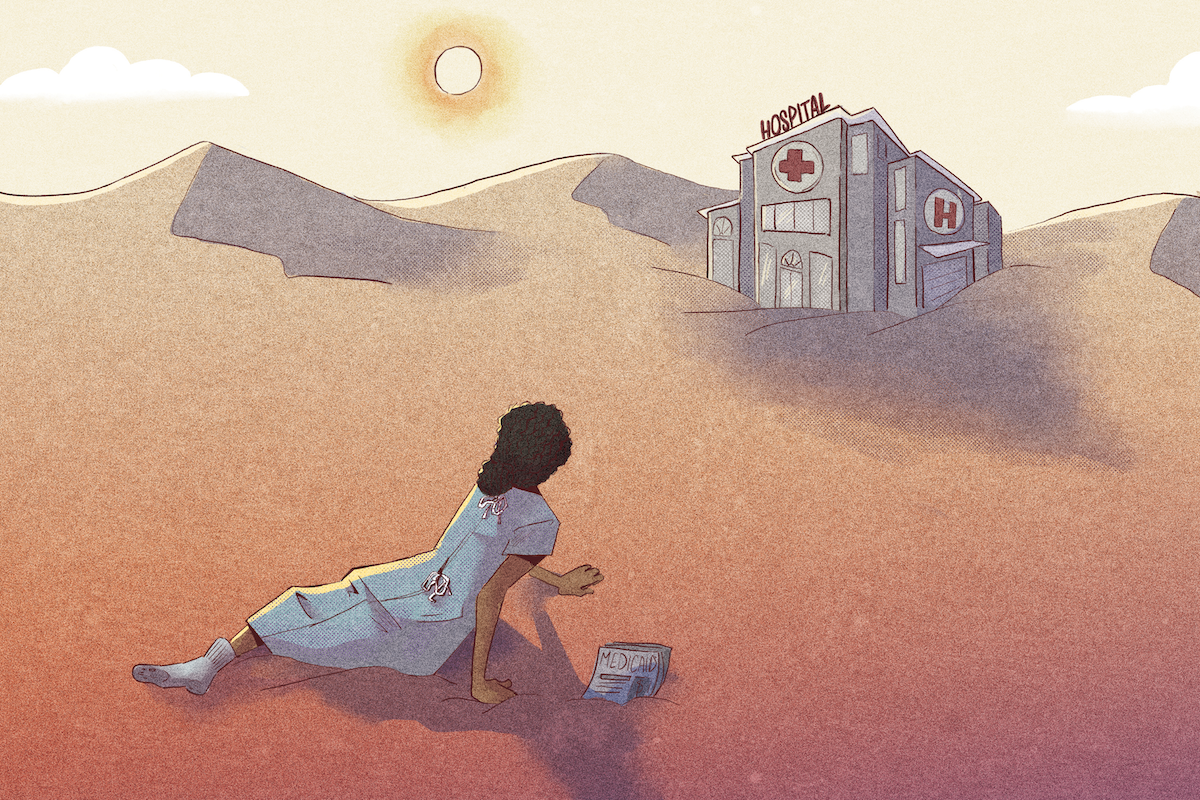
Across Chicago, safety-net hospitals (SNHs)—medical centers that provide healthcare for individuals regardless of their insurance status or ability to pay—are facing an uncertain future as the national healthcare ecosystem braces for the impact of sweeping federal funding cuts and new Medicaid eligibilty provisions.
Signed into law on July 4, 2025, the “One Big Beautiful Bill” Act, or H.R.1, would reduce federal Medicaid spending by an estimated $1 trillion between 2025 and 2034, according to the Congressional Budget Office. Although most new provisions will not go into effect until January 2027 in Illinois, some advocates and practitioners project that these cuts will exacerbate existing financial strains and dramatically increase the volume of emergency room visits.
“At the end of day, you’re beginning to reduce providing healthcare to people who very much need it,” said José Sánchez, CEO of the safety-net hospital Humboldt Park Health. “These are essential services to them.”
According to the Chicago Department of Public Health’s website, safety-net hospitals across the city provide significant levels of healthcare and other services to patients who are uninsured, on Medicaid, or otherwise vulnerable. There are 18 designated SNHs across Chicago, and more than half of these facilities are located on the South and West Sides.
According to data from the Illinois Department of Healthcare and Family Services, between October 2024 and September 2025, Medicaid inpatient utilization rates for safety-net hospitals on the South Side ranged from 54% at University of Chicago Medicine to 84% at La Rabida Children’s Hospital.
Medicaid inpatient utilization rates at non safety-net hospitals contrasted greatly: Northwestern Memorial Hospital was 25%, Shriners Children’s Hospital was 30%, and Rush University Medical Center was 36%.
Sánchez says that these facilities are facing a range of struggles, including a lack of capital, operating in aging infrastructures, and navigating complex socioeconomic issues in low-incoming communities. Still, safety-net hospitals will be disproportionately affected by federal funding cuts because the ecosystem is inherently reliant on Medicaid. He predicts that the safety-net hospital ecosystem will begin to feel the impact of these Medicaid cuts next year and in 2028, and also anticipates the likelihood of safety-net facilities closing, rather than reducing services.
“It will be unsustainable if all of those cuts pass on to the providers with this bill,” said Sánchez. “It is going to create deserts of healthcare in poor communities in the state of Illinois, and also across our nation.”
There are already significant health disparities between the North and South Sides of Chicago. According to data from the Chicago Health Atlas, morbidities that are more prevalent on the South Side include heart failure and coronary heart disease hospitalizations, cancer diagnosis rates, adult obesity, and diabetes-related hospitalizations.
Kimberly Hobson, CEO of the South Side Healthy Community Organization (SSHCO), a non-profit dedicated to improving health outcomes on the South Side of Chicago, said additional drivers of health disparities include barriers to healthy food access, stable employment, and affordable housing on the South Side.
According to 2024 data from the Chicago Health Atlas, a nearly 20-year life expectancy gap is the fact of life between some North and South Side neighborhoods. In places such as Lincoln Park and Lake View, life expectancy is about 84. In South Shore and Englewood, it’s 71.
“That tells you everything you need to know about how health disparities are shaping and cutting short lives of South Siders,” Hobson said in an email pertaining to the life-expectancy gap.
Additionally, many safety-net hospitals offer more resources than traditional healthcare facilities do, such as housing, transportation, and food insecurity programs. These facilities also address the social determinants of health, or the non-medical conditions in which people live and grow up in.
This is true of La Rabida Children’s Hospital, a safety-net hospital that serves 9,000 children annually. Amy Lulich, director of Outreach and Business Development at the facility, said that the hospital offers an even wider variety of programs because of their work with children. These additional services address nutrition, through open access food pantries, and literacy, through visits with a Chicago Public Schools teacher who supports and tutors children.
Many of these services are not reimbursed by Medicaid, according to Lulich, and she raised concerns about the unknown consequences of federal funding cuts on the care that La Rabida provides to low-income families.
“We don’t quite know the full financial impact yet,” she said. “ [These cuts] will threaten our ability to be able to provide those non-compensated services and programs.”
Two main provisions will go into effect in Illinois next year, on January 1, 2027. The first mandate enacts work requirements: adults ages 19 through 64, and adults with dependents 14 and older, will need to prove they have worked or volunteered 80 hours a month, or that they are enrolled in school part-time.
The second provision increases the frequency of Medicaid re-eligibility enrollment for ACA expansion adults—individuals who are single, childless and nondisabled adults under 65-years-old—from once a year to every six months. It will also reduce the timeframe for retroactive coverage.
The Illinois Department of Health and Family Services (HFS) estimates that half a million recipients could lose coverage due to these cuts. FHS also anticipates a drastic decrease in federal funding for Medicaid in Illinois, ranging from $26 to $51 billion over the next decade.
Hobson said that SSHCO is “closely watching” how changes to Medicaid will impact safety-net hospitals and other community healthy facilities in their area.
She cited the closing of Weiss Memorial Hospital as an example of the “urgent threat to Medicaid cuts.” Last year, the safety-net hospital on the North Side suspended all patient care after being cut from Medicaid and Medicare funding.
“On the South Side, where the healthcare infrastructure is already stretched thin, losing even one facility could be devastating, and life expectancy could fall further,” she said.
At La Rabida, work requirements may affect parents and lead to loss of coverage for families.
“This could affect their ability to care for their children with complex medical conditions who rely on parents as primary caregivers, especially those dependent on medical technology,” said Sharon Cindrich, director of Communications and Media Relations at La Rabida.
To Dr. Eden Takhsh, senior vice president of Operations at Saint Anthony Hospital, a safety-net hospital in North Lawndale, bills like H.R.1 and others will translate to spikes in emergency room visits if individuals are increasingly cut from care.
This sentiment was echoed by Rolla Sweis, president and CEO of La Rabida. She said that as people lose coverage, it’s “only normal” that individuals would turn to emergency departments for the care they need.
If that were to happen, according to Sweis, La Rabida would step in and support their partners.
“We do that right now, by helping decompress their inpatient size,” she said. “So when those kiddos no longer need to be in the pediatric intensive care, or they can’t go to the floor at that hospital or home, that’s where we help fill those gaps.”
Hobson said that the Chicago safety-net hospitals are “foundational partners” with SSHCO. She also said that one of the organization’s models is embedding their staff directly into these facilities who help connect patients with care, transportation, and access to healthy food.
In the face of Medicaid cuts and reductions to federal funding, Hobson said that SSHCO is continuing to focus on outreach and health education on the South Side through “providing personalized support” and upcoming health literacy education efforts next month.
“We will continue to show up every day to ensure residents have access to support and information during these times,” she said in an email.
Takhsh stressed that Saint Anthony tries not to have “knee-jerk” reactions to potential issues, and instead, said that the facility will be relying on their relationships with local, city, and state-level government officials to help advocate for adequate funding for safety-net hospitals.
“We have to focus on working with our elected officials, whether it’s Springfield, the federal level or the local level,” he said. “We try to keep a steady pace, and if anything, grow our services, knowing that we have to advocate for funding so we can do even more.”
Matt Brady is a freelance journalist from the Chicago area. He has written for The Daily Herald, the Evanston Roundtable, South Side Weekly, The Fulcrum, and Illinois Latino News. He is the Copy Desk Chief of the Columbia Chronicle, the student newspaper at Columbia College Chicago.
This is an important issue that does not get enough attention. Safety-net hospitals serve some of the most vulnerable communities and cuts at the federal level would have real consequences for people who already face barriers to care. Thanks for covering this.
https://kakobuydaily.com