

A lengthier version of this story was originally published by Borderless Magazine, a nonprofit award-winning bilingual news outlet reporting with and on immigrants. Visit their website and sign up for their newsletter at borderlessmag.org.
To help combat the fear of immigration enforcement in sensitive locations and enact stronger regulations protecting immigrant access at courthouses, hospitals, and universities, last year Illinois lawmakers proposed H.B.1312.
When the bill passed in December 2025, Illinois joined California and a few other states which have laws that address immigration enforcement in hospitals, according to Meghan Carter, a senior staff attorney at the Legal Council for Health Justice. Among other ICE-related provisions, it requires Illinois hospitals to implement policies governing staff interactions with immigration enforcement to protect patients’ medical privacy.
Carter said “there really weren’t many samples” to draw inspiration from while she helped draft the hospital provision of the bill. But she noted that the healthcare privacy law’s requirements were modeled after the Illinois Coalition for Immigrant and Refugee Rights’ (ICIRR) framework for what a welcoming hospital should look like.
Advocates involved in drafting the law had been working on it since late summer last year, according to Luvia Quiñones, senior director of health policy for ICIRR. When Operation Midway Blitz began in the fall, Quiñones said ICIRR heard reports from elected officials, immigrant-serving organizations, and hospitals that ICE agents had been entering hospitals and “roaming the hallways.” It left staff uncertain of what to do, so Quiñones said the activity moved up the timeline for the legislation.
“The design of the law is to ensure that hospitals are equipped to respond to federal or other immigration officials if they come to the hospital site,” Carter said. “Unfortunately, because of federal law, we can’t tell ICE what to do, but we can equip hospitals to respond to ICE.”
Now, as hospitals prepare for situations that’ll put their policies to the test, some medical staff and advocates are wondering whether internal rules are enough to protect patients in the face of federal authority. Hospitals such as Sinai Chicago, Cook County Health, University of Illinois Hospital, and Rush Medical Center have created policies outlining how staff will respond during interactions with immigration enforcement agents.
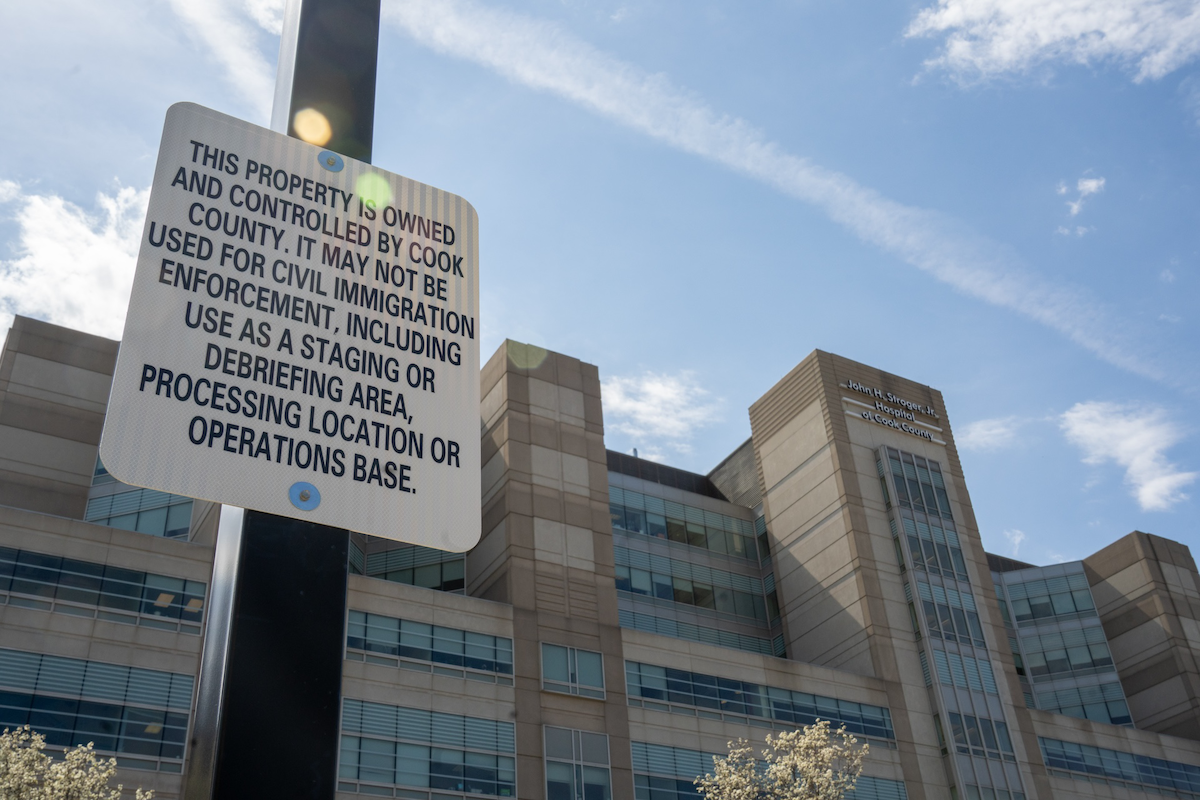
According to Cook County Health (CCH) policy, which includes John H. Stroger Hospital, outside law enforcement, such as ICE, in “CCH Emergency or Trauma Departments” must notify a CCH police officer or security officer “as soon as reasonably practicable after their entrance upon CCH Facilities.”
“Per our policy, all law enforcement agents are required to check in with our hospital police or security teams when they come to campus in their official capacity,” said Imani Harris, communications manager for Cook County Health, in an email. “We put up signage on our facility entrances in September 2025 to make that clear.”
According to public records requests, many Chicago-area hospitals share similar protocols for designating staff to interact with law enforcement in accordance with the new healthcare privacy law. Aside from the sensitive location protections, the passage of H.B. 1312 allows for any person to bring a noncriminal lawsuit against an agent who “knowingly engages in conduct that violates the Illinois Constitution or the United States Constitution” during civil immigration enforcement.
According to IDPH’s website, complaints are investigated based on priority, which can take days or months, depending on the nature, scope, and severity of the complaint allegations. IDPH did not respond to a request for comment on whether any complaints have been filed since March.“Every person in Illinois deserves access to healthcare without fear,” said Dr. Sameer Vohra, director of the Illinois Department of Public Health (IDPH) in December. “This new law reinforces IDPH’s commitment to building a healthier and safer Illinois for all families and communities.”
Katrina Pham is Borderless Magazine’s audience engagement reporter.