

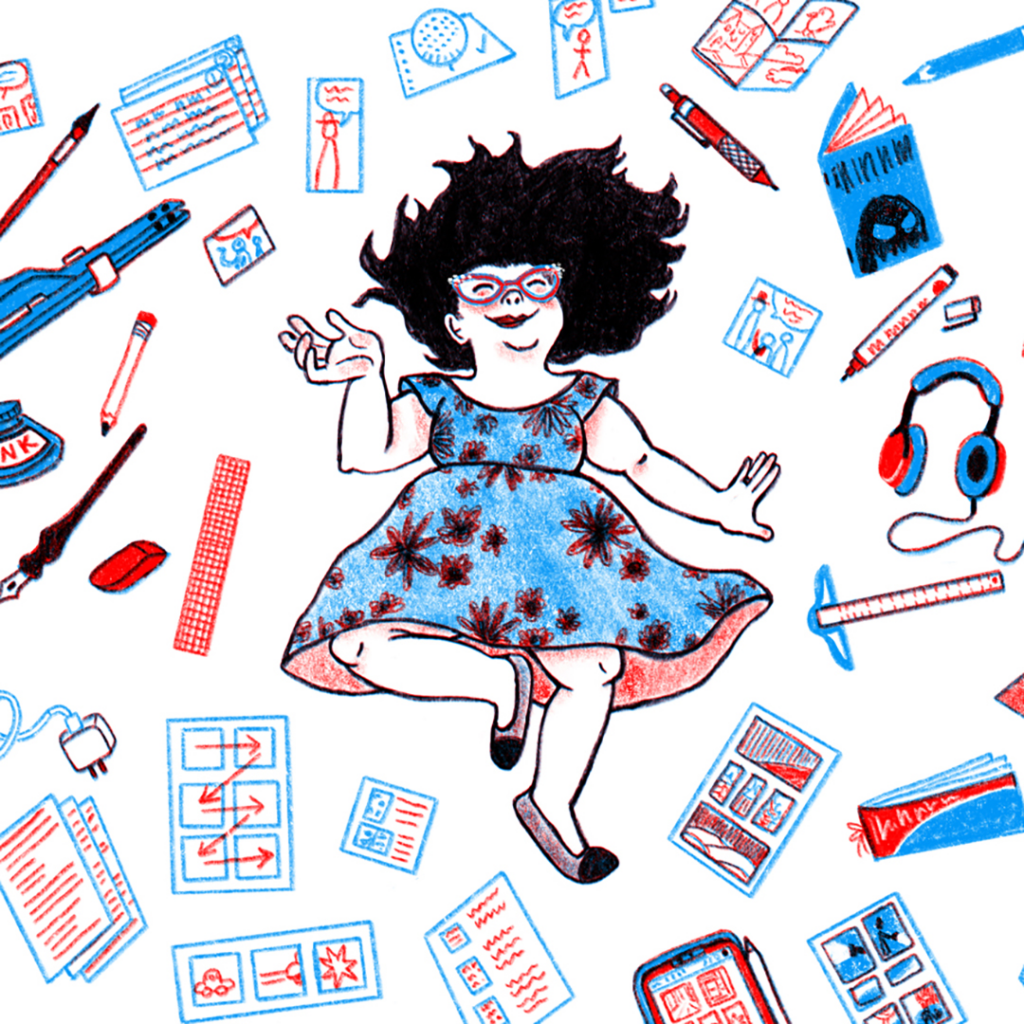
Beth Hetland is an award-winning and critically-acclaimed cartoonist and educator. Her graphic novel TENDER, a psychological thriller with elements of body horror, was selected for the 2025 Lynd Ward Graphic Novel Prize. She is an assistant professor of comics at the School of the Art Institute of Chicago. To see her work, visit www.beth-hetland.com.
Ellie Gilbert-Bair: What is a comic?
Beth Hartland: My definition of a comic is text and image working together to communicate something. Is that a hard-and-fast rule? No. I’d be more interested in somebody showing me something they say is a comic and asking, “Tell me how?” than saying “No, it’s not.” I have some colleagues who are pretty adamant about comics needing to have an emotional journey. Well, I feel like an airplane safety card is a comic!
As a visual culture, we’re seeing a lot of comics as education. Especially during the early pandemic days, illustration paired with text was one of the most efficient ways to communicate information about coronavirus. We’re also in a time where it’s easy to reproduce and distribute on your own.
What are some early versions of comics, and how have they evolved?
I look at a lot of sequential imagery. If we think about triptychs in the church—or the ways in which people translated scripture—oftentimes, the people viewing them were not literate. So, [artists] were figuring out ways to tell a story: the text becomes the verbal “reading,” and the imagery finds key moments to move through, so [viewers can follow along].
There are completely wordless comics that get a message across. There are Lynd Ward’s woodblock novels, published between 1929 and 1937. He wasn’t calling them comics at the time, but they were early iterations of the graphic novel, and communicated important labor movement messages.
Since the early 1960s, we’ve seen a rise in underground comics as a reaction to major publishers having to deal with the Comics Code of 1954. Fredric Wertham (who was the worst) wrote Seduction of the Innocent, “proving” that comics were corrupting the youth. The Senate convened multiple hearings in the spring of 1954 to determine whether that was true, and as a result, a lot of comics were censored. It stunted capital-p “publishers” in the U.S., but it also created a robust underground scene for “comix.” You could make a thing, put it in a head shop [a countercultural store that sold drug paraphernalia and alternative media], buy your friend’s comics, swap them or share them.
Have you seen differences in how people engage with comics as the world becomes increasingly digitized?
As people started sharing their comics on blogs, Tumblr put out super strict guidelines on what could and couldn’t be posted. The question became, how do we seize the means of production? The same thing happens whether it’s in print or online.
Over the last 10 years, the site WEBTOON has exploded. There was an independent platform called Comixology, but after Amazon acquired it in 2014, the readability and functionality really suffered. WEBTOON is its own beast. For some creators, it’s just a platform [for distributing], but there are also situations where WEBTOON is paying creators to make work specifically for their platform. Now, I’m seeing that WEBTOON comics are being bought by physical publishers, who then convert the vertical scroll into a horizontal page spread to be printed.
Working digitally has been a big change in illustration, in speed and in the ability to adjust things. Things can become homogeneous pretty quickly, and it’s a challenge to figure out, how do you retain your own mark making? How do you ensure this is a tool and not a crutch?
There was, at one point, an uptick in Instagram comics. We’d see the four squares and could swipe through 10 images in the carousel. As Instagram changes their algorithm, people have to shift. People are just trying to figure out what makes sense, and to build a readership of their work before putting it out.
Tell us about the Chicago comic scene.
The Chicago comic scene is immense. When I look at just festivals, we’ve got some of the greatest, period, especially for indie comics. We’ve got Chicago Zine Fest, Cake, the South Side Zine Fest, ZINEmercado, Pretty Good Fest, Staple and Stitch. The Chicago Art Book Fair is returning.
There’s a history of Chicago being an extremely avant-garde and experimental force as far as comics go. There was Brain Frame—an event where comics artists could interpret their work in front of an open-minded audience—started by Lark Lyra Lou Hill. There’s the reading series, Zine Not Dead, with Matt Davis and Brad Rohloff. These are spaces where I’m seeing new creators and I’m hearing new things.
There are also great comic shops. Quimby’s has been really engaged with events. Since their ownership change in 2025, they’ve pushed all the comics to the front of the store and started offering print and design services. Howling Pages is one of my favorite shops. They have a gallery space and host “drink, draw, duplicate nights.” A new shop that I’m really excited about is Sheep Cult Comics. It’s an art space that’s been hosting events pretty non-stop since they opened. They’re focused on a curated selection of work.
Comics are pretty unstoppable. We see them everywhere from gallery spaces, like the exhibit at the Museum of Contemporary Art a handful of years ago, to somebody’s basement down the street. The Chicago comic scene is so special because it has space for all these different iterations to exist at the same time.
This interview has been edited for clarity and length.
Do you have a topic you would like to ask an expert about? Email us at elliegilbertbair@southsideweekly.com
Ellie Gilbert-Bair is the Weekly’s assistant managing editor.
Great article! I found this very insightful and well written.
I love Hetland’s point that an airplane safety card can count as a comic — it’s a great reminder that text-and-image storytelling has always been about communication first. The history of the Comics Code pushing creators into underground ‘comix’ also shows how censorship can unintentionally spark new creative scenes.