
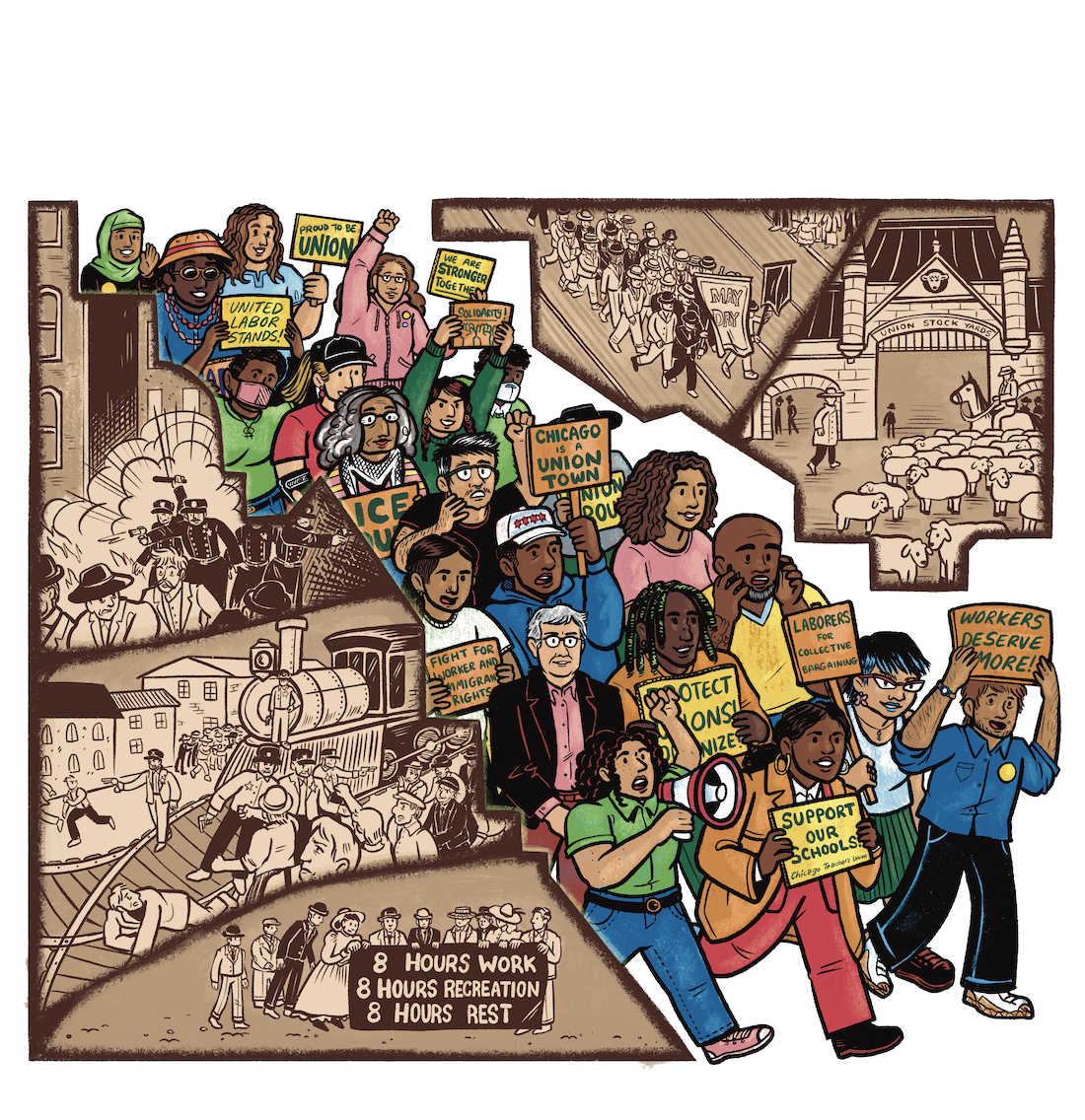
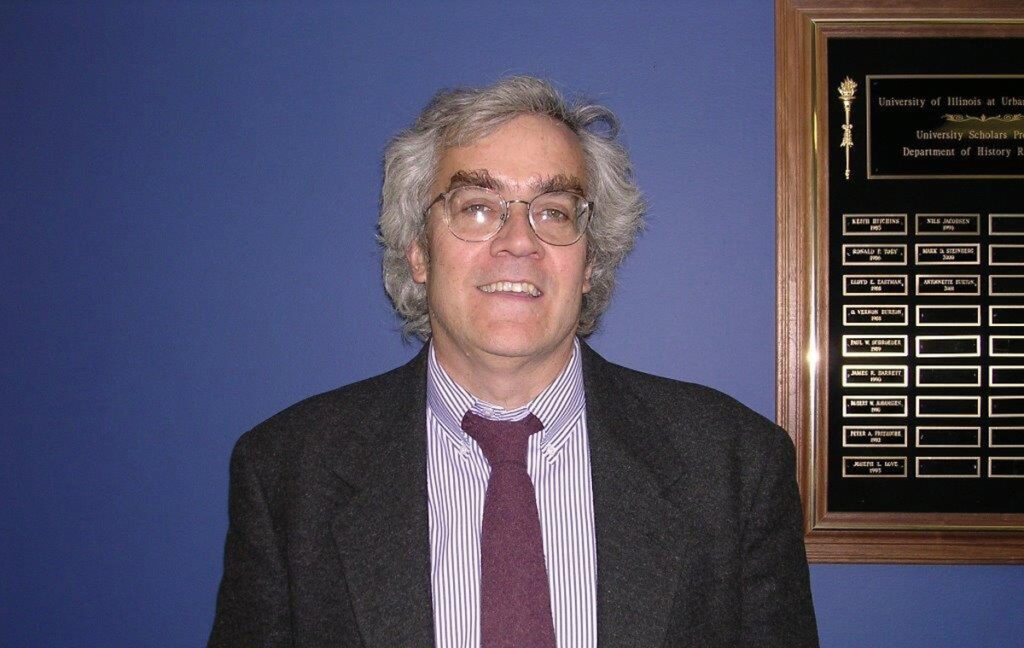
James R. Barrett is professor emeritus of history and African American studies at the University of Illinois at Urbana-Champaign. He was born and raised in Chicago and is the author of The Irish Way: Becoming American in the Multi-Ethnic City (Penguin Books, 2012), History From the Bottom, Up and the Inside Out: Race, Ethnicity, and Identity in Working-Class History (Duke, 2017). He is working on Chicago: A Peoples’ History.
Ellie Gilbert-Bair: Why do we celebrate Labor Day?
James Barrett: Nationally, [we celebrate it] as a recognition of the significance of labor in society. The International Workers Day is on the first of May, [commemorating a mass strike for the eight-hour work day, organized by the Federation of Organized Trades and Labor Unions in 1886]. It seems that part of the U.S. government’s motivation in establishing Labor Day, which falls on the first Monday of September every year, was to provide an alternative to May Day, which is generally recognized as a radical holiday.
The other motivation is a little bit unclear, but might have had to do with the Pullman Strike and boycott. The Pullman Strike was a national railroad strike, but its origins were actually in Chicago. At the time, there was a separate company town on the far South Side run by George Pullman and his corporation, [the Pullman Palace Car Company], and a conflict broke out there between Pullman and the American Railway Union.
If there is a connection between that and Labor Day falling in September every year, it might have to do with the fact that the federal government, which eventually declared the Labor Day holiday during that same summer of 1894, intervened. They intervened legally, using the Sherman Antitrust Act [a federal law passed in 1890 that prohibits monopolization], and they intervened with massive military intervention. A lot of people were killed during the boycott and strike.
How has Chicago’s labor movement evolved over time?
Chicago is generally recognized as a labor town, meaning labor has a stronger profile in Chicago than it does in many other places. In 1866, there were 20 unions already in the city. There was a labor federation to coordinate activities, labor had its own newspaper—The Workingman’s Advocate—strikes were beginning to take place, and so forth. That level of organization was a little bit unusual.
In the late 19th century, Chicago was sort of the seat of the radical labor movement in the United States—socialist organizations and anarchist organizations were strong, as well as craft unions and unions in several industries in the city. A general strike for the eight-hour work day was called on May 1, 1886, and it was in that context that the Haymarket Affair—[wherein around 1,500 workers gathered at Haymarket Square on May 4 to protest police violence that left one dead and many injured at a McCormick Harvesting Machine Company strike the day prior]—took place and put Chicago on the map.
The common misunderstanding is that Haymarket wiped out the labor movement. There was clearly an effort to do that; a lot of people were jailed in the wake of Haymarket, the Haymarket trial [a two-month trial of eight men charged with murder, in connection with a bombing at the rally] took place, and some of the people responsible for organizing the strike were executed legally [August Spies, a German immigrant and one of the organizers of the rally was sentenced to death].
What happened instead was another big upsurge in union activity. Unions reemerged, certainly by the 1890s. A lot of the early unions were essentially craft unions [which organized workers by trade rather than company or industry], so they organized only skilled workers. But in Chicago, there was a lot of activity among the unskilled as well.
Then, [there was] another period of decline. Black workers and recent immigrant workers were fairly well organized during the period of World War I, when there were labor shortages and the employers were in a tougher situation. The stockyards and the steel industry both had large numbers of Black workers and Mexican workers, but those unions with a lot of unskilled workers were often defeated.
The next big period of organization was in the wake of the Great Depression and during World War II, and those are the mass unions … in steel, electrical manufacturing, meatpacking and slaughtering, and the garment industries. Those unions, unlike a lot of the earlier ones, took everybody. Women were organized in the mass production industry—they were important in electrical manufacturing and some of the other industries. And these new CIO [Congress of Industrial Organizations] unions were pretty good on issues of civil rights. The stockyards had a very large number of Black workers, so that was really a breakthrough. The decline of those unions is directly connected to the decline of industries in Chicago. The meatpacking industry left Chicago, really by the 60s. By the 70s, steel was largely gone.
The most recent installment, which one could argue once again makes Chicago a labor town, largely has to do with … service workers, white-collar workers, and teachers. The earliest union for janitors in the United States was founded in Chicago, Local 1 of the Service Employees International Union. The first local of the American Federation of Teachers was in Chicago.
How have Chicago’s labor movement and its larger political landscape been historically connected?
Unions in Chicago traditionally have had close contacts with the political machine, the regular Democratic organization. You might say Chicago is still overwhelmingly Democratic, and the unions have a role in that, but it’s not the machine of the old days. Our mayor comes out of the Chicago Teachers Union though, and [that union] continues to have a lot of influence.
The older federation, the American Federation of Labor in Chicago, tended to be the unions with the strongest connection with the machine. We often think of the machine as a conservative influence, and in many ways, it was. Black citizens in Chicago, for example, were not very well represented by the machine until at least the Depression.
Traditionally, at least from the 1930s—some people would say earlier—the machine was mixed ethnically, but was overwhelmingly Irish. The Irish had the greatest political influence within it and within the unions, at least until the 1970s, especially the construction unions and the craft unions, which were based on apprenticeship programs. In other words, if you wanted to become a carpenter, you would have to go through an apprenticeship program. That was true of electricians and bricklayers and so on.
I don’t want to oversimplify a complicated problem, but a lot of these people grow up together. They’re from the same neighborhood. Everyone talks about Bridgeport—which now is full of young people and artists—that’s an old working-class Irish neighborhood. A lot of the mayors came out of Bridgeport, and so did a lot of the union leaders and the people that ran the police department, et cetera.
Historically, what challenges did Chicago’s workers endure when organizing?
With rare exceptions, [the label of Chicago being a labor town] was fought tooth and nail right down the line. Lockouts were used in many industries. It’s almost like the employers [would go] on strike; they shut down the industry and wouldn’t let people come back to work until the union was destroyed. The railroad industry, among other industries, used a blacklist to identify the people that were most active in the union, and keep those people out of that industry. There are blacklists in Chicago archives of corporations and of unions.
In the craft unions, [there was] a lot of discrimination against African American workers and against women. The conventional wisdom in some of the more conservative unions was that women, African Americans, even recent immigrants, could not be organized. They were “unorganizable.”
And history does not bear that out. [For example], the teachers union, which is very important in Chicago now, was organized by women. The big union that fought the Pullman strike and boycott in 1894 was led by socialist Eugene Debs—they did not take Black workers. Virtually all the porters on the Pullman line were Black, and those workers did not get a union formed in Chicago until the 1920s, when they essentially formed their own union: the Brotherhood of Sleeping Car Porters. They were not organized by white unionists. So both the employers, and in a certain way, the unions themselves, were an obstacle to many workers. But once the organization took place—both the stockyards and the steel industry are good examples—Black workers were swept into unions and they rose to leadership positions. These were big steps forward.
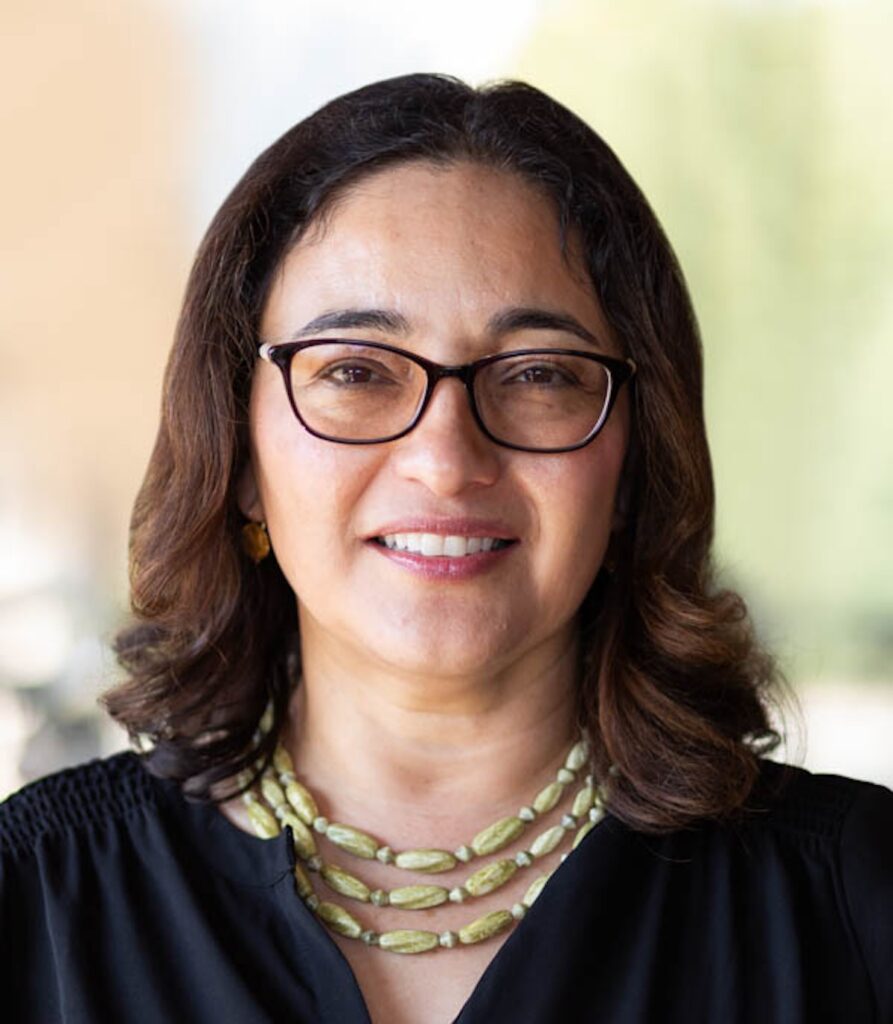
Lilia Fernández is professor of history at the University of Illinois Chicago. She is the author of Brown in the Windy City: Mexicans and Puerto Ricans in Postwar Chicago (University of Chicago Press, 2012), which examines migration, settlement, activism, and community formation. Her current research explores the historic ethnic and class diversity of Latino Chicagoans with an emphasis on industrial workers, student activists, and coalitional politics and solidarities among the working class.
You’ve studied the history of Mexicans and Puerto Ricans in Chicago. What were some struggles faced and strides made by these groups when organizing in the city?
Lilia Fernández: First, I think we need to acknowledge that these populations were present at all, because the way that we narrate Chicago’s labor history is very black and white, and tends to focus on European immigrants and the incoming African American migrants from the South, who started joining the meatpacking plants and such. But Mexican workers started arriving in Chicago in the late 1800s, and really in significant numbers by the 1910s and 20s. There were quite a number of them in local steel mills, in the packinghouses, [and] on the railroads. It’s important to recognize, for example, that Mexican workers participated in the Republic Steel event that led to what’s known as the Memorial Day Massacre in 1937.
Their numbers declined during the Great Depression because of massive deportation campaigns, much like what we’re seeing today. That was basically an effort to remove certain populations from the labor market, and to remove people off of welfare rolls—people who were asking for assistance from private charities, because at the time, we didn’t have a national social welfare safety net.
In the 1940s, many more Mexicans began arriving in Chicago, along with significant numbers of Puerto Ricans. This was explicitly, very clearly, a labor migration. People were coming to the city to work. Oftentimes, they were single men who came on their own to try to find a job, get set up, and then they would send for family members. When they arrived, Latino workers were pretty enthusiastic about joining labor unions in some areas.
For example, Mexican and Puerto Rican workers who tended to work in some of the hardest departments—like the blast furnaces at the steel mills—were very eager to join the CIO unions in the 1930s. The United Steelworkers of America, for example. In other industries, that was true as well.
One thing I will point out, however, is that there were moments when some of these unions were not operating in the interest of their members. They might be corrupt, they might be connected to the mob, they might have inside deals with the bosses, or they might have been recruited, or set up, by employers as a way to keep out other unions that might demand better wages [and] better working conditions. There were times when Latino workers might have fallen prey to those kinds of organizations or associations.
But when we talk about groups like the steelworkers, some railroad unions, and some unions in the factories—the Teamsters was a big one—many Latinos participated, and even took on leadership roles in some workplaces as shop stewards and that sort of thing. They were like any other worker: trying to get along, make a living, and survive.
An area where a lot of women, Latina women, were members of labor unions, was in the garment industry. The Near West Side of Chicago—which today are renovated condos and upscale apartments, and the area around UIC, where I work—was full of garment factories. There were many many women, and I’m talking here in the thousands, who worked in the garment shops often operated by men. Many of them labored for decades, getting paid pretty poor wages, and whether or not their unions were effective in representing them, I think, is up for debate. There were a couple of different unions: the Amalgamated Textile Workers and the International Ladies Garment Workers Union. So there’s a broad diversity of experiences that people have had.
Historically, what were some ways in which workers came together across differences?
The late 19th century was a really critical period in local labor history. In the era of industrialization—think of the railroads, the factories, the steel mills first emerging on Chicago’s landscape—there was a massive movement among workers to demand better wages, better working conditions, [and] to organize themselves in solidarity with one another. That was very difficult to do because there were so many different immigrant groups at that time, primarily from Europe, and we have to remember that they all spoke different languages. Communicating across German, Italian, Polish, Slavic languages, and more was not easy.
It shouldn’t surprise folks to learn that workers could often be divided, and employers often benefited from that. We tend to think only along racial lines—that Black workers were segregated from white workers, or that they were pitted against each other. But in many workplaces, like the packinghouses as one example, workers were segregated by ethnic group, or by national origin.
The older immigrant groups, or the ones who were born in the Chicago area or in the U.S., tended to be higher up in the labor hierarchy. They often got better jobs. They got better treatment from managers, foremen, [and] bosses. They often were the foremen, and could sometimes treat other workers pretty poorly, with prejudice and discrimination. We can imagine how that would keep workers divided, keep them from organizing and coming together across linguistic barriers, across ethnic or national origin lines, or across racial lines.
The most progressive or radical unions understood that they had to promote and foster interethnic, interracial solidarity and unity. Some labor unions might still have had meetings where they organize workers by language. So, if you spoke Spanish, you might be in one meeting, if you spoke Polish, you might be in another, so on and so forth. Despite that, which was basically out of linguistic necessity, they still would try to foster a sense of camaraderie, a sense of inclusion and belonging in the larger union.
Especially later on—by the 1930s, 40s, 50s—as more immigrant groups had assimilated, learned English, and particularly as their children, the second or third generations, were English-speaking, those barriers could fall away a bit.
That didn’t mean that there were not still prejudices amongst different workers based on ethnicity, nationality, or race. But the most powerful and effective workers and labor union members saw beyond those differences and advocated for what brought them all together, or what they had in common.
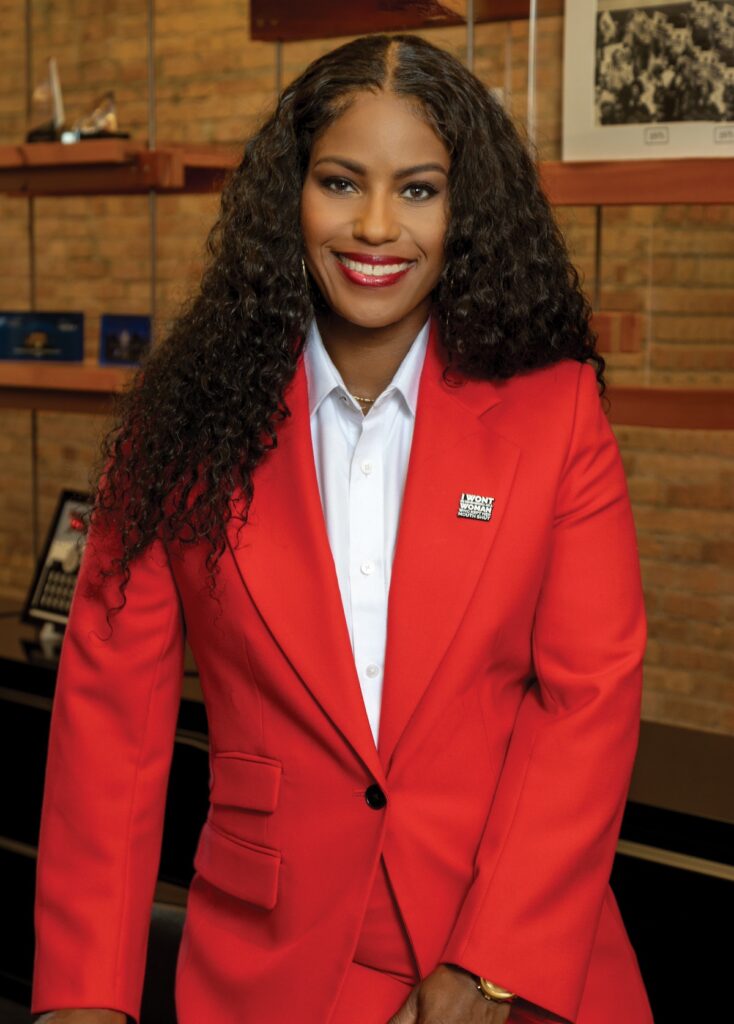
Stacy Davis Gates is president of the Chicago Teachers Union, president of the Illinois Federation of Teachers, vice president of the American Federation of Teachers, and chair of United Working Families. Her background as a high school history teacher drives her commitment to fully funded schools for all of our children. In the fall of 2019, she led a 15-day strike, negotiating a historic contract for smaller class sizes, social workers in every Chicago public school, sanctuary protections for immigrant families, and support for unhoused families.
How does the Chicago Teachers Union organize?
Stacy Davis Gates: A union is one of the most powerful institutions in American society because it is multiracial, it is multigenerational. We call each other sister, brother, sibling. We live everywhere, we work everywhere. It is the single most important institution in how we maintain democracy and fight for the protection, the support, and the benefit of working families.
We organize both for the worker, and our students and their families. Very early on, educators are taught that young people come from [different] people and they come from [different] places. If you are going to advocate for your workplace, you have to advocate for what every stakeholder in that workspace requires. [Adopting that philosophy] instantly made our voice bigger and more dimensional, because we take our students and their families’ issues to the table, like we do ours as workers and as members of our own families.
The Chicago Teachers Union … has tested and won the [debate about] investing in young people who need public education, the public good. We have an elected school board for the first time ever in the history of this city. We are well on our way to winning increased revenue for Chicago schools and every school in this state. We are well on our way to making sure that those who have more take more pride and responsibility in the common good as well. Those are things that this union is doing without apology, with joy, and with effectiveness.
What are you organizing around in Chicago right now?
The issues are easy to organize [around] because of the lack of affordability we experience as workers, as educators, as neighbors, and as family members. We are able to create more connection in our community, and throughout this country, and it is both our privilege, our honor, and our duty to create spaces that organize and negotiate for better wages, [especially for] a population of workers that are over 80% female. We are also able to transform public education by setting class size minimums in [the contracts we negotiate], and offer refuge for immigrant children and families through sanctuary policies that we’ve negotiated. We are able to see LGBTQIA+ young people and workers because we negotiate safe spaces for them, and we are able to repair relationships with Black students and their families through the creation and the expansion of the Sustainable Community School model.
Back-to-school season is approaching. What are you prioritizing and fighting for this fall?
We’re going to be prioritizing teacher voice. We think, in this season of the first-ever elected school board, that our members—who are teachers, paraprofessionals, clinicians, neighbors, heads of households—have the ability to tell voters why it is important to participate in this election, [and how] not to be duped by billionaires who have unprecedented power and control in this moment.
We believe that the people have to demonstrate the capacity to lead, that they have to demonstrate the capacity to engage and advocate. And look no further than our union—we do it in coalition. We do it with our students. We do it with the families we serve. We do it with our neighbors because we live in this city. We do it with other labor. We do it with community groups.
We create the capacity for the largest project of solidarity that the city has ever seen, and that is inherently democratic because there’s no way you get people in solidarity without taking votes, without asking questions, without having debates, without centering shared values and outcomes.
This interview has been edited for clarity and length.
Do you have a topic you would like to ask an expert about? Email us at elliegilbertbair@southsideweekly.com.
Ellie Gilbert-Bair is the Weekly’s assistant managing editor.