

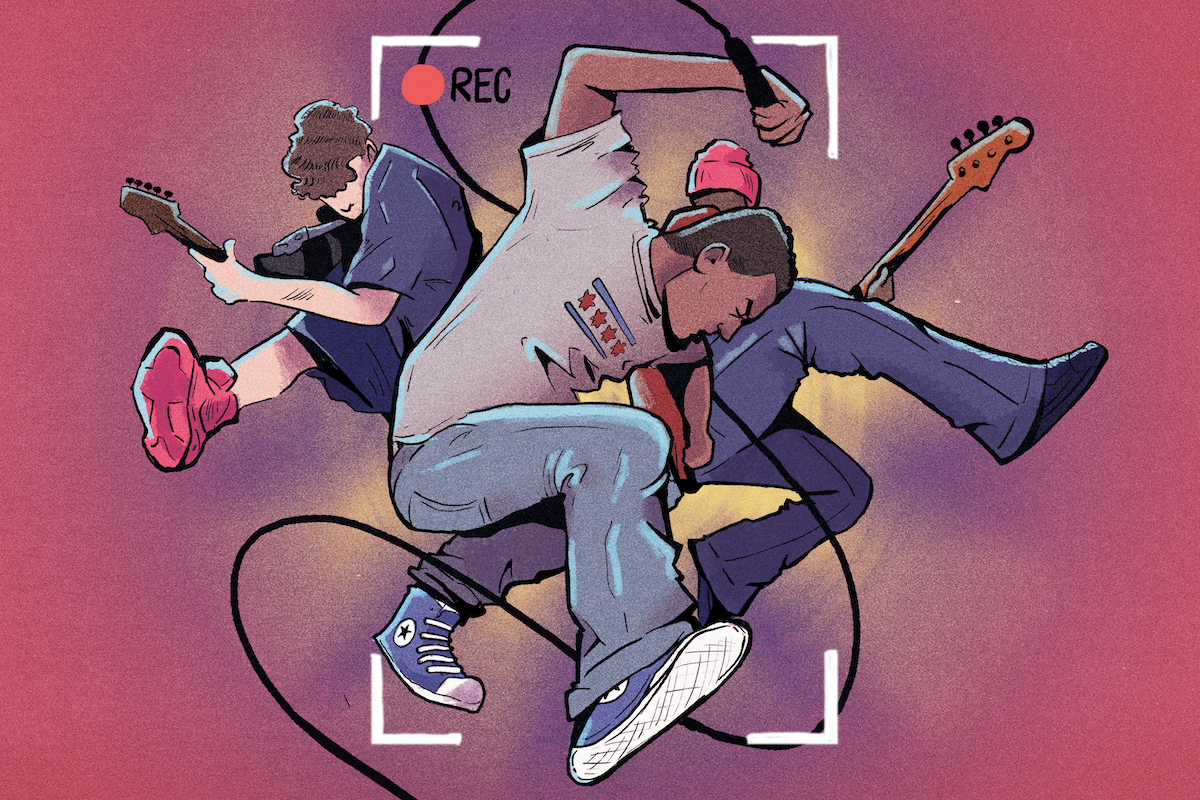
You can find music almost anywhere in Chicago—if you listen for it.
Drummers produce technicolor beats on buckets down Michigan Ave. The mellow ring of a vibraphone lights up Randolph Street. Pop hits warp in and out of earshot as bikers zip past you at Promontory Point. If you pay closer attention, you might even hear birdsong over the rumbling of the Green Line, or the polyrhythmic pull of Lake Michigan’s currents.
In the streaming age, we’re primed to discover music through our headphones. We are fed “daylists,” mixes algorithmically calibrated to match our personal tastes and moods at each hour of the day. Our plays, skips, and likes are used to develop Perfect Fit Content, music commissioned to fit a specific mood with improved margins. Our consumption of music has become infinitely individualized, even mathematically optimized. These profit-driven distribution systems make it easy to forget that the best musical encounters can be fruitful accidents, and our tastes can develop in community.
A rising tide of Chicago musicians, listening spaces, and music curators want to resist the stronghold of streaming. One of the musicians pushing back is Sam Cantor, who fronts the indie rock band Minor Moon and strums his guitar in the city’s cosmic country scene, a genre that blends the improvisational, exploratory spirit of psychedelic rock with traditional American Roots music. He and his friend Austin Koenigstein, a songwriter and producer who releases music as Smushie, have been talking for years about global politics, being musicians, and how those two things intersect. They were already frustrated by Spotify’s notoriously low pay for artists and platforming of ghost artists, fictional artist profiles designed by production companies that buy masters for a flat fee and pocket royalty payouts. So in June 2025, when Spotify founder Daniel Ek announced that he’d raised almost $700 million to invest in Helsing, a company specializing in military AI technology, Cantor and Koenigstein decided they wanted to change culture from the ground up.
“We were just like, we don’t want to be part of this,” Cantor said. “There’s so much frustrating stuff going on in the world, and it felt like this was a little area where all of [our] concerns sort of intersected.”
They were inspired by the 80+ artists who successfully boycotted South by Southwest in 2024, prompting the Austin-based film, music, and culture festival to discontinue their partnerships with the US army and RTX Corporation, a military contractor, for its 2025 run. Furthermore, they’d witnessed independent artists like Deerhoof remove their music from Spotify in June 2025, declaring, “we do not want our music killing people.”
Cantor and Koenigstein turned to friends in Chicago’s independent music scene who shared their frustrations about Spotify’s military ties and inadequate compensation model. They published an open letter in September 2025, committing to removing at least part of their discography from Spotify. As of April 2026, more than 100 Chicago musicians across genres and communities have signed on.
“We don’t know what the answer will be or how this is all going to shake out, but I think everyone is a lot more primed to look for the signs of viable change in the music industry,” said Cantor, who has since been playing a lot of old time fiddle tunes. Turning away from streaming has led him to center communal music-making and experiment with ways of engaging with music outside of the industry. This has included collaborating with Richard Hayes, known as the “Milwaukee Taper,” to record a live EP that was released on CD and Bandcamp last month. Hayes, like other tapers, records and distributes concerts for free, preserving live music with artist permission.
Cantor has also put together a growing guide to Spotify alternatives for listeners looking to build a more intentional relationship with their music habits. He recommends checking out Qobuz for streaming or turning to Bandcamp for buying and collecting. More than that, he hopes that listeners will invest in ecosystems that nurture creative, independent music making.
“All these platforms are built to keep you engaged at all costs,” he said. “[I’m looking for] whatever ways that I can distance myself from being pushed into thinking about music as content, as background, just an aesthetic reflection of my taste, as opposed to a piece of art, or something that has its own life to it.”
One place in Chicago where music has a living, human touch is Charis Listening Bar. Nuzzled in the heart of Bridgeport, Charis (pronounced care-iss) is an intimate, 35-seat bar that pairs creative cocktails with curated vinyl. Alex Jandernoa opened the bar in February 2025 in honor of his mother, whose middle name is Charis.
“My mom got cancer a couple years ago. It is terminal, but she’s been fighting it… I was really sick of people waiting to give the people they love their flowers. So this is a little ode to my mom and dad, while they’re still here and able to enjoy it, of their love of music, sharing it over good drinks and conversation,” said Jandernoa.
Whether it was through CDs, tapes, or vinyl, music has always underscored Jandernoa’s home life, and he hopes to share the magical ways in which music can transform a space with his community. He aims for openness, exploring divergent genres and attuning himself to the shifting energies in the bar.
“We look at the weather and we say, ‘oh, it’s nice out. It feels like it’s a day for R&B.’ Or, ‘oh, it’s raining. Let’s play some music that’s good for raininess,’” he said. “We’ll watch the first couple of guests that come in for the first hour or two and see what they bop their heads to… As the room changes and builds, we change the music. And once we settle into something that we like, we pull records from that accompanying genre from around the world.”
Drew Mitchell, who owns 606 Records in Pilsen, also directs the sonic curation at Charis, picking out their monthly vinyl selection and booking their DJs for Friday and Saturday nights.
“Drew has gotten to know everybody on the [Charis] team, and drops maybe 20 to 30 records a month that are based on our talks and music tastes. But also it’s changed as he’s gotten to know our staff. He drops a record or two that they mentioned they love when he’s played a set or had a drink,” said Jandernoa.
Mitchell grew up listening to music from tangible sources, and to this day, he’s kept up tradition. Occasionally you’ll find him on Bandcamp, but his favorite ways to experience music are vinyl, live music, cassette, radio, and “peace and quiet.” Above all, he loves listening to his kids, niece, and nephew sing. Mitchell opened 606 Records on the corner of South Allport St. and West 18th St. in 2015 to build community and spread love in the city, and his curating work at Charis carries the same heart.
“I had a big record collection and felt my calling was to open a small business and provide a safe space for music lovers… We look at Chicago artists first and foremost, while focusing on underground music,” he said. “The experience [curating at Charis] has been fulfilling in that we’re able to connect people to an environment that’s music forward, as well as spread love within the DJ community.”
The streaming age presents music as an object to be consumed. Reduced to background sound, it’s meant to be engulfed by our bigger, busier lives. But music is a relationship—between performers, producers, curators, listeners, and more. It has the extraordinary power to connect. So let us listen for strings, for colossal rhythmic tissue, for newly familiar voices.
Charis Listening Bar. 3317 South Morgan St. Wednesday–Sunday, 4pm–12am. charislisteningbar.com
606 Records. 1808 S Allport St. Tuesday–Friday, 11am–7pm. Saturday 11am–6pm. Sunday 11am–5pm. 312-585-6106. 606records.com
Ellie Gilbert-Bair is the Weekly’s Assistant Managing Editor.
Fascinating piece on how algorithms shape our cultural consumption. It is eye-opening to think about how much of what we listen to and watch is being curated for us rather than discovered organically.
kepo.ai