

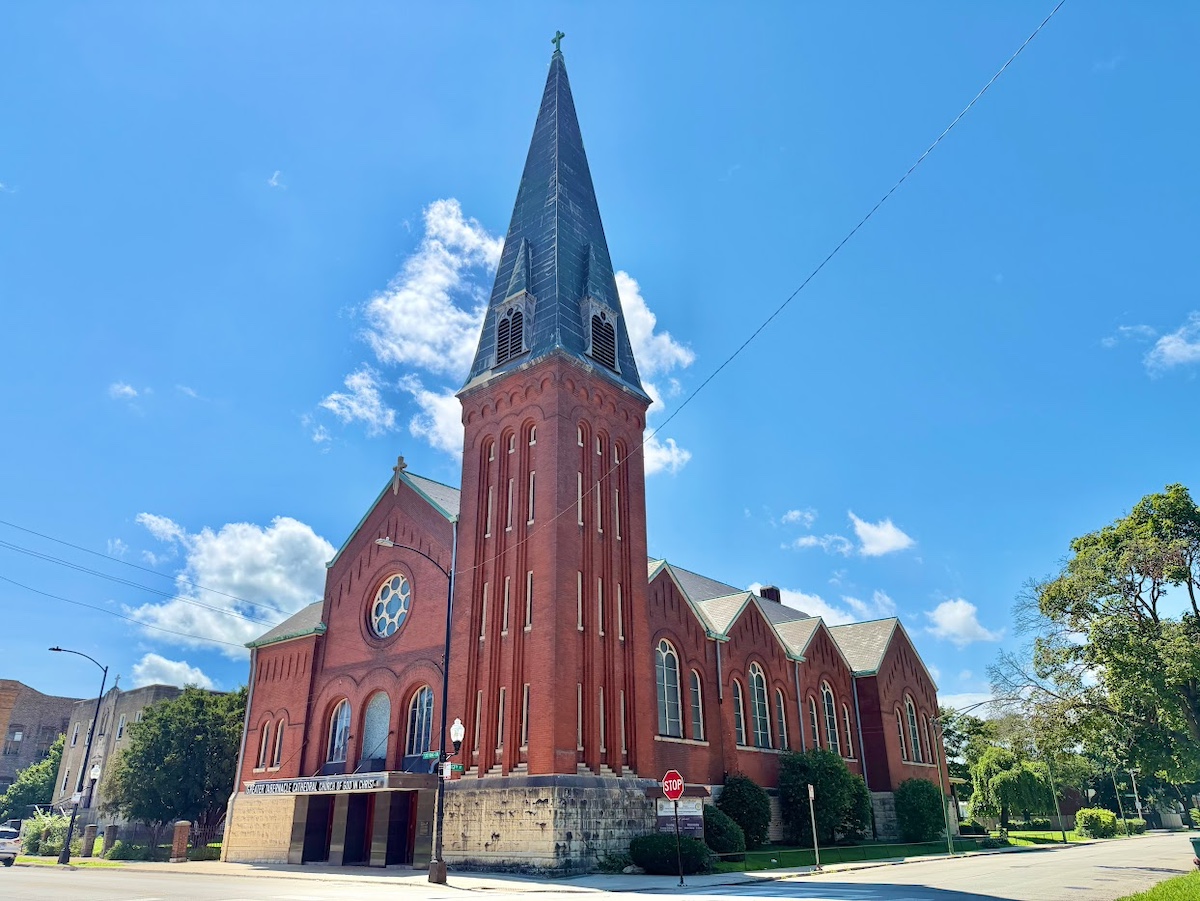
For nearly 140 years, a church has dominated the corner of 113th and King Drive. The origins of that red brick masterpiece, now known as the Greater Tabernacle Cathedral, lie in the days when Pullman and Roseland were both young. Roseland is the older neighborhood, founded on what was originally Potawatomi land, and where Dutch farmers and abolitionists settled as early as the 1840s. The model town George Pullman founded to house his factory workers would come in the 1880s, carved out of Roseland’s southeastern flank.
Pullman’s curious blend of paternalistic capitalism extended into even the religious lives of his employees. In 1882, Pullman’s gorgeous Greenstone Church was completed, designed—like the rest of the neighborhood—by architect Solon Beman, and clad in serpentine limestone quarried at great expense in Pennsylvania. Determined to see a return on this investment, Pullman came up with a three-step solution to a costly problem: 1. Refuse to sell land to religious groups. 2. Rent out Greenstone for an annual sum of $3,600 (about $132,000 in today’s money). 3. Profit.
No one could pay such an exorbitant price, and the church sat empty for years while religious groups met elsewhere, including the fledgling Catholic parish of Holy Rosary. After outgrowing several spaces, the parish, led by Father John Waldron, decided to build a permanent home. The southwest corner of 113th and South Park (now King Drive) looked perfect, but was owned by George Pullman. Surprisingly, Pullman entered into a verbal agreement for the land after first extracting a promise that the new church be designed by architect Solon Beman and built of red brick to match Pullman.
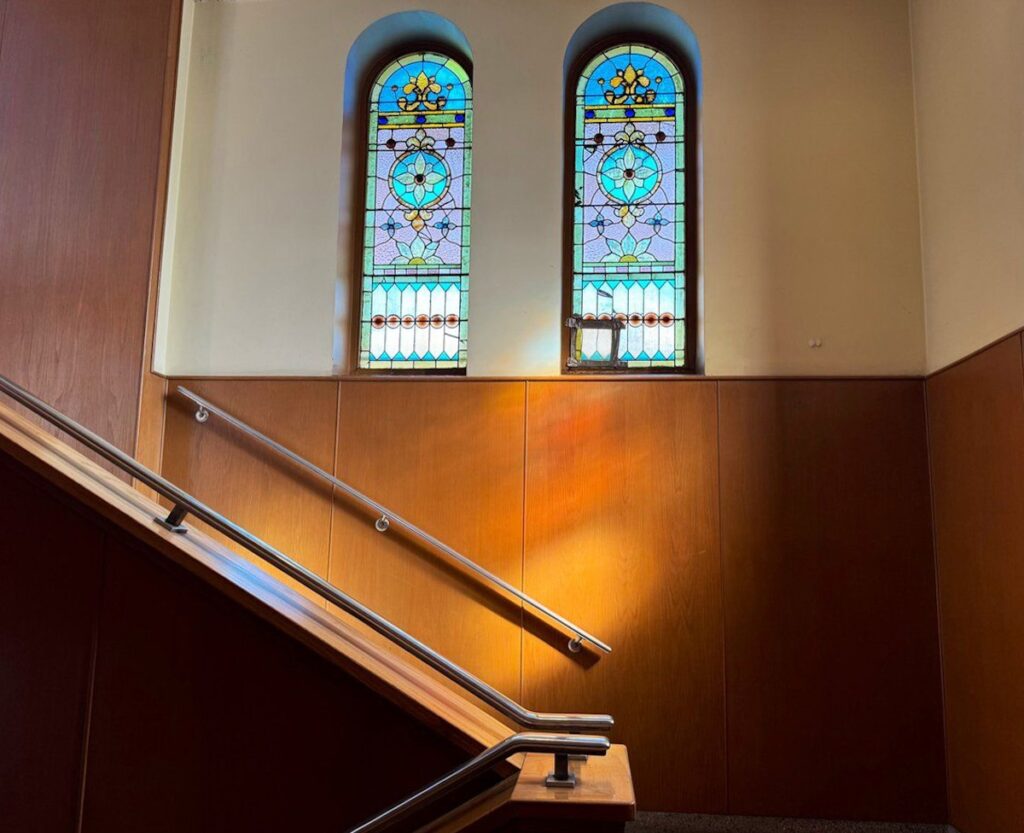
Credit: Cristen Brown
Construction was underway when Pullman reneged on the deal and work halted. Waldron was incendiary in the pulpit, and was quoted in the Chicago Daily News torching the industrialist as a “capitalistic czar; a man who ruled, crushed and oppressed by the force of money.” Work restarted, but not before more scandalous ink was spilled in the papers and Waldron resigned, perhaps not voluntarily. Still, by 1890 construction was finally complete.
Holy Rosary was spectacular. A Romanesque Revival beauty sitting on a heavy base of rough-hewn limestone, the upper reaches of the massive structure clad in red face brick, just as Pullman demanded. Boasting an enormous bell tower with a cross-topped spire, its soaring majesty was further emphasized by the flatness of Palmer Park directly across the street. Presiding over a neighborhood of smaller buildings, it is deliberately imposing. The architecture itself meant to invoke a feeling of a vast and immutable power.
In the neighborhood of Pullman, George Pullman’s great experiment was drawing to a close. The following years would bring the infamous strikes, the death of Pullman himself, and an order from the Illinois Supreme Court that the Pullman Palace Car Company sell all of its residential properties. Roseland, however, was thriving. Spacious new homes were built and stores sprang up along Michigan Avenue, which was establishing itself as a major shopping destination. But not everyone was welcome.
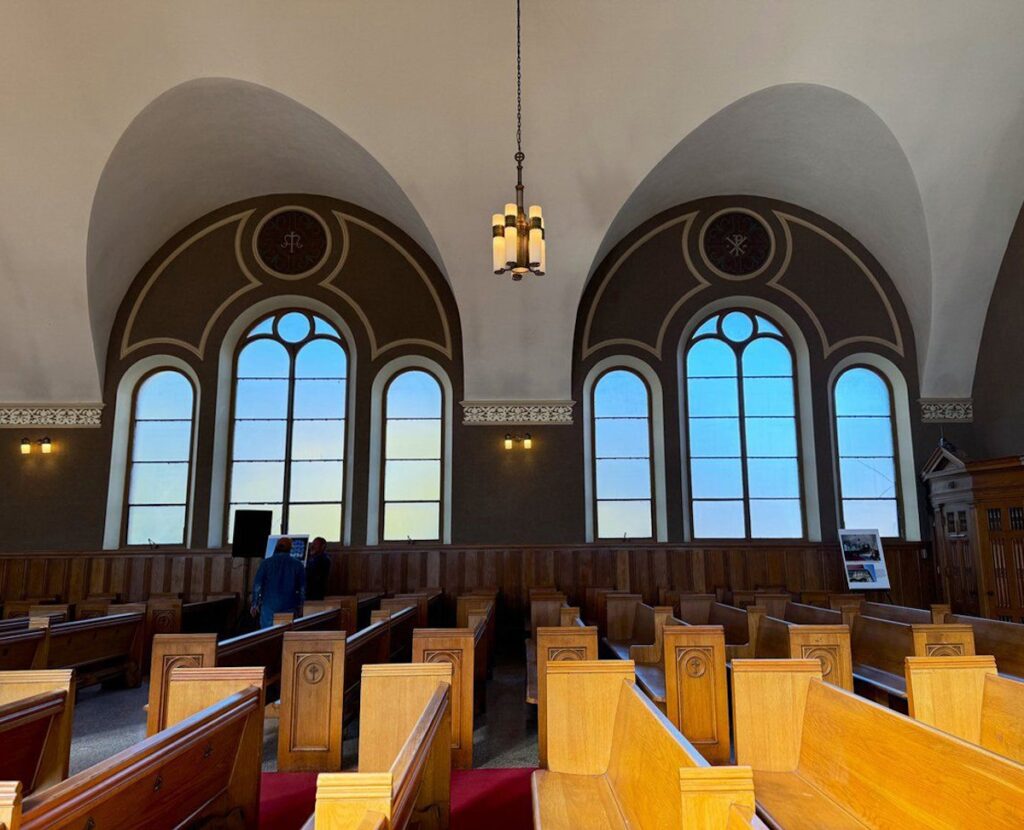
Credit: Cristen Brown
In reaction to the Great Migration, neighborhoods across Chicago began to implement racially restrictive covenants barring Black people from living within their boundaries and confining them to the “Black Belt.” According to the Encyclopedia of Chicago, Roseland, a “community that was once a stop on the Underground Railroad, added whiteness to its list of advantages.” Directly across the street from Holy Rosary, a racially restrictive covenant was signed by 24 neighbors in 1929, intending to keep Black folks out until at least 1950, according to the Chicago Covenants Project.

In 1948, however, covenants were ruled unenforceable by the Supreme Court, and Black people around Chicago began to push against the boundaries that had held them in place for decades, eventually moving to neighborhoods as far south as Roseland. These new families were rarely embraced. Though Holy Rosary was itself integrated, many of its white congregants began to leave the community in droves. Racial demographics inverted, and the Archdiocese reports that by the mid-1960s the parish’s school was almost entirely Black.
Holy Rosary, however, stayed, absorbing demographic shifts and adapting to the evolving needs of the community despite its shrinking congregation. In the 1980s, they offered office space in their underutilized rectory to the fledgling Developing Communities Project (DCP), a faith-based nonprofit working to bring change to South Side neighborhoods through grassroots organizing. Working from this office for several years before enrolling in Harvard Law School, the DCP’s first Executive Director, Barack Obama, refers to these years spent at Holy Rosary as “the best education” he ever had.
After a remarkable 126 years of serving Roseland, Holy Rosary closed its doors in 2008, when its congregation became too small to justify keeping the enormous campus open. The church complex was leased to New Day Ministries International for several years, and then sold to Greater Tabernacle Cathedral, a Pentecostal congregation with a long history of community support stretching back to its founding in the 1950s.
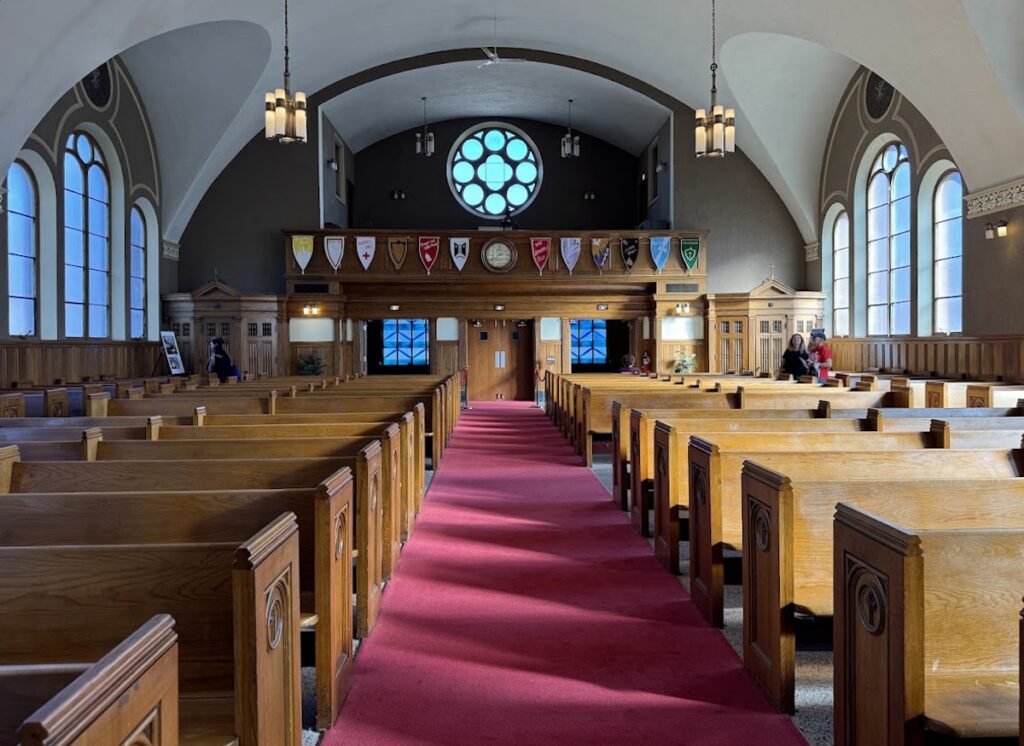
Credit: Cristen Brown
Grand Tabernacle lovingly stewards the building today, celebrating its long history of service to Roseland, and extending it. During their tenure in the building, they worked to have the church added to the National Registry of Historic Places and saw it become a Chicago Landmark, honoring the fact that, as they say on their website, “for generations, this sacred space has stood as a beacon of faith, worship, and community strength on the South Side of Chicago.” The church’s own mission of “strengthening families, empowering communities and transforming lives” ensures that this building will continue to stand as a beacon in Roseland.
Greater Tabernacle Cathedral, 11300 South Dr. Martin Luther King, Jr. Drive. Sunday School at 9:30am on Sundays, and morning worship at 11am on Sundays. (773) 264-9000. gtccogic.org
Born and raised on the far South Side, Cristen is an educator, local history enthusiast and architecture obsessive. She is deeply invested in discovering the many ways the built environment informs our understanding of Chicago’s past, present and future.
Greater Tabernacle Cathedral, 11300 South Dr. Martin Luther King, Jr. Drive has also been featured in Open House Chicago since 2024. The OHC 2026 hours are Saturday 10am-5pm and Sunday 1 – 5pm. October 17–18, 2026 Please stop in for a chance to see this gem in person.