
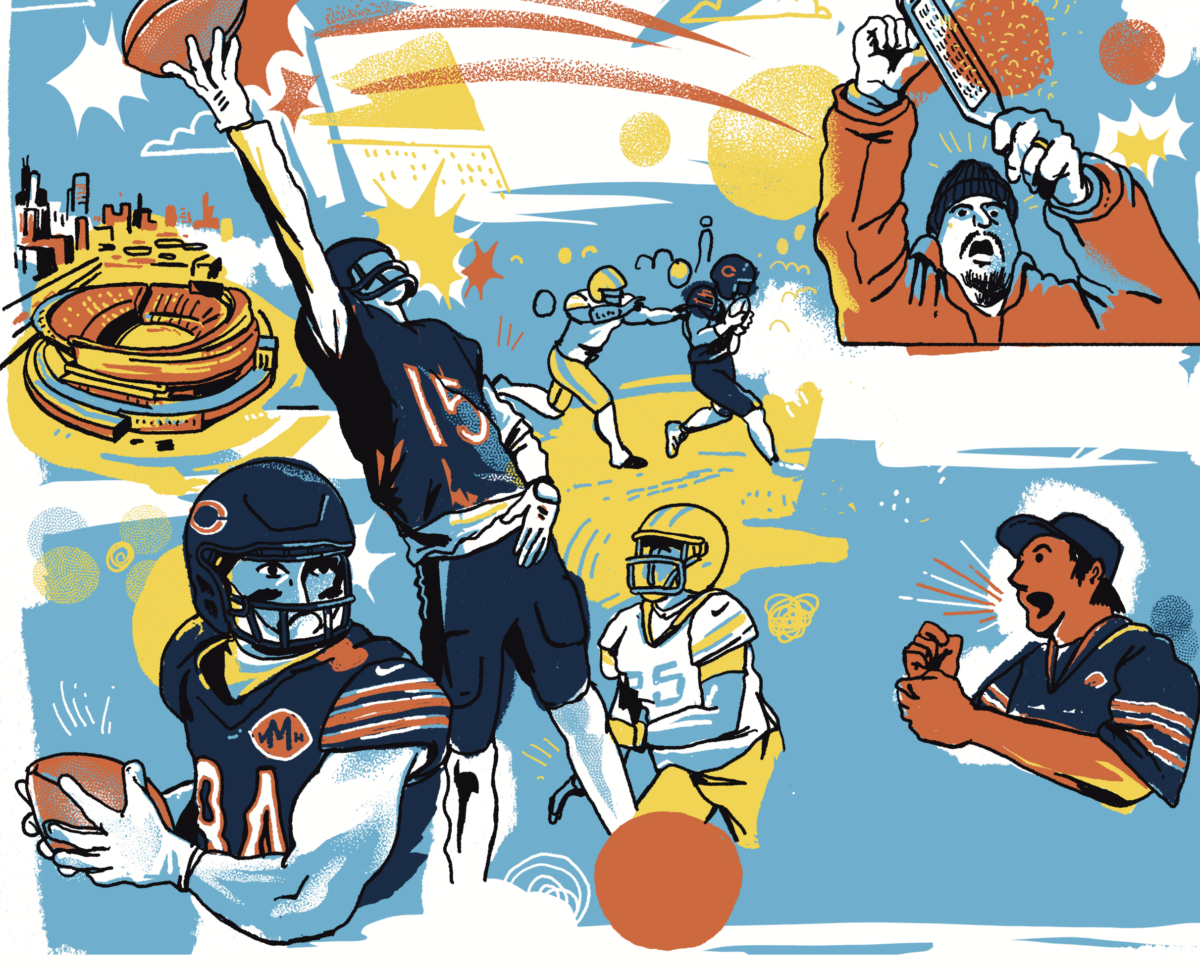
Chicagoans love their sports. When a team is good, they rally, and they rally hard. But after years of mediocre teams, the intensity of renewed interest in the suddenly competitive Bears feels remarkable. It didn’t go unnoticed outside of Chicago, either. Longtime television play-by-play man Al Michaels has probably called as many NFL games as anybody alive right now. Near the conclusion of the Bears’ stunning playoff victory against the Green Bay Packers, an awestruck Michaels declared, “I’ve done thirty-one games in this stadium and it’s the first time I’ve felt it shaking like this.”
That seismic reaction to a scoring play at Soldier Field came despite the fact that the Bears still trailed late in the game. You can imagine the pandemonium twenty minutes later, when a dramatic touchdown pass gave them the lead that would complete a historic comeback and give Chicago its first playoff win in fifteen years.
If you’re more into quantifying things, here’s a number for you: 45 million. That’s roughly how many viewers watched the subsequent week’s matchup with the Los Angeles Rams, making it the most-watched divisional round playoff game in the history of NBC’s football broadcast. This was just a week after the Bears’ victory against Green Bay became the most-streamed NFL game ever, drawing in a record 31-million-plus viewers on Amazon Prime Video. That would have beaten every non-Thanksgiving broadcast during the NFL’s regular season—for a game that wasn’t even available on television for most of the country!
Such mania wasn’t limited to Soldier Field. Despite hailing from the Bay Area, where the 49ers and Raiders reign supreme, twenty-three-year-old graduate student Raunak packed into Jimmy’s Woodlawn Tap in Hyde Park alongside dozens of buzzing Bears fans for the game against the Rams. “The entire bar was more packed than I’ve ever seen,” they told the Weekly. “There was a collective energy in the room animating [fans’] desire to win. You could tell that everyone, regardless of whether they knew each other, where they’re from, or how they’re related to each other, all wanted to see the Bears win.”
That’s not necessarily unique in and of itself. Chicago has no shortage of raucous sports bars. What made this unique was a palpable sense of joy at the fact that there was something to be excited about. Sports fans love to argue, but there seemed to be a rare unity of satisfaction with the Bears this fall as they racked up improbable win after improbable win. Fans seemed happy simply to have made it that far. And though they ultimately lost to the Rams in heartbreaking fashion, they gave their fans one more instance of magic and elation in a season defined by such moments. As a desperate fourth-down heave from quarterback Caleb Williams found the arms of Lake Barrington native Cole Kmet for a game-tying touchdown, for just a moment, Jimmy’s shook like Soldier Field.
Fifteen years is a long time without a taste of victory, but it’s not the first time in recent years that Bears fans have seen playoff football. Why did this particular team seem to elicit such an exuberant reaction from dedicated and casual fans alike? Their 11-6 regular season record was good, but far from spectacular. In both of the team’s historical Super Bowl runs—1985 and 2006—they were more or less their conference’s best team from the outset of the season. Entering 2025, few analysts or fans expected the Bears to even secure a playoff spot, much less reach the cusp of the NFC Championship.
Alfred Anderson has known this team as long as anyone you’re likely to run into. “I’m seventy-two years old and I’ve been looking at the Bears since I was about ten,” he told the Weekly. “I actually thought [this year] was going to be a repeat of all the other bad seasons.”
Bears history provides no shortage of bad seasons. Despite being among the NFL’s oldest and most storied franchises, they’ve won just one Super Bowl, and appeared in only one more. Between that last playoff win in 2011 and the start of the most recent campaign, their .412 win percentage ranked twenty-seventh out of thirty-two teams.
Though surprising to most, the turnaround to their first NFC North title since 2018 didn’t come as a complete shock. There were signs that things would be a little different than in years past, for those who were looking.
There was the presence of quarterback Caleb Williams, the top pick in the 2024 NFL draft who some believed was primed for a breakout after an uneven but promising rookie campaign. Perhaps more important—at least for public perception—were sweeping changes made to the coaching staff, highlighted by the hiring of Ben Johnson last February as the nineteenth head coach in the team’s 106-year history. Longtime season ticket holder Stefan Mozer called the Bears’ season “terrific” in light of low preseason expectations, opining that “perhaps most of all, the change in the coaching situation” was at the heart of the unexpected success. “I thought that Ben Johnson, when he was hired, was the kind of guy who would make a difference,” he said.
Considered an offensive innovator who helmed a high-powered Detroit Lions offense from 2022 to 2024, Johnson had been the NFL’s most sought-after coaching candidate for two years running prior to taking over the Bears. His decision to choose Chicago surprised fans and analysts alike. Their reputation for losing and organizational dysfunction had long been considered a major deterrent for well-qualified coaching candidates. (“Bad news Bears!” Raunak had laughed when asked about their impression of the team before the season.)
The combination of Johnson’s strategic chops with Williams’ quarterbacking abilities were a sign that Chicagoans might want to start paying attention. Still, some fans, including Mozer, harbored doubts about Williams’ ability to be a Bears’ long-awaited franchise quarterback. The team’s historical futility at the position is well-documented. No Bears quarterback has appeared in more games than Sid Luckman, who last took a snap in 1950. The Bears are the only team to have never produced a 4,000-yard passer in a season. The possibility that they may have finally found “the one” is a large part about why Bears fever swept through the area so intensely as their winning ways continued
“I’ve had several friends say to me they think that Caleb and crew are here to stay for a number of years and will make a difference going forward,” Mozer said. “I think the belief is generally that there’s a better foundation than there’s been in many years.”
Anderson agrees. “I think I’m seeing a team that I saw back in ’84,” he said. “Even though they didn’t win it, I knew that with Ditka at that moment and the team they had… I knew the next year was going to be something to watch. That’s the way I feel about this team.”
That’s high praise, given that virtually every Bears team since has lived in the shadow of the famed 1985 squad. Not only were they one of the most dominant teams in league history, their collection of personalities made them cultural icons. There’s no modern point of reference for the ’85 Bears releasing the hit song “Super Bowl Shuffle” mid-season, or helping inspire the Saturday Night Live skits that birthed the now-ubiquitous exclamation: “Da Bears!”
That peak was brief, and fans have been chasing it ever since. Despite being a lifelong Chicagoan and a dedicated football fan, Mark Patterson isn’t a Bears fan. That’s because for most of his life, as he put it, “they basically stunk!” It’s not an uncommon sentiment around Chicago. Seeing things from a more neutral (though no less invested) perspective, Patterson was struck by the “overflowing bandwagon” that developed as the team’s improbable playoff hopes became reality.
Fans across the spectrum agree that just about everyone had a good time with the Bears this season, despite the heartbreak at the end. It’s the kind of sentiment that gave this past season the feeling of magic in the air—and that the start of something special was brewing. Anderson took note of the reaction Bears fans at Soldier Field had to the season-ending loss on the 18th.
“When they walked off the field,” he noted, “everybody stood up and gave them a standing ovation.” The sentiment, he felt, was that while fans were disappointed, they were grateful rather than angry, an all-too-rare collective reaction in the sports world. It’s a sentiment we’d do well to remember as we move into what might be the most promising era of Bears football most of us have ever seen.
Malachi Hayes is a Bridgeport-based writer and South Side native.
This article is spot on! Well written and captures the Chicago sentiment!
What an exciting season!