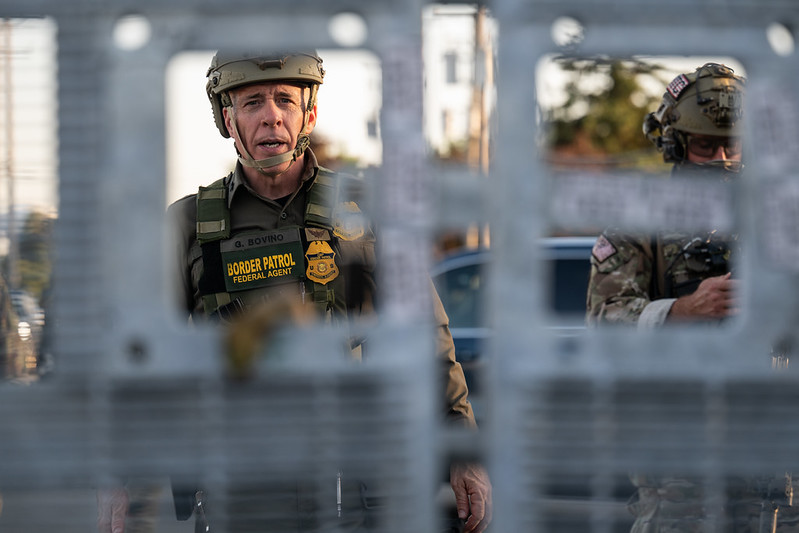
Juan Espinoza Martinez hugged his attorney Jonathan Bedi after the verdict—not guilty—was read aloud in a federal courtroom in downtown Chicago on Thursday afternoon. Since early October, the thirty-seven-year-old father, brother and Little Village construction worker had faced a federal murder-for-hire charge. Federal prosecutors alleged Espinoza Martinez had put out a $10,000 hit on Customs and Border Patrol (CBP) Commander Greg Bovino. He endured months in federal custody, and Tribune journalist Jason Meisner reported he withdrew a pretrial release motion in late November after hearing Immigration and Customs Enforcement (ICE) had a detainer out for his arrest.
After all that, a federal jury acquitted him after deliberating for about three hours.
“From day one, we said the government could not prove Juan engaged in any murder-for-hire plot. They could not,” Bedi and his fellow defense attorney Dena Singer said in a Friday press release on the verdict.
Despite the acquittal, Espinoza Martinez is not yet a free man. Echoing the release hearing in November, Immigration and Customs Enforcement (ICE) took him into custody following trial. Publicly available ICE data indicates that at time of writing, he had been moved from Chicago to a detention center in Clay County, Indiana. Espinoza was a DACA (Deferred Action for Childhood Arrivals) recipient who’d lived in Chicago since he was five years old, but according to the Tribune, he failed to renew his status in 2020 due to financial hardship.
The Weekly reached out to Espinoza Martinez’s immigration attorney for comment regarding his status in ICE custody, but did not hear back by press time.
His trial lasted less than three days. Jury selection began Tuesday morning, attorneys read their opening arguments Wednesday morning, and the jury received the case early Thursday afternoon. Jurors heard from only four witnesses in total. Prosecutors called to the stand Homeland Security Investigations (HSI) agents Christopher Perugini and Donald Adams, as well as self-professed longtime law enforcement informant Adrian Jimenez. Espinoza Martinez’s defense attorneys called only one witness, his brother Oscar Martinez.
Jimenez testified he owns a construction business and first met Espinoza Martinez when Espinoza Martinez reached out for work. At the heart of the case was a Snapchat message Espinoza Martinez sent to Jimenez in early October.
Accompanied by a photo of Bovino, it read, “2K for info cuando lo agarren [“when they catch him”] / 10K if u take him down / LK 🤘🏽🤘🏽🤘🏽 on him.”
Jimenez, who also testified he’s been a law enforcement informant since “the mid ’90s,” said he contacted a federal agent about the message “almost immediately.” It kicked off an investigation that, by all accounts, Espinoza Martinez cooperated with. Federal agents arrested and interviewed him on October 6, after he willingly waived his right to remain silent or to have an attorney present. Jurors also saw Espinoza Martinez consented to a search of his phone and provided federal agents with the means to access it.
During that interview, clips and transcripts of which jurors saw at trial, Espinoza Martinez repeatedly insisted that he never meant to threaten anyone. He told the agents he was only repeating things he’d heard around the neighborhood, including gossip allegedly from the Latin Kings gang — the “LK” referenced in his message.
“I’m not hiring anybody,” he told the agents at one point in the interview.
The agents didn’t take him at his word.
“What else do you have on your phone?” one of the agents asked Espinoza Martinez at one point, as he became visibly more nervous.
A grand jury returned an indictment against him on October 14 for murder racketeering, a charge that carries a maximum ten-year prison sentence on conviction. Over the course of the trial, prosecutors showed jurors the “2K/10K” message, along with other Snapchat messages related to Bovino and immigration agents’ activity that Espinoza Martinez shared.
They argued that, taken together, the messages represented Espinoza Martinez’s serious attempt to solicit Bovino’s murder, in response to the threat the Border Patrol commander and other federal immigration agents posed to Chicago’s Little Village community this past fall.
“What those messages show is that he was angry, he didn’t like [what] was going on in his neighborhood,” federal prosecutor Jason Yonan told jurors, further arguing Espinoza Martinez was “fixated” on Bovino.
Prosecutors also pointed to a picture advertising a for-sale handgun, which Espinoza Martinez shared with his brother not long after he messaged Jimenez.
“That message was sent by the defendant within twenty-four hours of him sending a message about a murder for hire. It speaks for itself,” Yonan said.
Prosecutors even deemed Espinoza Martinez’s use of Snapchat suspect, noting the platform’s disappearing message feature.
“He could have sent it on another medium, but he didn’t. That is also evidence of his intent,” Assistant U.S. Attorney Minje Shin argued.
Espinoza Martinez’s defense team painted a much different picture of the messages. They argued he had merely shared “neighborhood gossip,” and pointed to a lack of material evidence that he tried to facilitate or pay for Bovino’s murder.
“You’re not gonna see wire transfers,” Bedi told jurors.
Oscar Martinez’s testimony bolstered that narrative. He said on the stand that he took his brother’s messages about a hit on Bovino as a joke.
“Nobody’s gonna do it for $10K,” Martinez said on the stand.
Martinez’s testimony also countered the government’s argument about the handgun advertisement. He said he is legally licensed to own firearms in Illinois, and that his brother sent him the advertisement because he was already looking for a gun like that.
Specifically, Martinez said he was attracted to the gun because its handle was emblazoned with a depiction of St. Jude, the family’s patron saint.
“It was only because it had St. Jude in the handle?” Bedi asked Martinez at one point.
“Yes,” Martinez answered.
Singer argued that taken together, the prosecution’s case represented an “overreaching government” —one she urged the jurors to stop.
Interwoven among the arguments from both sides was the issue of the Latin Kings.
Court documents show Perugini, even before the October 6 interview, believed Espinoza Martinez was a Latin Kings gang member, and a “high-ranking” one at that. In an affidavit dated October 5, Perugini wrote he believed Espinoza Martinez had “authority to order other [Latin Kings] members to carry out violent acts, including murder.”
The Department of Homeland Security (DHS) echoed the claim Espinoza Martinez was a Latin Kings gang member in an October 6 press release, as did the Justice Department in its own statement that day.
Assistant Homeland Security Secretary Tricia McLaughlin called Espinoza Martinez a “depraved” individual “who [did] not value human life” in prepared remarks accompanying the October 6 DHS press release, and repeated the claim he was a Latin Kings member on social media later that month. The DOJ added Espinoza Martinez was an “alleged” gang member, though its statement also included a comment from Chicago HSI Special Agent-In-Charge Matthew Scarpino calling Espinoza Martinez a “ruthless and violent member of the Latin Kings.”
Espinoza Martinez’s attorneys argued he was neither a Latin Kings member nor a member of any gang, and the claim fell apart before trial. Presiding U.S. District Judge Joan Lefkow barred certain testimony and material related to his alleged gang membership from the trial in a January 15 memo.
“Without evidence showing that the defendant is a member of the Latin Kings or that the Latin Kings instructed defendant to send the alleged murder−for−hire information, the prejudicial nature of such testimony outweighs any probative value in violation of [federal evidence rules],” Lefkow wrote.
Federal prosecutors nevertheless alluded to the Latin Kings multiple times over the course of the trial. In closing rebuttal arguments, Shin argued it didn’t matter if Espinoza Martinez was actually in the gang or not. If the Bovino hit info came from the Latin Kings, Shin said, and Espinoza Martinez passed the info along with the hopes of action, he “made it his own.”
Following the acquittal, neither the Justice Department nor DHS had taken down their October statements deeming Espinoza Martinez a Latin Kings member, and they remain online as of press time. The DOJ did update their statement to note a jury found Espinoza Martinez not guilty; DHS’ statement remains unchanged.
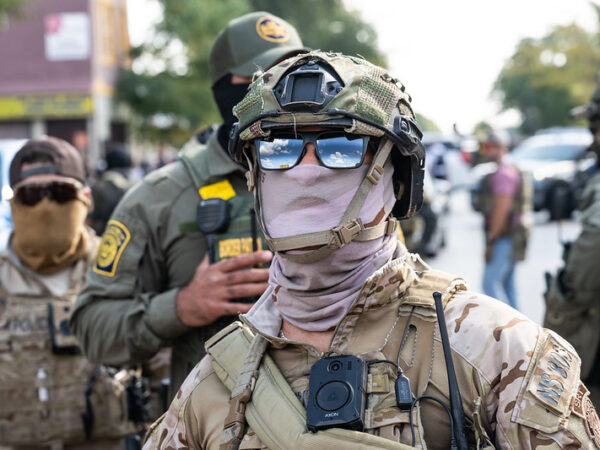
There’s evidence DHS’ narrative around the Latin Kings impacted more than just Espinoza Martinez himself, even influencing on-the-ground federal immigration agents during Midway Blitz.
Multiple reports Border Patrol agents filed regarding their October operations in Chicago, made public per a court ruling by U.S. District Judge Sara Ellis, referenced their fear of alleged bounties placed on law enforcement. One agent specifically cited Latin Kings bounties in his justification for deploying chemical weapons in Little Village on October 23, claiming the situation was “highly dangerous” and in need of “immediate resolution.”
Bovino himself made a nearly identical claim in his own report describing his use of chemical weapons in Little Village that day.
“I felt this was an emergent, highly dangerous situation, especially in light of the aforementioned bounties placed on the heads of law enforcement, in need of immediate resolution for both the safety of Border Patrol agents and the public,” he wrote.
Espinoza Martinez is now the fifteenth person whose federal charges stemming from the so-called Midway Blitz mass deportation campaign have fallen apart in court. His case is the first of the Midway Blitz cases to reach trial.
The Justice Department did not respond to a request for comment by press time. Far right White House Deputy Chief of Staff Stephen Miller, however, took to X (formerly Twitter) last Thursday to rage over Sun-Times reporter Jon Seidel’s post on the verdict.
“Leftist judges and juries are empowering violent insurrection against the government in an effort to stop ICE from removing criminal alien invaders,” Miller wrote.
Bedi And Singer had a different take.
“This case is exactly why we have juries and an example of the power of the Jury Trial,” they said in their Friday press release. “Twelve ordinary citizens stood between an overreaching government and an innocent man.”
Dave Byrnes is a Chicago-born independent journalist covering the Trump administration’s anti-immigrant blitz. He lives in Lincoln Square, but is a lifelong White Sox fan.