
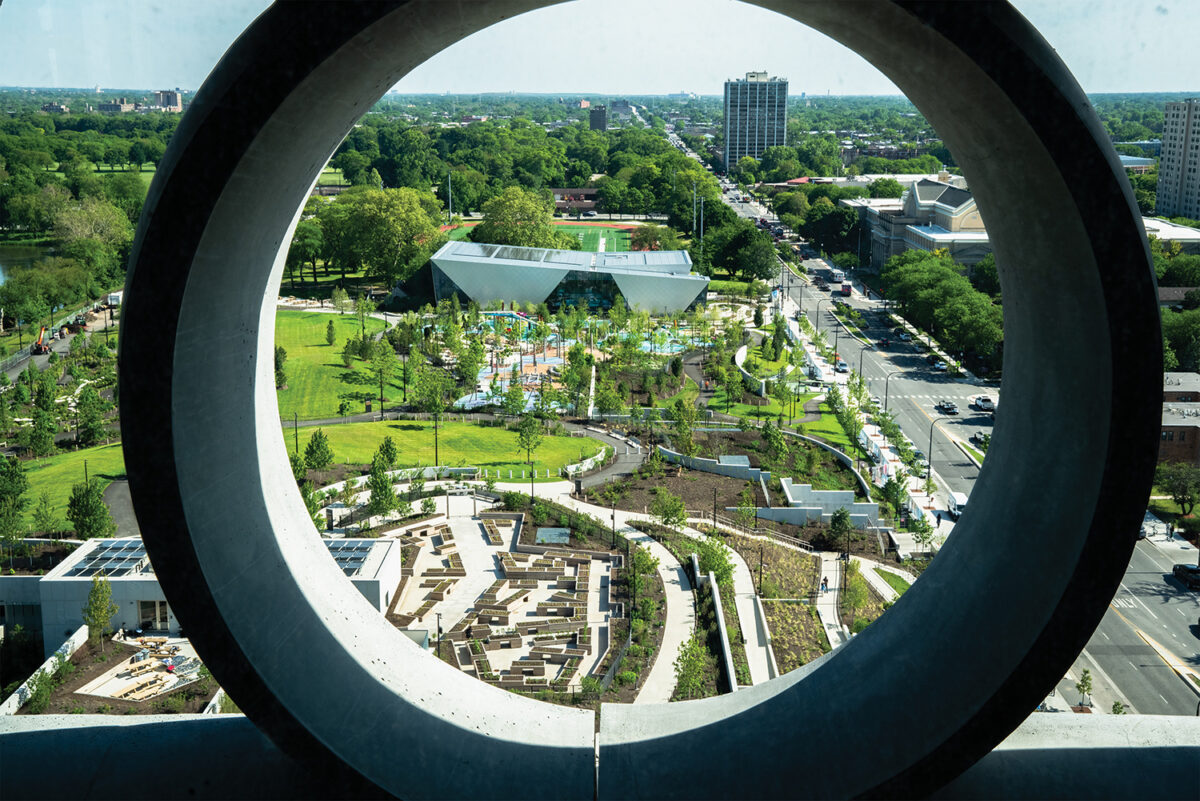
After a joyous opening over Juneteenth weekend, the Obama Presidential Center—the neobrutalist monument to Barack Obama’s presidential tenure—now looms over Hyde Park. Coverage of the opening generated great demand and interest, with tickets already selling out through most of November.
The towering museum chronicles Obama’s path to power, an elevated garden nods to Michelle Obama and Eleanor Roosevelt, and a gleaming basketball court honors the president’s favorite sport. The Center aims to cement the legacy of the nation’s first Black president in the neighborhood where his political career began, nearly a decade after Obama left office.
Though some architecture critics have criticized the Obama Center’s museum building for resembling an “Obamalisk,” “Obamausoleum” and “a forbidding tower,” its interior is an unfussy and grounded counterweight to its solemn, gray exterior. Every design element is thoughtful and polished, attending to accessibility or aesthetics. Displays include descriptions in braille, and several add tactile elements, like cloth samples from former First Lady Michelle Obama’s ensembles.
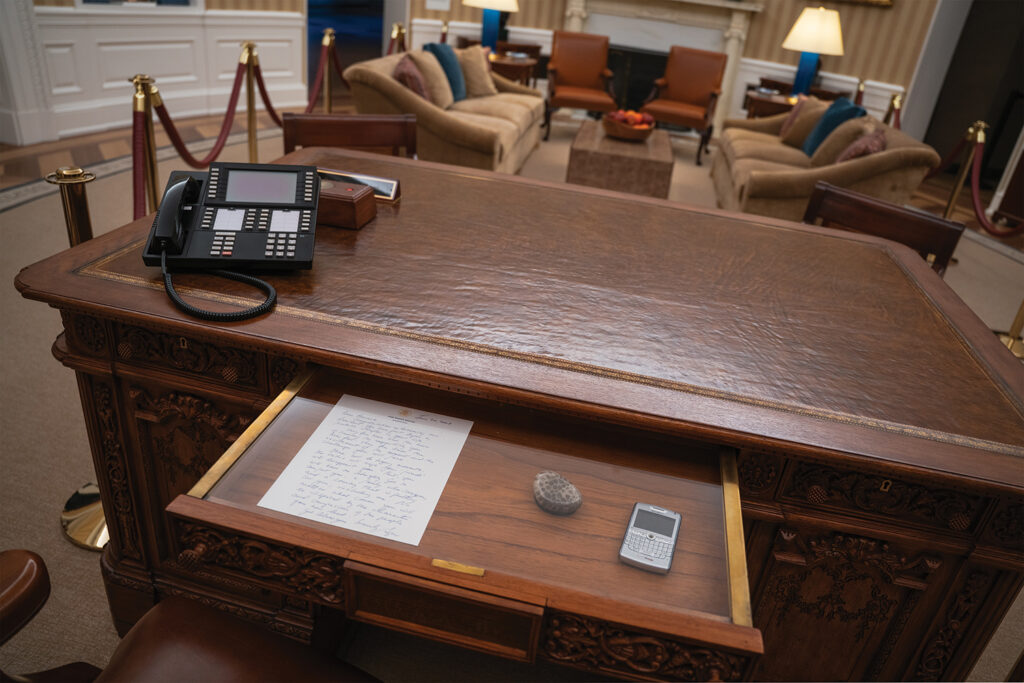
Museum visitors will even find a full-scale replica of the Oval Office, donated by Chicago-born TV writer Shonda Rhimes, who knows a thing or two about designing those interiors for seven seasons of the White House drama “Scandal.” The detail in the office is astounding; there are duplicates of the Resolute Desk, Frederic Remington’s “The Bronco Buster” statue and Charles Alston’s bust of Martin Luther King Jr.
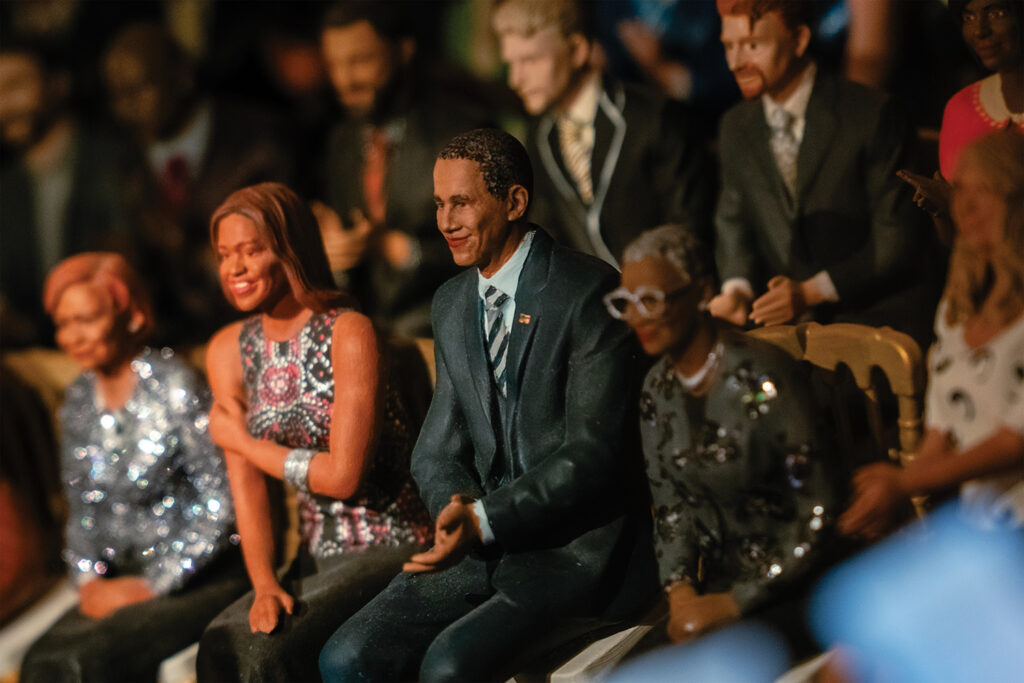
The exhibits refer to the former president as “Barack,” an intentional choice that creates a casual intimacy with him. The soundtrack playing throughout the museum grooves to “Who’s That Lady?” by the Isley Brothers and “Signed, Sealed, Delivered (I’m Yours),” a favorite Obama campaign walk-out song that Stevie Wonder played on the final night of the 2008 Democratic Convention.
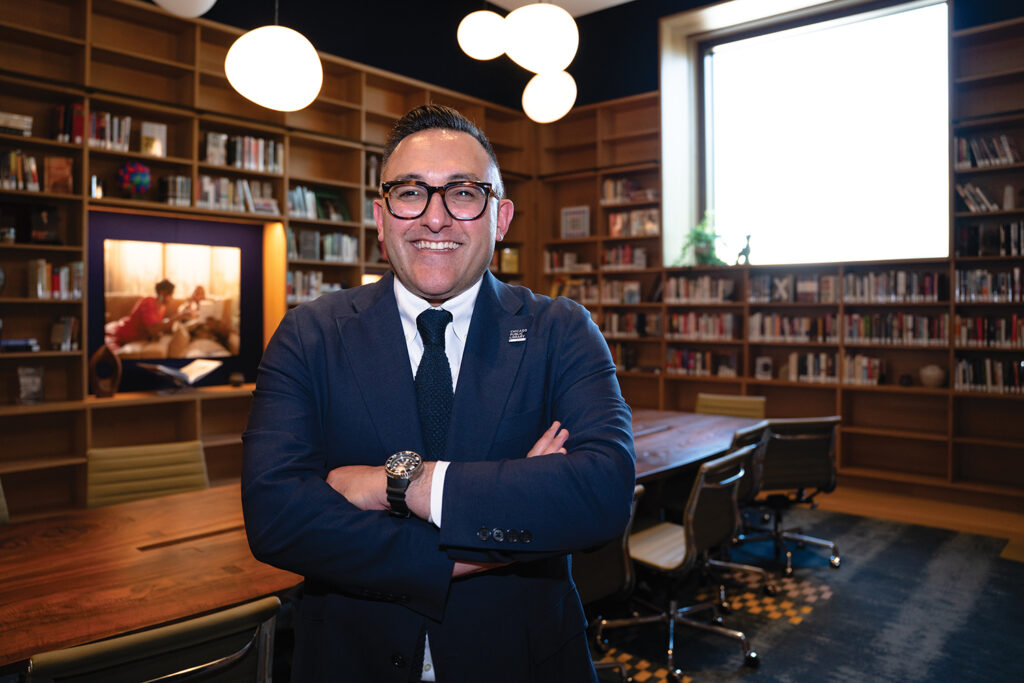
Beyond perusing the museum, the public can gather at a new branch of the Chicago Public Library, where they can climb atop the roof to learn about growing fruits and vegetables in a garden managed by Chicago Botanical Gardens. The great lawn, between 61st and 62nd streets, unfurls into a colorful playground with squishy grounds to cushion falls, and slides disguised as mallard ducks nestled between giant cattails.
But like its sphinxlike namesake, the Obama Presidential Center is enigmatic, and a bit contradictory. The Obamas have constructed a 21st-century response to Daniel Burnham’s “White City”—the nickname for the 1893 Columbian Exposition in Jackson Park—with a sprawling campus that features an expansive forum and an imposing granite tower that will awe and inspire some visitors. It’s a gem for Hyde Park residents, providing public grills for cookouts and rolling lawns for sledding season.
Yet it’s also a magnet for gentrification. And the history of the OPC is marked by public refusals by Obama and Center leadership to sign a community benefits agreement (CBA), despite repeated calls to do so by South Siders and Mayor Brandon Johnson. These tensions color the new institution, which has global ambitions and scale, but a heart and sense of place anchored on the South Side.
“I met people, many of them right here, on the South Side, who taught me that true leadership is about listening, building trust and helping people tap into their own power,” Obama says over the museum’ audio guide.
The broader community plays a major role on the museum’s second floor, which takes visitors through Obama’s early days. Rounding a cylindrical display emblazoned with the word “Hope,” a voiceover narration by the Obamas chronicles their time raising their children in Hyde Park.
“She was a South Sider by birth and I was a South Sider by choice,” Obama says. “Chicago is where everything most precious to me began.”
The exhibit also showcases Obama’s rapid political ascent, starting with his community organizing in the 1990s, state senate tenure into the 2000s, and his successful campaign for Illinois’ senate seat in 2004. One case cites former Chicago Mayor Harold Washington as one of Obama’s inspirations, displaying campaign buttons for Washington next to an “in memoriam” card for the city’s first Black mayor. (Washington died of a heart attack in 1987, just two years after Obama arrived in Chicago.)
Shortly after he was inaugurated as State Senator for Illinois’ 13th district in 1997, Obama even wrote a Hyde Park Herald editorial about the challenges he would face in Springfield.
“…perhaps the biggest impediment to change in Springfield is the lack of meaningful engagement in the process among ordinary citizens, and particularly those persons most vulnerable to government action—or inaction,” Obama wrote.
The center also grounds itself through commissioned artwork by South Side artists. Norman Teague designed eight wooden benches throughout the museum. The smooth, solid walnut benches serve as seating and as art, with a streamlined shape resembling canoes.
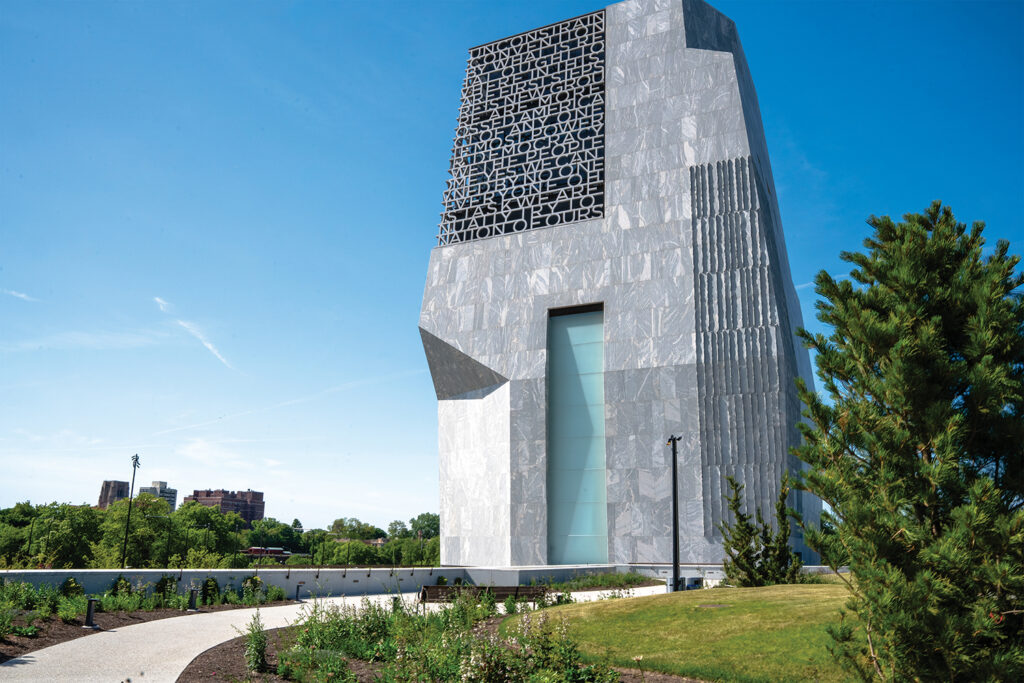
Inside the breathtaking Sky Room on the top floor, Teague’s benches feel more like church pews under a secular belfry housing Idris Khan’s hand-stamped, cobalt-colored words from Obama’s 2015 speech in Selma. Those same words wrap around the southwest corner of the museum’s exterior, one of the maligned architectural choices that from the outside looks like a jumbled crossword. But from within the Sky Room, the five-foot-tall, white, sans-serif font frames the Midway Plaisance and gothic buildings stretching westward.
Obama’s monument continues across the campus with an NBA-sized basketball court dubbed “Home Court.” On the upper deck, a mural of basketball players by Chicago artists Dorian Sylvain and Sam Kirk blends an athletic scene with the political message of “Pass It Forward.”
In a conversation with the Weekly, Sylvain recalled a robust community of Black theaters and artists from his time growing up on the South Shore in the 1960s, including DuSable Museum of African American History cofounder Margaret Burroughs and Gwendolyn Brooks, the first Black poet to win the Pulitzer Prize.
But Sylvain also noted that disinvestment on the South Side stripped the neighborhood of those cultural centers and once-thriving business districts. “Of course, now with the Obama Center opening, there’s this huge ripple effect. I literally can see the neighborhood changing, new families moving in, a lot of younger families, prices have gone crazy,” she said, adding that the foundation’s unwillingness to sign the CBA continues to rub neighbors the wrong way.
Last September, South Side advocates notched a win when Chicago City Council and Mayor Johnson passed the long-awaited CBA, giving limited easing preferences to displaced residents and establishing a property tax debt relief grant program for residents in Pilsen, Englewood, and South Shore. Notably, references to a long-sought community benefits agreement between the OPC and surrounding neighborhoods are notably omitted from Obama Center holdings and displays.
Some local tenants have already benefitted from the expanded fair notice under the Woodlawn and Jackson Park CBA, according to Dixon Romeo, executive director of Southside Together. But the CBA coalition, which includes Southside Together, is still trying to figure out how to mitigate rising rents in the area, he said.
Whether Dixon and other South Siders will be able to enjoy much of the center’s campus is still up in the air.
“It hasn’t opened yet, so we’ll see,” Dixon said. “My main concern is, I think basketball courts are dope, but you got to be able to live next to it to utilize it in a real way, right? If it pushes you out to the south suburbs, you got to drive two hours to get here, I don’t know if that benefits you.”
During a June 3 press conference, when asked how the foundation’s resistance to the CBA squared with Obama’s own legacy as a community organizer, Obama Foundation Chief Executive Officer Valerie Jarrett seemed to dig in her heels. Jarrett responded that the foundation entered into a “redevelopment agreement” with the city, which was approved by City Council and signed by the mayor. “Community benefits agreements typically are signed in partnership with representatives from the community. Well, we believe the representative for the community should be the City Council,” Jarrett said.
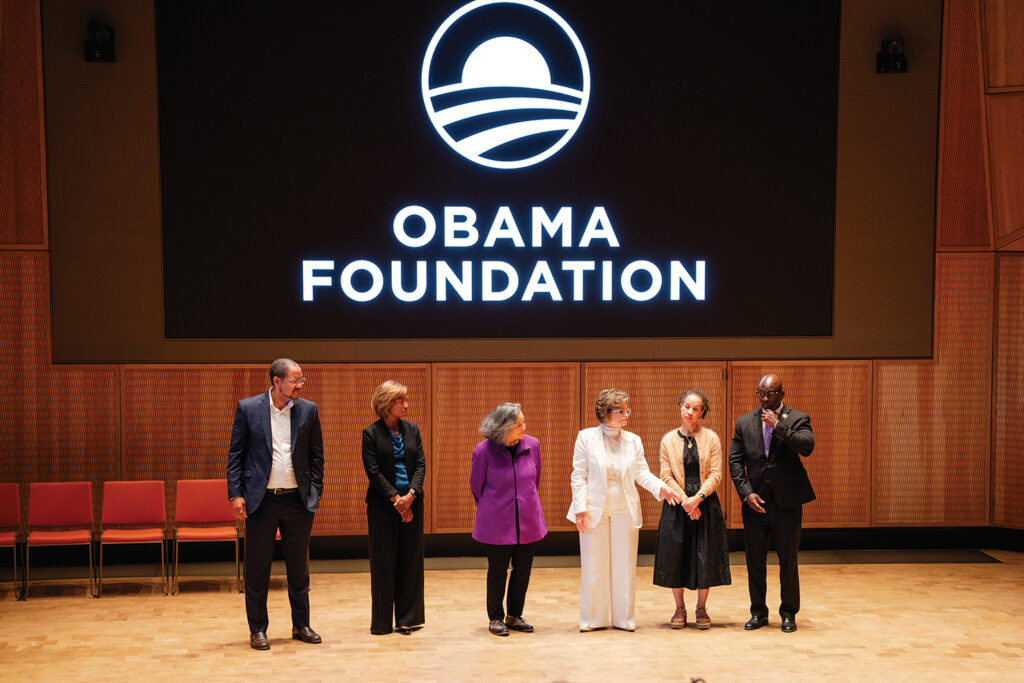
She added, “We posted on the website all of the commitments that we made, many of the commitments we made, as I said, came from the community process that we engaged in over many, many months, and we have lived up to every single commitment that we made, and so we want to be judged by the commitments we made, not an agreement with a self-appointed group of community representatives, so redevelopment agreement is the community benefits agreement.”
That “redevelopment agreement” appeared to refer to a “use agreement,” signed by Mayor Rahm Emanuel in 2018, which allowed the foundation to pay the city $10 to use the nearly 20-acre plot of land for 99 years. The legislation did not address curbing displacement in the area, a concern that Alderman Ray Lopez (15th) and then-Alderman Deborah Mell had raised before a committee vote at the time.
Housing costs in Woodlawn and South Shore, communities abutting the center, are on the rise; concerns about displacement are not abating. But as the OPC opens, there are also positive expectations about the museum. As Dorian Sylvain observed, “There is big love for Obama. There is also a neighborhood floundering, so to have these grounds for the neighborhood really means a lot,” she said.
The museum requires a paid ticket (for IL residents, $26 for adults and $15 for children; for out-of state visitors, $30 for adults, $23 for children), though the Center’s leadership has emphasized that the ground floor of the building, including the cafe and giftshop, will remain free to the public.
Leigh Giangreco is a freelance reporter based in Chicago. You can follow her work on Twitter/X @LeighGiangreco and at leighgiangreco.com.
James Hoeck is an independent photographer, journalist and artist. Hoeck is a freelance photojournalist with South Side Weekly.
Oh, goodness, all this fuss over the new center! While I certainly understand why everyone is feeling a bit protective of the neighborhood, I think it’s wonderful to have a new space that really celebrates our city’s history. The architecture is definitely a bold new look for our skyline, but I’m honestly just excited to head down and see that replica Oval Office for myself—I’ve already got my camera ready! Change can be such a complicated thing, but I’m hopeful we can all just focus on the good it brings and keep being kind to one another. I’m planning to make a day of it, catch a nice view of the water, and treat myself to a proper Italian beef; at the end of the day, we’re all neighbors just trying to enjoy our great city.
Will the Center be opened during the month of December 2026? What are the dates the Center will close in December?
Wow, so much noise over a building, but I do get the worries.