
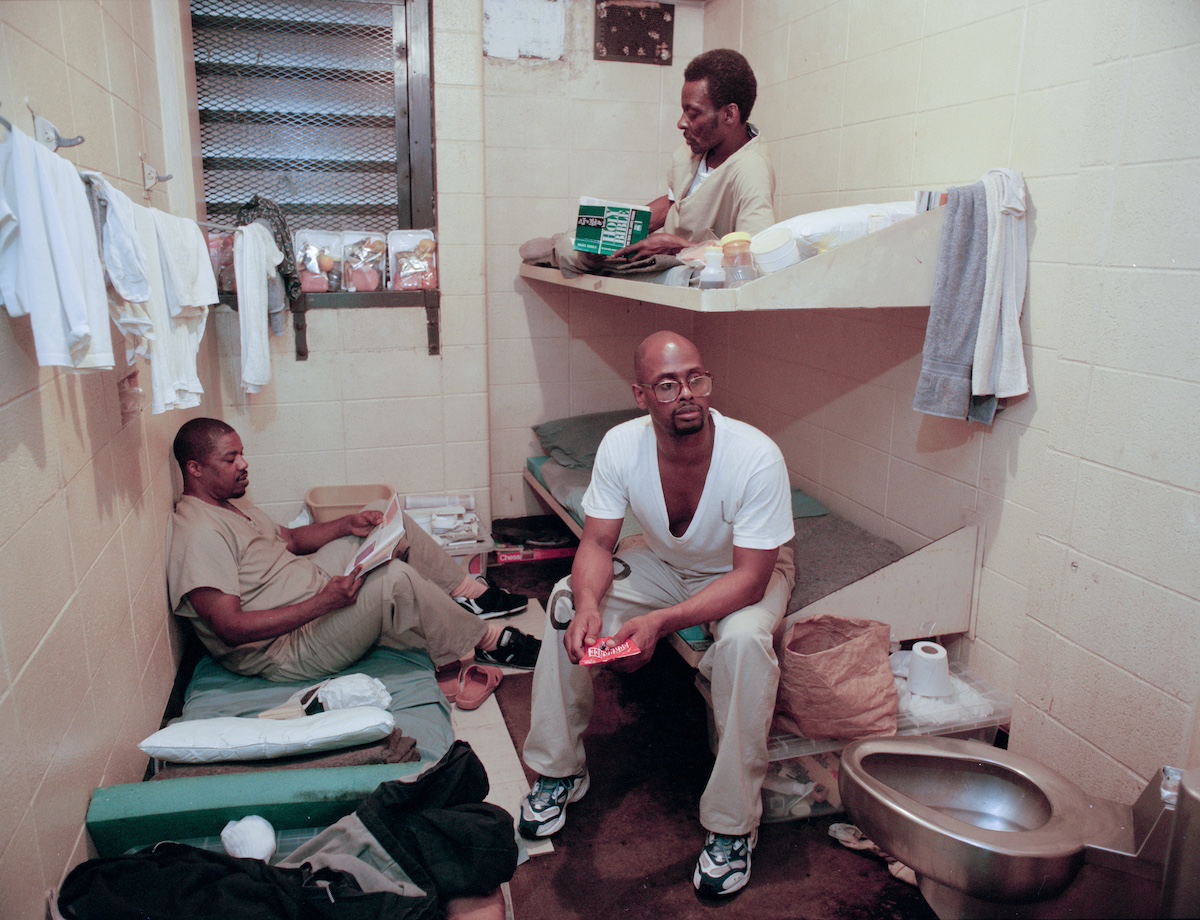
Before going to jail, Kenan carefully looked after his beard, which he grew out to be thick and bushy. “My daughter said I look like Santa Claus,” Kenan said.
Kenan is a clean person, generally. He hates mess and won’t even go into someone’s home if it’s dirty, preferring to stand and talk from the threshold.
But when he was booked into Cook County Jail in March 2022, he lost control over his personal space. In the Residential Treatment Unit (RTU) of the jail, where people with ongoing medical needs are housed, he encountered other insiders with bugs living on their bodies.
“It don’t matter who you is, anybody can get bugs. All you gotta do is just graze shoulders on somebody,” Kenan said. “I try to keep my area clean. But my area [is] by the bathroom right now, so everybody walks past my bunk.”
These bugs are ectoparasites, according to Dr. Emily Landon, an associate professor of medicine and infectious disease specialist at the University of Chicago Medical School. “An ectoparasite is a bug that lives on you,” explained Dr. Landon. “An ectoparasite infection is when you’re infested. Infested is the word that we use, although that word can be troubling to people.”
Ectoparasites can cause deep anxiety. This anxiety about becoming infested, and the lack of control over his space and body, led to increasing stress. Eventually, Kenan reached a tipping point.
“Every time I saw somebody scratching, it made me itch,” he said. “So I said, you know what, I’m finna cut this off. I’m cool, I’d rather cut [my beard] off and regrow it.”
Being sick, including having ectoparasites, means losing control over your body, said Dr. Landon. “There’s a loss of dignity every time that you’re sick,” she said. “You’ve got to go bare your body to someone that you don’t necessarily know in order to get them to do things that sometimes violate your skin, your body, to give you medicine.”
Interviews with insiders and documents obtained via FOIA highlight the daily struggles of people in jail to keep themselves and their spaces clean and hygienic.
Insiders’ grievances reveal a pervasive presence of bugs in the jail. Responses from jail officials to grievances often show surface-level compliance in notifying pest control, but do not address underlying problems.
Insiders reported not being provided with towels, sometimes for weeks at a time, in apparent violations of jail policy.
An analysis of internal laundry records suggests that, at times, uniforms and sheets are washed less than half as often as they should to meet the jail’s own policies. Yet, jail policies also forbid people from washing and drying their own clothes, and people are penalized for doing so by having funds removed from their commissary accounts.
The RTU is a 974-bed division of the jail, subdivided into smaller tier living areas, that houses people with ongoing medical needs, making them especially vulnerable to infection. It is not an emergency medical ward, but people in the RTU should have continuous monitoring while undergoing processes like wound care, drug detox, and mental health treatment. Unlike some other buildings of the jail, where people are locked in cells to sleep during part of the day, some tiers in the RTU are open dorms, where everybody sleeps in the same room and can physically move around the room and bathroom during the day and night.
Liam recalled getting assigned to the RTU after being brought to the jail in April 2026. “You get handed a mattress and you walk in and you get any empty bed available or empty concrete slab,” he said.
The concrete slab Liam chose, with the green foam mattress he laid on top, was his only personal space. But “it’s not really your space,” he said, “because people are moving around the [RTU].” He was constantly on alert to maintain control over his bed.
Still, Liam preferred this open dorm to many other areas of the jail where people are locked in cells. “Better than sitting behind a steel door for twelve hours a day.”
What soon made Liam’s stay difficult was his lack of access to basic cleaning supplies. On his first day in the RTU, Liam was handed the mattress and a set of sheets. He was not given underwear, towels, or shampoo.
The jail handbook states that upon beginning their stay in the jail, insiders are provided with a towel. In response to questions in an earlier story, a spokesperson for the Sheriff’s Office wrote that insiders are provided with two clean 24 inch by 16 inch towels every week. Yet multiple people interviewed by the Weekly said they were not provided a towel.
Liam and the people in the RTU with him were distressed that they could not shower with “essential[s] to maintain personal hygiene.”
“It’s really hard to go take a shower and clean yourself without a towel,” Liam said.
Insiders repeatedly asked staff for towels, soap, and shampoo, but told the Weekly that staff denied them these supplies.
Liam and 21 other people in the RTU with him advocated for their access to hygiene products by filing a grievance.
“A grievance is your formal way of complaining to the jail that they’ve done something wrong,” Liam said. “Basically violated your civil rights.”
They quickly hit a barrier: there were only two physical forms. Insiders asked for more forms. “Guys were arguing with [COs] that, hey, we need more grievances,” Liam said, “and they wouldn’t bring the forms. They didn’t bring the forms. Because if they bring the forms, then they’ve got to deal with the paperwork.”
Liam alleges the COs broke jail policy by discouraging people from filing grievances, and limiting access to grievance forms.
According to a jail spokesperson, the Cook County Sheriff’s Office (CCSO) is unaware of any such incident. The spokesperson said, “there are multiple avenues for individuals to file grievances, including via the grievance form, by contacting a supervisor in the division, by speaking with a Corrections Liaison, or even by filing a complaint with the Office of Professional Review.”
The men continued to fight for themselves. They filled out the form on the front and added their names to the back—one grievance signed by 22 men.
“We have not received towels and other essential personal hygiene items since arrival,” the men wrote. “This is a detox deck there is vomit on the floors, urine, feces, and mold all of which carry pathogens that can lead to sickness and death. Attached is a formal list of all inmates who wish to file a grievance!!!”
All 22 people wrote their full name and ID number, asking for supplies together.
Among the signers was a man who had appeared to be going through withdrawal. He had been using crutches, but for three days he laid in his space without moving. “If you’re five feet away from him, you smell it,” Liam said. “[Guys] kept bringing it up to the COs and the nurses and everybody else.” After they submitted the grievance, Liam remembers him saying, “I really appreciate this [grievance]. I couldn’t help myself for the last couple of days.”
Liam said that within 12 hours of filing the grievance, he was transferred out of the RTU, where he had been for 14 days. He was released from jail days later. He was never given a towel.
The Weekly reviewed grievances that insiders wrote about bugs and pests from January to March 2026.
“I always hear buzzing noise in ear,” wrote M.D. in a grievance. “Hard time to sleep.”
“Got bit by ants in my cell,” wrote J.W.
“We have an infestation of gnats, from the showers, cells, dayrooms, toilets, and garbage. Hundreds if not thousands are along the walls of the whole tier,” wrote J.N. “They are incubating in the feces and urine water that’s tracted amongst the entire tier due to a busted sewage pipe in the closet. These gnats and flies land in our food in your face and body.”
Within days of submitting these grievances, insiders received a short response from jail officials: “pest control notified.” The response to J.N.’s grievance, about gnats incubating in waste from a “busted sewage pipe,” did not address the underlying problem of raw sewage on the tier.
J.N. replied he was “not happy or satisfied” with the response. The next communication he received stated, “original response stands.”
T.H. experienced a similar back and forth in grievances about the mice in his cell. “I have mice living in my cell, they’re entering through a hole under my toilet,” wrote T.H.
Nine days later, jail services staff wrote a response to T.H.: “pest control notified.”
T.H. wrote back, “not one person showed up from Pest Control. The mice are all over the place.”
Jail staff did not address T.H.’s appeal or take further action. They responded to T.H. “original response to stand.”
The CCSO did not respond to a request for comment on T.H.’s situation or the jail response to T.H.’s grievance.
In the fall of 2025, there was substantial ectoparasite presence in the RTU. “They put this man on deck with us—he had more than 30 bugs on him,” Kenan said. Several others in the RTU were suffering too. Internal emails from the Sheriff’s office reveal, in an inspection of one floor, they found 10 people with ectoparasites and gave 9 haircuts. A dedicated “ectoparasites team” swept multiple tiers.
But sometimes treatments appear to fall short when paired with other policies and procedures of the jail.
“Here you get new people from off the streets every day,” Kenan said. “It’s like giving a dog a flea bath, but put them back in the same cage that had the fleas without washing it out.”
He added that jail officials sometimes treat people for bugs, but don’t replace sheets and clothes; sometimes everything is treated but somebody with bugs is introduced to the tier, restarting the spread of bugs.
In jail, insiders wear “DOCs,” jail-issued uniforms, which serve as clothing and pajamas. Unless a person buys long underwear or undershirts from the commissary, the DOCs are the only clothing an insider can wear.
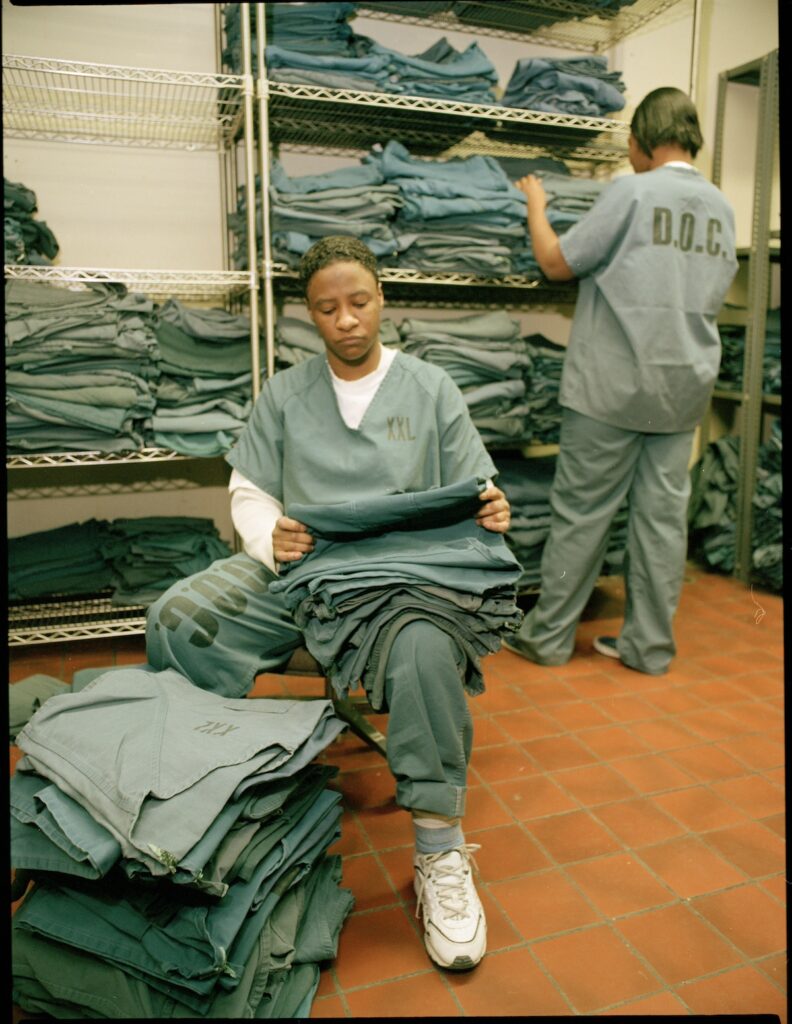
Laundry workers come to each tier twice a week. When laundry comes to the tier, insiders have to strip first and hand laundry workers their dirty clothes, and then receive a clean replacement.
“You’ve got to take off your pants and your top in front of the door right down to your boxers,” Liam said. “If you have boxers because you came in with them or bought them. And hand the uniform through the doors. Then they give you a medium or a large, or whatever size is closest.”
The jail gives insiders a handbook to explain jail policies. The laundry section states, “The CCDOC provides you a clean uniform twice per week, fresh linens once per week, and a clean blanket once per month. In addition, laundry service for clothing purchased on commissary is regularly provided.”
Yet, internal laundry documents suggest that laundry is done less often than would be needed for the jail to meet this policy.
The jail keeps a record of all the sheets and uniforms cleaned each day. In the RTU, while Kenan was there, the most common weekly rate of sheet cleaning was one set of sheets cleaned weekly for every three people in the RTU. During that period, jail records show uniforms were washed twice a week at a rate that could provide clean clothes for between 25% and 75% of the population.
A CCSO spokesperson wrote, “Individuals have the right to accept or decline the exchange of their linens and clothing unless the items are unsanitary. If IICs are not present when their scheduled laundry exchange service occurs, they can request new linens and uniforms, and those items are delivered within hours of their requests.”
The Weekly was not able to independently verify that insiders can receive clean sheets and clothes within hours of requesting them. None of the insiders interviewed for this story referenced access to clean linens outside of the bi-weekly laundry exchange time.
| Rate of laundry compared to RTU population, fall 2025 | ||||
| Weekly rates of sheets, shirts, and pants cleaned compared to the RTU population for August–November 2025. | ||||
| Month | Avg RTU Population | Avg. sheets cleaned weekly | as % of pop. | Avg shirts cleaned weekly | two shirts cleaned as % of pop. | Avg pants cleaned weekly | two pants cleaned as % of pop. |
| August | 890 | 301 | 34% | 701 | 39% | 731 | 41% |
| September | 893 | 181 | 20% | 1080 | 60% | 1146 | 64% |
| October | 894 | 234 | 26% | 1059 | 59% | 968 | 54% |
| November | 888 | 389 | 44% | 1139 | 64% | 1135 | 64% |
| Method: Using documents obtained via FOIA, the Weekly used the RTU population and count of laundry recorded in Laundry Weekly Exchange Reports for the RTU to calculate the average amount of laundry done per week as a percentage of the average RTU population. For example, in August, on average there were enough clean sheets laundered by the jail for 34% of the RTU. | ||||
One reason insiders might not be exchanging their clothes with laundry workers is they struggle to navigate the system. Our reporting suggests this impacts the most vulnerable people in jail.
In the RTU, M.C. wrote a grievance that “They have not came and asked me do I want to change my green suit in a month. I have had the same green suit for a month and it stinks.”
The green suit indicates he was charged with a sex offense, like masturbation, while in jail. The green suit is stigmatizing. It is a visual symbol of punishment for sexual behavior.
“This is not right,” M.C. continued. “I should be able to have clean clothes please and thank you.”
Six days later M.C. received a response: “IICs are given 2 opportunities to change their uniforms” with the date of the last uniform exchange for M.C.’s tier. It’s possible M.C. didn’t know how the laundry system worked. It is possible M.C. could not safely go to the laundry-exchange area of the tier. It is possible M.C. struggled to communicate with the laundry workers enough to get new clothes.
A person jailed on a woman’s tier wrote, “I need new clothes and sheets/blankets. They need to come weekly. Women need to change our clothing more often.” A response to this grievance was not contained in the documents obtained via FOIA.
The Weekly also spoke to insiders who described people struggling to move, let alone navigate laundry exchange. Other insiders described negotiating to convince laundry workers to take dirty sheets that had been used to clean up flooding. Front-line decisions about what laundry is exchanged are made by incarcerated workers assigned to the laundry and supervised COs.
Some insiders do laundry on their own, washing uniforms and sheets in the showers with soap they buy themselves. Typically, these are people who have been in jail for a while or are more self-sufficient. By doing laundry themselves, they take on more work and risk violating jail policies with disciplinary consequences. But it can be worth it to exert some control over their clothes and environment.
J Keith has been in the jail for more than ten years, and cleans his own clothes. He said when you turn in sheets or uniforms, you may get worse quality in return. “I actually got a good jumpsuit with the buttons on it, so I don’t let it go,” J Keith said. “If you got the ones with the Velcro, they might not button up.” J Keith prefers to keep his own linens instead of exchanging them every week.
Kenan makes the same choice as J Keith. He uses supplies bought in the commissary to wash his own clothes.
The jail’s handbook states that “ropes or hand-made clothes are not permitted to be used … for drying clothes and/or linens … Washing and drying clothes in housing areas is not permitted.”
The handbook also states that “failure to follow laundry procedures is a violation of the rules and regulations and will result in disciplinary report and possible disciplinary sanctions.” For violating the clothesline policy, “The CCDOC may seek reimbursement/restitution … i.e. money will be taken from your commissary to pay for the damaged property.”
But according to multiple people interviewed by the Weekly, the practice is tolerated.
“The lieutenant came up here and snatch [the clothesline],” Kenan said. “I’m not gonna lie to you, I’m not supposed to have the clothes lined up, but that’s how I dry [my laundry]. I wash my clothes when I get a shower. I wash my clothes by hand because they barely do the laundry.”
“I said, ‘Okay, well, you worried about our clothesline and why we haven’t had laundry in months?’ Because they’re not washing our clothes. So why is y’all complaining about us having lines up and putting our stuff where we need it to dry if y’all don’t wash our clothes?’”
In the grey areas between policy and daily reality, Kenan argued with a Lieutenant that the lack of laundry in his tier justified the policy-breaking clothesline.
J Keith hangs a clothesline, too.
“I shower every day so I’m washing my clothes every day,” J Keith said. “Yesterday I was just washing and I said, ‘I’m so tired of washing clothes.’”
His clothesline hangs in the cell he shares with another person.
“We make it simple,” he said. “It’s basically his clothes line and my clothes line, but if he ever needs, if he ever needs the space, and I ain’t got enough, he always can use mine.”
J Keith imagined a day when he doesn’t live in a cell: “I can’t wait to get a washing machine and dryer.”
Micah Clark Moody is a PhD candidate in Sociology at Northwestern University. She has investigated pretrial jailing systems in Michigan, Los Angeles, and Chicago. Meghna Anand is a recent graduate of the University of Chicago, where she studied neuroscience and public policy, specializing in public health.