
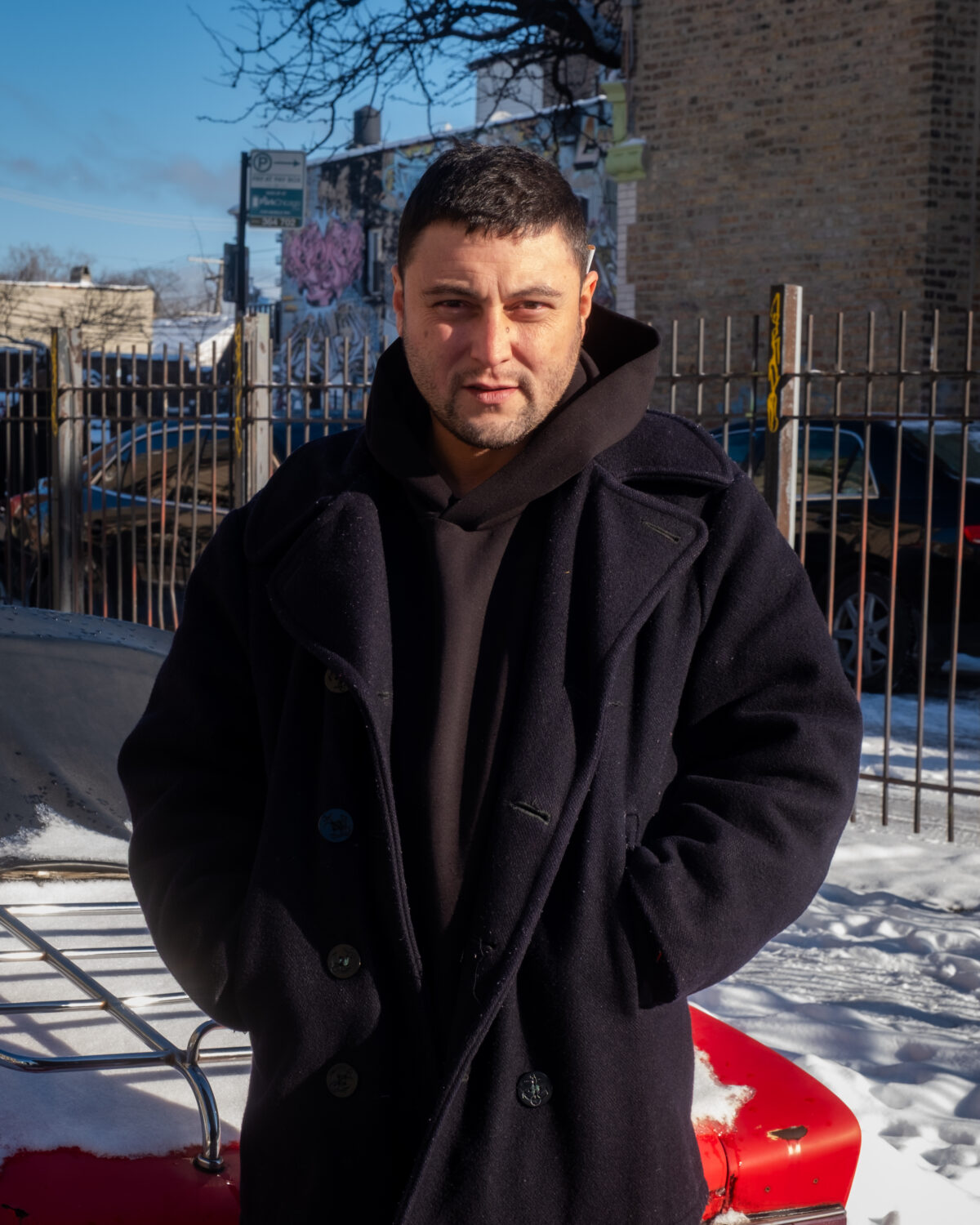
Pilsen-based musical artist Rudy De Anda is getting ready for his last show of the year, which will be at the historic Thalia Hall on December 19. The night will double as his fourth appearance at the venue and a celebration of his fifth year in the city.
“I feel like Chicago will be this huge stamp on my life,” De Anda said, reflecting on the past half decade. “It’s crazy to talk now five years into this chapter, but it’s straight up a chapter now.”
De Anda packed up and drove across the country from Long Beach, California during the COVID pandemic and after the completion of his first project,Tender Epoch, a thirteen-track Chicano psychedelic soul debut album. These days, he refers to it as his “ticket to leave” California.
It wasn’t long until De Anda established roots in Pilsen and started booking shows. His first performance as a Chicago resident was at Empty Bottle with Combo Chimbita. Next, he opened for Chicano Batman at Concord. His third show, with Thee Sacred Souls at Lincoln Hall, began to get De Anda locally noticed.
“I remember [Thee Sacred Souls] finished and then people were trying to clap for them to do an encore,” De Anda said, recalling the end of the Lincoln Hall show. “You could ask [my ex], she wouldn’t be salty enough not to admit that she witnessed this too. But they took so long to come out for an encore that people eventually started chanting ‘Rudy.’”
For De Anda, it was a “W moment,” the kind of unofficial Chicago inauguration you can’t plan for.
“I think by then, people were like, ‘All right, who is this?’”
“Burn It All Down”
In 1992, the Rodney King uprisings lasted five days in Los Angeles, sparking mass mobilization in the liberation movement. Protesters against police brutality destroyed property—and caught in the crossfire was De Anda’s childhood home in Compton.
“I say, ‘burn it all down,’” De Anda said. “I was just a casualty of a bigger problem.”
The apartment his family lived in caught on fire, forcing them to relocate to Long Beach. De Anda believes this move was what led him to a path in music as it brought him closer to the music scene.
“My uncle’s girlfriend [told] my grandma she was taking me to the movies, but she took me to some DIY shows when I was twelve. And I feel like that’s really what sealed it,” he said.
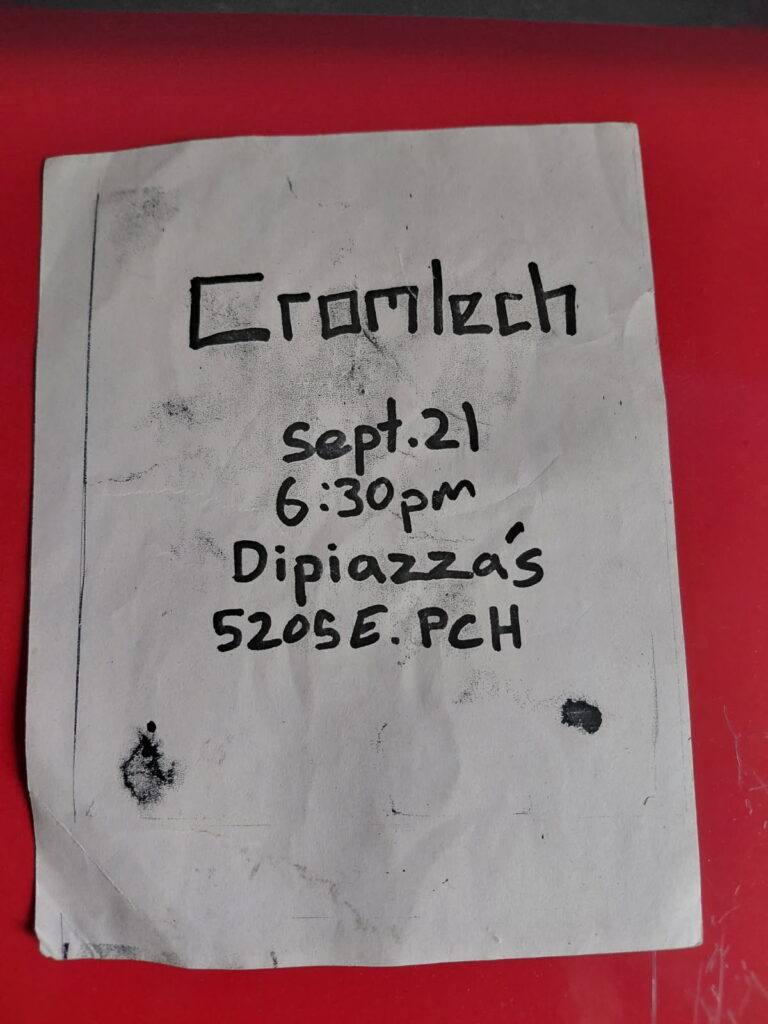
De Anda’s coming-of-age chapter would be mixed with teenage angst, painted fingernails and Converse covered in band names. At an age when many are in search of identity, he found refuge in music. He and his friends really didn’t know how to play any instruments, but they wanted and needed to start a band. Their first performance was at a local pizza joint.
“I think I still have one of the flyers, which is crazy,” he said. “It’s just a little piece of printer paper. We were called Cromlech.”
Not long after that, life shifted again. When his family moved to Las Vegas at the end of high school, he became determined to make his way back to Long Beach. Once he did, he threw himself into the Wild Pack of Canaries, a project he now describes as “Rudy De Anda 1.0.” His real solo era wouldn’t arrive until Colemine reached out in 2018.
“On Some Anthropology Shit”
Since his debut album, Tender Epoch, De Anda has released a second full-length album with Colemine, titled Closet Botanist (2023). The LP stays true to his ability to merge retro influences with contemporary sounds. De Anda’s music is characterized by subtly funky elements and a blend of Spanish and English lyricism, all infused with a sense of Chicano romanticism.
On a recent collaboration with San Francisco cumbia duo El Grupo Gallardo, De Anda taps into tropical cumbia with the singles “Quiere Sabor” and “Puerta Dorada,” released this past October. More recently, he shifted to a darker palette with “Mi Amparo,” his late-November release with local post-punk band Nothing But Silence. “Mi Amparo” is a romantic, atmospheric track that blends De Anda’s signature psychedelic flair with soft, acoustic textures.
“I feel like it just kind of proves that I can do whatever the fuck I want,” he said.
De Anda is working on some more cumbia tracks for the coming year as well as an LP true to his staple funk-soul sound, also under Colemine, which he describes as a “match made in heaven.” Like De Anda, the label places a strong emphasis on physical media releases. He is stoked to share that the new cumbia tracks were produced in Little Village, the midwest mecca of sonideros since the early 1990s.
“It gives me goosebumps thinking when I release that, no matter what happens, I’m gonna have some type of musical representation of La Villita—on some anthropology shit.”
And while Chicago is home for now, De Anda said he’s caught the travel bug. Freshly back from his Gulf of Mexico Tour this past fall, where he hit new stops in Guatemala, the wanderlust artist teases the potential of intimate acoustic shows in Chile this spring. He’s also toying with the idea of eventually relocating to Mexico or even Spain. For De Anda, traveling goes hand in hand with creation, as each place lends inspiration. Still, he credits Chicago for loosening his approach to music and expanding his sense of what a song can be for a community.
“Just be a little more loose, you know? And sometimes people just want to dance and they just want to be at a barbecue and listen to [1992 house music anthem] ‘Follow Me,’” he said. “I didn’t get that when I first moved here, but now it’s like, I wouldn’t have it any other way.”
Jocelyn Martinez-Rosales is a Mexican American independent journalist from Belmont Cragin committed to telling stories from communities of color through a social justice lens. She is also a senior editor at the Weekly.