
Martinez Duncan and Jeremiah Bush were locked in a Cook County Jail cell on Tier 5A when the fire started in their cell.
People jailed on the tier called for help.
At 7:15pm, an officer responded to calls for help and radioed “10-70,” the code for fire in a cell.
A sergeant ordered all cells on the tier to remain locked.
Sometime later, 11 people on the tier were moved to fresh air. Martinez and Jeremiah remained locked in the cell where the fire was burning.
Officers pepper sprayed them three times.
Sixteen minutes after the radio call of “fire in cell,” officers opened the door to remove Martinez. Jeremiah fought his way out.
Jeremiah, 22 years old, was hospitalized with burns.
Martinez died. He was 24 years old.
This is an account of what we know about the November 20, 2025 cell fire that led to Martinez’s death based on leaked incident reports written by the officers involved. The Cook County Sheriff’s Office declined to comment, citing ongoing investigations by Illinois State Police and the internal Office of Professional Review. For involved officers whose identities we could not independently verify, we have used pseudonyms. Officers involved were outside Martinez and Jeremiah’s door as the cell was on fire. We do not know every order that was given. We do not know the precise times each action occurred. Some answers may be provided by body-worn camera videos of the incident and surveillance video. Some answers are only known by the officers involved. Some answers died with Martinez.
Around 7:00pm, Officer C. wrote that he left Tier 5A to complete the required shift Living Unit Log on a computer at a desk in the hallway next to the tier. The Tier 5A computer was broken.
Officer R. was assigned to distribute food and collect trays. He was on Tier 5A when, he wrote, “[Individuals in custody] sitting [in] the dayroom then began to yell at [individuals in custody] in cell 9. I then immediately stepped off the tier and notified Officer C. to step in.”
According to the unreleased incident reports, surveillance footage shows the fire started when a third incarcerated person lit a wick and threw it under the cell 9 door.
In 2025, there were at least 134 cell fires in Cook County Jail. At least 11 cell fires were in the residential treatment unit, which includes Tier 5A, and is the area of the jail where people have higher medical and mental health needs but are not in the hospital.
Some fires are set by wicks. As one incarcerated person, J Keith, explained, to make a wick “you take the tissue, you roll it up. You got to roll it all together, as tight as it can get. Then it looks like a rope. So when you put fire to this rope, this wick, it’s an ongoing fire. Burn and burn and burn.”
Wicks are used as candles and air fresheners. People share a toilet in the 7 by 14 foot two-person cell. Wicks are also used as lighters.
Small wick fires can become uncontrolled cell fires. After Martinez’s death on November 20 and before the end of 2025, there were at least two more cell fires where Martinez was jailed, Division 8, and 39 cell fires jail-wide.
In a fire two days after Martinez died, people in the burning cell were immediately released. On surveillance video, a lieutenant saw “flames engulfed from inside the cell.” Responding staff were “hesitant” to open the cell, but the lieutenant “gave clear direct orders to unsecure the door immediately.” The people were let out of the burning cell. According to the report, people were “without injury.”
Martinez was not immediately released. Around 7:15pm, Officer C. wrote, he heard people in the tier calling for him to come back. Officer C. wrote that he went cell-to-cell, checking on each person, before seeing “dark smoke emanating from cell 09.”
Martinez and Jeremiah were locked in cell 9.
Cells in Tier 5A are small sealed rooms designed to jail two people. There is a “chuckhole” locked slot in the cell door a few feet above the floor, 7.75 inches tall and two feet wide.
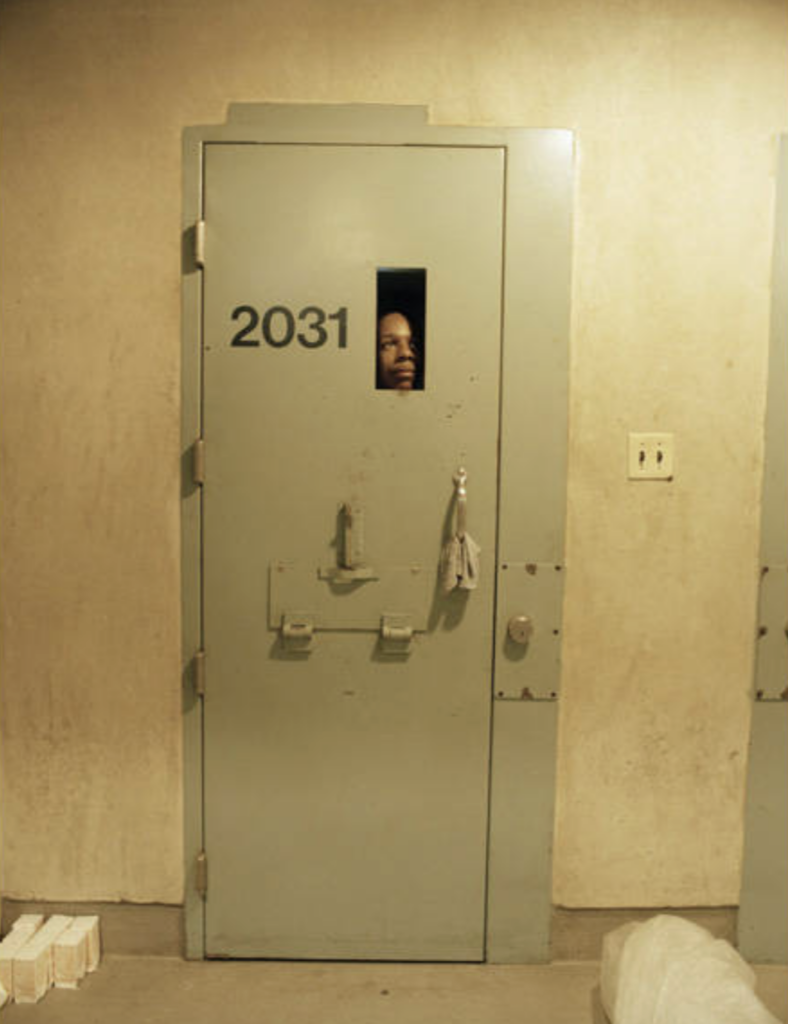
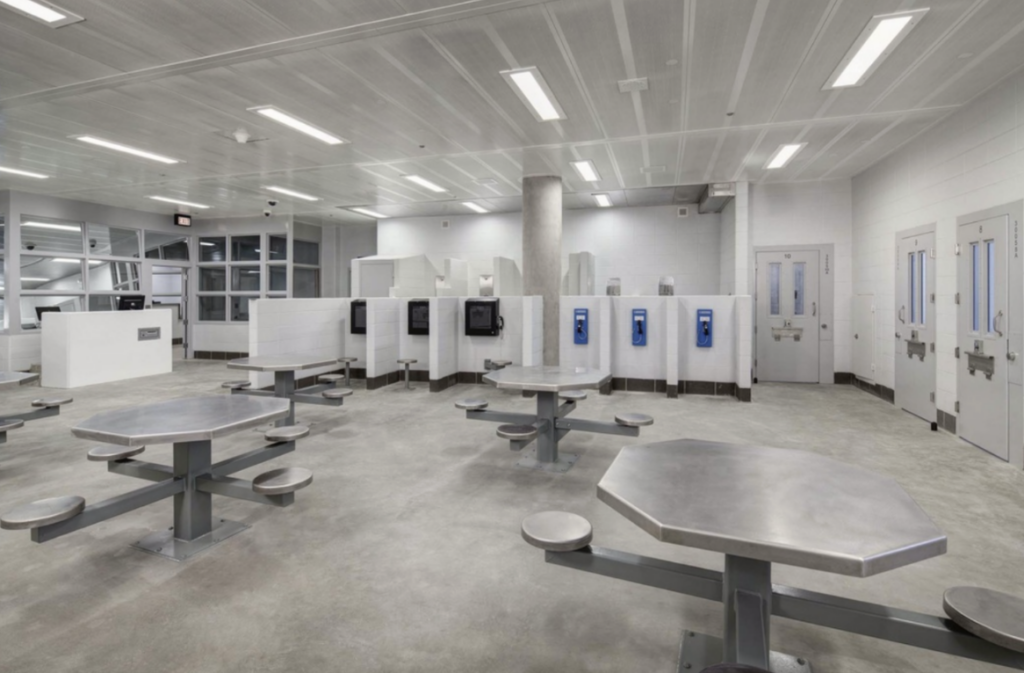
At 7:15pm, Officer C. radioed “10-70”: “fire in cell.”
Supervisors responded over radio. According to Officer C.’s report, he was “advised by sergeant(s) via radio not to enter or open any tier doors.”
Smoke continued to pour from cell 9, where Martinez and Jeremiah were locked behind the tier door.
Supervisors Sergeant Brendon Lombardi and Sergeant Timothy Skinner arrived. Sgt. Lombardi ordered officers to move people out of nearby cells and to a nearby recreation area.
Sgt. Lombardi reports “giving clear and concise orders to the inmates in other cells complaining of trouble breathing to place hands through the chuckhole with their backs to the chuckhole to be secured.”
For each person in every cell to be let out, Sgt. Lombardi’s order required the following sequence of actions: an officer has to unlock the chuckhole, the jailed person puts their back to the door, puts their arms through the hole behind them, waits to be handcuffed, pulls their arms back into the cell, the second jailed person puts their back to the door, puts their arms through the hole behind them, waits to be handcuffed, pulls their arms back into the cell, the officer unlocks the cell door, and the person walks out handcuffed. In a fire, the air is clearest near the floor. The smoke rises. In a smoky room, this sequence requires standing up in the smoke.
All 11 men, except Martinez and Jeremiah, were moved out of the tier.
“All victims of arson were removed,” reported Sgt. Lombardi.
Martinez and Jeremiah were still locked in their burning cell.

Sgt. Lombardi identified Martinez and Jeremiah as offenders committing arson and others in the tier as victims of that offense.
At some point a fire extinguisher was used, spraying water into the cell. The fire continued and Sgt. Lombardi radioed for a second fire extinguisher at 7:22 p.m.
Having ordered the release of others on the tier, Sgt. Lombardi returned to cell 9. He ordered that their chuckhole be opened and that they were “to place their hands through the chuckhole with their back to the chuckhole.”
“Due to smoke, it was hard to see in the cell,” he added.
Martinez got one hand out of the chuckhole.
According to Sgt. Lombardi’s report, “[Inmate] presented his hand with an unknown object in it (possible weapon).” He did not later clarify if a weapon was found in the cell or what the object in Martinez’s hand had been.
After an unknown amount of time, Martinez was not standing upright in the smoke with both hands outstretched behind his back and extended through the chuckhole.
Sgt. Lombardi interpreted this as resistance: “Inmate Duncan, Martinez #2024-1113133 refused all orders.” He referred to Martinez’s actions using the words “resist” and “refuse” eight times in his report.
“For the safety of my staff,” he wrote, he “ordered the chuckhole secured.”
The small slot to the outside room and air was locked, sealing Martinez and Jeremiah in the burning cell.
Sometime after locking the chuckhole, Sgt. Lombardi radioed his supervisor, Lieutenant Nicole Rafferty.
Sometime later Lt. Rafferty arrived on the tier with a “cell fogger,” a device that only supervisors can access. The cell fogger is attached to a canister of concentrated pepper spray. It turns a stream of pepper spray into a fog designed to pollute all available air in an enclosed space.
Cell 9 was already filled with smoke.
Sgt. Lombardi “took the cell fogger.” We do not know if the cell fogger was used.
The chuckhole was opened for a fire extinguisher to be used.
Martinez got one hand out of the chuckhole. Officers handcuffed his hand. Martinez tried to pull his arm back inside.
With one hand cuffed, officers did not open the door.
“Ofc. [Ricardo] Leonardo remained in control of the handcuffed hand due to Duncan attempting to pull it in with the one cuff secured,” wrote Sgt. Lombardi.
With one arm cuffed and pulled out through the chuckhole, Martinez was close to the door. According to the reports, he did not get his second arm through the door.
In the words of Sgt. Lombardi, “Duncan continued resisting and refusing orders.”
In “close proximity” he “utilized a one second burst” of pepper spray which, he wrote, hit Martinez’s shoulder. “More orders were given and ignored.”
While Martinez’s arm was still being pulled through the chuckhole, Sgt. Lombardi “utilized another half second burst that made contact with his back area. More orders were given that were ignored.”
He “utilized another one second burst of OC. Duncan still continued to resist and refuse all orders.”
At some point after the three shots of pepper spray, officers reached through the chuckhole, grabbed Martinez’s empty hand, pulled his arm through the slot, and handcuffed him.
“19:30 they were still in the cell,” wrote Sgt. Skinner. Fifteen minutes had passed since the code for fire in a cell went out.
With Martinez handcuffed, officers chose to open the door and pull him through. Sgt. Skinner wrote, “As soon as the cell door was opened to exit [Martinez, Jeremiah] pushed out of the cell.”
Sgt. Lombardi ordered officers to “perform a takedown” on Jeremiah. He was brought to the ground.
At 7:31pm, Martinez and Jeremiah were on the other side of the door.
Sixteen minutes passed between the first officer arriving and someone unlocking the door to free Martinez from the burning cell.
Outside the cell, handcuffed to a metal ring on the wall, Martinez lay contorted “in a semi-fetal position.” The officer noted “coffee ground emesis”—vomit blackened by blood—coming from his mouth. Another officer asked medical staff to “clear his mouth.” His head was limp, even after an officer pulled his hair to move him upright.
Medical staff asked officers to uncuff him so he could be put on a gurney.
It was at this point, after sixteen minutes of smoke inhalation and three hits of pepper spray, that medical staff were first mentioned in an incident report.
On the gurney, officers reported that Martinez had “no vitals” and “no pulse.”
Martinez was put in an ambulance to Mount Sinai Hospital where he was pronounced dead.
At 1:09am Jeremiah was sent to Stroger in an ambulance for burns.
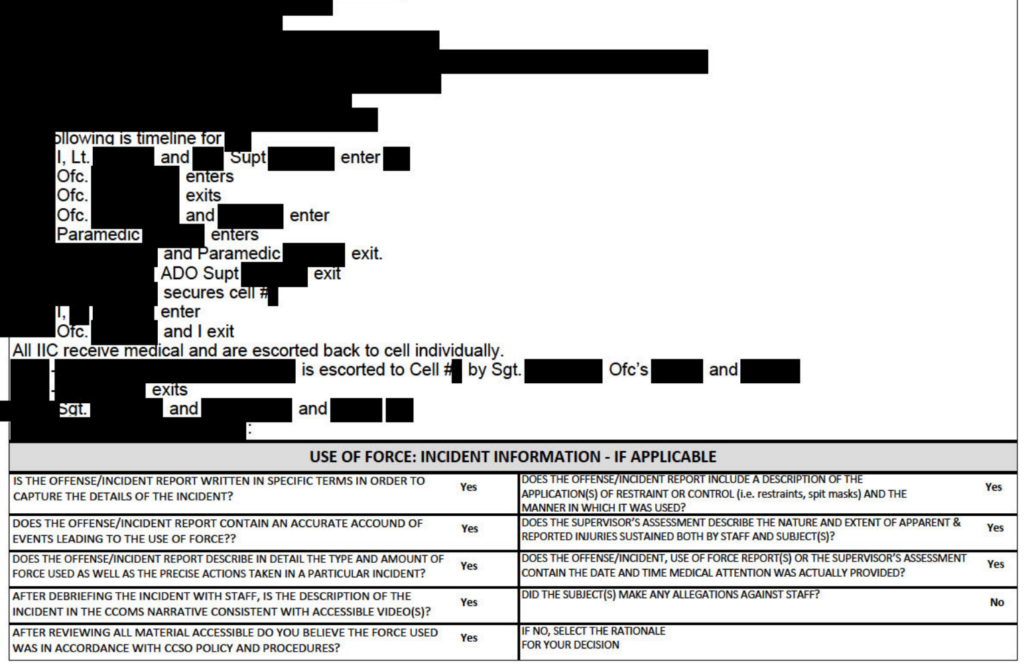
There are a series of questions that demand to be answered.
An officer answered “yes” when asked whether “the force used was in accordance with CCSO policy and procedures.” Is that officer right?
What was in Martinez’s hand? A weapon, like Sgt. Lombardi speculates? A pen? A notebook of phone numbers he didn’t want to burn? Nothing at all?
Was Martinez “resisting” like Sgt. Lombardi claims? Was he having a panicked response to suffocation? Standing up into the smoke to reach his arm through the chuckhole, could he balance? Could he see? Could he breathe?
Is it within policy to spray pepper spray into a burning cell?
If Martinez did not have pepper spray in his lungs, in addition to smoke, would he have died?
Why was it five hours before Jeremiah was taken to the hospital?
What might body-worn cameras reveal?
These are questions that can be answered by incident reports, policy, and law.
Within a month of Martinez’s death, two other people died in the same part of the jail. Shamire Jackson died on December 5. Marvin Flanagan died on December 17. Why are so many people dying?
Martinez’s death also demands answers that no incident report can address.
Who is responsible for ordering two people to be locked in a burning cell? The officers who followed the order? The sergeant who gave the order? The lieutenant who did not change the order? The administration that supervises, promotes, and governs those people? The culture that makes locking people in a fire conceivable?
What about the jail must be true for Martinez to die this way?
Will this happen again?
What were Martinez’s last words?
We don’t know.
Micah Clark Moody is a PhD candidate in Sociology at Northwestern University. She has investigated pretrial jailing systems in Michigan, Los Angeles, and Chicago. Harley Pomper is a PhD student in social work at the University of Chicago. They organize across jail walls to report on carceral injustices and political repression.
Have you guys ever even been in the jail? Why don’t you try looking at this from the officers point of view too ?
Hey B why don’t you shut up you stupid asshole?
The problem with you bootlickers is you imagine yourself on the side of these oppressing murderous people. You’re on the bottom with the rest of us.
Arguably the officers perspective is, “I don’t care if he’s burning to death… rules is rules” or perhaps “why should I assist someone? I should just let them die because I assumed they did it to themselves.” They didn’t.
These Pigs Deserve to Roast.
Oh that’s not-
This story would be unbelievable if you never been on this side of police abuse.
These officers are murderers, plain and simple
Thank you for this important piece of journalism. I hope this catalyzes changes to policies and training protocols to prevent future deaths. My heart goes out to the two victims and the impacted families.
Sixteen minutes while they pepper sprayed a man trapped in a burning cell and then had the audacity to call him “resistant” for trying to breathe is beyond any justification or policy defense. god.