
This story was first published by the Hyde Park Herald.
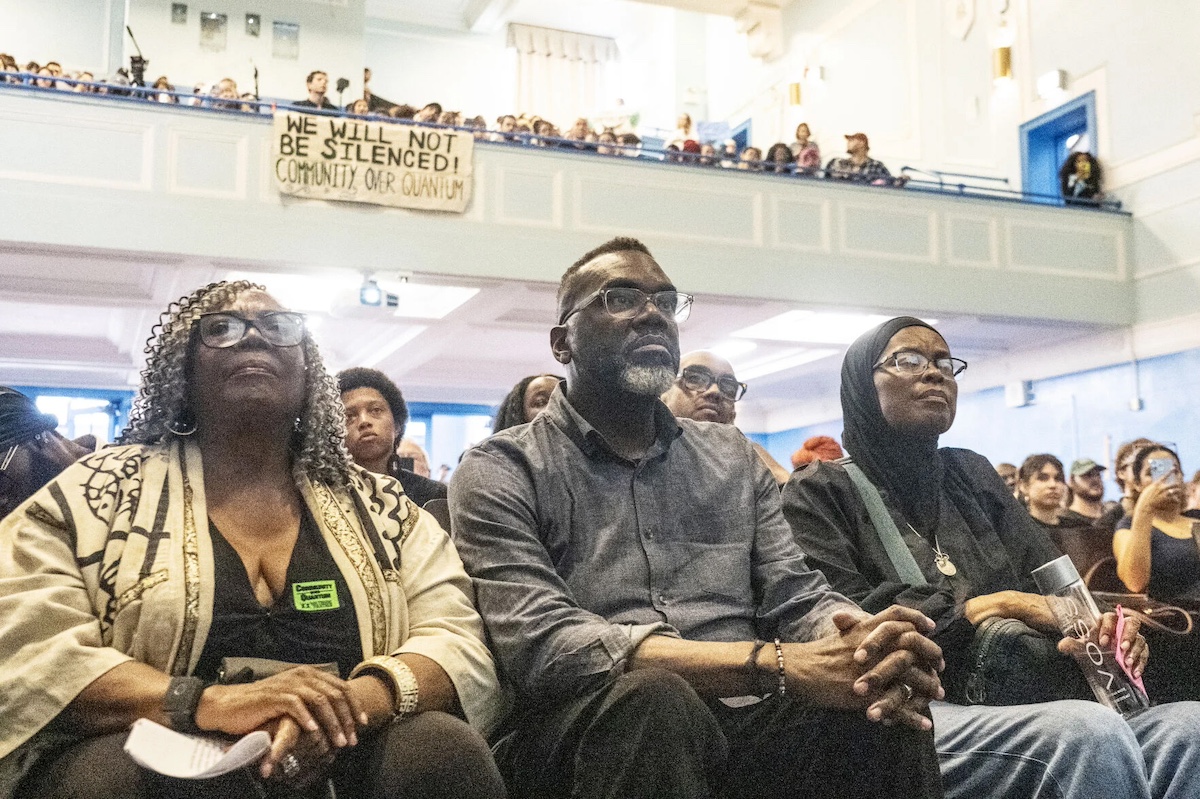
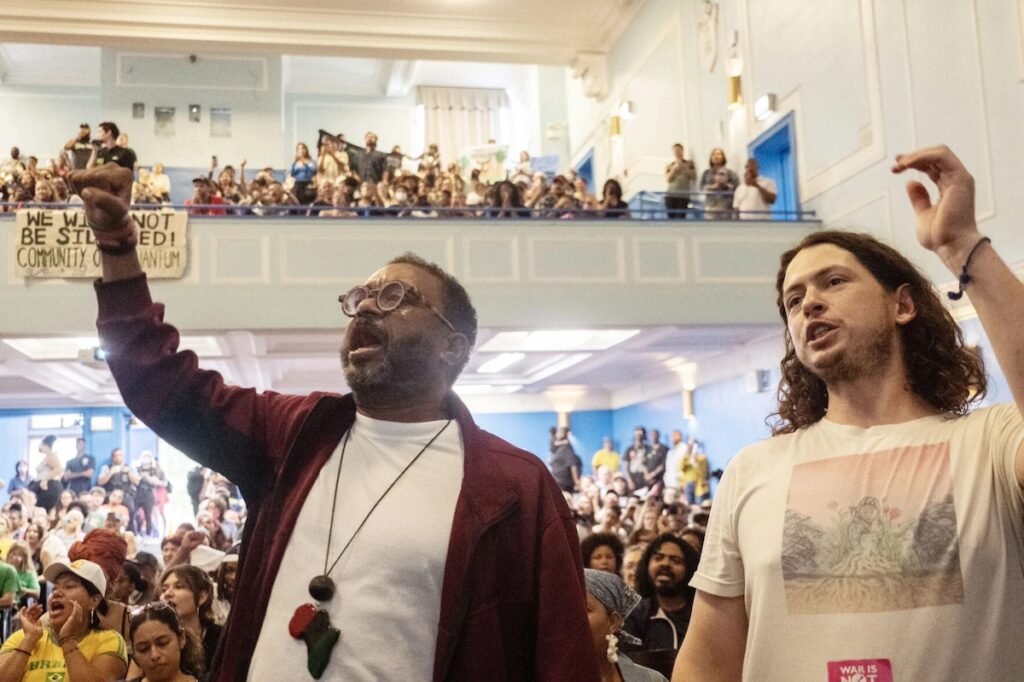
Hundreds of South Side residents packed the gymnasium at Arnold Mireles Academy on Saturday, August 15, shouting down Mayor Brandon Johnson and booing when he declined to call for a full stop to construction of the Illinois Quantum and Microelectronics Park (IQMP), the $9 billion development rising on the former U.S. Steel South Works site in South Chicago.
The town hall, called “Community Over Quantum” and organized by the community group Southside Together, opened with a water ceremony by Kalpulli Xinachtli Xochikalli, a Pilsen group that practices Nahua traditions. Participants danced in a circle around a conch, an ear of corn and a ceramic vessel to drums and rattles.
Below the stage sat a poster of an eagle with “pull the permits” written across its wings, beneath banners reading “clean air and water is our right” and “our homes, our community, our choice.”
Organizers called for Johnson to put a halt to the quantum campus and related developments. Justin Cosby, an emergency medical technician and organizer with Southside Together, led the crowd in enthusiastic chants of “Mayor Johnson, shut it down. Revoke the permits. Do it now.”
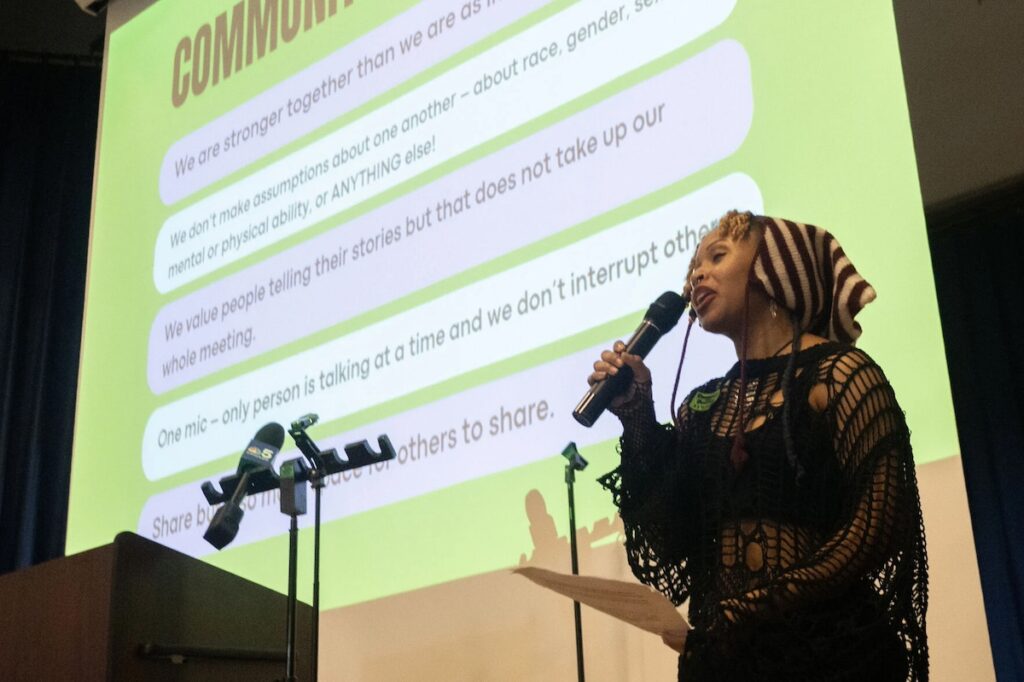
Appearing onstage after listening to organizers’ demands, Johnson was asked by Renee Redmond, a South Chicago resident and Southside Together organizer, whether the quantum campus development squared with his environmental commitments.
“My values have not changed,” Johnson told the crowd. “Innovation cannot take place at the expense of environmental justice. Development cannot happen at the expense of utilities and working people, and that’s why investment cannot happen at the expense of our overall public health.”
Johnson said environmental remediation is taking place at the site, per state requirements, and that he received a letter from IQMP stating the 128-acre campus would not house a data center. He did not address whether this affected Related Digital’s planned data center to the north of the site.
“If they were to do that, they would be strictly bound to the executive order that I have put forth to provide stronger regulations,” Johnson said.
The IQMP’s developer, Related Midwest, said the company “is very focused on delivering the first phase of the development and a data center is not part of that development.”
“Related Midwest is committed to transforming the 440-acre vacant former South Works site into a vibrant hub for innovation and research that will provide residents with the opportunity to build a career in their own backyard,” said spokesperson Tricia Van Horn.
Related Digital did not respond to a request for comment as of press time.
Johnson did voice support at the meeting for a City Council-led moratorium on data centers citywide, an idea he floated when he signed an executive order August 11 creating enhanced environmental and noise review for the facilities and a temporary pause on new tax incentives. But he stopped short of announcing his support for halting development of the quantum campus itself, drawing loud boos.
Organizers argued the distinction between a data center and a quantum computing campus is beside the point.
“Data center, quantum center, whatever you want to call it, it’s all the same,” Redmond said in an interview afterward.
The IQMP’s leaders disagree.
“The IQMP is not a data center, and it will not house one on its campus,” Harley Johnson, IQMP’s CEO, wrote in an August 14 letter to Mayor Johnson. “That distinction matters for the environment as much as it does for technology.”
Quantum computers rely on “a closed-loop helium cooling system,” Harley Johnson wrote, rather than the water-intensive cooling that large-scale data centers require. He claimed that “the water use we anticipate will be comparable to that of an average hospital, not a server warehouse.”
“And because quantum systems solve problems in far fewer computational steps, their power needs will be significantly lower than a data center’s,” Harley Johnson wrote.
Although the technology’s potential to reduce data centers’ energy demands has not yet been proven, some industry leaders think quantum processors will eventually become components inside data centers, lowering their overall energy demand rather than adding to it, according to CNBC.
But some quantum computers may require data centers of their own to house classical computing equipment paired with quantum hardware and cryogenic systems that keep components near absolute zero, according to University of Chicago quantum instructor Danyel Cavazos and Itamar Sivan of IQMP tenant Quantum Machines, as reported by the Chicago Reader.
ComEd has estimated the quantum campus will draw up to 350 megawatts, while the data center Related Digital has proposed for the site’s north end would need at least 1 gigawatt, enough to power roughly 800,000 homes.
Johnson’s statements Saturday marked a shift from last September, when he stood with Governor J.B. Pritzker at the project’s groundbreaking, months after Related Digital had already announced the data center.
“This investment will bring new jobs and educational pathways while also paving the way for expanded health care and community amenities,” Johnson said then.
Rather than a quantum campus, organizers said they want investment in a grocery store, as well as upgrades for hospitals and schools in the area.
Cosby pointed to the recent closure of a nearby grocery store as evidence of elected officials’ misplaced priorities.
“It’s weird that the city and the state have money to subsidize a quantum computer, but not a grocery store,” he said.
Cosby tied the fight to a national wave of opposition to data centers. A March poll by Gallup found that roughly seven in 10 Americans oppose local construction of data centers. The research firm Data Center Watch found that at least 75 projects worth roughly $130 billion were blocked or delayed nationwide in the first quarter of 2026 alone.
In June, Pritzker seemed to join that wave by suspending tax breaks for new data centers and calling for new legislative reforms in the fall.
Southside Together organizers said they plan to continue their campaign, with a rally planned at the IQMP site on September 12. They also urged residents to attend the September 23 City Council meeting to voice their disapproval.
“We need thousands of people locked in together to do what we need to do to get this facility shut down,” said Southside Together organizer Lia Terrell.
Not everyone in the area opposes the project, however. In March, a group of residents and businesses formed a coalition backing the entire Quantum Shore development, including the proposed data center, saying they represent the “authentic voice of Southeast Chicago residents.”
Jorge Perez, owner of Chico’s Donuts and one of the coalition’s organizers, claimed that most of the attendees at Saturday’s meeting were outside activists who don’t speak for South Chicago residents.
“The fact that most of these folks are scared proves the point that they’re not South Chicagoans because most South Chicagoans are pretty tough and resilient, and have much more grip than a lot of these folks,” he said. “The boogeyman kind of tactic is kind of played out.”
Perez separately runs Lake Effect Community Development, an economic development nonprofit that may partner with the IQMP’s developer to build housing on 40 lots close to the quantum computing campus.
Perez told the Herald he would not financially benefit from the nonprofit’s proposed development.
“We’re doing that as a mission of God,” he said.
“We’ve sold donuts to them and coffee,” Perez continued, referring to the quantum campus developers. “But that’s at Chico’s.”
Max Blaisdell is the staff writer for the Hyde Park Herald.
As I understand it, Quantum may be a positive development, as long as environmental concerns such as lake access and park expansion are addressed as well as power, water, noise, and emissions. But I believe none of these promises that a data center is not part of their plans. After all, they’re both part of “Related” and the community opponent stands to benefit financially from any expansion
You don’t want help from outside activists? Your present pain is our future pain.