
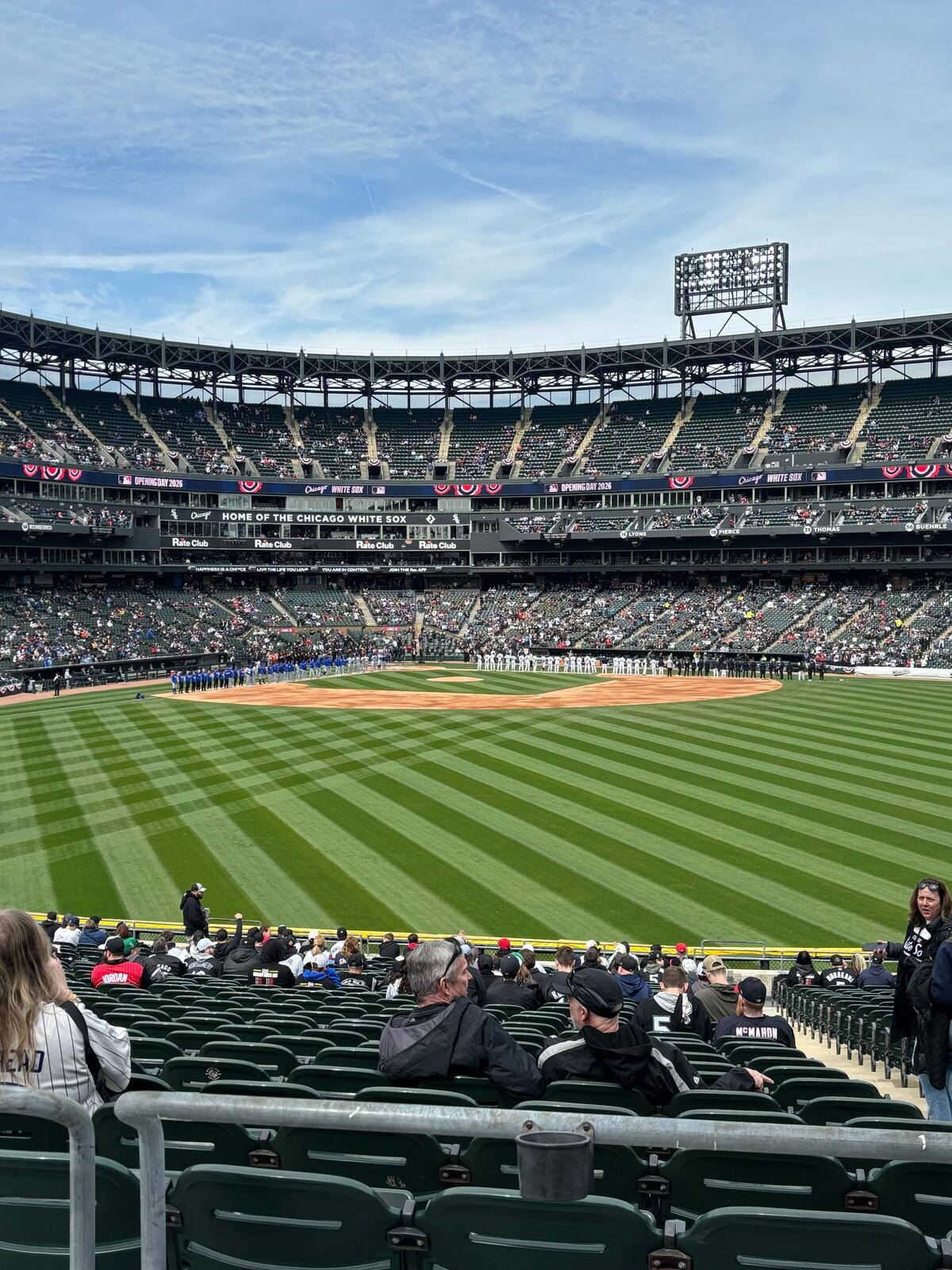
Toronto Blue Jays second baseman Andrés Giménez stepped to the plate in the top of the eighth inning at Rate Field in Armour Square last Friday, his team trailing the host Chicago White Sox by a 3-1 score.
Bright springtime hope had hung in the air for a fair bit longer than home fans are used to. The White Sox were in a groove. They’d leapt out to an early lead on offense, and after a shaky start, young pitcher Sean Burke had settled down to allow just one hit over his last 15 batters faced. With Giménez at the plate, the Sox needed just four more outs to secure their second win of the season.
But there’s a reason that the bright springtime hope doesn’t usually last until the eighth inning at Rate Field. When you lose three out of every four games for nearly the length of a presidential term, as the White Sox have since 2022, extended periods of hope even within a single game are few and far between. Even when things seem to be going well, Sox fans have been all but trained to expect the worst possible outcome, no matter how good the odds look.
Still, hope is always abundant on opening day. All things seem possible, even for a fanbase that’s just endured the worst three-year stretch in the team’s 125-plus year history.
It felt especially abundant on this opening day. The weather had finally blossomed into a lovely 60 degree afternoon, following a week of clouds and rain. As promising, this year’s White Sox squad figures to be their most interesting in several seasons. “The first thing that sticks out is the smiles on peoples’ faces,” beer vendor Leo Daley said about his opening day experience. “Lots of good positive energy, and excited people.”
Unfortunately, Giménez brought much of that energy crashing down with one eighth-inning swing of the bat. When the ball clanked off the top part of the right field foul pole for a game-tying home run, the crowd’s reaction—those who weren’t cheering for the Blue Jays, of course—wasn’t anger so much as a collective sigh. As if to say: things never change, do they?
Curiously, it didn’t seem to break the mood of anyone in my immediate vicinity, as you might expect from a late-game meltdown on opening day but. But there’s an easy explanation, based on the fans I spoke with. The game wasn’t the point. Not in the way that you’d think.
The energy around the stadium was palpable even two hours before the 1:10pm game time when I strolled through Armour Square Park on the corner of 33rd and Shields. The area is mostly sleepy and residential, but this morning, throngs of jersey-clad fans packed the outdoor seating areas and sidewalks surrounding Turtle’s Bar & Grill and Cork & Kerry, two of the select few drinking establishments in the immediate vicinity of the ballpark. It’s not Clark and Sheffield, but it’s as buzzing as you’ll ever see this little stretch of 33rd St. west of the Dan Ryan expressway.
Tailgating is typically associated with American football, but a thriving tradition has developed in the parking lots where the old Comiskey Park once stood. Hundreds upon hundreds of coolers, folding tables, grills, and corn hole sets were spread throughout the sea of parking lots surrounding the current stadium. On Friday, the densest action was seen in Lot B, just a few feet away from a plaque marking home plate at “Old Comiskey,” as it’s still affectionately known to fans old enough to have set foot in it. The number of flags flying tall from poles sprouting out of all types of vehicles made the scene resemble a boat club. I saw a Mexican flag, a Greek flag, a Pride flag, a University of Illinois flag, and any number of others bearing twists and variations on the White Sox logo.
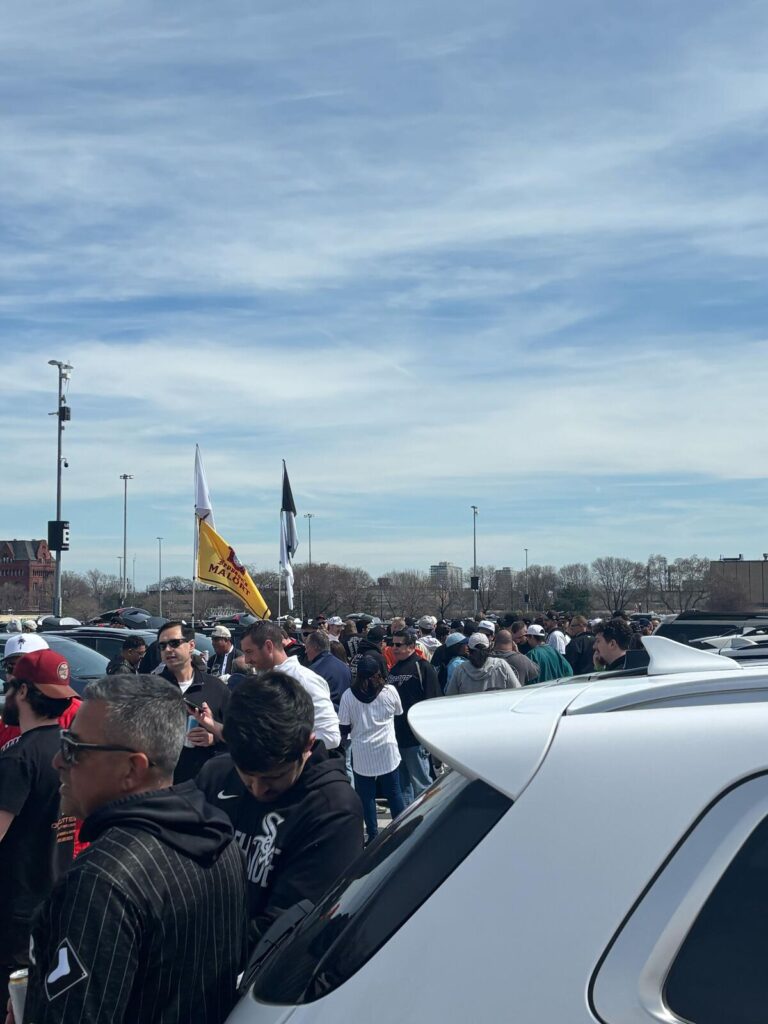
Naturally, it was the Malört flag that caught my eye. At its base, a table was neatly spread with a selection of commercial and craft whiskey—and of course, Malört—that seemed a few notches above typical tailgate fare. That’s where I found and spoke with Peter Fonseca, founder of the “Chicago Sports Bums” fan group and the organizer of “Whiskey at Comiskey,” which I had inadvertently stumbled across.
“Once a month in Lot B we do free food, free beer, free whiskey for anybody that wants it,” Fonseca told me when I asked about his table set-up. He ballparked about 175 attendees for the Opening Day edition, an impressive number considering the short-notice rescheduling of the game from Thursday to Friday. He says they had more than 300 RSVPs for the initial gathering before the postponement was announced on Wednesday afternoon. The energy was high enough that I might not have known the difference.
This is Whiskey at Comiskey’s fourth season, the tradition having come about in 2023 as the Sox descended from title hopefuls into their worst season in a half-century. “The way we figure it, White Sox fans deserve something good!” Fonseca said with a grin.
Plenty of teams (baseball and otherwise) have undergone extended stretches of futility. Fans organizing monthly whiskey tastings to make a trip to the park worthwhile? It might not be a first, but it’s the only one I know of.
Scenes and conversations in and around the ballpark on Friday reinforced my perception that White Sox fans have, if nothing else, an undeniable sense of humor about their downtrodden status. Dating back to the team’s league-record 21-game losing streak and 121 total losses in 2024, some fans seem to have embraced the lowest lows of sports fandom, perhaps figuring that record-setting ignominy is, if nothing else, more fun than being regular old bad.
I say that having witnessed the end of that 2024 season, when Sox fans actively rooted against their own team, as they cynically celebrated the approach of the record-setting loss. At the 2026 opener, I spotted one fan on the outfield concourse sporting a custom number 24 jersey bearing the numbers “41-121” on the back in lieu of a name, a reference to that all-time flop of a campaign. Elsewhere, I counted no fewer than five jerseys referencing confirmed Sox fan Pope Leo XIV, two of them with accompanying headdresses. It’s a fanbase that’s learned to embrace the weird in the absence of anything to be proud of in the traditional sense.
Before the game, a bit deeper in Lot B and away from the main blob of tailgaters, I found another affable group camped under a pride flag. They aren’t affiliated with any broader fan groups, but they told me they make the trip from northwest Indiana a handful of times every summer to “tailgate our asses off” and enjoy the company of others.
“Welcome to the family barbecue!” exclaimed a woman who introduced herself as Nikki when I approached. Their group numbered just five, but they mingled and shared a table and food and drink supplies with a slightly larger party camping out of the vehicles adjacent to theirs. I asked Nikki if the two groups knew each other, and to my surprise, she said they had just met. “We happened to have liquor, they wanted to do shots, and we made friends!”
When I asked Rick, another member of the party, why they enjoy coming to games, he was equally chipper about the interaction. “We just love the community here… They loaned us their folding table and said, ‘just put it in our car when you’re done!’”
The sense of community that people find at White Sox games isn’t just about finding new friends at parking lot cookouts. Leaning on a right field concourse railing overlooking the outfield, I asked Nathan, a fan in his late-20s, what it was about Rate Field that kept him attending opening day year after year despite the team’s dismal outlook. Moments before a hit from Sox outfielder Austin Hays gave them a 3-1 lead in the third inning, his answer came without hesitation.
“It’s the atmosphere. The people who come out are true Sox fans,” he said. As the only White Sox fan in a family full of Cubs fans, he naturally contrasted the Rate Field experience with its North Side counterpart. He described feeling at Wrigley Field “like people are there just to be there, like it’s a trend.” But on the South Side, “you’re there to enjoy the game with the fans. Even if the game’s going bad, you’re all on the same page, you’re not just there to sit on your phone and talk with the people next to you… you’re there to really engage with the atmosphere and be there with people. Especially on opening day.”
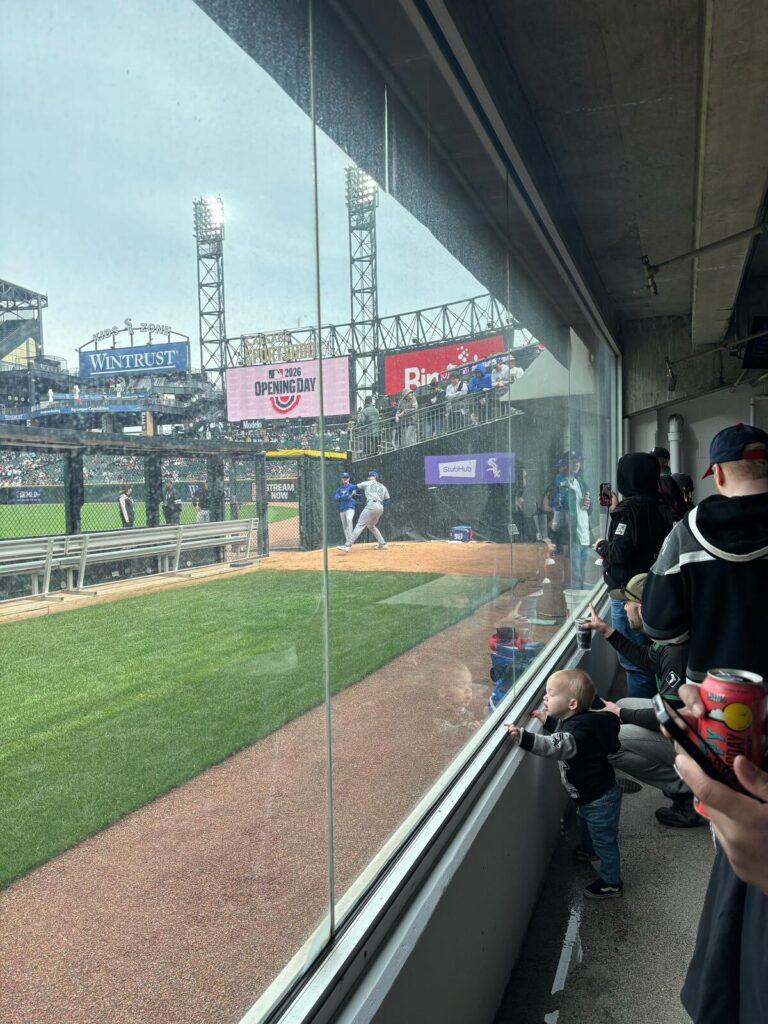
Nathan wasn’t the first fan I talked to who made the comparison to Wrigley. Sitting at a bar in the “Craft Lodge” below the right field bleachers, Carlos told me he felt the “game atmosphere” around the Cubs was much better. It’s a fair contention—the Cubs have been a competitive team, and their games are often packed and typically more raucous than your average Sox game. Still, even though he identifies as a Cubs fan, he was wearing a White Sox jersey and said he prefers the “ambience” of baseball on the South Side. “You feel like you have room to breathe.”
Later in the day, I asked Leo the vendor what stood out about Rate Field’s atmosphere, given his experience selling beer at nearly every venue in Chicago, Wrigley Field included. He had positive things to say about Sox’ fans “energy and demeanor,” especially on well-attended days like the opener. “It is such a community vibe over there,” he said. “You have more than half the stadium hanging outside the park for hours in the parking lot cooking hot dogs… there is a sense of community [that] does feel different from other stadiums.”
So as much as it was about a baseball game being played on the field, Friday afternoon felt more like a celebration of the community that’s built itself around the game on the field. It’s clearly an intergenerational community; the substantial number of young children clad in recently-purchased onesies and similar garb was equally matched by grizzled adult fans wearing shirts and jerseys older than half the players on the field. During a pre-game In Memoriam tribute, two of the loudest cheers were reserved for pitchers who played nearly 40 years apart in Wilbur Wood and World Series hero Bobby Jenks.
It’s also a community that embraces having bonds as Chicagoans as much as they have as White Sox fans. The team didn’t limit their In Memoriam to only their own; fans in the stadium were able to additionally pay loud respects to Chicago hockey legend Troy Murray and Sister Jean Schmidt, the Loyola University cleric who gained recognition for her role as chaplain to the school’s men’s basketball team amid their Cinderella run to the 2018 Final Four. (Murray passed last month, and Schmidt in October, 2025.) First pitch honors went to Chatham native Chance the Rapper, commemorating the 10-year anniversary of his Grammy-winning Coloring Book mixtape. The artist also operated a pop-up merch stand outside Gate 5 of the stadium. It’s like Carlos the Cubs fan told me down in the Craft Lodge. “At the end of the day, it’s one city… it’s Chicago!”
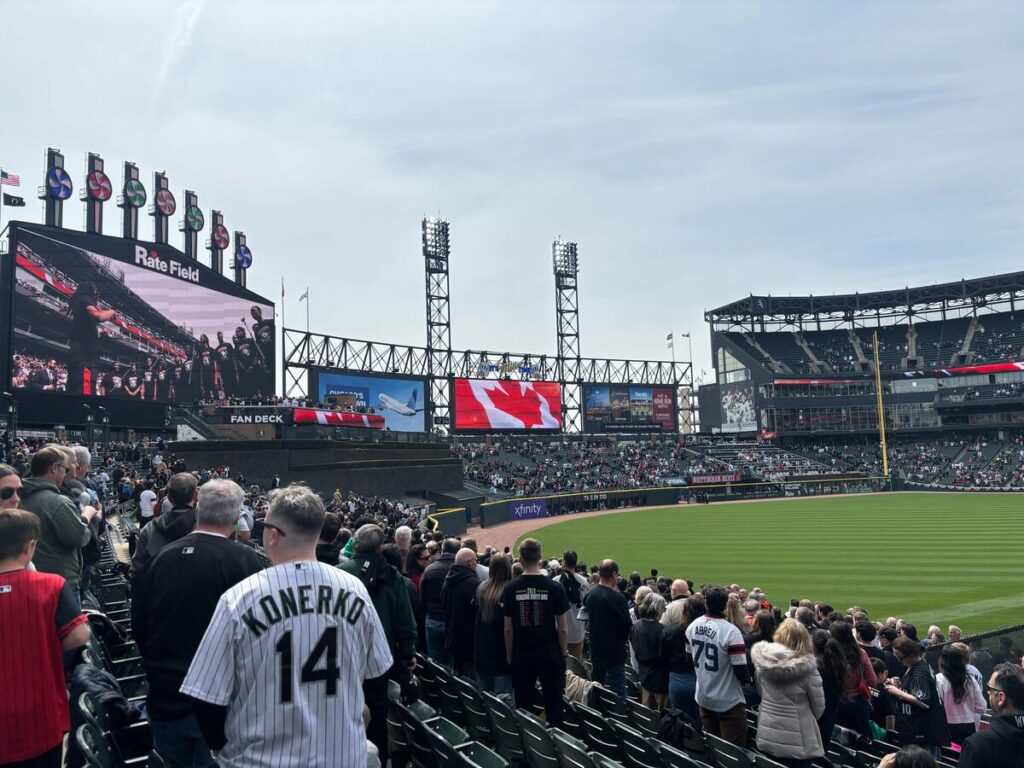
Undoubtedly the biggest cheer of the afternoon was reserved for the third inning, when the crowd watched in real time as franchise icon and current team studio analyst Ozzie Guillén was informed that he would be honored with a number retirement ceremony this coming August. Guillén has been a fixture in the Sox organization for as long as any Sox fan under 50 can remember, first for 13 years as a star shortstop, then for an eight-year managerial tenure that included the team’s lone post-WWI championship. After a disastrous one-year stint with the Miami Marlins ended his MLB coaching career, Guillén returned to the Sox organization, where he has now spent more than a decade as a television pre- and post-game host.
It was a fitting feather in the cap of what mostly felt like one of the most emotionally upbeat games I’ve attended in recent years. So when Andrés Giménez hit his game-tying home run to pull the Sox back from the precipice of victory, it makes sense why some fans seemingly saw little use in getting angry. Win or lose, it sure looked like many of them had already gotten what they came for. Victory or defeat was just icing on the cake.
Even so, hope may really be rearing its wings this time around. Virtually every fan I spoke with was able to cite concrete reasons for optimism that this year’s team would provide a change of direction. For most of the game, the sentiment felt validated. And just when Giménez’s home run seemed to have sent many of those hopes for a fresh start up in smoke, the Sox did something entirely unexpected: win.
Why so unexpected? They hadn’t just allowed Toronto to tie the game. Only a few outs later, they had fully given them the lead, courtesy of a throwing error from third baseman Miguel Vargas that put Toronto up 4-3 and in any other recent year would have all but sealed a loss. Comeback wins have not been in vogue on 35th street as of late.
2026 is a new year, though. Down to their last three outs, the Sox plated the game’s tying run on a daring squeeze bunt from veteran outfielder Derek Hill. Just a few pitches later, a game-winning single from rookie Tristan Peters sent Sox fans home with their first comeback win of 2026.
The air was celebratory, all the way to the end, as thousands of jolly fans shuffled down the stadium’s concrete exit ramps to the sounds of fireworks and the familiar tune of Sweet Home Chicago. A celebration not just of a win, or even of a potentially mold-breaking win. It felt like a celebration of local community and tradition, of rebirth, and of renewing the kinds of social ties that can be all too difficult to come by in a time where maintaining community and connection is as important as ever.
If it comes with a side of a competitive baseball team? All the better.
Malachi Hayes is a Bridgeport-based writer and South Side native.