
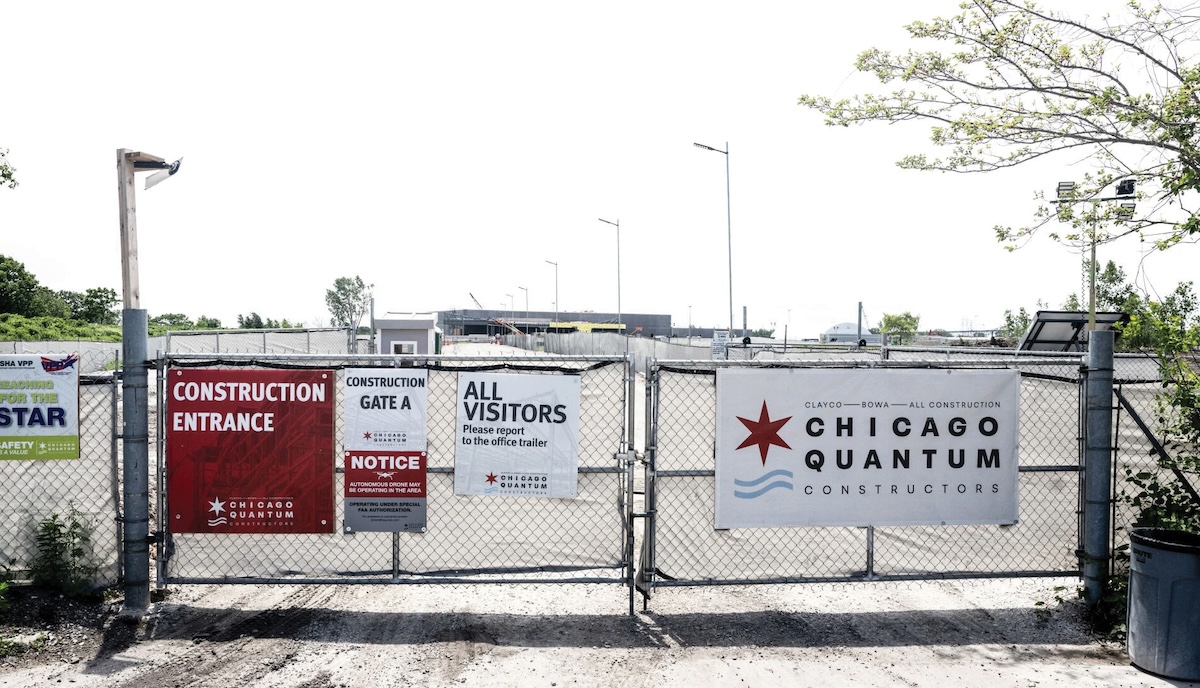
A group of graduate students, research staff, and scientists, many affiliated with the University of Chicago, is joining the opposition to the Illinois Quantum and Microelectronics Park, arguing that their technical expertise gives them the ability to challenge some of the environmental and scientific claims made in support of the $9 billion development.
The group, Science for the People Chicago, released a report in early July alongside a public webinar outlining what members describe as months of research into the proposed 440-acre quantum computing campus, known as Quantum Shore, on the former U.S. Steel South Works site in South Chicago. The report examines the site’s environmental remediation, projected energy demands, and the technological feasibility of quantum computing company PsiQuantum’s plans to build the first-ever, error-correcting quantum computer.
“What we already know is sufficient to justify canceling the project,” said Josh Sodicoff, a co-chair of Science for the People’s local chapter and a Ph.D. candidate in the University of Chicago’s Genetics, Genomics and Systems Biology program. “But what we have uncovered through review of environmental reporting, permits, press releases and the underlying science shows a project both capable of massive negative impact on its neighbors while unlikely to meet its most basic aims.”
The group’s criticisms echo concerns that Southeast Side residents and community organizations such as Southside Together, Environment Transportation, Health and Open Space, and the Alliance of the Southeast have raised since Governor. J.B. Pritzker announced the project two years ago. Those groups have pressed for a legally binding community benefits agreement and questioned the cleanup of the former steel mill, the project’s electricity demands, displacement risks, and whether local residents will benefit from the roughly 900 full-time jobs.
Science for the People first got involved in March after members reached out to Southside Together. According to Hanna He, a clinical research professional and the group’s other co-chair, their role has been to “increase the scientific literacy surrounding the Quantum Center to give residents the full picture of what was going on in the backyard.”
She said the group includes researchers with backgrounds in genetics, environmental microbiology, science education, and clinical research, while the broader project drew on “contributions from twice as many people and insights from a group spanning quantum industry specialists, biogeochemists, and fellow organizers.”
Unlike previous community opposition, the group’s report attempts to evaluate both environmental science and the underlying quantum technology. Members said they reviewed public records, analyzed environmental data, investigated infrastructure plans, and examined public information released by PsiQuantum, a California-based company that is the campus’s anchor tenant.
Much of the report focuses on contamination at the former South Works property, which he said remains extremely toxic.
“Due to its extensive industrial history, South Works is now highly contaminated,” she said. “The concentrations of toxic inorganics are extremely high.”
The report argues that increased flooding risk along the lakeshore is likely to draw those contaminants into Lake Michigan and that the project has not taken its toxic dust mitigation efforts seriously.
Those concerns build on years of criticism from neighborhood environmental advocates. Last December, the Illinois Environmental Protection Agency conditionally approved the developer’s remediation plan, requiring additional soil and groundwater testing before updated “no further remediation” determinations can be issued. The developer, Related Midwest, has said the project will include protective surface caps, slurry walls, and other safeguards designed to meet current state environmental standards.
Related Midwest did not respond to a request for comment as of press time.
The group also challenged PsiQuantum’s timeline for building what the company describes as “the world’s first utility-scale, fault-tolerant” quantum computer. PsiQuantum, which is valued at $7 billion, has said its photonic approach will unlock applications ranging from drug discovery to advanced materials and has attracted hundreds of millions of dollars in state and federal support.
But Sodicoff argued that recent technical milestones announced by the company do not demonstrate that goal is within reach. He said that the company’s ability to connect chips between cryogenic cabinets, while impressive from a physics standpoint, does not indicate they are able to do so “in a way that is really usable for anything.”
PsiQuantum did not respond to specific questions about its technology’s viability.
“PsiQuantum is proud to be the anchor tenant at the Illinois Quantum and Microelectronics Park,” said spokesperson Chris Estep. “We’re committed to being a responsible neighbor alongside the local community here, and to bringing the full promise of quantum computing to life on Chicago’s South Side.”
While Science for the People hopes to put a stop to the quantum campus, they are not opposed to redevelopment itself. Instead, they argued the former steel mill should be cleaned through less invasive bioremediation techniques before being repurposed for amenities that nearby residents have long said they need, such as grocery stores, pharmacies, parks, or housing.
Max Blaisdell is the staff writer for the Hyde Park Herald.
I’m glad others finally questioning the technical feasibility of the “quantum tenants”. I’m a former NU engineering professor, and I still can’t understand how these companies are able to make their technical claims. Many of my friends have worked in quantum computing at some of the best laboratories in the world studying this stuff – and (in private) they all admit that it’s not clear if there’s any real application or ability to deploy the architectures anticipated. This is a huge bet of IL funds being made on a field of science that is still in a very early RnD phase. I sadly think this project is being ran by real estate developers and politicians who, even assuming the best of intentions, simply don’t have sufficient ability to question the technical merit of a plan or understand how big of a gamble this all is. To me, it’s terrifying. I applaud the efforts of other local PhD scientists and graduate students to actually question the validity of claims being made by the proposed tenants.
Hi D, could you reach out to us at sftpchicago@gmail.com? We’d love to talk about the state of the quantum industry!
Yeah – no.
Its not the job of some academics to opine on the validity or worthiness of the science. That is the job if the investors.
While I generally dont support governments crowding out private investors, it is their job to do what’s best for society.
If quantum even comes CLOSE to its potential it will be the best money government ever invested.
This is an old fashioned Chicago Shakedown. Quantum will be the most important advancement mankind has ever created, with the potential to unlock the mysteries of the universe. But a group of Marxists want to exchange it for a park.
Liberalism is a mental disease.
Noam, can you provide an explanation, accessible to us ignorant folks, about exactly how quantum might “unlock the mysteries of the universe?” And how we mundanes might benefit? Thanks.
i have no doubt that parks, grocery stores and housing would be great additions to the South Shore and East side Communities. I think that whatever remediation efforts that are needed to make the South Works suitable for development as an employment generator need to be employed as soon as possible. If good paying jobs result from development of the site the grocery stores and housing will suddenly appear as if by magic.
These data centers must not be close to humans. Tell JB I said so.
It’s absolutely the job of academic scientists to report their findings about the dubious values and deleterious effects of technological projects. Investors only care about money – their money. They show no concern for the lives of citizens. We need counterpowers. Academia is a lot more valuable than the risky bets of heartless oligarchs, in this regard and many others.