
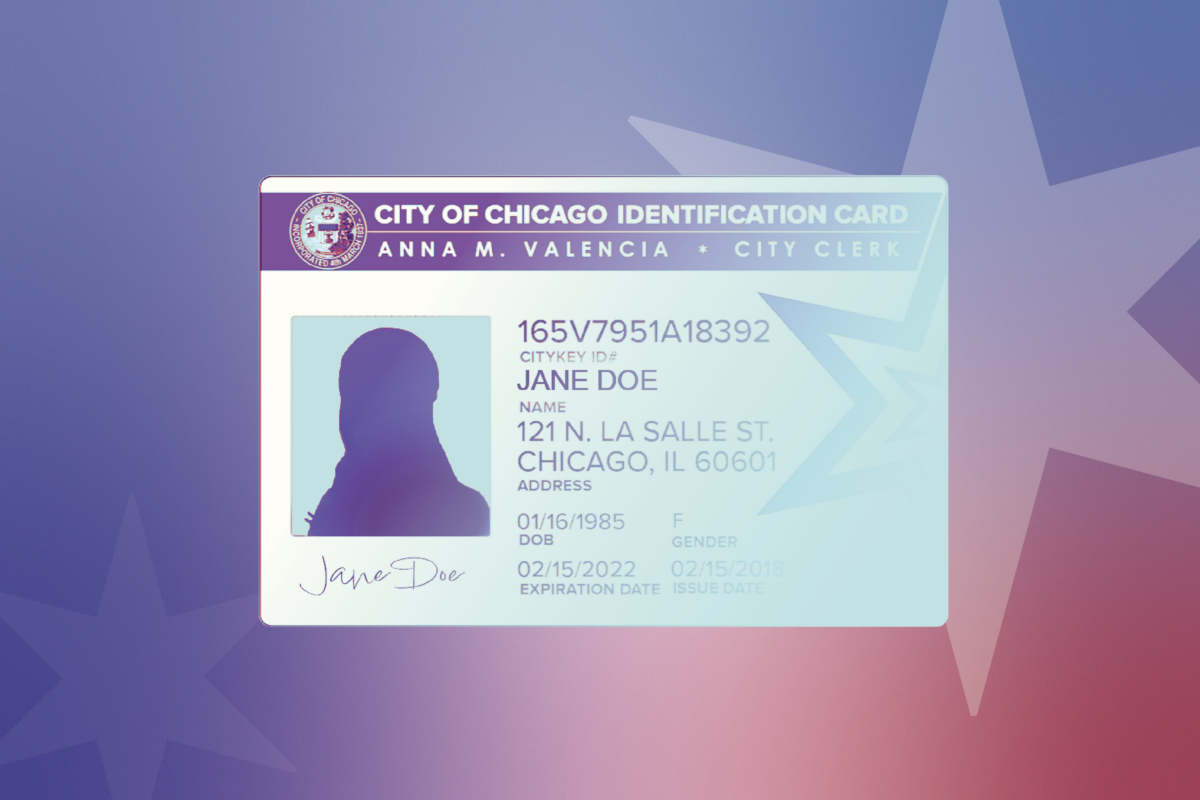
It was around 10 p.m. on a weekday last fall when Catie Burrill and her boyfriend walked up to Giant Penny Whistle Tavern in Pilsen.
“Not that busy, no line outside,” Burrill said. “Two men were working the door. They let me in first after checking my Illinois driver’s license.”
When her boyfriend, a Venezuelan immigrant, handed over his government-issued CityKey ID, one bouncer “turned to the other for advice.” The second bouncer asked if he had another form of identification.
“He didn’t,” Burril said, “and the bouncer immediately said no, shaking his head, repeatedly and assertively, stating, ‘You need a real ID, a real ID.’”
The couple left.
Her boyfriend chose not to speak publicly about the incident. “He has been under a lot of stress and doesn’t want to be involved,” Burrill said.
After stepping away, Burrill and their friend, Carlos Flores, returned to the bar to ask again whether a CityKey card could be accepted. This time, a different staff member was at the door. “She was much kinder and told us she would allow it as long as she was the one working alone,” Burrill recalled.
Flores reached out to Giant Penny Whistle afterward via Instagram, and a representative told him that they had heard about the situation and that their ID scanners “did not recognize” the CityKey and that they believed the Chicago Liquor Commission required bars to use scanners.
But according to Burrill’s account, that is not what happened that night.
And according to the Municipal Code of Chicago does not require businesses to use ID scanners.
“Some businesses may have a Plan of Operation which requires them. The use of ID scanners is the discretion of a business, unless required by a Plan of Operation,” Elisa Sledzinska, Deputy Commissioner of Communications and Outreach, said in an email.
In the same Instagram message, the business said it would begin to accept CityKey IDs.
The Weekly reached out to the business but did not receive a response.
The incident highlights how limited awareness of CityKey can result in immediate denial of access. In this case, the initial bouncers did not recognize the card and turned Burrill’s boyfriend away without further explanation.
In 2016, City Council allocated $1 million to create a municipal ID program, and in 2017, it passed an ordinance granting the City Clerk’s Office authority to operate what is now the Chicago CityKey Program.
Funded with public dollars and promoted as a way to increase access for residents who face barriers to state-issued identification, CityKey was designed to help Chicagoans navigate daily life.
But in practice, its usefulness depends on whether a private business chooses to recognize it at all. This gap opens the door to discrimination, leaving some of the city’s most vulnerable residents uncertain about when and where their ID will be recognized.
Since the program began, the City Clerk’s Office says it has printed more than 153,000 CityKey IDs. City officials describe CityKey as a low-barrier alternative intended to reach residents who may be excluded from state identification systems. No registration or pre-qualification is required, and every Chicagoan is eligible regardless of age, insurance, income, health, or immigration status. The CityKey card is free to obtain.
According to the City Clerk’s Office, residents often choose CityKey because of barriers that make obtaining a state ID or driver’s license difficult. Those barriers can include financial constraints, immigration status, housing instability, and limited access to required documents.
But unlike state-issued IDs, CityKey is a municipal identification card and does not carry the same legal authority under Illinois law. Businesses that sell alcohol or require age verification are legally required to accept state or federally issued IDs, but CityKey is not explicitly included in the list of valid IDs. As a result, private businesses are allowed to decide whether to accept it, creating a patchwork of policies across the city.
The City Clerk’s Office confirmed that it cannot require privately owned businesses to accept CityKey for entry, purchases, or age verification. A spokesperson said the office currently has eighty-eightbusiness partners that accept the card and works with the Department of Business Affairs and Consumer Protection (BACP) to encourage participation.
But because participation is voluntary, the responsibility ultimately falls on cardholders to know which businesses accept the ID and to explain or defend its legitimacy when it is questioned.
CityKey also does not include a barcode or scannable feature. According to the City Clerk’s Office, adding such a feature would require maintaining a centralized database, and CityKey does not store cardholder information.
For immigrants in Chicago, the uncertainty around whether an ID will be accepted can compound an already heightened sense of anxiety. Immigration raids have increased in neighborhoods across the city, prompting many residents to stay home, avoid public spaces, and alter daily routines to reduce the risk of encounters with federal agents.
That anxiety has intensified as CityKey itself has come under federal scrutiny. In June, Chicago paused online applications for the municipal ID program after the City Clerk’s Office received a subpoena from U.S. Citizenship and Immigration Services (USCIS) seeking records related to CityKey applicants. City Clerk Anna Valencia described pausing online CityKey applications as a “tough decision” aimed at protecting vulnerable residents.
While residents can still apply for CityKey in person, the pause underscored long-standing concerns about data privacy and the risks undocumented residents face when their identification is questioned or documented. City officials say in-person applications do not leave records behind, as documents are returned to applicants and no database of personal information is maintained.
Burrill described how being turned away at a bar intensified fears around immigration enforcement. “We’ve both been feeling anxious about ICE and have been keeping a low profile for the past month,” she said. “It was our first time going out in a while, and we were really looking forward to having some fun.”
Incidents like this illustrate how a municipal ID meant to foster access and belonging can fall short in practice, especially for immigrants already navigating a climate of fear.
Even outside of immigration status, CityKey holders report facing barriers in everyday transactions. In a Reddit thread, one user wrote: “I have one [CityKey] and it’s fine except that many stores won’t accept it for proof of age or residency.” The user said Mariano’s and Target refused to accept the card, adding, “There’s also no scannable barcode, which doesn’t add to legitimacy.” When they contacted the City Clerk’s Office, they were told: “The CityKey may be accepted as valid proof of age, but a business can choose not to accept it as a form of ID as a matter of policy.”
The City Clerk’s Office says these experiences reflect the most common complaints it receives from CityKey holders. According to the office, frequent issues include businesses being unaware of the program, CityKey not being accepted for age verification at private establishments, and cardholders being unable to obtain certain government documents using CityKey alone.
In response, the office says it continues to promote CityKey by holding events throughout the city, establishing new partnerships, and collaborating with existing partners. It also encourages businesses and cardholders to help raise awareness of the card—leaving individuals with the burden to explain or defend the validity of a government-issued ID at the door or checkout counter, as with Barrill and her boyfriend’s experience that night at the Giant Penny Whistle.
“It felt like selective discrimination to us!” Flores said, echoing a reality for many who carry CityKey. Even as the card was designed to expand access and protect vulnerable residents, gaps in awareness, business acceptance, and legal authority leave holders navigating a patchwork of rules and the stress of proving their identity every time they step out.
Alma Campos is the Weekly’s immigration reporter and project editor.
You seem to be missing the point of this program. It’s not so people can buy beer, it’s so you can get a job/sign a lease/open a bank account and generally participate in necessary areas of society. There are so many angles you could have criticized this program on but you picked this instead.