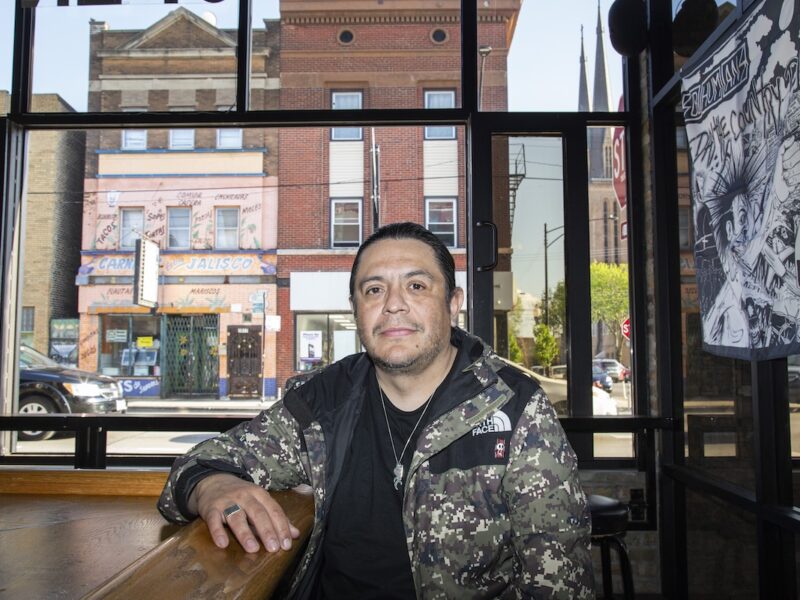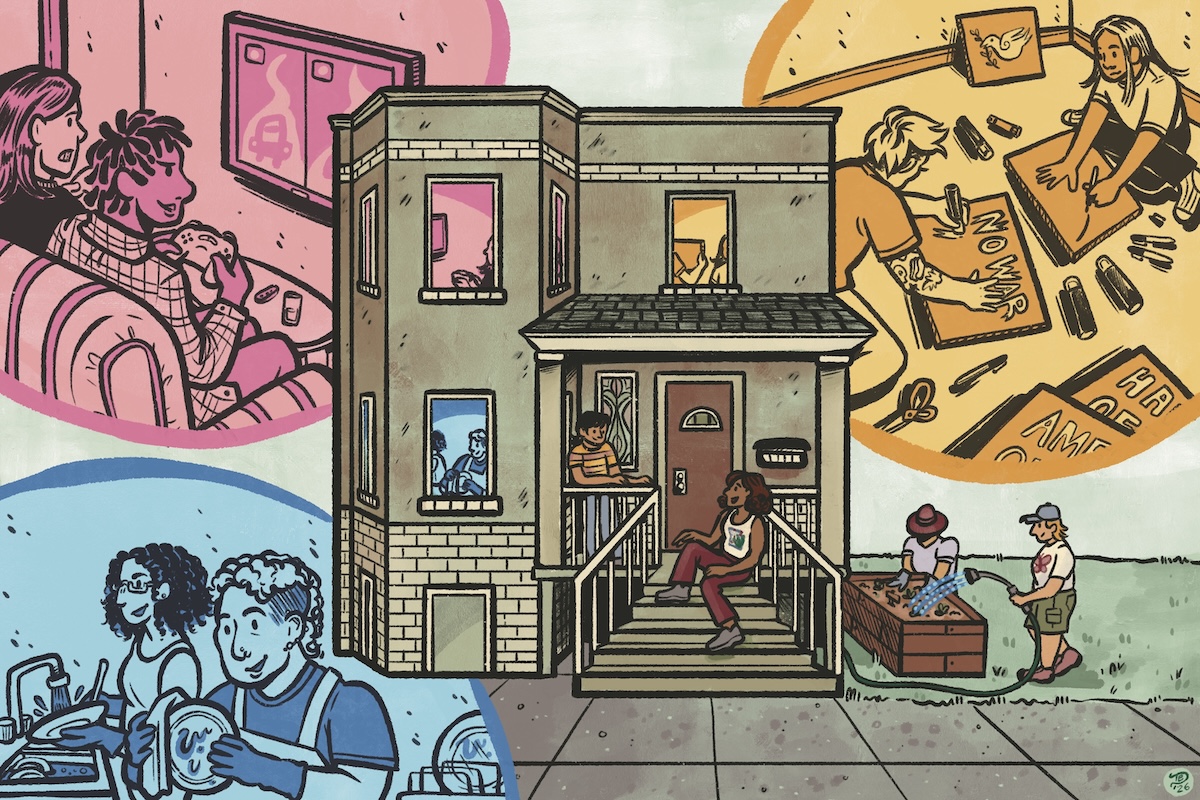
While doing eviction defense and mutual aid work in the pandemic’s early days, veteran housing organizer Robin Semer realized she wanted to explore long-term solutions for people dealing with housing insecurity.
“When I was doing the eviction [defense] work, it was like, band-aids all the time,” Semer said. “I said, ‘I want to do something that does something positive for people, not just always trying to patch up some kind of problem that people are having … let’s give people an alternative, something that’s better.’”
In 2023, Semer tapped into a potential long-term solution to the current affordable housing crisis on the South Side by co-founding a housing cooperative, La Villita Housing Coop. A two-building, six-unit housing coop housed on one property in Little Village, La Villita Housing Coop is a limited equity housing cooperative, a model where residents own shares in a residential building and manage it collectively. According to La Villita’s website, this cooperative is rooted in values of “community and equity, and…offers an alternative to the rising rents and displacement that have unfortunately affected so many in our community.” In other cooperative models, residents can also rent their homes.
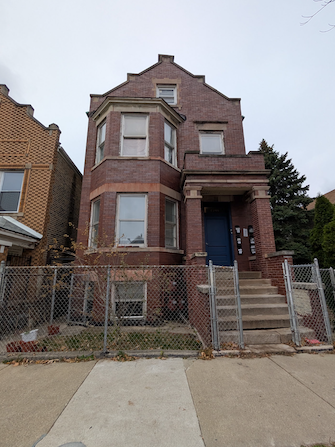
Cooperative housing is not a new concept. According to the National Cooperative Law Center, momentum for this model of affordable living started taking shape in 18th-century Europe, primarily in Great Britain and France. Housing cooperatives first appeared in Chicago in the 1920’s, popping up in South Side neighborhoods such as Hyde Park and South Shore, and offering a way for low-income earners to secure affordable homes.
One hundred years later, housing cooperatives are still alive and thriving on the city’s South Side.
La Villita Housing Coop is one of several housing co-ops in the region, joining the ranks of Hyde Park’s Qumbya Housing Cooperative, Jumpstart Housing Cooperative—which owns one building in Bronzeville and another in South Chicago—and several others.
Though there isn’t a ‘one size fits all’ approach to housing cooperatives, they all provide some crucial benefits to South Side residents: A strong sense of community; more affordable housing, whether renting or owning; and democratic decision-making. These elements create a sense of connectedness and fulfillment for many co-op residents.
Community
Anna Nedoss is president of the Qumbya Housing Cooperative, a co-op of three separate residential buildings in Hyde Park that was formed in 1988. She has lived in four individual housing cooperatives during her adult life, and said that each of them had very tight-knit communities.
“That is certainly true at Bowers,” said Nedoss. Bowers was founded in 1991, and is one of the buildings owned by Qumbya. “I feel like there are people here who I absolutely trust with my life…. I have met people that live in co-ops that are less tight knit than this, where most people have their main social circle—or their main friend group—outside of the house.”
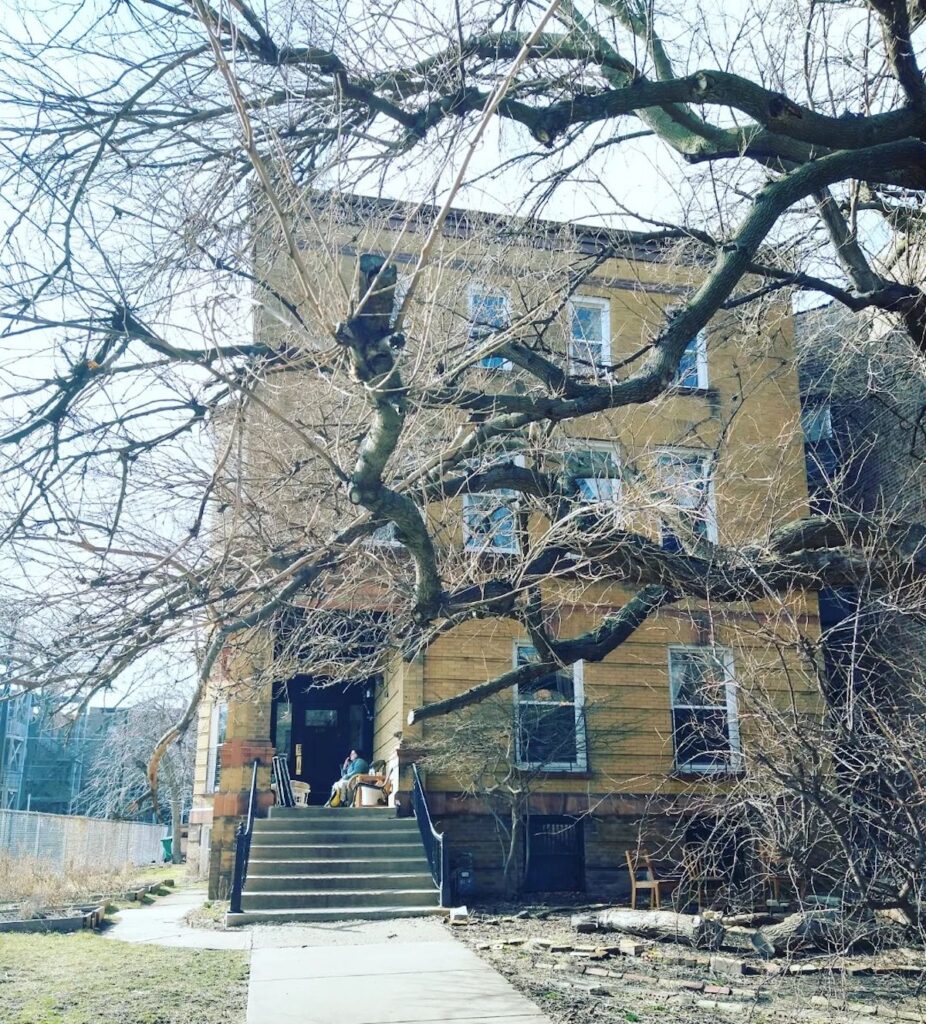
Nedoss has 19 housemates who make up her main social circle.
“We do a lot of stuff together; we go on trips together,” Nedoss continued. “Every night at the house, there’s something social happening, either like a movie, or a board game or just people chatting in the kitchen… we eat a meal together seven days a week.”
Alicen Buder, a Chicago high school teacher and Qumbya resident, said she has dinner with her Haymarket House housemates Monday through Thursday every week, as well as brunch on Saturdays and another dinner on Sundays.
Buder, who lives with her husband and infant daughter, recalled how her roommate sprung into action the day she went into labor.
“One of my roommates drove me to the hospital when I was in labor, and stayed at the hospital overnight just to make sure I was okay,” Buder stated. “We even told them, ‘you can go home.’ They were like, ‘what if I just stayed?’”
The aspect of community, the ability to rely on your friends and neighbors, manifests itself in ways that extend far beyond board games and hospital trips. Many residents actively support their peers during challenging times.
Nedoss said that when house members have gotten months behind on their rent, because of job loss or other crises, they are offered payment plans. In these situations, housemates have also stepped up and crowdfunded for each other, Nedoss said.
Nedoss stated Qumbya has only evicted coop members when they have not shown good faith efforts to pay.
“If they lived in a building with a landlord, they would get evicted, whereas here, you get a payment plan,” she said. “We don’t want to evict people. We, at our core, are opposed to evicting people unless it’s a situation that cannot be resolved or someone is in danger.”
Veronica Rodriguez, a resident of the La Villita Housing Coop, said the sense of community amongst co-op members was a big factor in choosing this alternative style of housing. Rodriguez explained that this sense of safety and belonging is especially important right now, due to the Trump administration’s anti-immigration practices.
“I think more than ever now, when folks are trying to plug in and keep each other safe [amid] recent raids and threats from our government based on legal status,” Rodriguez said. “It’s been a necessity to find people who you can have these difficult conversations with, or easy conversations on how we can show up for each other.”
Nedoss said that communal living has been a godsend for her.
“This is a place where we take care of each other,” Nedoss said. “No matter what happens to people in this house, we’re going to take care of each other.”
Ownership Models
There are a few different models of co-op living. One model is what is called a limited equity model, where co-op residents own a share in a property, but not the entire property itself.
Semer said this model restricts how much a unit—or a share of a building—can be sold for.
“Our bylaws say that the amount that members can sell for is the amount that they put down for their deposit, which for most people is $5,000, and three percent interest compounded annually,” said Semer.
Nyah Griffin, vice president of property management at Jumpstart Housing Cooperative in Bronzeville, said that each unit owner has equal equity in their building.
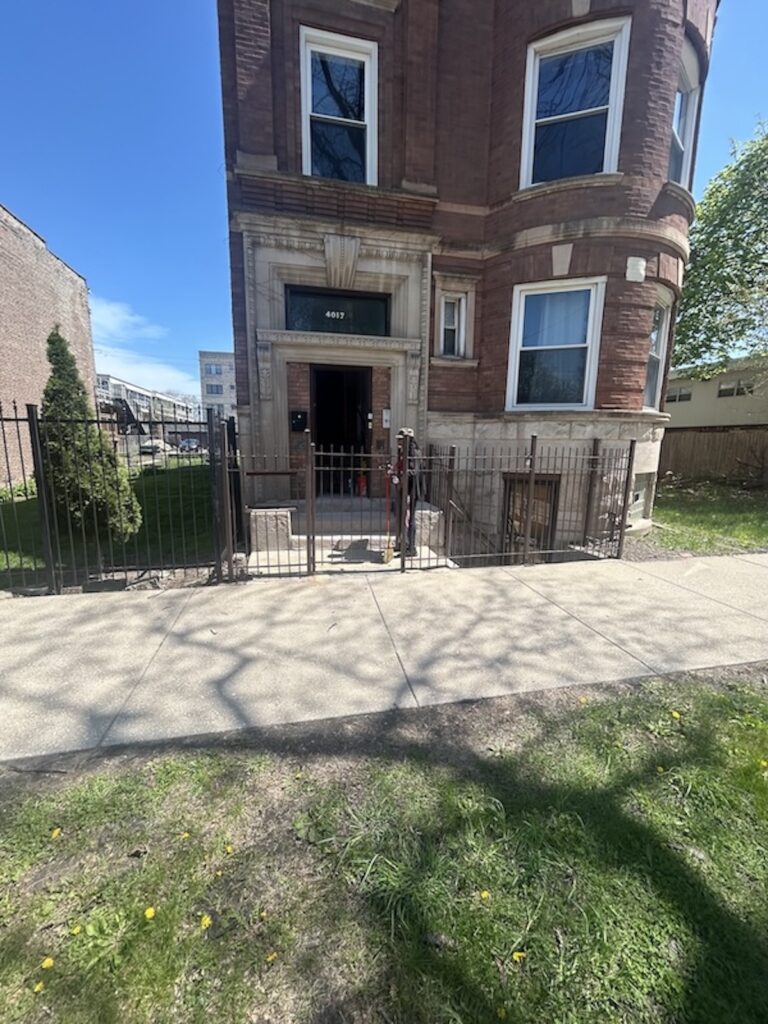
“Two of the units are three bedroom [units], and one of the units [has] two bedrooms, but even that two-bedroom has a different living and dining room space to add more value to that unit,” Griffin said. “That way, it’s equal to what also happens in the building. I can do whatever upgrades I want on my unit, but that’s not going to change my equity at the end of the day; the way that we keep it affordable is that it’s a limited equity opportunity, so nobody can go in and revalue their space.”
Griffin, who has been evicted in the past, said joining a housing cooperative can offer a second chance to people who have been formerly incarcerated, or who may not have the “cleanest” rental histories.
“I can choose to be part of this co-op, and I know they won’t judge me for any of my background,” Griffin said. “It’s really just on me to be able to show up and do what I have to do, and I have to rewrite my story.”
The limited equity model is not the only form of cooperative living on the South Side.For example, Qumbya is owned by NASCO Properties, a nonprofit that owns co-ops throughout the country, mostly in college towns, Nedoss said.
Nedoss explained that every co-op owned by NASCO Properties elects a member to serve on the board. Co-op residents pay rent to NASCO instead of buying property.
“We don’t have a monetary stake, but we have full decision making control over the nonprofit that owns our house,” Nedoss said.
While the limited equity model and nonprofit property management model have some distinct differences—the former is geared towards home ownership while the latter is still a form of renting—the overall goal is the same: to keep costs low and housing affordable.
Nedoss said that while NASCO Properties raises the rent slightly every year with inflation, Qumbya is able to keep its rent affordable because the board is in charge of how much their rent is.
“We have to raise rent enough to be able to pay rent to NASCO Properties, but they usually raise it below inflation,” Nedoss said. “The entire time I’ve lived here, which has been three years, our rent has not changed at all.”
Rodriguez has lived in Little Village her entire life, but has lived at La Villita Housing Coop for just four months. She said getting to stay in the neighborhood where she was raised was a key reason for choosing this particular co-op.
“This is exactly what I imagined for myself,” said Rodriguez. “To still be in my neighborhood that I grew up in, that I know about, that I know people in…but to also continue building community with, and even learning about affordable housing and fighting against gentrification… Knowing about all these issues, it’s really what solidified [me] supporting efforts like La Villita Housing Coop.”
Democracy/Collective Decision Making
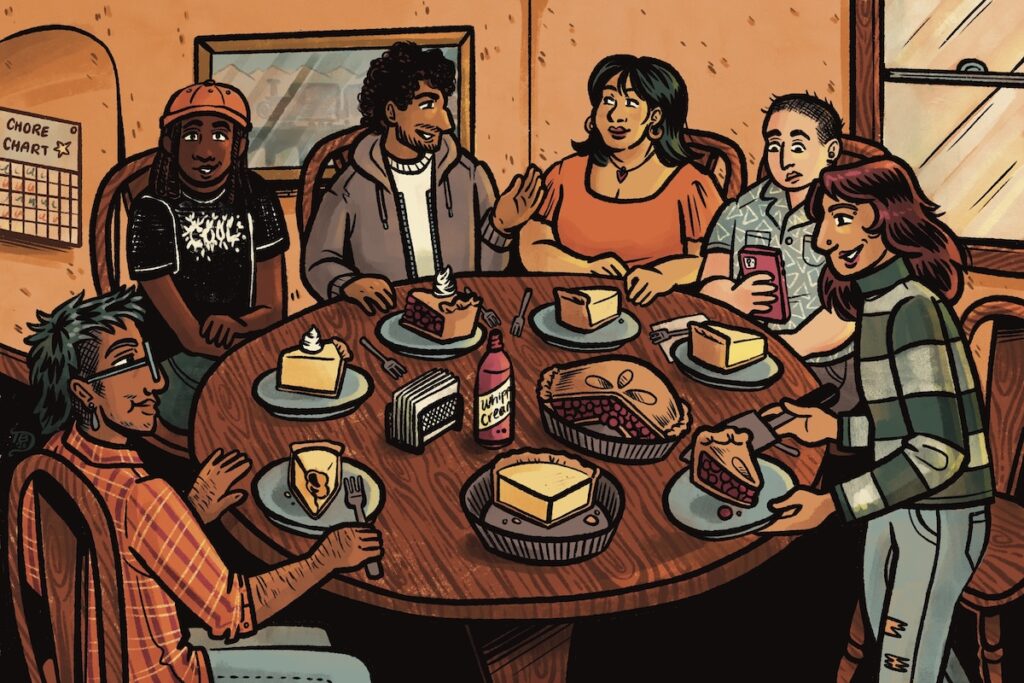
Because collective living is by definition a collaborative process, most housing cooperatives have a governing board made up of residents to help keep things running smoothly. Nedoss, who currently serves as Board President for Qumbya Housing Cooperative, said that the cooperative has a six member board, with two members from each of the three houses.
“We have six different roles on the board,” Nedoss said. “We have a board president, a treasurer, a secretary, maintenance chair, membership [coordinator], and then the last one is conflict support.”
Buder, who has lived at Haymarket House for 11 years, said that collective living is a “political project in some ways,” and that living in a cooperative space allows her to practice deeply held values such as “democratic decision-making and cooperation.”
Along with monthly rent, Qumbya residents also pay what is called “food group,” which is a monthly contribution that covers groceries, utilities and anything else for the house that is decided on collectively.
“One example of democratic decision-making is how we choose to spend that money,” Buder explained. “We use consensus-based voting, which means any individual member can block a motion from happening with anything that we’re discussing as a house, and it forces us to really have conversations and come to compromises about things.”
Semer shared that La Villita Housing Cooperative recently expanded its board from four members to 11 members, and said that a quorum—a majority of members—must be present to pass any co-op rules.
Semer said strong bylaws are essential to the coop running in a smooth and orderly fashion.
“We did it along with pro bono attorneys, that helped us along the way,” Semer said. “We used advice from other cooperatives that formed before us that we respected, and basically took a very long time trying to figure out how the process can be fair and be fair to everyone involved.”
Semer said housing co-ops need a lot more money and support in order to bring more affordable housing to the South Side. One form of financial support comes in the form of grants, she added.
“Hopefully we can create more cooperative housing ourselves and maybe even others in order to keep housing in the hands of the residents—in the hands of the community—as opposed to in the hands of developers that just take their money and leave,” Semer said. ‘[They] don’t care about what happens to the community as a whole.”
Ryan Rosenberger is a Chicago-based music journalist who has been covering the scene since 2018. His work can be found in The Columbia Chronicle, These days Mag, The Weekly, and more.