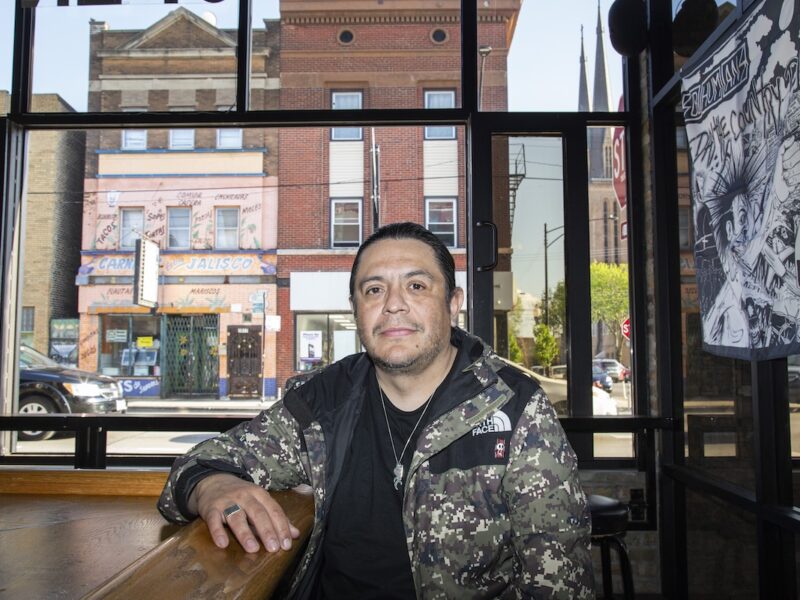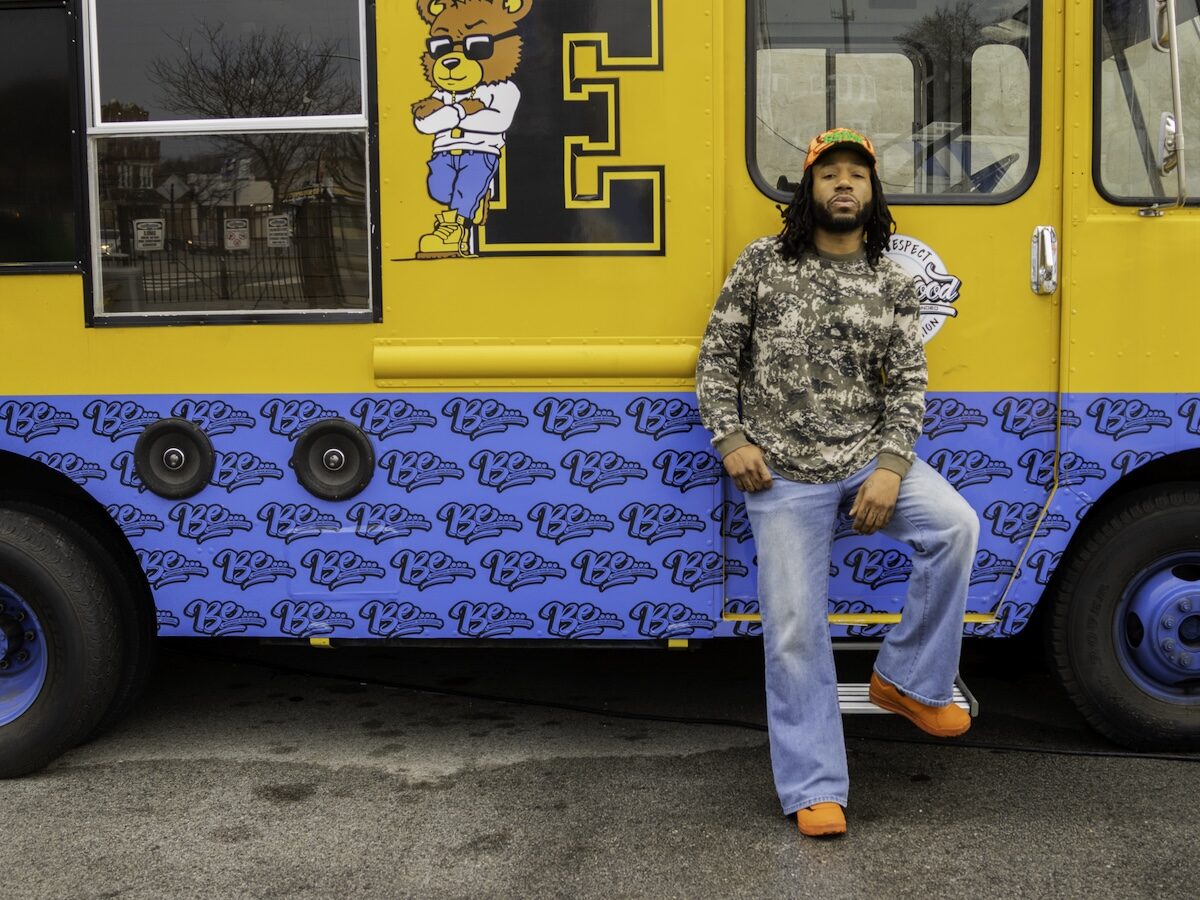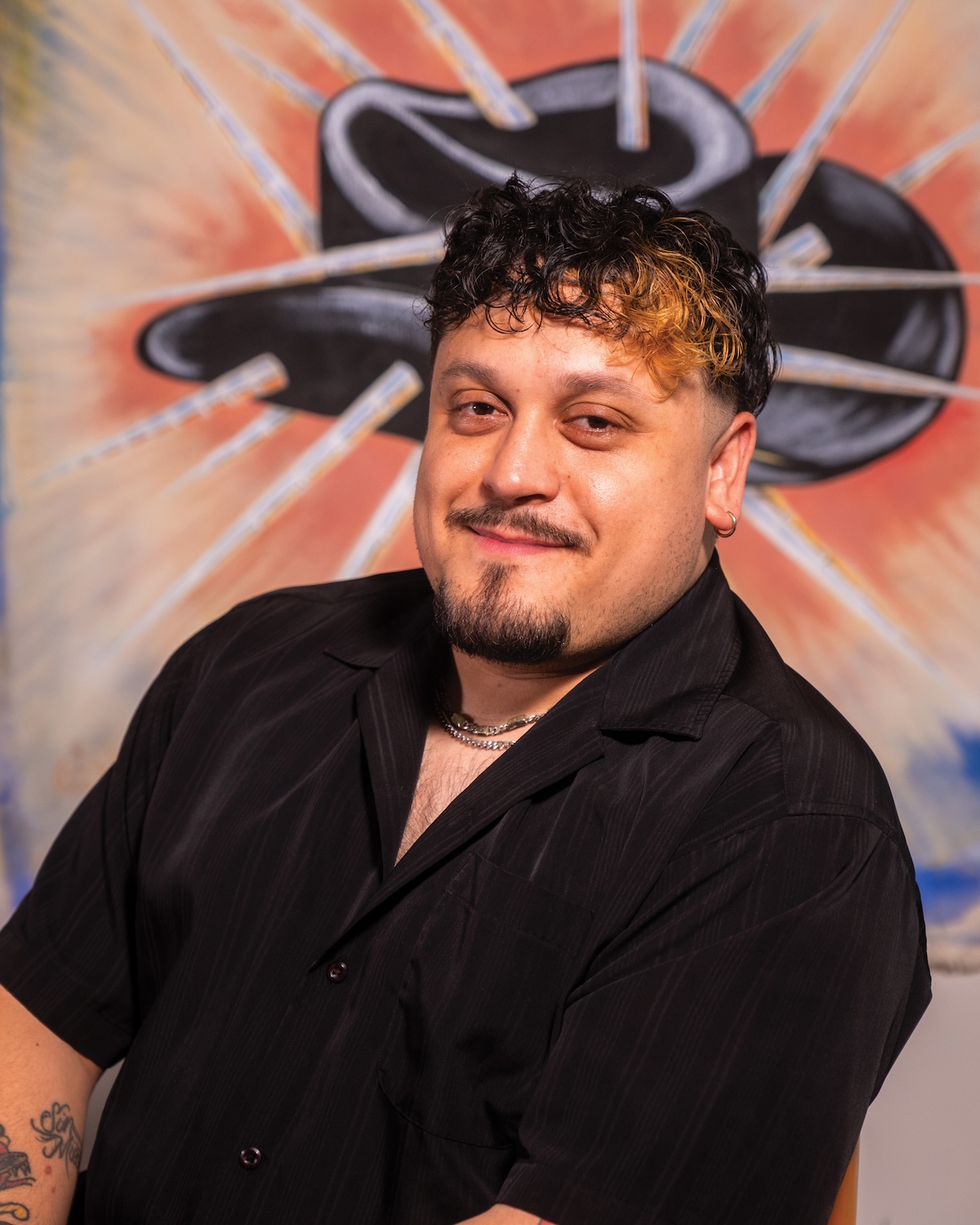
When friends think of Brian Herrera, they might think of his witty sense of humor or his electric bike. But Chicagoans who may not know him at all know his undeniable talent. The multidisciplinary Little Village resident is the artist behind murals across the city, the hands behind dozens of DIY show flyers, a filmmaker, and most notably the creator of Mesofuturismo art.
“What if Aztecs were never colonized,” Herrera said, “and we just stayed within the veins and the soul of what it means to be Mexican? And we take a lot of pride. And we not only do that, but also we evolve immensely, technologically. What would that look like?”
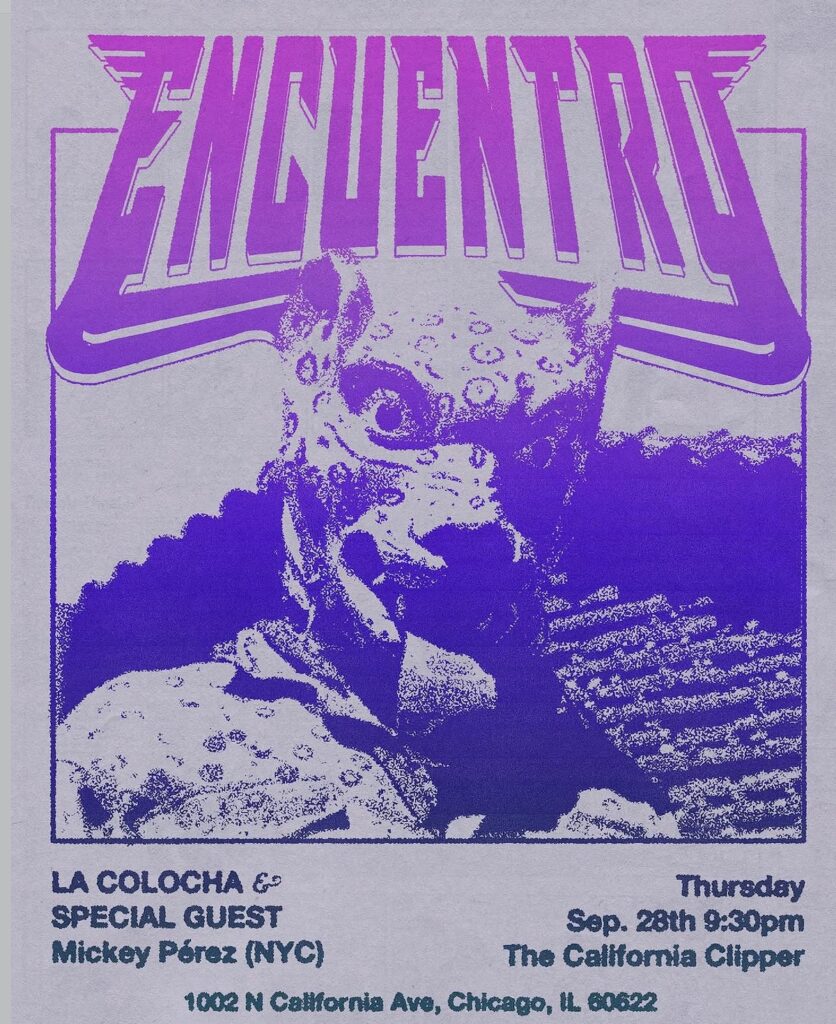
In drawing from symbols, patterns, and storytelling rooted in southern Mexico and Central America, Herrera’s Mesofuturismo art invites us to imagine this alternative reality. His works combine gradients and airbrushed textures with chrome-finish details, while utilizing motifs like the jaguar and snake to fuse together ancestral symbolism and imagined technologies. These vivid paintings and digital artworks are, themselves, a nod to Afrofuturism—shaped in part by Herrera’s upbringing in Veracruz, Mexico, a major entry point for the transatlantic slave trade during the colonial era.
“Growing up in my pueblito, a lot of those people that were darker, were shamed for being darker,” Herrera said.
Veracruz has one of the highest populations of Afro-Mexicans in the country. From a young age, Herrera witnessed the racism and colorism embedded in everyday life, an experience that shaped how he sees identity, history, and survival.
That understanding only deepened after he emigrated to the U.S. at the age of 12 and settled in Logan Square. Herrera had dreams of one day following in his grandfather’s footsteps and joining the Mexican Navy, or even joining the medical field. But suddenly he was in high school, adapting to a new country and seeing his neighbors pushed out of their homes in the name of Rahm Emanuel’s “Building a New Chicago” initiative.
In high school, Herrera’s math teacher showed the class the 2010 documentary Exit Through the Gift Shop. Directed by and starring the secretive guerilla artist known as Banksy, the film explores the world of underground street art. Herrera was radicalized. “I was like, ‘Holy shit, that’s really cool. They’re using art as a way to be political and make a statement.’” The film inspired his own take on the gentrification of the Rahm Emanuel years.
“I would steal [the ‘Building a New Chicago’] signs, and spray paint [using red paint] ‘building a new gentrified Chicago’ with a stencil,” Herrera said. “I would wheatpaste it around the city. And man, bro, these white people were so mad.”
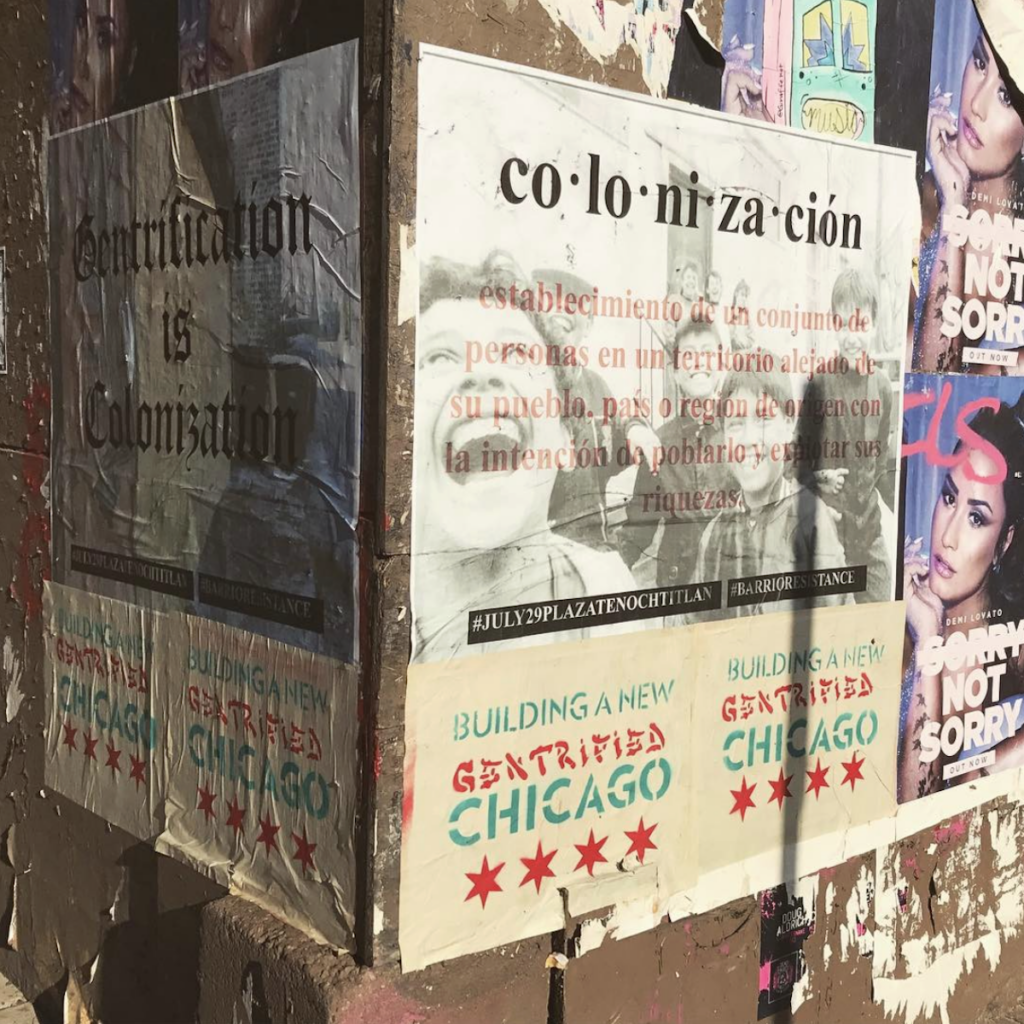
Generations of Latine families have been priced out of Logan Square, a process that began decades ago and intensified in the 2010s. After graduating high school, Herrera was kicked out of his home and experienced homelessness, sleeping along the abandoned train tracks that have since become the 606 trail, before relocating to the South Side. Watching and experiencing displacement and cultural erasure pushed Herrera further into art as a political practice.
During this time, Herrera found guidance and mentorship from artists in Pilsen. He volunteered at Pilsen Arts and Community House, then called Pilsen Outpost, an artist hub and gallery. Herrera was just a punk kid, involved in the DIY scene and trying to find his footing while dismantling the system. Years later, his punk identity would lead him to create his 2024 short film, Ask A Punk.
“[The short film] shifted my perspective on what punk can be,” Herrera said. “Being radical is like being [in support of] each other and being in community and being fucking mentally stable and emotionally stable and helping each other out.”
Ask A Punk is a coming of age film centered on a queer teenager in Little Village who finds resilience through the DIY punk scene. The film has since been shown in seven festivals around the globe. In many ways, the protagonist of the film reflects parts of Herrera. The film ends in a cathartic scene as Little Village hardcore band Perro Mundo performs, with bodies moshing and headbanging. The protagonist can’t help but feel joy in the moment—a sense of happiness and freedom that Herrera holds close, and signals as one of the most defiant acts we can make.
“We gotta fight back with our happiness and be relentless with it,” Herrera said.
Herrera’s recent portfolio is extensive and impressive, including recent collaborations with Sentido, Color a la Mexicana, the Adidas Mexican National Soccer Team, and an upcoming campaign with the Chicago Transit Authority designed to reach Spanish speakers and Chicago’s Latine community. “I’m doing all this commercial shit, but it’s really not. Maybe I’m more like, infiltrating these spaces with my shit,” he said.
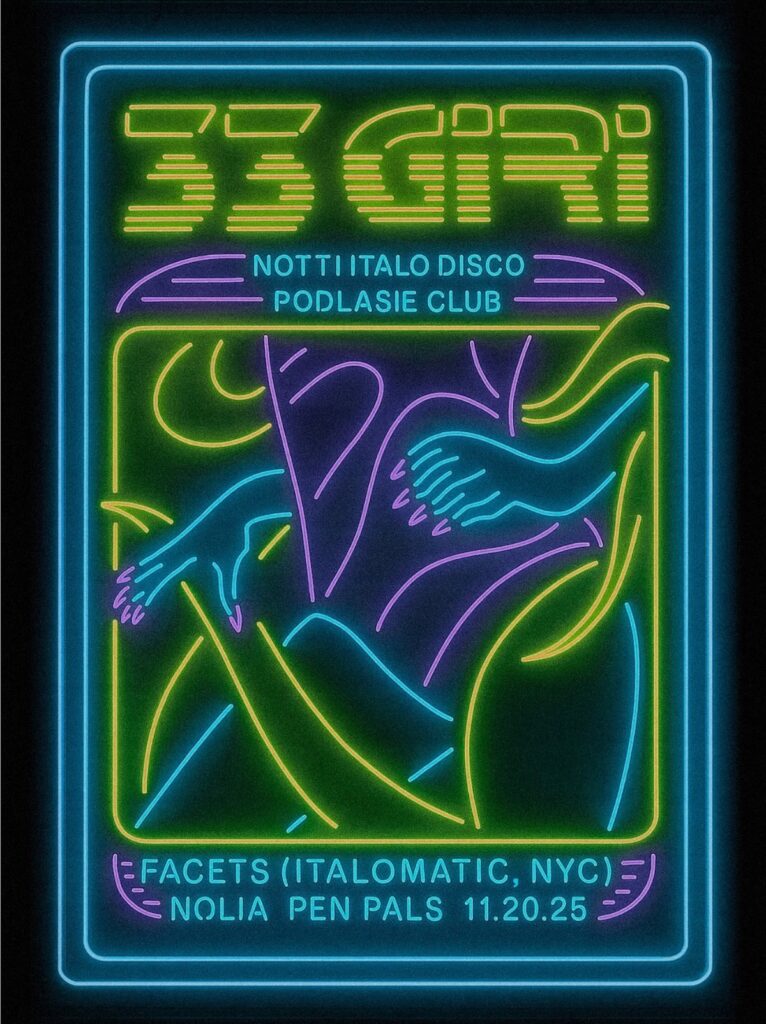
Through grit and perseverance, Herrera has created multiple alternate realities. He is planning for an upcoming solo show next year, with Mesofuturismo serving as the theme for the entire collection. The cover for the Weekly’s Alternative Issue features Herrera’s latest painting, Shards of Tonatiuh the Sunless.
What has emerged from Herrera is not just a visual language filled with bold colors and sharp lines, but a way of thinking and moving the culture forward. It’s the refusal to accept the limitations imposed and the practice of imagining beyond what reality has already set in motion. Through art, Herrera teaches us that there is power in reclaiming and recreating.
Now, as he prepares to marry his partner, Margo Naragon, next year, much of what Herrera’s envisioned feels within reach, taking shape in this current reality.
“I want to be seen as that person that brought up the whole squad on the stage.”
Disclaimer: I am a proud friend and colleague of Brian Herrera, and it was through that relationship that conversations began about featuring his work on the cover of the Alternative Issue.
Jocelyn Martinez-Rosales is a Mexican American independent journalist from Belmont Cragin committed to telling stories from communities of color through a social justice lens. She is also a senior editor at the Weekly.