


Warning: This article contains spoilers.
Cumbia can be found in every corner of Latin America. A blend of African, Indigenous and Spanish influences, featuring storytelling and hypnotic percussion, Cumbia is said to have originated in Colombia in the 19th century. It has made its presence known, firmly declaring, “I am here” in countries like Cuba, Argentina, and of course, Mexico.
And if there is an additional thing these countries share in common besides really good cumbia,
it is the spirit of resistance. Cumbia is one of the main genres that defines a sonidero, a community-driven street celebration and dance. The 2018 documentary Yo No Soy Guapo (or “I Am Not A Thug”) by Veracruzana director Joyce Garcia takes us into the streets of Tepito, a community in Mexico City, where residents are fighting to keep the sonidero tradition alive.
While Garcia’s film premiered in the U.S. and Mexico in 2018, it was screened for the first time in Chicago’s Bridgeport neighborhood at the Co-Prosperity Sphere this March. Lumpen Radio and the Ruidosa Art Collective hosted the 80-minute documentary, followed by a Q&A panel with Garcia facilitated by Stephanie “Soli” Herrera of Ruidosa and DJ Citlalic “La Colocha” Jeffers Peña. Rudiosa organizes regular cumbia parties, and Herrera and Peña are two Chicagoans who have continuously contributed to the local cumbia scene.

“It struck me as a very rich, very beautiful universe,” Garcia said of her introduction to sonidero culture. In the 2010s, Garcia was a graduate student in Mexico City, and her first sonidero in the capital reminded her of home in the Mexican coastal state of Veracruz.
Sonideros emerged in the late 1950s in working-class Mexico City neighborhoods like Tepito, where community-built, jerry-rigged speakers were assembled into powerful sound systems. From these humble origins came sonideros: MCs blend salsa, guaracha, and cumbia while shouting out people and dedications on demand. Many people create and hold up posterboards featuring messages during these events, with the hope they’ll be shared through the mic.
Garcia was inspired to document sonideros after witnessing one that filled her with comfort, and nostalgia for home.In an interview with the Weekly, Garcia used her hands as she spoke to emphasize the scale of these DIY celebrations: massive outdoor celebrations that stretch across streets and avenues, with networks resemble a tree’s root system and all things working cohesively. Initially, Garcia thought of capturing the annual celebration in the neighborhood of Tepito that honors La Virgen de la Merced on September 24. The virgin is a symbol of liberation and often referred to as “la Madre de los cautivos” or “Mother of the Captives.”
“I came from still photography, so I started taking photos, but it fell short for me,” Garcia said.
She explained that she felt compelled to use film to capture the explosive cultural phenomenon she was tapping into. But what started as a project to document celebrations quickly evolved into something more urgent. “Yo No Soy Guapo” begins as a portrait of sonidero culture, but becomes a resistance archive: a story about control over sound, over space, and over who is allowed to gather. In Tepito and in cities like Chicago, where cumbia continues to thrive, that fight feels familiar.
“I think especially in the society and the political climate that we are living in and the current administration, I think we really need to uplift each other,” Lumpen Radio director Stephanie Manriquez said.
The film follows Guadalupe Tlacomulco Macías, known as “Lupita La Cigarrita,” as she traces the history of sonideros, calls out machismo without mincing words, and mobilizes her neighbors community members to demand public space. Lupita is a sonidera, one of the first and few women in the movement, and an organizer of Tepito’s annual dance. We also see Lupita on the trail of “Sound La Socia”, one of the first sonideras whose work and advocacy is less well-known, due to the misogyny that pervades the movement.
At the screening, Lupita’s enterprising spirit extended beyond the film. After the viewing and panel, guests carried that energy into an all-femme sonidero, Ruidoteca, at the Ramova loft—a reminder that without women, there is no movement. La Colocha, who spun at the Ramova sonidero set, also co-hosts Potencia Sonidera with Sonido Trumbull Shadow, a Sunday radio program at Lumpen dedicated to discourse around sonidero culture.
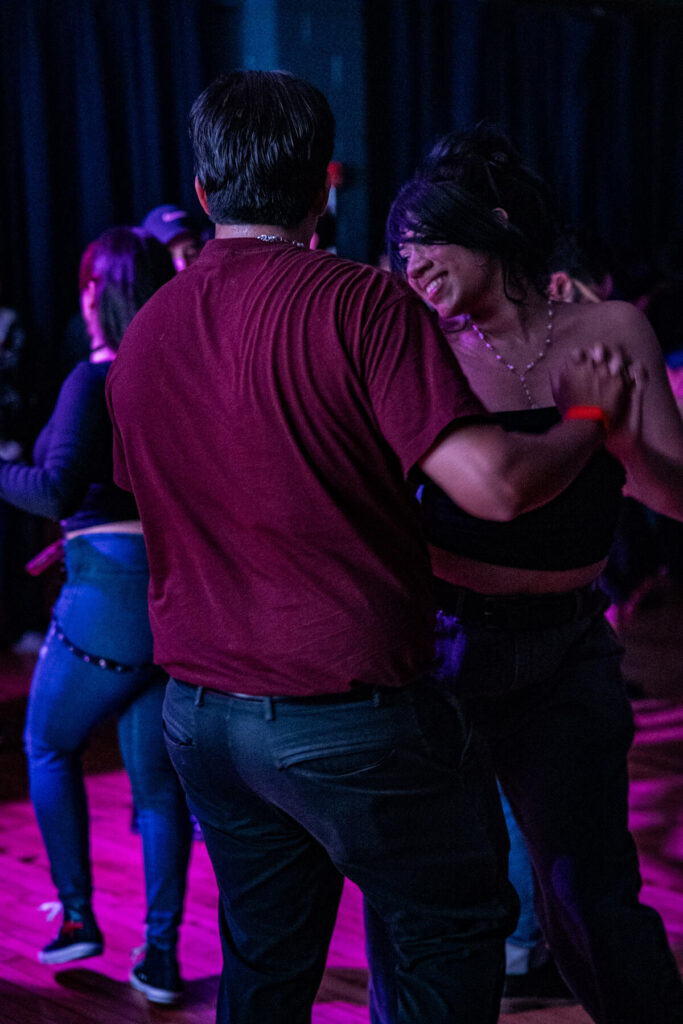
“It is meant to be kind of an extension of this archival, kind of trying to build this popular education,” La Colocha said. Manriquez added, “We are living something that probably our ancestors were hoping for, which is caring for each other, that we create our spaces where we, women, feel safe, that we feel empowered, that we are not competing with each other more than uplifting.”
In the same vein, through Ruidosa, Herrera has hosted cumbia events at venues like Empty Bottle and Casa Cafe, and is currently preparing for an upcoming art show, “Cumbia Sin Fronteras,” which will be centered on sonidero culture. These efforts are centered around producing accessible events that also implement educational components that pay respect to the growing culture.
“The whole point of it all is to have people experience how sonideros would be like in the motherland,” Herrera said. “We treat these events with a lot of care, a lot of intention. We’re always making sure the events stay in its authenticity.”
The need for preserving culture in its truest form aligns with the central theme of Garcia’s film. With a camera in hand, Garcia shows how power is exercised to control and limit who gets to use public spaces. In one striking scene, Garcia captures law enforcement officials halting the annual preparations for the celebration for La Virgen de la Merced. One of the officials informs gathered attendees that the neighborhood can’t utilize public spaces for sonideros because no one has issued them permits to do so.
La Cigaritta tries to reason with the officials, explaining that even if they were to apply for permits, they would not be granted. The police don’t budge, insisting that the celebrations will only bring crime to the neighborhood. But in secret, daring community members try to keep the party going, before ultimately being busted.
That year, the celebrations weren’t the usual. Food and drink was still in abundance but the music, the heart, was missing.
“I think the film was also about the attempts to erase people and erase their culture by removing them from public spaces,” La Colocha said, underscoring the shared realities between Mexico City and Chicago.
“Many apparatuses of the state have tried to erase, disappear people, whether it’s ICE through the raids, or whether it’s police through police brutality and extrajudicial killings, I think it’s important for us to be connecting,” La Colocha continued.
It’s no coincidence that cumbia parties and sonideros are on the rise in Chicago. From Mitclan Production’s staple Cumbia y Los Goths to Kombi Chicago’s Cumbia Cathedral, there is a growing appetite for spaces that feel both rooted and resistant. As the cost of living continues to rise and younger generations of Latinos seek to reconnect with their cultural inheritance, sonideros offer something more than music. They are inherently working-class spaces, shaped by histories like those documented in Yo No Soy Guapo.
“It’s not like they said, ‘Yes, we’re going to be anti-capitalists’; rather, the organization simply comes from a different place,” Garcia said.
It’s about the community coming together to build alternative spaces that do not yield to bureaucracy or force, and instead incubate different ways to create, consume and live. There is joy in resistance, and time and time again oppressed communities have shown just that. Garcia’s film ends with a montage of people dancing, a powerful symbol that stretches across Latino America and survives through generations, borders and suppression. It highlights the importance and power of autonomous events, showing how our survival relies on cultural exchange.
“The people are not going to go down without a fight and without fighting for what they love, which is their culture, their community, their neighbors and their way of living,” La Colocha said.
Jocelyn Martinez-Rosales is a Mexican American independent journalist from Belmont Cragin committed to telling stories from communities of color through a social justice lens. She is also a senior editor at the Weekly.



Nice piece. You really let the culture speak for itself instead of over-explaining it.
Imagine if the police who shut down sonideros had to publicly explain, on camera, why joy is a threat to public order.
https://hablo.no/