
When the Chicago White Sox aren’t playing, the stretch down 33rd street, between the Dan Ryan and the river, can feel peculiarly serene, remarkable for its quiet.
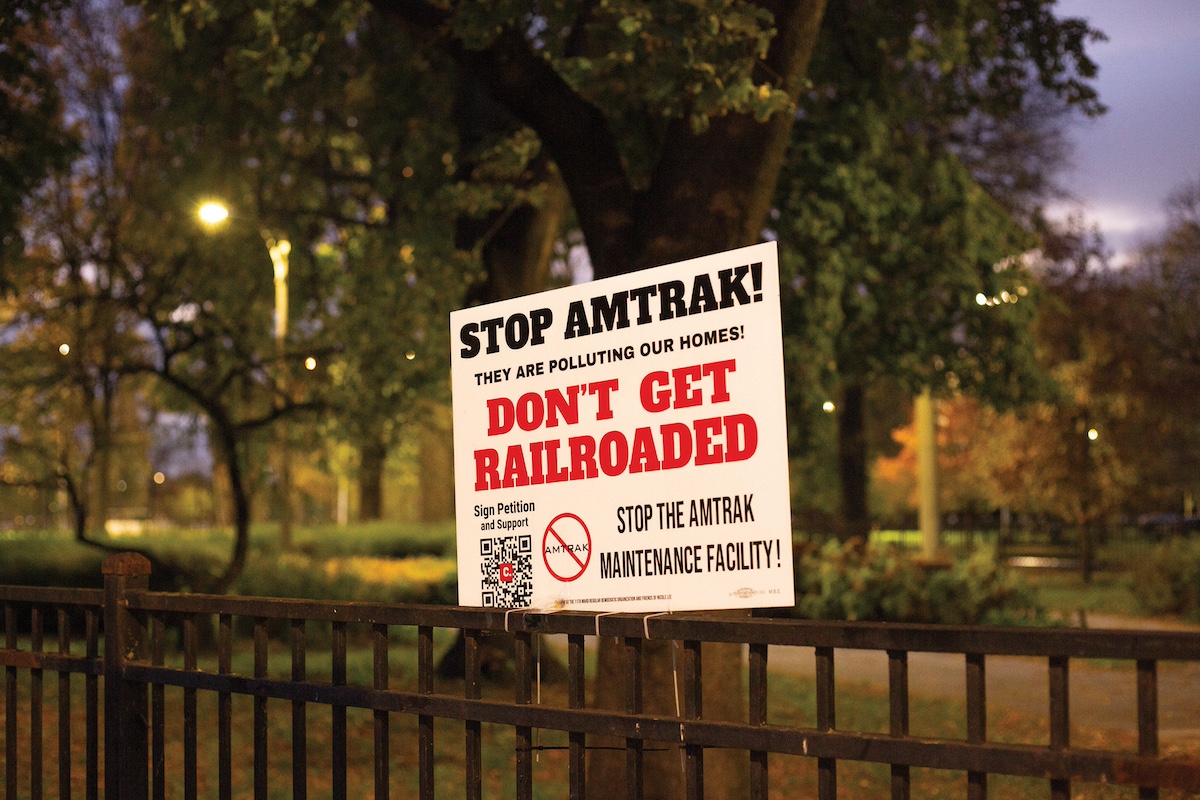
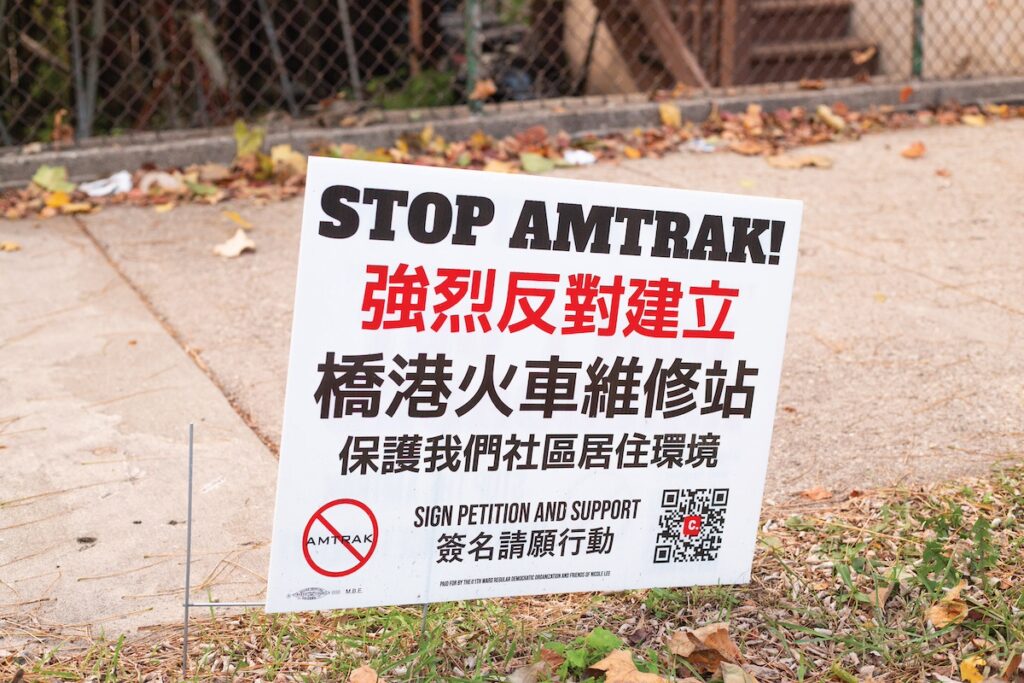
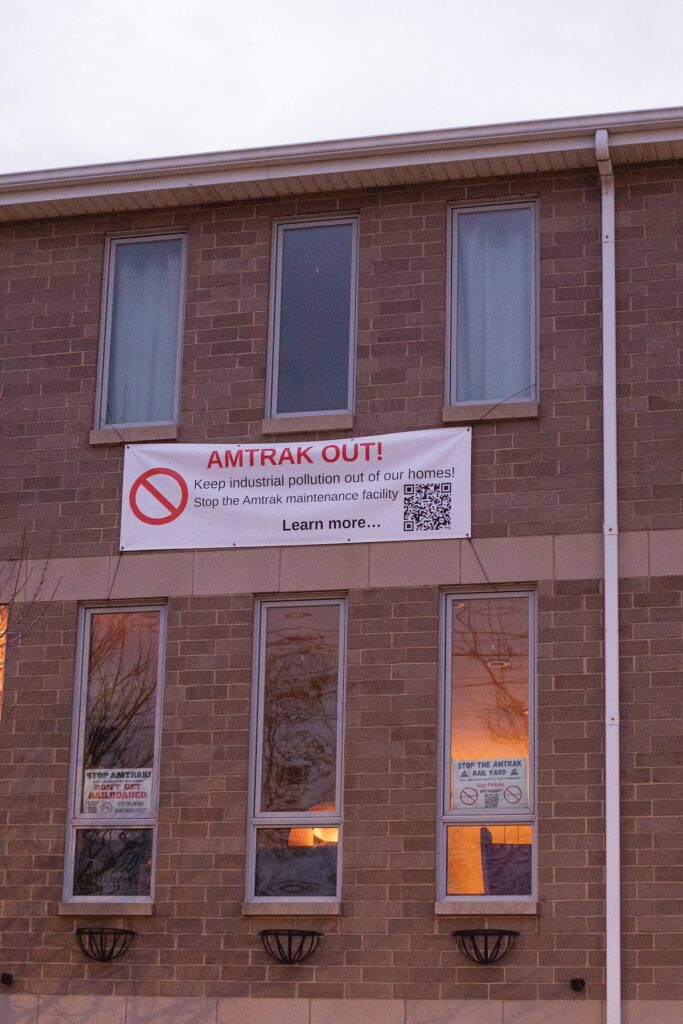
But these days, there is a heightened energy in Armour Square and Bridgeport, captured, in part, by numerous yard signs insistently posted throughout the neighborhoods.
Though general midterm elections were just held, and Chicago is only a few months away from municipal elections, these signs are not for elected officials or ballot measures. In bold red and black lettering, they declare “Don’t Get Railroaded” and “Stop Amtrak Now.”
This public campaign is the brainchild of the Bridgeport-Armour Coalition, formed this September after Amtrak formally announced comprehensive plans to build a multi-story 24-hour maintenance hub in the heart of Armour Square, Bridgeport, and Chinatown.
Consisting of members from community groups, including Bridgeport Environmentalists, Bridgeport Alliance, the Coalition for a Better Chinese American Community, and the 11th Ward Independent Political Organization, the Coalition is helping to set the tone for a sudden and forceful political environmental battle that has consumed the area in recent months.
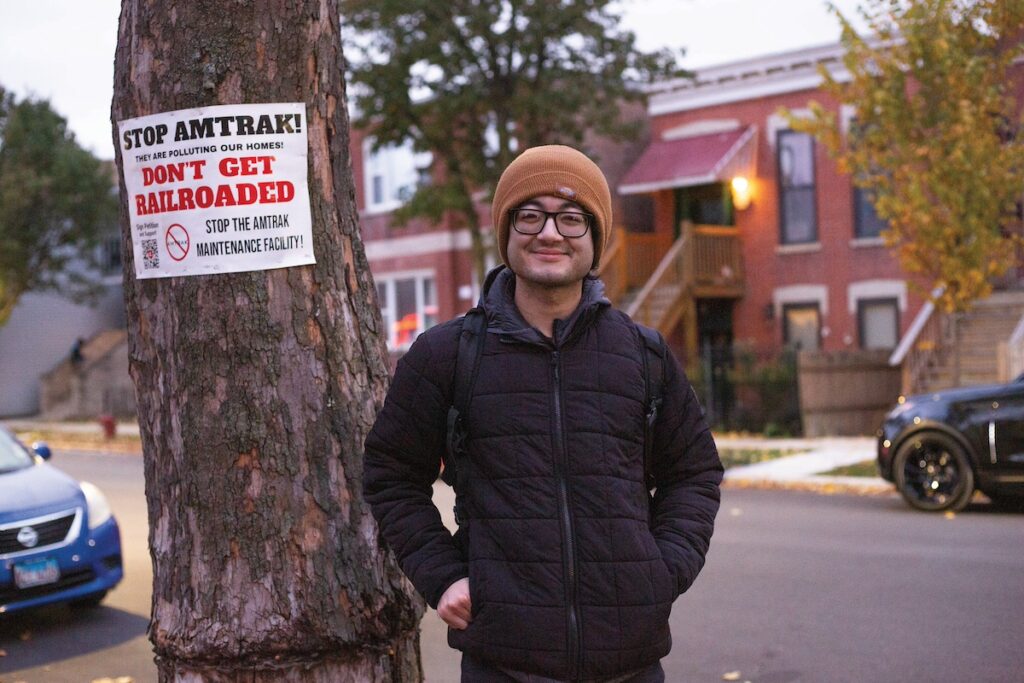
“We formed in response to Amtrak’s plans to place this maintenance and fueling facility in the middle of our neighborhoods,” said co-founder and Bridgeport resident Maria LaGiglio, who lives just a few feet away from the proposed site.
Resident Matthew Malec, speaking on behalf of Bridgeport Environmentalists, told South Side Weekly that the Coalition “has placed a particular focus on neighbors in the immediate vicinity of the site,” organizing in large part “on behalf of seniors and families with children, who would be especially vulnerable to … industrial activity.”
Proposal for new Amtrak facility raising alarms
Since the late 1970s, the country’s government–funded national rail company has had a flagship train car maintenance facility where 14th Street meets the Chicago River in the South Loop. On a website about the project, created by Amtrak and Canal Edge, the private firm helming the development, they state “the [14th Street] site cannot accommodate today’s equipment.”
At an October 7 meeting called by the Chicago City Council’s Committee on Transportation and the Public Way, Amtrak representatives also said upgrading their facilities “cannot be achieved at [the] existing 14th Street yard,” and that rehabilitating it would be “more expensive and result in more service disruptions than building a new one. ”
Amtrak also wants to build this new facility further south along the Canal Street rail corridor—between Archer Avenue and 39th Street—cutting through the heart of Bridgeport, Armour Square, and Chinatown.
The introduction of the new facility, which is set to run 24/7, would also result in the relocation of the Chicago White Sox and their stadium. Citing environmental concerns, residents say this new development would be disastrous for the neighborhood, adversely impacting overall quality of life. In addition to environmental impacts, residents and community advocates are concerned about diminished property values and the loss of the Sox, the heart of the neighborhood’s economy.
LaGiglio’s stance is quite clear. “I’m open to any development that goes there, but it can’t be a polluting facility,” she said. “We absolutely cannot receive industrial garbage in the middle of our houses, 100 feet away from our homes, from our park, from our schools.”
For months, Amtrak had insisted that a “categorical exemption” written into environmental law allowed them to proceed without substantive review. But in late October, after nearly two months of pressure from community members and local elected officials, including 11th Ward Alderperson Nicole Lee, Cook County Commissioner John Daley, and several members of the Illinois Congressional delegation, Amtrak agreed to conduct a “preliminary environmental review” of the site.
This report was an “environmental assessment,” more limited than a full environmental impact statement, and released on November 6—just 11 days after Amtrak leadership agreed to conduct a review. It concluded that the new facility would result in “insignificant” impacts on categories such as transportation, air quality, noise and vibration, and hazardous materials.
Both the speed of the review and its findings have drawn skepticism from elected officials and community members alike. Alderperson Lee and Commissioner Daley released a joint statement rebutting Amtrak’s claims about the negligible impact of the facility “on behalf of the nearly 7,000 residents who live within 500 feet of this site.”
“We beg to differ,” they concluded.
Deborah Ahrens, a Bridgeport resident who spent years running Amtrak café cars on long-distance trips between Chicago and California, believes these operations do not belong in a densely-populated residential neighborhood.
Ahrens, who has extensive experience with the logistics of cross-country rail travel, says the amount of waste regularly generated by long-distance trains alone would make the venture extremely burdensome for neighboring communities.
“When [cross-country trains] get back to Chicago, if it didn’t get to take the garbage off for a while, you’re talking just from one [diner] car eight to 10 big, lawn-sized brown bags full of food products. Packaging, garbage food … from the coaches, at least 15 bags of trash from there, and then you have your sleeping cars, that are going to have three to four bags apiece.”
Currently, eight long-distance trains terminate daily at Union Station—many have been on the rails for 40+ hours. There are also five regional routes, with multiple daily departures and arrivals. As Ahrens points out, all of that garbage will need to go somewhere.
Amtrak’s recent environmental record at 14th Street has also alarmed some residents and activists, prompting questions about their ability to responsibly handle the new site.
For example, in 2021, Amtrak was the subject of a lawsuit filed by the neighboring Continental Paper Co. over alleged contamination at 14th Street stemming from a 2019 diesel spill. In their ruling, the Northern Illinois District Court found Continental Paper’s claims to be true, even though Amtrak was found not liable due to a legal technicality. And most recently, in 2024, a fire at the 14th Street facility resulted in another spill, and hazmat response.
Lack of transparency generates bait and switch claims
Preliminary plans for this new development became public in March 2026, when it was reported by Crain’s Chicago Business that billionaire real estate mogul Justin Ishbia was closing in on an agreement to purchase the 14th Street rail yard.
In mid-2025, Ishbia had reached a deal to purchase a minority stake in the White Sox, including a series of buy options providing a path to majority ownership by the early 2030s. Naturally, the railyard purchase was quickly linked to a potential new ballpark for the White Sox, who have spent several years seeking an upgrade from their current digs at Rate Field.
According to slides presented by Amtrak in an April 2026 online, private seminar facilitated by the University of Illinois-Chicago’s Urban Transportation Center, the agency engaged with Ishbia on the purchase as early as August 2025, just two months after Ishbia’s buy-in to the White Sox. The seminar, which was led by Amtrak executive Joe Shacter, was advertised as pertaining to planned upgrades to Union Station, with no mention of the maintenance facility project.
In November 2025, Ishbia created a new company, Canal Edge LLC. Canal Edge reportedly engaged City Hall concerning the facility almost immediately, according to Crain’s.
However, the project’s scope was not publicly shared until April 2026, when it became clear that Amtrak’s new proposal would far outstrip the plans for a “storage facility” at Canal Street they reportedly initiated in 2023. After initially signing a letter of support for the project, in January 2026, U.S. Senators Tammy Duckworth and Dick Durbin walked back their full endorsement when details emerged about potential community impacts.
Similarly, last month a spokesperson for Illinois Governor J.B. Pritzker expressed concerns. According to Matt Hill, Amtrak’s current proposal “is significantly different from the project the state originally supported.” It’s unknown when those plans were presented to state lawmakers, or what they contained.
Conflicts of interests appear to shroud railyard plans
When current federal Transportation Secretary Sean Duffy unveiled his “Golden Age of Rail” initiative this summer, the imminent realities became clearer to some observers; the $5.3 billion funding package included up to $600 million in federal funding for the relocation of Amtrak’s facility.
At the same time, it was reported by Crain’s that City River Holdings, another LLC created by Ishbia around the same time as Canal Edge, had applied for a nearly $2 billion loan from a different agency within the Transportation Department for the mixed-use development of the 14th Street site following its purchase.
Ishbia and Canal Edge publicly released complete plans for the aforementioned mixed-use development in early September. Dubbed “The Railyards,” it centered around a new baseball stadium, and confirmed what many suspected: with Amtrak moving in, the White Sox would be moving out.
While some White Sox fans received the proposal with enthusiasm, the significant environmental impacts of the potential new railyard—combined with the loss of perhaps the area’s largest economic engine—threw the 11th Ward into crisis-response mode. Just three days after the announcement, on September 8, elected officials and community leaders held a press conference decrying the proposal and calling for further transparency.
Amtrak officials found themselves excoriated at two community meetings held on September 18 and 21, despite a full endorsement of the project from Chicago Federation of Labor President Bob Reiter.
At the local level, Alderperson Lee has taken the lead among elected officials in the legal and political resistance to the matter. More broadly, State Representative Theresa Mah, whose 24th district includes most of the proposed site, issued a letter addressed to Amtrak’s Board of Directors directly opposing the project and asking them to “reconsider” both the proposed site and the sale of the 14th Street site. The letter was co-signed by numerous members of the South Side’s state congressional delegation, including State Representatives Aarón Ortíz (1st District) and Sonya Harper (6th District), as well as State Senators Celina Villanueva (12th District) and Javier Cervantes (1st District).
Governor J.B. Pritzker also weighed in last month, reportedly calling the proposal a “bait-and-switch” on the part of Amtrak officials. Senators Durbin and Duckworth similarly walked back early support, calling for further transparency and community engagement in a joint statement last month. Neither Durbin nor Duckworth responded to requests from South Side Weekly for further comment on the issue.
U.S. Representative Mike Quigley (IL 5th District), currently running for Mayor, appeared at September’s press conference and echoed calls for transparency.
Additionally, some community members and elected officials believe Amtrak and Ishbia have used the White Sox to distract from their pressing environmental concerns. “To us, it’s obviously just a billionaire real estate deal. The White Sox didn’t ask for this,” LaGiglio opined.
Who decides what happens next?
Ishbia and Amtrak have made the case that the local government has little to no say in the matter. Under the Interstate Commerce Act, all intercity and transcontinental rail lines—including the Canal Street tracks—fall under federal purview. So, if the federal government wants to sell Ishbia the land and give him money to develop it, it’s theirs for the selling—and for the building. If they want to develop land, environmental reviews are the only boxes they need to check.
But among some residents, fans, and elected officials, there seem to be growing concerns that the Sox may be being used as a pawn in a broader scheme to enrich a few businessmen at the expense of thousands of ordinary Chicagoans.
“A lot of 11th Ward constituents work at the ballpark or genuinely love the White Sox, and feel a little bit betrayed. But that’s not me and that’s not most of our group,” LaGiglio says. “That is not our issue. They can go!”
Community leaders note that the Wentworth Gardens housing complex has been excluded from nearly all developments, with 3rd Ward Alderperson Pat Dowell stating she had not been notified or consulted about the project. Amtrak also failed to provide translators at their community events, foreclosing on input from the numerous primary Chinese speakers who would be impacted by the project.
Amtrak has been largely tight-lipped in recent months; only designated and pre-approved employees can speak with the media. Canal Edge and City River Holdings, private enterprises seeking to obtain approximately two-and-a-half billion dollars of federal (i.e. taxpayer) grant in the coming years, have no known public officers beyond Ishbia himself.
Besides Ishbia, Eric Lynn—Ishbia’s first cousin and a consultant with heavy federal government ties—seems to be the only person to have represented the firm. Lynn attended October’s City Hall hearing on behalf of Canal Edge.
At times, Amtrak and the White Sox representatives have said they’ve been unaware of plans engineered by the team’s minority owner. Emails obtained by South Side Weekly paint a picture of internal confusion within both team and agency following the August announcements, with the ISFA receiving public talking points from press officials in the Governor’s office.
Reportedly, Amtrak were in talks to meet with ISFA officials in early October. However, an ISFA spokesperson told the Weekly that the agency “has not had any discussions with Amtrak about the sale of any of the Authority’s properties.”
The 30-day public comment period on Amtrak’s environmental findings concludes on December 7. Amtrak and the Federal Rail Administration are hosting two public forums, one set to take place on December 2 at IIT’s Hall Conference Center (3241 South Federal Street), and the other virtually on December 3.
It’s also unclear when, exactly, Amtrak and Canal Edge aim to have shovels in the ground. Nobody is quite sure what’s going to happen after December 7, but residents don’t plan on easing up.
“Bridgeport used to butcher hogs until Bubbly Creek congealed solid,” said a Bridgepoint Environmentalists flyer. “The industrial character of the area may color its past, but it shouldn’t determine its future.”
Malachi Hayes is a Bridgeport-based writer and South Side native. He last wrote for the Weekly about the upcoming White Sox season.