Englewood rapper and farmer Heavy Crownz says he “believes in the African proverb: ‘if you want to go far, go together.’”
That shows in Trench Baby Turned Farmer, Heavy’s debut album, which brings together a long list of friends and collaborators across nineteen tracks: production from renzell, oddCouple, Rokmore of The Gr8 Thinkas and Chris Crack; instrumentation from Sam Thousand, Lonzo, and, I.C.y; and features from The O’My’s, Lilla Sol, Gr8Sky, and Vic Spencer, just to name a few.
But this adage also shows up in his day-to-day life. A former teacher and graduate of Tuskegee University, specializing in African American studies, Heavy now works as the director of programs for Imagine Englewood if, a nonprofit that creates safe and empowering spaces for youth to imagine, explore, and grow in Englewood—including the Peace Campus on South Honore Street where he discovered the love of farming that inspired much of the album.
Trench Baby Turned Farmer does not shy away from the trauma that Heavy experienced growing up and the weight of serving as a model for his community. But he doesn’t mean “trenches” in the way some people use it, as he explained to the Weekly.
“I always describe Englewood as the trenches, but not in the sense where it’s negative all the time. The trenches was [also] a safe space that soldiers found refuge in during war,” he said. “So for me, it was a safe space that also has some rough parts. But it was a loving, beautiful place for me.”
The album balances these sorts of opposites. It’s a stage for collaborators and an introspective memoir, a breakup album and a party album, an ode to farming and a beacon of hope all rolled into one. But throughout, it embodies the “resilience, confidence, ingenuity and imagination” that Heavy credits Englewood with instilling in him.
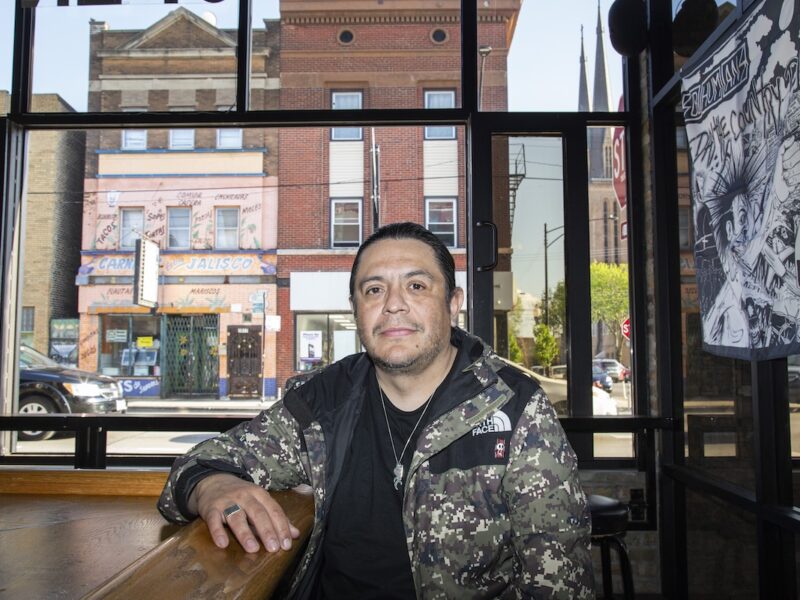
So on the last day of March, we met at EnglewoodBranded to talk about the inspiration behind Trench Baby Turned Farmer and the future of the neighborhood he feels so much pride in.
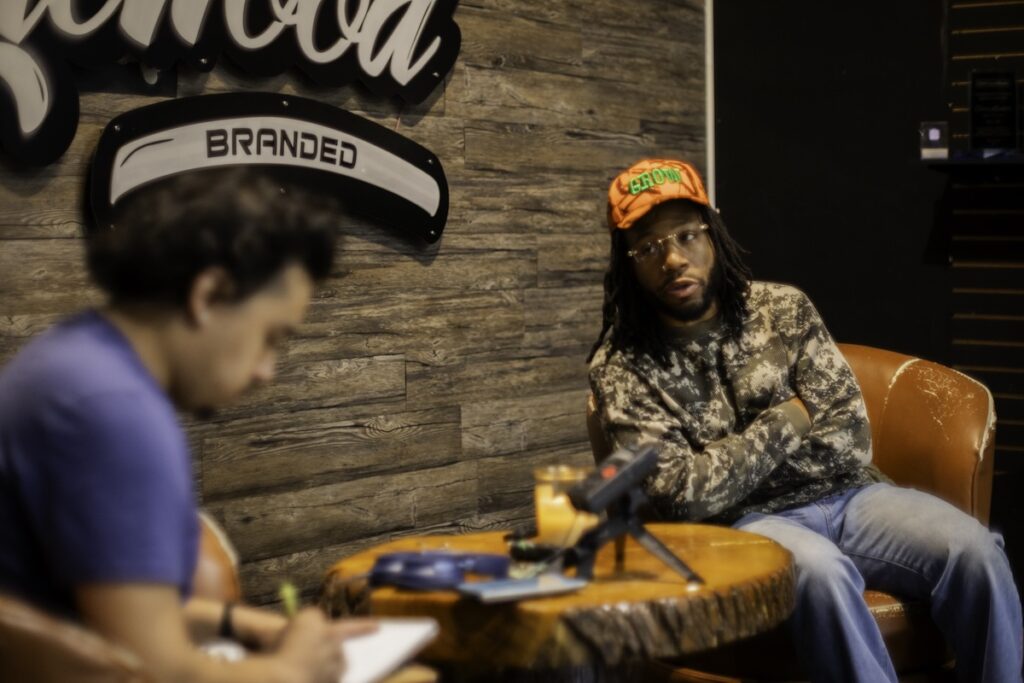
Where did you get your start in music?
What got me started in music is a kind of loaded question. I think I’ve been rapping since I was eight years old. My first rap notebook was at 11. I took rap serious for the first time in college, and then I was a high school teacher for almost five years, and not taking rap as serious as I could. But I had a conversation with one of my coworkers that was like, “I’m reaching these 30 boys in this classroom, but it’s a million young boys that I’m not reaching. And the kids in my class are always on their phones looking at the next big rapper.” So I decided that I wanted to be an example of what they can be by really chasing after my own dreams. And I left teaching to go on tour, to take rap extremely seriously.
What changes do you see coming to Englewood?
I can tell you, because of the work that I do day-to-day [at Imagine Englewood if], that I don’t have to guess. I know, because I’ve been blessed to be on those Zoom calls with the people that are leading. So everything I’m saying to you is not guesses. These things are coming to Englewood: new housing, new businesses, restaurants and stores, art spaces, gallery spaces. All those things are coming to Englewood. We are about to reopen up the green line on Racine, so more transportation options for folks. We are putting some stuff in place right now to bring a brand new development right here on 63rd at Ashland. I can’t speak too much on it, but it’s gonna be grand.
What are your thoughts on third spaces as an answer to with violence?
So we operate a third space right now called the Peace Campus, which is where I work every day, on 64th and Honore Street. That is a beautiful third space. We have multiple basketball courts, a garden and farm, a nature playlot for the kids. We have multiple homes that have been transformed into program spaces for different programming, from youth programming to health and wellness programming, to essential needs programming.
When you have spaces where people can congregate and take up space, it automatically turns into a violence prevention model—because the space is so beautiful, and the people that are holding the space are so loving, and it just creates a certain energy. And then the residents have done so much work to have an understanding that this is a safe space for everybody. It’s a block that everyone knows, like, this is a block where no violence should be occurring. It’s definitely a beautiful thing.
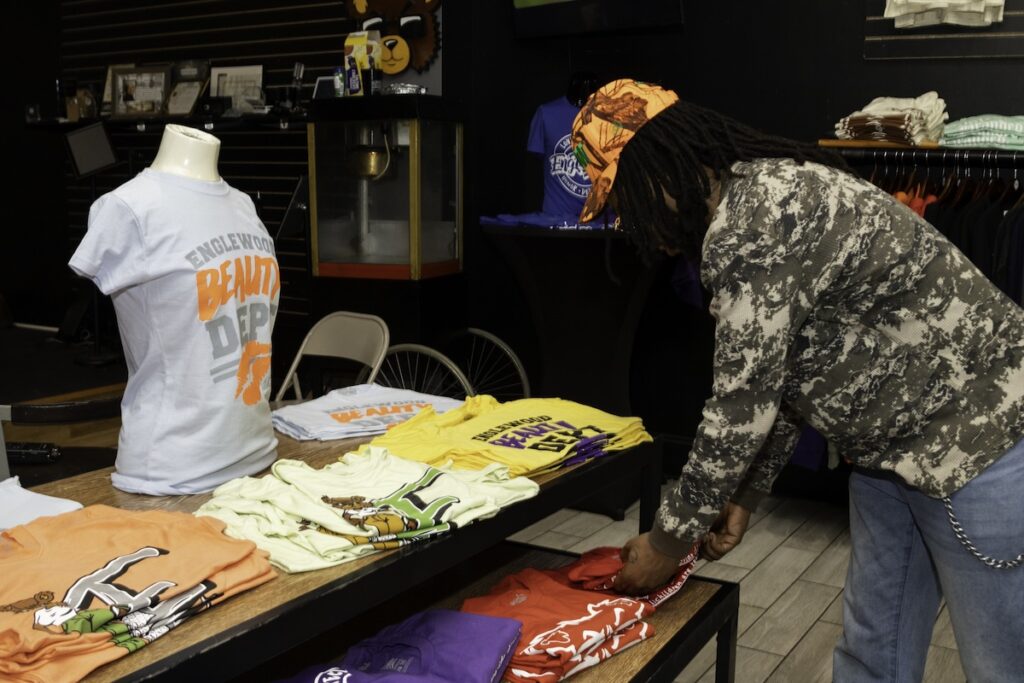
Who are some Englewood community changemakers that need their flowers?
Oh man, you gonna get me in trouble, because if I don’t mention everybody… There’s so many people. My brother Pha’Tal from Think Outside Da Block. My brother Donya from Englewood Heroes. Michelle Rashad, my boss at Imagine Englewood if. Cecile De Mello at Teamwork Englewood. Anton Seals at Grow Greater Englewood. My sister Bweza at Sistas in the Village, all the farmers. My brother Adonnis also works with Grow Greater Englewood. My brother Rami at the IMAN Fresh Market. My big bro Corey Luckett here at EnglewoodBranded, where we are right now. Aisha Butler from R.A.G.E. Man, Janelle St. John at Growing Home. That is the only USDA certified farm in Chicago, and it’s right here in Englewood.
I could go on and on—that’s what makes Englewood so dope. It’s unlike any other neighborhood in Chicago right now, because there are these superheroes and super groups of people. We all have heard the negative tropes, we all have heard the stereotypes, and we’re like, “Nah.” We shifting all those narratives, and we gonna do it together.
What got you into farming?
So during the pandemic, I was struggling a lot with my self expectations. I had just ended an engagement. I moved back in with my parents, and I was in between my parents crib and crashing at one of my homies cribs. And my self expectations were just causing me to spiral. But my mom gave me this book on grace, and in the book, it was talking about how a tree doesn’t strain to grow or worry about its growth, it just accepts the seasons and it grows. And that just blew my mind. I just started seeing my world agriculturally—like, everything started being a metaphor for me. And I started rapping about it.
But I was like, “Man, I’m doing all this rapping about it, but I really need to do it.” So I started showing up at different events in Englewood. One of my best friends introduced me to my now-boss Michelle, I got hired, and I started working. And shortly after that, my good friend Jai Kalondra started operating the garden, and she taught me how to grow food. So it’s been about five years now, and I’m not a master. I’m still growing every day. I’m learning every day. And we’ve grown so much in my own personal backyard. I started a garden and grew sunflowers and herbs on the campus at Inglewood. We grow everything from squash to zucchini to pumpkins to watermelon to peppers to kale, chard, herbs, mint, basil…
What lessons can you take from farming?
I’ve learned how you got to be patient with things that you start. Like, don’t expect to plant a seed and then have fruit tomorrow. That’s been really big for me with music—the relationships that I build, I don’t anticipate them bearing fruit the very next day. So I’m intentional with my relationships and letting them grow over time, willing to do the dirty work on myself to be the best artist I can—[and I mean] going into the soil, but really what I mean by that is going within yourself and asking yourself the hard questions to make sure that you’re showing up as the person you say you are. So yeah, farming has definitely taught me patience, and to be intentional with everything you do, so that you can reap the benefits and the fruit later.
Heavy Crownz will perform with King Louie, Bella Bahns, Casino Trell, and Ca$h Era at Lincoln Hall on May 22. Go to lh-st.com/showsfor tickets or follow Heavy Crownz on Instagram at @heavycrownz for updates.
Trench Baby Turned Farmer is on streaming platforms and available for digital purchase at www.heavycrownz.bandcamp.com.
Francisco Ramírez Pinedo is a journalist based in South Chicago.