
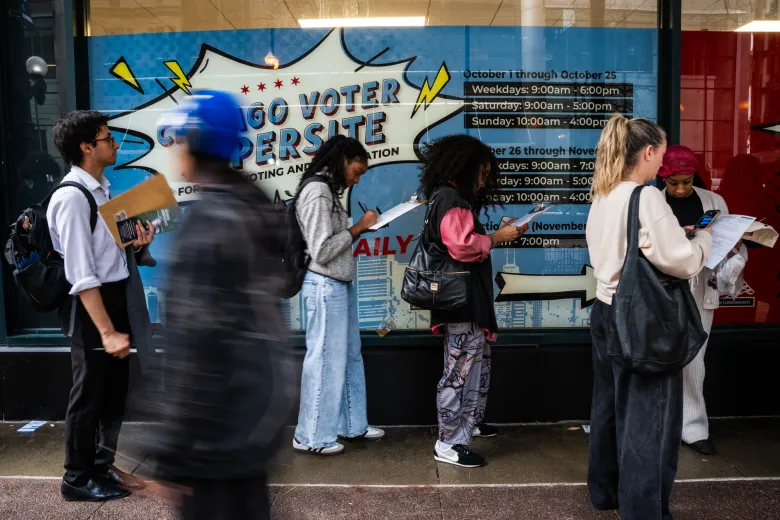
This story was originally published by Block Club Chicago.
Chicago voters largely support the state implementing an additional tax on millionaires, the creation of a standalone festival grounds and the resumption of gunshot detection technology throughout the city.
That’s according to the results of several non-binding ballot referendums Chicagoans had the chance to vote on in Tuesday’s election. Voters got to weigh in on at least six questions, while some also saw ward or precinct-specific ones.
Voters answered in the affirmative by wide margins on each ballot measure with more than 90 percent of the city’s 1,291 precincts having reported results as of 11 p.m.
Tuesday’s referendums don’t trigger any automatic change in law or policy, but will likely be used by politicians and advocacy groups to make a case for some of the issues and ideas included.
Below, read more about the questions and results.
Millionaires Tax
Chicagoans on Tuesday voted decisively in favor of two ballot questions that asked whether the state of Illinois should impose a new tax on millionaires to fund public education and other initiatives.
The idea of a millionaires tax has been talked about for years, but it has gained support recently from powerful politicians, including Illinois House Speaker Chris Welch—although an effort to advance the policy earlier this year in Springfield did not move forward.
One of the millionaire tax questions on Tuesday’s ballot, backed by the Cook County Board, asked voters if the state should adopt a 3 percent millionaire “surcharge,” and if the revenue it brings in should then be split to provide property tax relief to residential and commercial taxpayers and to improve education funding.
The other question, sponsored by the Chicago school board, more broadly asked if millionaires should be taxed more to fund schools.
A report published in April by the Illinois Economic Policy Institute found a millionaires’ tax applying a 3 percent tax on income over $1 million would affect an estimated 41,000 people in the state. The tax could bring in $4.2 billion in revenue annually by 2030, the report found.
Detractors have argued a millionaires’ tax could hurt business owners and possibly drive taxpayers out of Illinois.
As of 11 p.m., about 80 percent of Chicago voters had backed both millionaire taxes.

Public Fairgrounds For Festivals
Chicagoans also voted in favor of a question asking if the city should explore creating a permanent outdoor event space to host festivals and other events.
Some have suggested Chicago could operate something similar to Milwaukee’s Henry Maier Festival Park, which hosts Summerfest and other events along its lakefront.
The idea has gained traction as some major summer and fall festivals have been criticized by neighbors for taking over public parks for weeks at a time. That includes Lollapalooza in Grant Park and Riot Fest in Douglass Park in North Lawndale.
Rain during September’s Riot Fest left Douglass Park full of mud and standing water, angering some neighbors. Like Lollapalooza, festival organizers are on the hook for site cleanup.
No specific location has been posed for where the fairgrounds could be built, but Ald. Nicole Lee (11th), who introduced and passed a resolution through the City Council, told Block Club last month it could potentially be located in a part of the city where it could spark economic development.
As of 11 p.m., more than 67 percent of voters supported the measure.

Gunshot Detection Technology
A large majority of voters would also like to see the city resume using gunshot detection technology, according to election results.
Chicagoans had the chance to weigh in on a ballot question asking whether the city should restart the use of technology similar to ShotSpotter, which has been one of the most controversial public safety issues during Mayor Brandon Johnson’s time in office.
Johnson campaigned on phasing out ShotSpotter, citing studies that question its efficacy. He ultimately terminated the city’s contract with ShotSpotter parent company’s in September 2024, after Chicago hosted the Democratic National Convention.
At the time, Johnson pledged that the city would look for new technology that could alert police and other emergency responders to gunfire.
The city then issued a request for proposals for the technology in early 2025 and received bids from various companies, officials previously said. But a contract has yet to move forward, prompting alderpeople to repeatedly press the Johnson administration to take action.
Last month, the Johnson administration announced plans to launch a pilot program for new gunshot detection technology on parts of the South and West sides, although details remain sparse.
As of 11 p.m., more than 72 percent of voters voted in favor of restarting the use of gunshot detection technology.

Midway Blitz Reimbursement
Chicago voters also largely backed a ballot question supported by Johnson that asks if the city should seek compensation from the Trump administration for the economic fallout from last year’s Operation Midway Blitz.
During the aggressive immigration enforcement action in Chicago and the surrounding area, federal agents detained more than 3,800 people, most of whom were Latino, according to Department of Homeland Security records.
Midway Blitz also saw agents tear-gas, assault and detain Chicagoans who documented and protested the arrests. And the agents’ presence caused immigrant business corridors to lose more than $1 billion in economic activity, according to a report last month from the Great Cities Institute at the University of Illinois Chicago.
The ballot question asked if the city should pursue “all lawful means” to recover money from the federal government for costs and economic harm related to Midway Blitz, including “lost tax revenue, public safety response costs, and services provided to residents and families affected by those operations.”
Chicago’s Law Department under Johnson has sued the Trump Administration numerous times over a variety of issues, but the Mayor’s Office has not explained exactly how the city would seek compensation related to immigration enforcement going forward.
As of 11 p.m., nearly 85 percent of voters were in favor of seeking compensation.

Vacant Property Penalty
The school board this summer also backed a ballot question asking voters if they would support charging a new financial penalty on the owners of vacant or undeveloped land to bring in additional revenue for education.
That question got a mixed reception from school board members at the time.
Some said the vacant lot charge would help spur safety improvements in underserved neighborhoods while bringing in more revenue for schools, while others voiced concerns over how it would be enforced.
As of 11 p.m., more than 73 percent of voters had approved the question.