If there’s a line between music and fashion, then Chicagoans from Law Roach to Chief Keef have ignored it. But breaking into those creative spaces whether at a sewing machine or a recording studio can be a challenge.
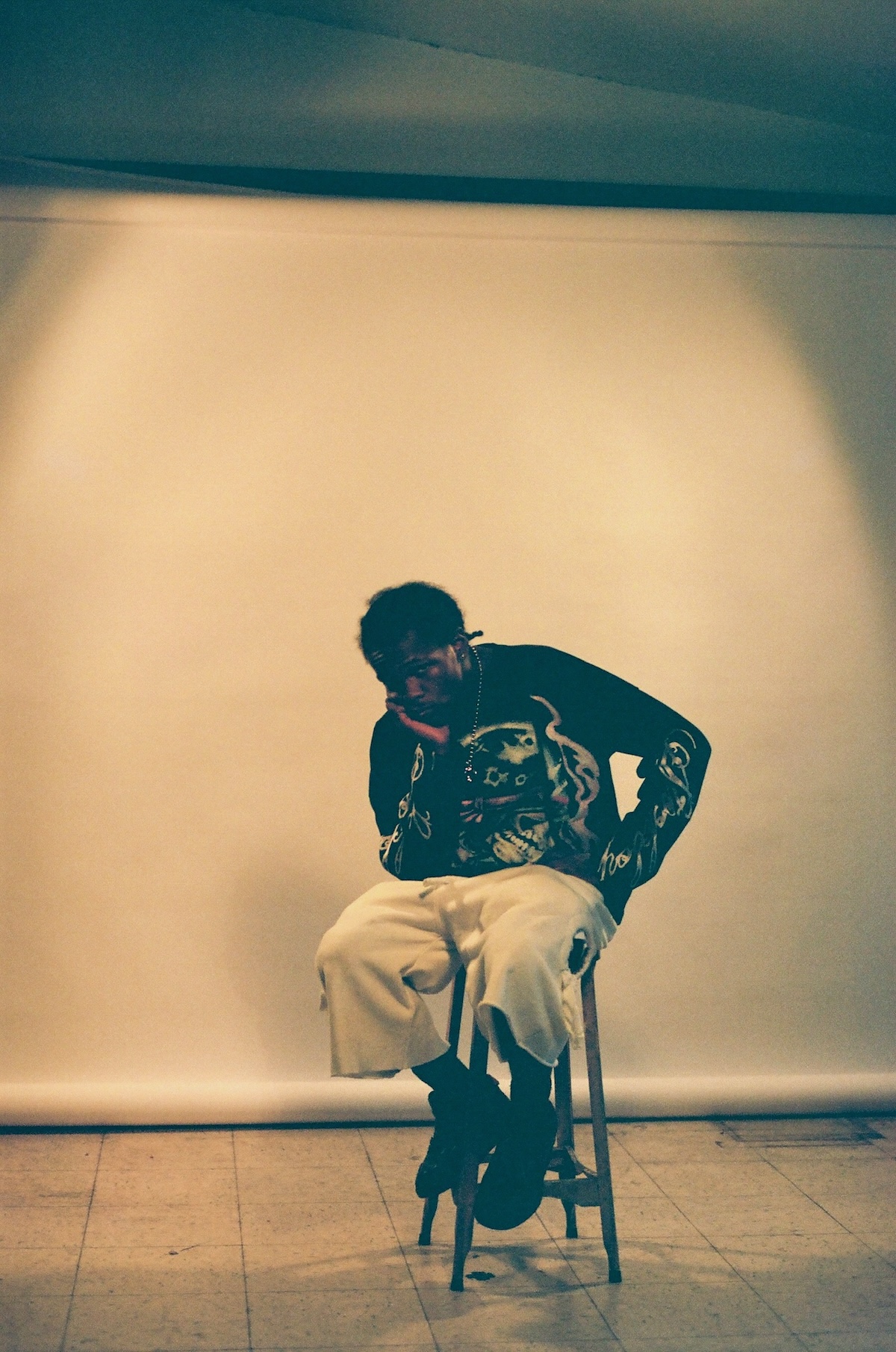
That hasn’t stopped 21-year-old Alexander Fair, who goes by Menace4Hire. The West Englewood-raised artist has already built three companies for designing and distributing clothes, graphic designs, albums, events, and guerilla marketing campaigns.
There’s aghettoartstudio (what Menace4Hire calls an outlet for his “designer brain”), where he works on clothing, textiles, and art. There’s4Hire, his media platform for the “dissemination of information.” And those companies both sit under The Y Corner—“the business-facing part of that in like, the lamest terms,” he jokes. Menace is for hire.
When not working on these projects, he works closely with Jasir Bailey, a longtime friend and founder of Stockboy, a Hyde Park clothing shop and showroom that supports those looking to break into fashion by providing guidance on how to get a brand off the ground and in front of people. And on top of these ventures, on April 11, Menace released My Ancestor’s Favorite: a thirteen-track album featuring collaborations with Kaicrewsade, Sonny, and Waine Ghazi.
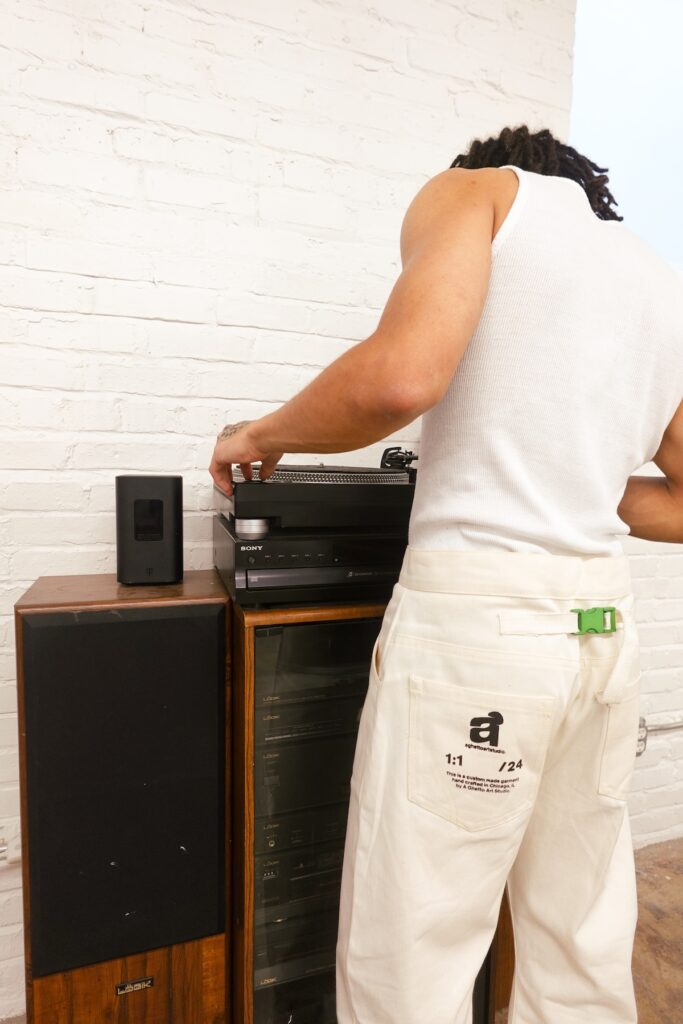
In each of these lanes, Menace4hire brings his own vision. His fashion builds on a streetwear foundation with skewed silhouettes and statement pieces like stitched reversible tees and high-vis orange flight pants. Each incorporates many shapes, cuts, and colors that bring them to life. His music also uses texture to full effect: take the song “Ch3rrypit” from his project With All That I Know Now, which stitches together low-pitched samples, fuzzy static, and hard-hitting percussion into a backdrop for Menace’s lyricism.
In conversation with the Weekly, Menace talks tailoring, gatekeeping, mall kiosk t-shirt printing, and how other South Siders can succeed.
This interview has been edited for length and clarity.
How did the South Side influence your clothing brand and music?
There’s two sides to that. The first side is, I grew up seeing a lot of what I didn’t want to participate in. In some ways that was gang culture, you know gun violence, all that kind of stuff. I used to just dread driving through where I lived—to where I had to go to school. Because it just looks so different sometimes, seeing the kind of dilapidated nature of where I’m from. The South Side is something to be proud of, I love it regardless. I think it made me a well-rounded person at the end of the day, specifically, because I didn’t always go to school here, I just lived there. I would lay my head there, but I’d do everything else around different parts of the city.
Why was it so important to you to venture out into other parts of Chicago?
My mom had always made it a point for me and my brother to not be confined to that environment, specifically because of what it can produce. She made it a point to always have us go to school on the low end or in Hyde Park or wherever else. I would skate from there to the Ashland bus, then hop on the Ashland bus and get on the Green Line and go to Grant Skate Park. A lot of my first solid friendships—people that I’m friends with today, [like] Malcolm, who produced on my project, or Bugg.mp3, the producer—we got closer because we spent time at Grant Skate Park together, skating. My mom just made it clear that this (West Englewood) is not the only thing you can see, so I can credit my mom for that.
When did you start getting into fashion?
At 12 or 13, I watched The Get Down, and just seeing graffiti and DJing, I wanted to get into graffiti. That inspired me a lot. Sketching words out segued into my first clothing design on paper, which was called “Good Intentions.” It was pretty trash. But that’s kind of where that started. [When I was] 14 or 15, Jasir Bailey and I—that’s my best friend since we were in seventh grade—we took our first photography class together. That was my introduction into being good at Photoshop. At 14 and 15, I was designing on Photoshop, trying to get screens burned so I could actually print t-shirts. I started interning for Kim Products at some point and we went to the LA Fashion District, just seeing that at a young age was kind of cool, having something to necessarily aspire to.
How did the fashion scene in LA and New York compare to Chicago for you?
New York drove me to be a lot more hands-on, even more cut and sew. LA was more a graphic, embellishment-based kind of thing because that’s what they do a lot of in LA. They do cut and sew in LA, don’t get me wrong, but a lot of their literal Garment District is [t-shirt] blanks and printing: embroidery.
And then New York, on the flip side, is raw fabrics, Botani Trim zippers, ribbing. So it’s a very different kind of landscape. Going in there changed how I saw fabric stores—because you’ll go to a Chicago fabric store, and they think it’s the greatest thing they’ve ever seen. But I just still always think about Mood Fabrics [in New York] and how they have several levels of high-quality fabrics. You can get deadstock fabric, stuff they use for runway collections, that they don’t plan to use anymore. You can buy it. So that just changed my whole perspective.
The thing about New York is that you can do everything there, and you can’t do everything here. You can do parts of the process here. Maybe I can source fabric. But we don’t have thousands and thousands of tailors that are willing to make the design that you’re trying to make. There’s just so much that Chicago doesn’t have that makes it hard for people to even want to move that here. Even down to what Jasir’s trying to do [with Stockboy] and what I’m trying to help him pivot into in terms of offering resources.
It is nice what you and Jasir are doing.
It’s moreso him, because he’s just really inspired by the first time we ever made a t-shirt and it just didn’t go well. That’s some shit that both hurt us—we have manufacturing trauma, and it sent us down these paths of making it easier for ourselves and others. But for him, it’s literally giving people the resources and the tools to just do it, and for me, it was like, “I will never go through this again, because I will know how to do it myself.”
We designed this t-shirt, went to get it made at a mall kiosk, and they said it could be the size we wanted it to be. We were trying to do a rap T, mind you, and you know how big rap T prints can be, 16″ x 20,” like full …. Bro. The disappointment of it being a legal paper-sized design. But to think that that’s the only place you could go! Because then you have the aspect of Chicago where it’s like, you could get stuff screenprinted—and yeah, they’re gonna tax the fuck out of you. They’re going to tax the shit out of you.
When people come and go, they take what they can from the city, but to replenish it is not very common. Because of the lack of resources, people will monopolize something, and they’ll hold the keys or tools [out of reach from other people because at some point they’d end up making] less money. And that’s just not something we really care about, because if you’re good at what you do, you’ll always be good, you’ll always make money.
Some people don’t really care to help out, because they think that helping out means that at some point they are not the person to help anymore, which means they don’t get credit, they don’t get paid.
Do you think fashion has a higher barrier of entry than music
Yes and no. I think both are at the point where the barrier of entry is how much you’re willing to learn to do it yourself. At first it was like, you had to go to XYZ studio to record a demo, right? Now you can record a song in BandLab, put it on SoundCloud, and it might still blow up. You can record a video on your iPhone, it still might blow up. You can design something on your iPad in a cheap little app and get it made, and it might go crazy, you know? But yes, I think fashion definitely has a higher barrier of entry in terms of doing it well. To make good quality clothes is definitely harder than just making clothes. To make good quality music is not nearly as hard as it used to be—and it just continues to get easier because people are willing to help.
What made you start doing music?
Kaicrewsade put me on “Fone Kalls”—that was the first song I ever recorded. Kai was doing the KPC [Kai Poetry Clubs], and I’d already done poetry since the third grade, but I hadn’t written in a while. I remember being kind of nervous. But I ended up doing the poem. He’s like, “You got to get on the song.” Senite was already on the song and he was recording in his car. That was my first verse ever, I had never recorded any music on my own before.
Do you have any advice for kids on the South Side wanting to get into fashion or music?
My three things: Get outside. Go to shows when it comes to music. Get outside, go to fashion shows. Go pull up to Stockboy, ask us questions. Go to panels. There’s a lot of different panels where Joe Freshgoods is talking, or whoever else may be talking about what they went through with clothes.
And then fail. You’re gonna have to lose a lot of times just so you can understand better. Go to the fabric store too. Start going to Textile Discount Outlet, pull up there and just start touching on stuff and feeling so you can understand how things move and bend, all that when it comes to fashion. So those are my three biggest things. I’ve been teaching the kids too. If you have questions, come hit me up. I’m not a shark, I’m not gonna bite!
Follow Menace4Hire on Instagram @menace4hire. His latest album, My Ancestor’s Favorite, is available on CD at www.cottonroad.net/and on cassette at www.littleheadbutt.bandcamp.com.
Stockboy Chicago, 5239 S Harper Ave. Open Tuesday–Friday, 10am–6pm. (312) 978-0031. www.stockboychicago.com
Keegan Hon is an independent journalist who focuses on topics surrounding art, music and fashion. You can find his work on all platforms under KayHon.