
This story was produced with the support of Altavoz Lab, an organization dedicated to uplifting the work of community journalists.
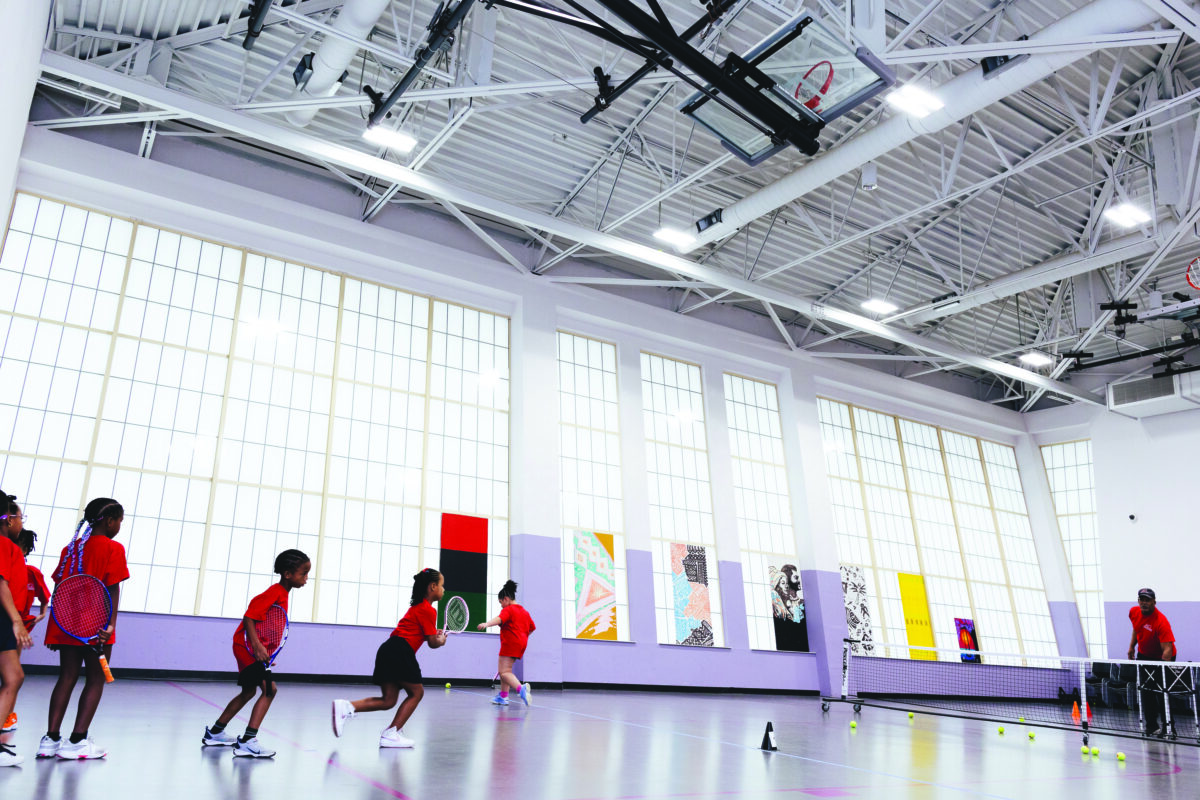
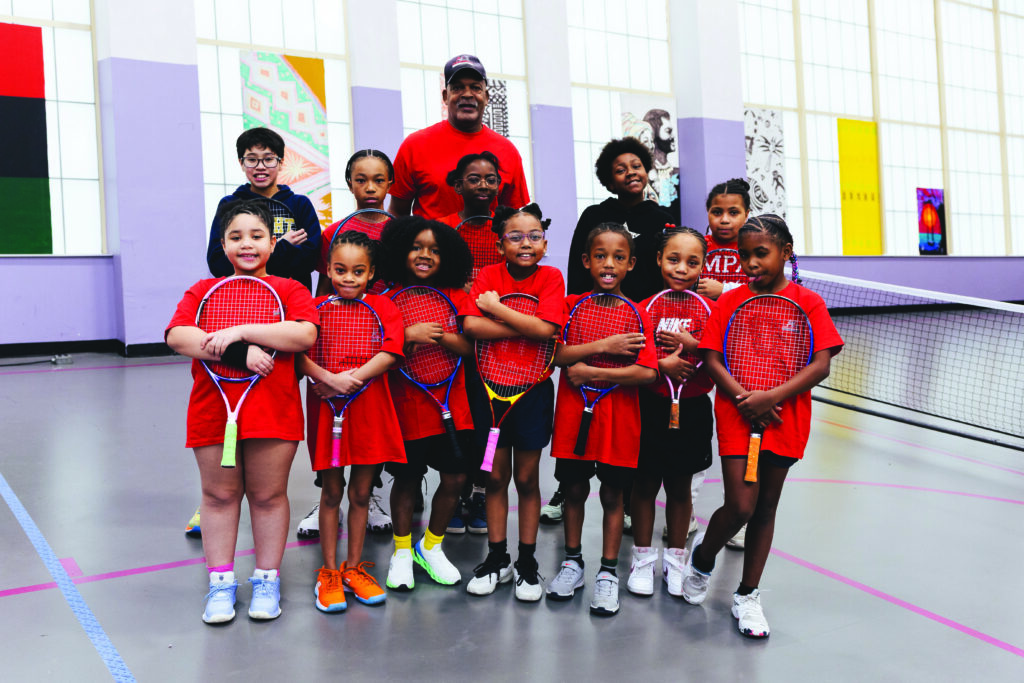
On the third floor of New Covenant Missionary Baptist Church in Greater Grand Crossing, Coach Tyrone Mason directed his “little and big” kids, as he likes to call them, where to aim and hit a bright yellow tennis ball.
“They’re progressing really fast,” he told the Weekly. “Today we’re teaching them strategy.”
With a hopper of tennis balls next to him, Mason served the kids from the other side of the net so that each could take a swing with their racket.
“Cover shot!” he yelled as he threw the ball underhand to each eleven-year-old.
For thirty years, Mason has taught local youth who are predominantly from Black families on the South Side the game of tennis. He estimated that he’s taught hundreds of kids, adding that most families hear about him through word of mouth, since he doesn’t have a website.
In the summer months, Mason can be found using the two tennis courts at Kenwood Park, but said the space is too limited for the nearly fifty kids that he coaches throughout the season.
“There’s not a lot of indoor facilities on the South or West Side, so there’s a limit on where the kids can go in the wintertime to play,” he added.
In a couple of years, the seventy-year-old Mason hopes to retire—and also hopes to see more indoor and outdoor tennis courts built.
“In 2027, I want to have a facility built where the kids can play and it can be a staple for years to come,” he said. “I can leave and it’ll still be there for the kids. That’s my goal.”
He mentioned McFetridge Sports Center, in Irving Park, the Park District’s only indoor tennis facility. McFetridge also includes an ice skating rink and hockey and dance lessons.
“Why don’t we have one in the South Side?” he asked. “Or the West Side?”
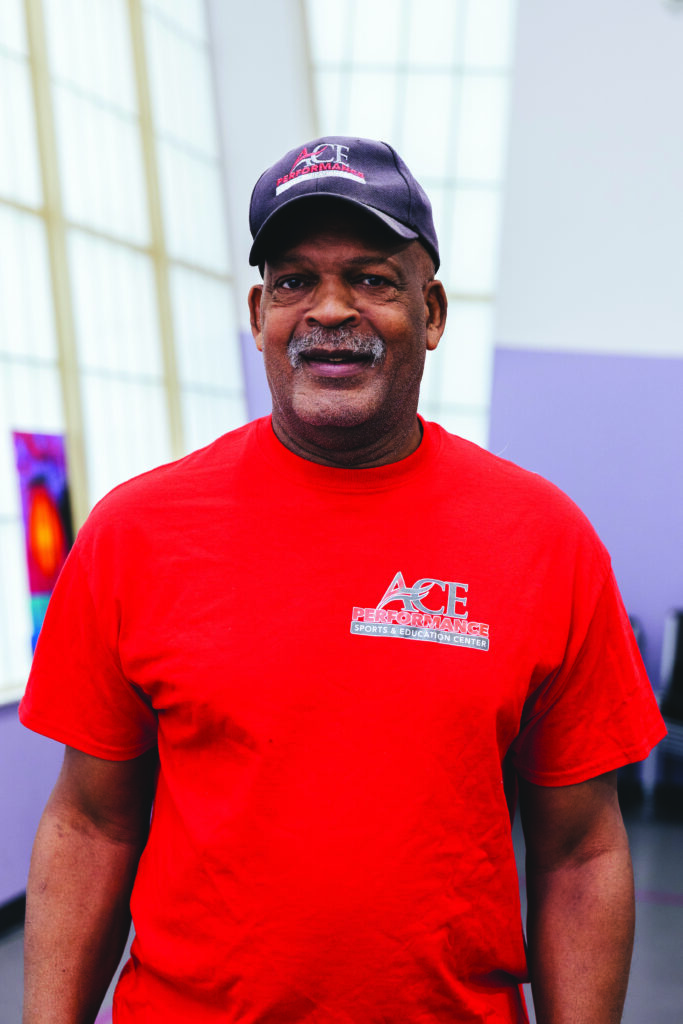
Mason told the Weekly he’s not only trying to create a safe space for youth, but also aims to expose young people to new opportunities through sports.
“The people that you get to meet playing tennis, the travel that you get to do, it’s totally different,” compared to basketball, he said. “We don’t have enough safe environments on the South and West sides that aim to put different things in kids’ hands.”
For many Chicago kids, parents, and community members, finding safe, accessible indoor and outdoor courts for sports and play can be a challenge.
Maria, whose family receives lessons from Mason, said that she often has to drive outside her area of Brighton Park to find recreational spaces for her sons, ages six and twelve.
“I don’t have a tennis court that is within walking distance and so you start to see a lot of barriers to these sports that actually are the best sports for longevity and good health,” she said.
Young people in Chicago have seen increased policing of where they can go, for how long and when. In recent years, the City Council has debated various enhanced curfew policies designed to curb large youth gatherings. Critics of the curfew ordinances, including Mayor Brandon Johnson, have said they disproportionately target Black youth.
“It’s of critical importance in this particular moment where there’s quite a bit of youth persecution and blame being placed on young people, [to have] spaces for them to express themselves and create becomes all the more important because they don’t get into this kind of self-fulfilling prophecy around young people being inherently bad,” said David Stovall, a professor of Black Studies and Criminology, Law, and Justice at the University of Illinois, Chicago.
“Having those places for recreation, for creativity, is an important interruption to what the world often says about them, particularly when we’re talking about Black and brown youth in a city like Chicago.”
Since 2018, the Chicago Park District has cut funding for eighty-three tennis courts and twelve basketball courts, according to budget appropriation documents. Baseball and softball fields have seen seven reductions, while the number of volleyball courts have remained unchanged.
Meanwhile, pickleball has exploded across Chicago parks. Since 2016, the number of pickleball courts has grown to 208. In 2022, the Park District announced “Pickleball Mania” and the goal to construct fifty new pickleball courts by the end of 2025 with funds from Chicago’s Recovery Plan. While the cost per court is unclear, documents the Weekly reviewed show that project costs can range from the $20,000 spent to install pickleball courts in Maggie Daley Park in 2018 to more than $1.4 million for tennis and pickleball courts installed in Grant Park in 2023.
Pickleball is similar to tennis, but is played with a smaller paddle, ball, and court. For many players, it can be an easier and more affordable game.
The Park District did not respond to questions about the declining number of basketball courts or why pickleball courts have increased.
“It’s an interesting moment where pickleball is in its kind of apex moment where you see courts pop up all over the place, but I wonder geographically where those pickleball courts are in relation to development in that area,” Stovall said. “Pickleball courts can be a marker of gentrification.”
Dozens of young people, parents and community members on the South and West Sides told the Weekly through digital and in-person surveyingthat they primarily use their local outdoor basketball and tennis courts, but want improved physical conditions and increased indoor court facilities for full year-round programming.
Survey respondents spoke of often seeing broken glass, trash, overgrown weeds, cracks within the pavement, lack of nighttime lighting, and broken fences in parks, adding that such conditions could dissuade them from using those spaces.
At Cole Park in Chatham, a father pointed out that only one of the two full-size basketball courts was functional, due to missing nets.
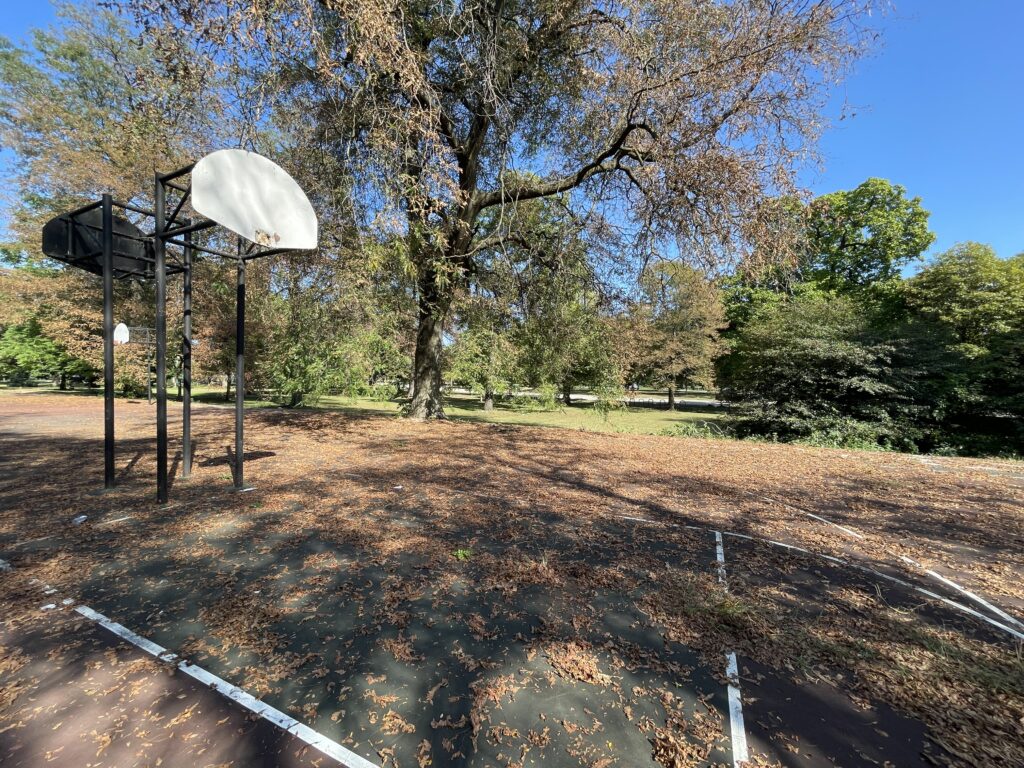
A parent who completed a virtual survey stated that they use public basketball courts, but “most of the courts we try to go to are a mess.” Other respondents said that they wished for more well-maintained parks and recreational spaces.
On a drive past Hamilton Park in the Englewood neighborhood, Te’Riah Montgomery, a mother of three boys, said she was surprised to see the condition of the park.
“I’ve never seen the weeds,” she said, recalling the park’s lush lawns during her childhood. “I used to hear so many crickets or cicadas, but [now] it was very quiet, very different, not inviting,” she said. “I see why these kids might not want to go.”
Chase, Montgomery’s seventeen-year-old son, said he has grown up loving to play basketball but has had to travel to different parks to find nets or rims on a court.
“It kind of makes me feel frustrated,” he said. “Why aren’t the rims on the basketball court?”
According to finance documents the Weekly obtained via a public-records request, the Park District spent nearly $2 million in 2012 to revitalize 100 basketball courts across the city through its “Slam Dunk” initiative.
The removal of basketball rims and nets has been debated by city leaders and officials as a potential means of decreasing violence that might occur at courts or in nearby areas.

When asked in the Weekly survey what they need in order to feel safe, respondents spoke of concerns related to violence but also wished “to know the community is invested [in]” courts and have “an active and effective government that supports an active community.”
Other respondents also mentioned policing, camera surveillance, increasing lightning, and “better looking areas,” in order to feel safe.
“People lose their lives due to anger at the court,” said Lady Sanders, a program manager for My Block, My Hood, My City, a nonprofit that serves youth on the South and West Sides. “I don’t think it should be blamed on the sport itself,” she said.
Sanders, who has worked with the organization to replace missing basketball rims, nets, and backboards for public courts, says that the removal of rims “should not be used as a punishment to everyone.”
She emphasized the need for young people to have an outlet.
“People don’t pay attention to what the kids are battling,” she said. “They need something to do, and having a court down the street or up the block from them, can eliminate stress in ways that a lot of people don’t understand.”
In 2024, the American Psychological Association (APA), reported that stress and related mental-health problems were at an all-time high. Between 2016 and 2020, the number of kids aged three to seventeen who were diagnosed with anxiety grew by 29%, while depression grew by 27%. The American Institute of Stress (AIS) reported in 2024 that on average, American teenagers rated their stress level at 5.8 on a ten-point scale. Adults, meanwhile, averaged 3.8.
In addition to increased emotional and mental support—particularly from adults—the APA noted that youth need recreational spaces to maintain their mental health.
For South Side parents like Maria, knowing they can find Coach Mason at Kenwood Park in the summer is a relief.
“This was one of the only spaces where Black children who are coming to the park [have] someone who knows them, knows their parents, and is sort of just watching the entire space and making sure that kids are safe,” Maria said. “I thought that was incredibly amazing in that, yes, there are tennis courts in Chicago, but this one is under amazing supervision under Coach Mason.”
With more than thirty years of interacting with and teaching Chicago kids, Coach Mason said providing them safety is an important part of his vision.
“When you have a facility, kids feel comfortable calling it their home,” he said. “‘I can go here, and mom can pick me up from here. I can get a chance to be in a safe environment.’”
Jewél Jackson is an investigative, multimedia storyteller who reports on society, culture, and youth.
Related Stories
South Side Sports Roundup January 15, 2025
The latest results and news from the Chicago sports world.
The Rink Celebrates 50 Years as ‘A Powerhouse in the Community’
Illinois’ only Black-owned roller rink preserves culture and celebrates community in Chatham.
Battle for the Blacktops
Faced with a growing shortage of usable courts, hoopers are fighting to preserve streetball in America’s basketball city.