

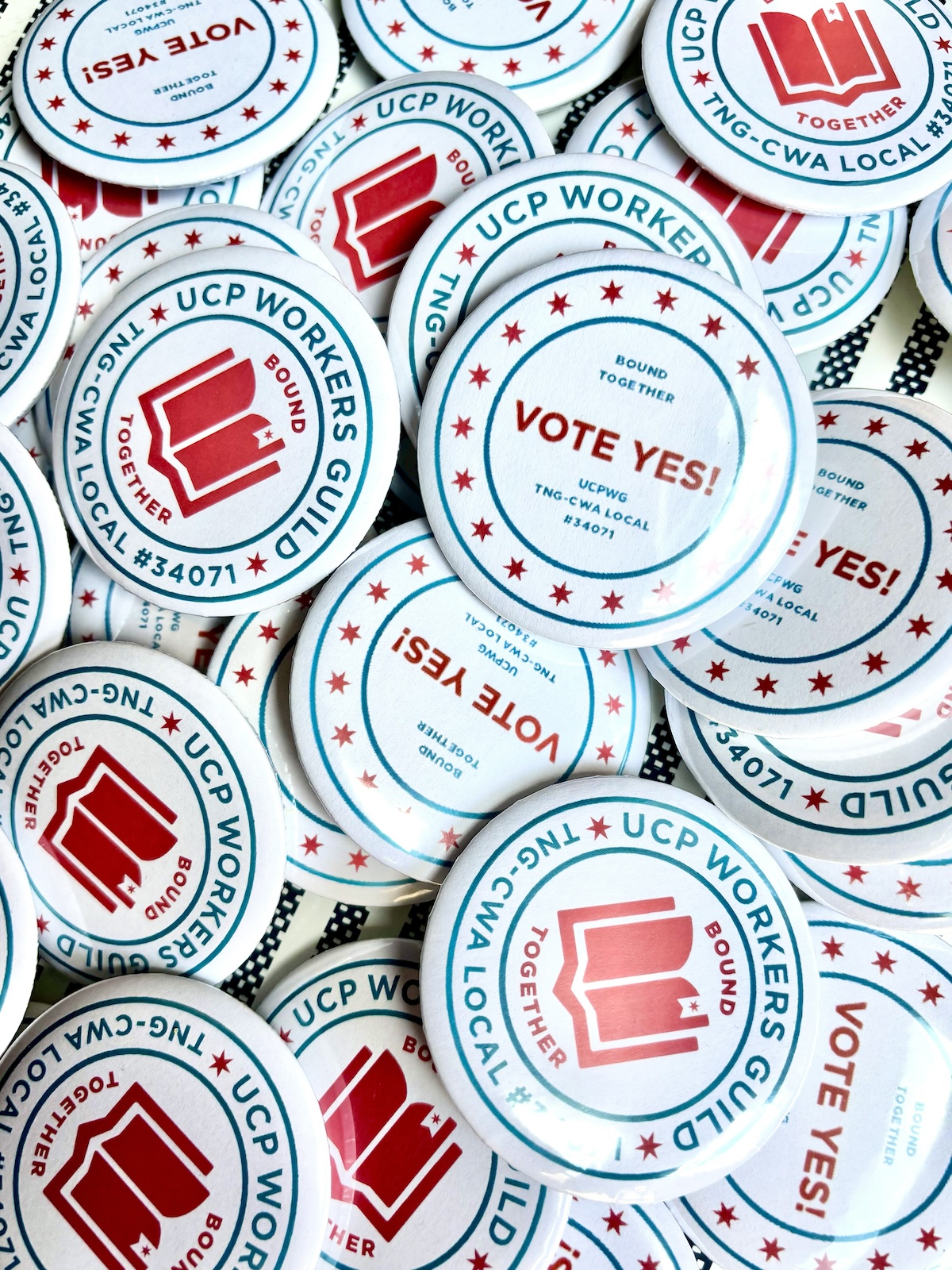
On July 8, members of the University of Chicago Press (UCP) Workers Guild will find out whether they have won their union election after a public campaign that began this spring.
Either way, employees at the press, one of the largest university presses in the United States, feel more connected and ready to advocate for themselves.
“It’s kind of corny, but the solidarity aspect is so incredibly important,” said Adrienne Meyers, senior promotions manager at the press and a member of the UCP Workers Guild. “Things have already improved for so many of us simply by … understanding that this person on the other end of the email thread is working two side jobs because they’re not getting paid enough, or this person over here has been promised a promotion for years and years, and it’s just not happening.”
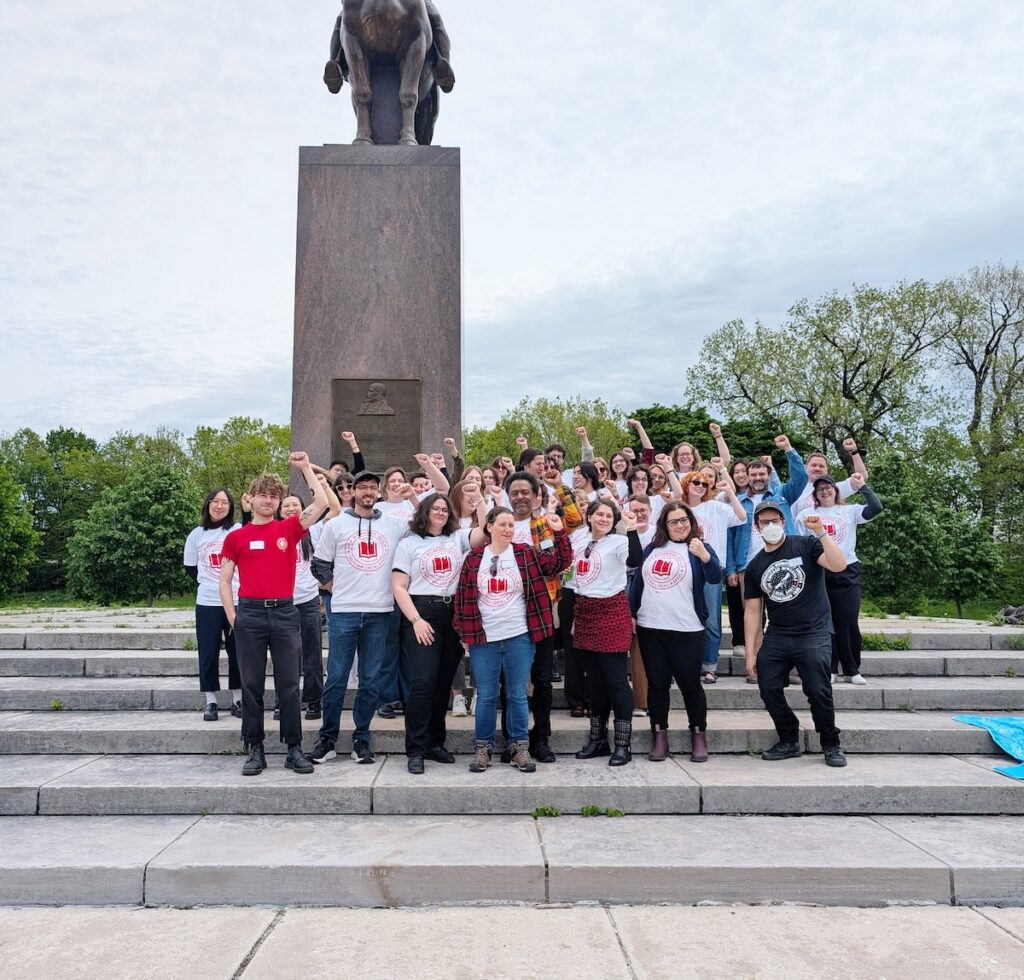
The Guild’s union drive comes at a time when many universities and cultural institutions around the country are cutting budgets—including the University of Chicago. But it’s also a notable example of how, against that grim backdrop, publishing workers and cultural workers are coming together to ensure they have seats at the table.
The union drive, organized with the Chicago News Guild (Local 34071 of the NewsGuild-CWA), launched on May 4 with union cards signed by a supermajority of eligible employees. After the University of Chicago chose not to voluntarily recognize the union, workers went to the polls in person at the press’s offices in Woodlawn on June 9 and 10. Mail-in voting is still underway, and ballots must be received by the National Labor Relations Board’s regional office by July 7.
Warehouse workers at UCP’s Chicago Distribution Center in Pullman, who are responsible for distributing books and journals for the press and more than 120 publishers who are clients of its distribution services, have long been unionized with the International Brotherhood of Teamsters. But according to the UCP Workers Guild, it would be the first union at the press to include editorial workers.
Of UCP’s more than 270 employees, 139 are eligible to be in the union (depending on a handful of challenges that will be decided following the election if necessary). This would include employees across the press’s books and journals divisions, IT, and administrative staff, as well as some workers within its distribution services division, such as those who run the press’s digital book repository service, Bibliovault. Managers and confidential employees (those whose role involves access to information on management policies regarding labor relations) are excluded, as are the approximately 60 CDC warehouse employees already represented by the Teamsters.
According to Meyers, the COVID-19 pandemic helped spark more serious conversations about unionizing among the rest of the press’s staff, as working from home and other new opportunities for flexibility opened their eyes to what was possible, and heightened financial pressure coupled with salary freezes underscored how fragile their positions were. High staff turnover in the following years added fuel to the fire.
“That brought up a lot of conversations about, okay, if this is not a stable place to work, then what are we doing here, and what can we do to make it better for ourselves and for each other?” Meyers said.
Pay equity, sustainable working conditions, and transparency about how the press workplace operates are the UCP Workers Guild’s key organizing principles. “We believe that one job should be enough,” its mission statement says. The union has also called for manageable workloads, clear policies on promotions, protections for remote and hybrid work arrangements, and guardrails against the risks posed to their work by the rise of generative AI.
Transparency is an important part of achieving those goals. “We seek to demystify the press’s operational relationship to the university and the bureaucratic policies that prevent managers from hiring, retaining, and rewarding staff,” the Guild’s mission statement says. The Guild’s Instagram says workers don’t know the answers to questions such as whether UCP is profitable and who determines staffing levels.
“How can we advocate for ourselves if we don’t know anything about how this business works? How can we negotiate our salaries or make a case for a promotion when we don’t know who we’re making that case to?” Meyers said. “Our fundamental questions about the business model and the business relationship, and power over some of the day-to-day working conditions and things like that, still are pretty mysterious.”
UCP’s website says it is “the largest American university press in terms of output, staff, and revenue,” and that it’s been self-sufficient, not financially supported by U. of C., since 1955. But it’s difficult to determine more about its finances; the press’s revenue from book publishing is not listed separately in the university’s most recent available financial statements and tax forms (though some information about distribution of books and income from advertising in journals is available).
The university’s budget crisis is also a concern. U. of C. has made major cuts to its budget in recent years, seeking to reduce a budget deficit that hit $288 million in fiscal year 2024. Though the financial health of the university has been better than anticipated—the deficit reduction is ahead of schedule and expected by university leaders to reach $140 million in June—the school also announced plans last September to reduce spending by another $100 million over the next several years, citing federal policy changes.
U. of C’s cost-cutting measures have included, among other things, staff hiring freezes, layoffs of hundreds of staff, scaling back capital projects, pausing enrollment for 19 of its Ph.D. programs, and reducing the number of graduate students it funds. Some faculty, staff, and campus unions have questioned whether some of these steps are necessary or effective, pointing to years of big spending on new buildings and other controversial financial choices. U. of C.’s more than $5 billion in debt is high for a school with its level of assets.
The University of Chicago Press workers’ effort comes amid a wave of unionizations in the publishing industry in recent years. Workers at Verso Books, a bellwether, won union recognition in late 2020. University press workers at Duke and Oxford organized in 2021 (in Duke University Press workers’ case, after a protracted fight: Duke fought the results of the election until early 2022). And just a week before the UCP employees’ announcement, employees at major publisher Hachette announced their own union drive. According to the Hachette Workers Coalition, with more than 600 employees included, it is the largest union in trade publisher history.
Like all of those presses, the UCP Workers Guild has unionized with a local branch of the NewsGuild-CWA, which has 27,000 members nationwide. The UCP Workers Guild would be a similar size to the Oxford University Press USA Guild, which represents about 150 employees, and larger than Duke University Press Workers Union, which had about 80 members in its bargaining unit when it was organized in 2021.
“This is a part of the media industry that has for a long time not had any organized workforces, and clearly there is a hunger for it,” said NewsGuild organizer Esteban Gil, whom the UCP Workers Guild is working with. Publishing, he said, is one of many industries where workers “do it for the love of the job”: “It’s not a place that you go to necessarily get rich, but it is a place you go because you love the work and you love the creation of knowledge and content.”
As the Guild points out on Instagram, this relationship to the work can be understood as an example of vocational awe, a term coined by scholar and librarian Fobazi Ettarh to describe how the idea that librarianship is a sacred calling results in treating libraries as institutions as inherently sacred—and directly worsens librarians’ working conditions.
Like librarians, publishing workers—and, notably, workers at museums and other cultural institutions—often have their “love of their work exploited,” the Guild notes. The working conditions of these industries contribute to a reputation for combining significant cultural cachet with exclusion and gatekeeping. In scholarly publishing, like in the U.S. publishing industry in general, the workforce is more than 70% white and more than 70% women as of 2023 surveys.
Many Chicago cultural institutions have also unionized in the last five years, including the Art Institute of Chicago, the Griffin Museum of Science and Industry, the Newberry Library, and the Shedd Aquarium.
Though the cultural and publishing industries’ challenges aren’t identical (for one thing, public-facing customer service is a bigger part of museums’ and libraries’ work), their commonalities might be a chance to learn from each other.
Nasr del Valle runs a newsletter called Chicago Cultural Workers and organizes events for workers in the sector. Over the past year, through karaoke nights, group museum visits, and volleyball picnics, he’s helped to build community across institutions.
Del Valle says connecting with other cultural workers has been rewarding in a number of ways, but one is that it helps identify patterns in their working conditions. “When you get enough folks that say, ‘Hey, wait a second, so you’re in this problem, I’m in this problem. How can we put our heads together to get out of this?’ … That’s when labor organizing becomes also community organizing,” they said.
Putting heads together is also a chance to share resources. Del Valle has taken action on civic opportunities shared by the Chicago Public Library employee union, promoted creative endeavors of fellow cultural workers, and shown up for museum union rallies. They include information about labor history in their newsletter and aim to educate folks about their rights. “When people know about the history, people actually know what they’re talking about, they’re going to be a little less afraid,” he said.
Meyers said that the UCP Workers Guild has been intentional about connecting and swapping notes with other university press unions, unions at U. of C., and unions within the NewsGuild. The group has aimed to understand “how things have worked out for other people, what kind of challenges and successes they faced, tips and strategies.” The campus labor community has been particularly supportive, and it’s been helpful that they can speak to “dealing with the university’s own structures and bureaucracies.”
One feature of the UCP Workers Guild union election that surprised the Guild was that employees were categorized as “professional employees” or “non-professional employees” for the vote. The distinction is laid out in the National Labor Relations Act, but it also divides the group. Pursuant to the Act, in addition to voting on whether to be represented by the Chicago News Guild in collective bargaining, “professional employees” are voting on a second question: whether or not they want to be in the same bargaining unit as those categorized as “non-professional.”
The Guild’s website claims the university stipulated the use of the classifications. The University of Chicago did not respond to a request for comment.
The distinction “is one that, as a unit, we don’t feel makes a whole lot of sense for our workplace,” Meyers said. “For instance, we had two people who worked the exact same job and were hired on the exact same date. One was categorized as professional, and one was non-professional. So, those distinctions have been really strange.” She added, “The best outcome from our perspective is that we are all in one unit together.”
The UCP Workers Guild is feeling confident going into the election nonetheless.
“A union is not going to work if most people don’t want it, because we, the workers, are the union,” Meyers said. Through every step, she said, they’ve checked in with each other to make sure most folks are truly on board before moving forward. “We’ve only gotten here because a majority of … our colleagues have been receptive and excited about this.”
Olivia Stovicek is a senior editor for the Weekly. She last wrote for the Weekly about reflections from the Stop General Iron hunger strike.