

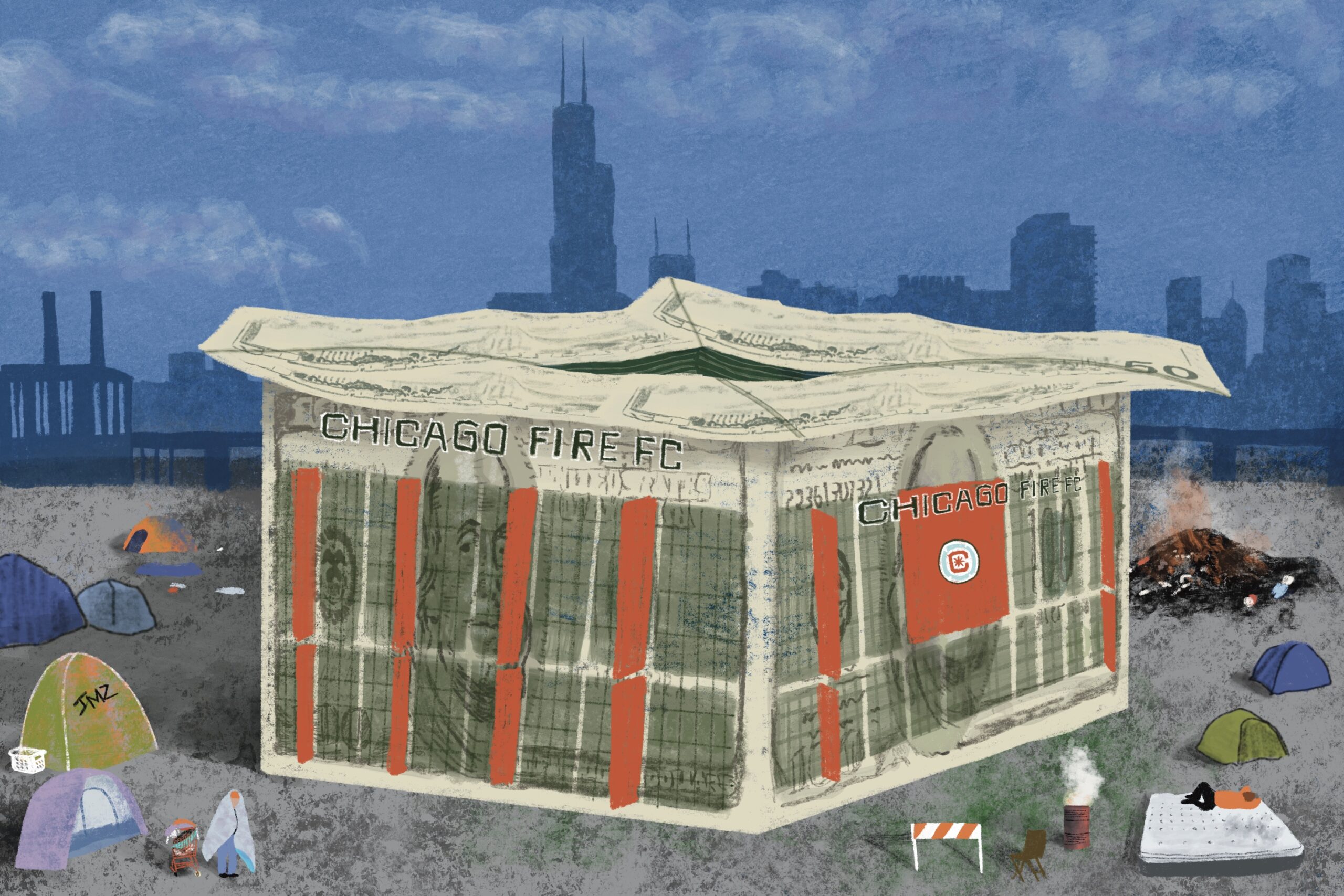
The future home of the Chicago Fire is not easy to get to.
At least, it took me a few tries. From the Roosevelt Road overpass in the South Loop, I scanned for a way into the tract of land known as The 78, where the groundbreaking for the 22,000-seat stadium was taking place in 20 minutes. With no through access for blocks, I had to venture further northwest to Harrison and Wells before heading south. For now, this stretch of Wells is the only way in or out of The 78: bordered by Metra tracks to the east and the south branch of the Chicago River to the west, there’s no arriving from those directions, either. A rare kink in our beloved grid system.
Not that it’s mattered much until recently. Looking out from the Roosevelt overpass last Tuesday, I might have mistaken Chicago for a Rust Belt rail junction, were it not for the gleaming skyline behind me.
That’s how this piece of land has looked for about as long as most of us can remember: dusty and vacant, nestled between a twisted web of tracks and railyards with the steel of the defunct St. Charles Air Line Bridge rising in the distance.
On this day, though, a huge white canopy tent plopped in the middle of The 78 cut through the rainy gloom. As I arrived, a steady stream of cars filed into an adjacent makeshift parking lot. I had kindly been invited to the groundbreaking ceremony along with Fire season ticket holders, other media members, and a smattering of elected officials.
Given the usual pace of major infrastructure projects in the city, it’s remarkable that we were about to witness shovels in the ground less than a year after the concept was first announced to the public. Chicagoans learned about the stadium last June through an open letter from the Fire’s billionaire owner, Joe Mansueto. After clearing zoning committee votes, the plan was voted in by the full City Council in September.
The new stadium will be privately owned and funded by Mansueto, sidestepping the need to request taxpayer dollars that ultimately tanked recent stadium proposals from the White Sox and Bears. Real estate company Related Midwest, which acquired the plot in 2016, is slated to develop a surrounding planned community. Renderings from the Fire and Related Midwest show numerous green and social gathering spaces, commercial corridors, and high-rise residences conceived around a proposed extension of Chicago’s riverwalk. Information on potential developers and commercial tenants has not been released.
It’s a grand accomplishment for the Major League Soccer (MLS) franchise, which has struggled with turf quality and scheduling conflicts at Soldier Field in recent years. The Fire played there from 1998 until 2006 before moving to Bridgeview’s SeatGeek Stadium, built specifically for the soccer team. Dissatisfied with the results, they returned to Soldier Field in 2020.
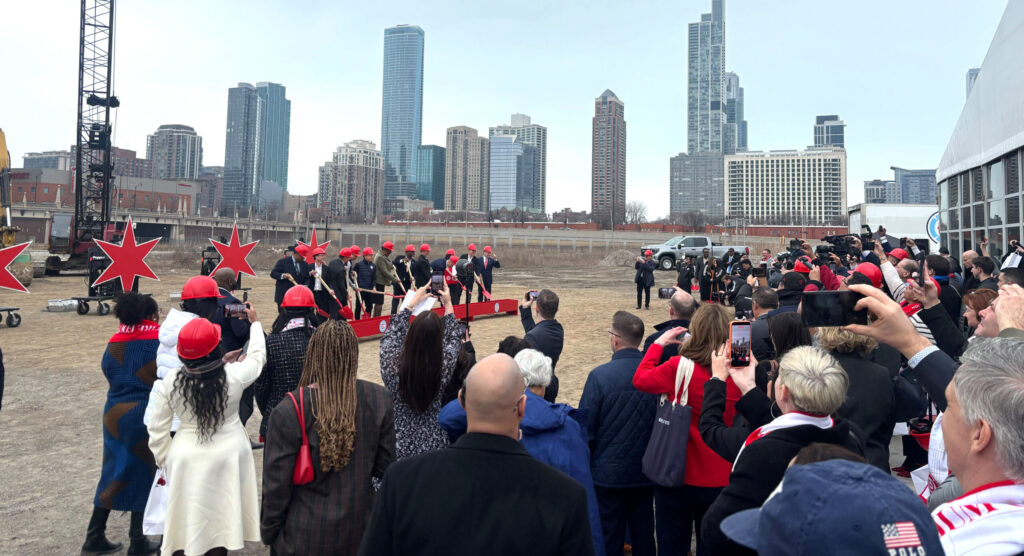
Under the tent at The 78, speeches began at 2pm with Fire’s president of business operations, Dave Baldwin, who appealed to the growing popularity of soccer in the United States as grounds for the stadium project’s viability.
“Soccer is having its moment in America,” Baldwin said, referring to the Fire as a “sleeping giant” that could be awakened by new facilities. MLS Commissioner Don Garber stressed that projects like this were critical to fostering a local soccer culture. Even 3rd Ward Ald. Pat Dowell, whose ward includes The 78, was in the know. “Soccer is booming in the United States, I’m told,” she deadpanned near the end of her time at the podium.
The imminence of a soccer explosion in the United States is not a new talking point from those within the sport. Commissioner Garber wrote a guest column for the New York Times in 2002: “Finally, we are witnessing…the coming of age of the American professional soccer player, with literally millions more developing their games on soccer fields and alleyways throughout our country.” At that time, the impending construction of multiple soccer-only stadiums around the country led the commissioner to conclude that “By any measure soccer has arrived.” On Tuesday, Garber pointed to stadium developments in Chicago, New York, and Miami as similar evidence.
A lot can change in twenty-four years. MLS did grow substantially in the decade-and-a-half after Garber’s column, growing from twelve to twenty-two franchises and seeing average attendance jump by nearly 50 percent in that time. Since then, though, average attendance has stagnated, even as the number of franchises has ballooned to thirty.
The league’s broadcast reach appears to be struggling, too. MLS games, shown exclusively on Apple TV since 2023, averaged 120,000 unique viewers last season, down two-thirds from 2022 when matches were available on ESPN.
Perhaps attendance and viewership aren’t critical factors in stadium planning. After all, the Women’s National Basketball Association (WNBA) and the National Women’s Soccer League (NWSL) only have a handful of dedicated stadiums, despite both leagues booming in recent years. The WNBA has seen its per game attendance nearly double since 2022, and averaged just under a million viewers per game across networks. The NWSL has experienced the same growth over the last decade, and reported an average of 214,000 viewers across all networks.
Speakers from the Fire and MLS heralded the groundbreaking as a milestone for American soccer. Elected officials did the same for Chicago’s economic prospects. Those present believe that the stadium represents a landmark economic milestone for the city and their constituents. “This day today signals that Chicago is open for business,” Ald. Dowell declared.
The 78 site has long been prized as one of downtown Chicago’s last undeveloped swaths of land. The railyard that sits just across the river on the site’s western border once encompassed the entire area, before being cleared in the 1970s as heavy industry and passenger rail declined. But as other Loop-adjacent neighborhoods have boomed, The 78 remained barren. A TIF district encompassing the land was created under Mayor Richard M. Daley in 1997, and for a time, it was owned by infamous real estate developer Tony Rezko. Rezko failed to develop the site amid the corruption scandals that ultimately led to his imprisonment, and it remained in limbo until Related Midwest’s purchase from a Luxembourg-based company in 2016. Now, after ten years of failed proposals that included a casino and stadiums for the White Sox and Bears, it’s finally happening.
With that history in mind, it’s understandable why the elected officials at the groundbreaking ceremony sounded so excited. Noting the site’s famously long vacancy during his speech, Mayor Brandon Johnson promised: “With today’s groundbreaking, we begin to meet our city’s fullest potential,” calling the project a “major step towards the development of the whole city.”
It’s the first public comment on the project from Johnson since it was announced. It also echoed the rhetoric used by the mayor in his support of the Chicago Bears’ failed 2024 stadium proposal, emphasizing the benefits of focusing private investment around a stadium as an anchor for a larger business community. That proposal promised nearly 2,300 permanent local jobs in the region, while Related Midwest projects a total of 5,000 for the Fire stadium project and community. But while the Bears’ proposal offered a projected annual economic impact of $248 million for the city, Related Midwest’s plan for the Fire claims their development will result in over $2 billion in yearly economic impact.
It’s hard to know what to make of these promises. Stadium public policy expert Geoffrey Propheter at the University of Colorado Denver told the Weekly that job creation numbers promised by stadium developers are often impossible to corroborate or follow up on, because who’s to say what they’re counting as a job? What kinds of jobs are we talking about, and more importantly, what do they pay and who gets them? “Half the problem,” Propheter said, “is that there is no standard lexicon for describing these [things].”
In his remarks, Johnson stressed the need to ensure that Chicagoans and local residents would be the beneficiaries of the jobs and development promised by the parties involved. In an August statement to the Weekly, a spokesperson for Related Midwest stated that their projection of 5,000 permanent jobs included “jobs and investment generated in the broader supply chain”—that is, second- and third-order jobs down the supply chain, which may or may not be anywhere near Chicago or its residents. The spokesperson also declined to directly answer whether they and their partners would commit to ensuring the jobs created by the project would provide employees with a fair and living wage.
Propheter also said that projections for economic impacts and tax revenue may be overstated because impact studies often overzealously (and erroneously) identify all economic activity associated with a development as being caused by said development. More importantly, he said, they don’t account for the opportunity cost of what might otherwise be occupying the development space in question.
“Even if the numbers themselves are credible, an economic impact report is still completely useless from a policy standpoint because of those tradeoffs. It tells you nothing about what you could have done differently [with that space] and what those costs and benefits would be if you allocated the target resources in some other way,” Propheter said.
“Generally speaking, the highest-value and best use of land is never, ever for sports.”
It’s easy to see what’s in this for the Fire. The turf at Soldier Field is notoriously poor, and the Fire are routinely obligated to relocate games and plot their schedule around Bears games and concerts at Soldier Field. They won’t have to sign a lease. The team will have facilities that they can finally be proud of. “You don’t wash a rental car,” Mansueto quipped about the Fire’s current tenancy at Soldier Field.
But the speed of the project’s development and approval has left residents with questions about the development’s scope and concerns about its impact on surrounding neighborhoods.
Speaking on behalf of Community Benefits Agreement (CBA) for 78, a “cross-ward coalition representing the interests of working families” in wards impacted by The 78, organizer Sarah Tang described the development agreement’s affordable housing allocations as “not satisfactory,” and called for “good housing solutions, not just what’s required.”
According to Tang, CBA for 78 is primarily concerned with housing security, and pushing back on the forces of land speculation that typically accompany stadium developments—and could price longtime residents out of their homes. She called the potential for stadium-based displacement “a real, existential threat” to communities like Pilsen, Chinatown, and Bronzeville. With the development set to include high-rise apartments and yet-to-be-announced soccer-themed commercial endeavors, concerns that price pressure could expand into adjacent wards aren’t without merit.
At the ceremony, Dowell said her role in the project was informed by extensive community input, explaining that at least twelve community meetings had been held. “These types of projects do not take place in a vacuum,” Dowell said. “It requires a lot of input and listening.” Related Midwest cited a poll conducted by a South Loop community group showing “73 percent of respondents were ‘supportive’” of the proposal.
Not all community members are echoing that level of support. At a press conference held the day before the groundbreaking ceremony, representatives of the different community groups in CBA for 78 shared concerns that the developers’ promises to the community would go unfulfilled without a CBA in place. Consuela Hendricks, co-president of community organization People Matter, told media members that “new development should prioritize families that are already living in the communities instead of pushing them out.”. Other speakers echoed Tang’s earlier contention that the basic affordable housing fulfillments proposed by the developers are still likely to be out of reach for residents in surrounding communities.
Tang told the Weekly that residents’ capacity to bring forth concerns was limited. She said most meetings were private, and that all public 3rd Ward meetings were conducted via Zoom, with vetted questioning and no open floor, while the only 11th Ward meeting was invite-only. “All the other meetings that were face-to-face were privately held by homeowners associations in the area,” she said.
In an emailed statement to the Weekly, Dowell wrote that her office conducted two community meetings over Zoom “to ensure accessibility” and that questions were “slightly edited when necessary to combine similar inquiries.” Dowell added that her office met with a number of local organizations across South Loop and Chinatown, published an FAQ about the project, and answered emails from constituents.
At the ceremony, Dowell acknowledged Curt Bailey, the president of Related Midwest, who was thanked repeatedly through the afternoon’s remarks. Disclosure records show that Bailey donated $1,500 to Dowell’s campaign committee in March 2025, just over two months before plans for the stadium were announced. Dowell received an additional $3,000 from Don Biernacki, a Related Midwest executive vice president, in 2025, including $1,500 on the same day as Bailey’s donation. Biernacki has also contributed $4,000 since 2023 to 11th Ward Ald. Nicole Lee, who was in attendance at the groundbreaking.
Multiple speakers cited the endlessly publicized fact that the stadium would be privately financed by Mansueto. But plenty of public money is still tied up in the project. In 2019 the city created a TIF district in the area and entered an agreement with Related Midwest in which the developer would cover up front costs of infrastructure improvements and then recoup the investment from tax revenue captured by the TIF. The planned infrastructure, which included a new Red Line station and repositioned Metra tracks, was projected to cost $700 million.
In an emailed statement, a spokesperson for Related Midwest confirmed that the stadium development will not include an additional Red Line station, and cited extensions of existing streets, a parking garage, and paths for pedestrians and cyclists as projected solutions to traffic congestion.
The TIF district created for these transit projects remains in place. According to the spokesperson, Related Midwest has not recouped any costs from the TIF yet, but is in discussions with the city over how to rework the initial TIF to fund the public infrastructure developments that will support the new stadium plan. 25th Ward Alderperson Byron Sigcho-Lopez has called for transparency regarding the developer’s use of these TIF funds, saying at last Monday’s press conference that any unused funds could be “used for affordable housing and other needs.”
As remaining questions continue to shape the development, what’s clear is that The 78 is entering a new era. The name of the site, after all, was coined with the notion that it might be Chicago’s 78th community area. After decades of political grandstanding and failed proposals, it seems that’s actually happening, at least in part.
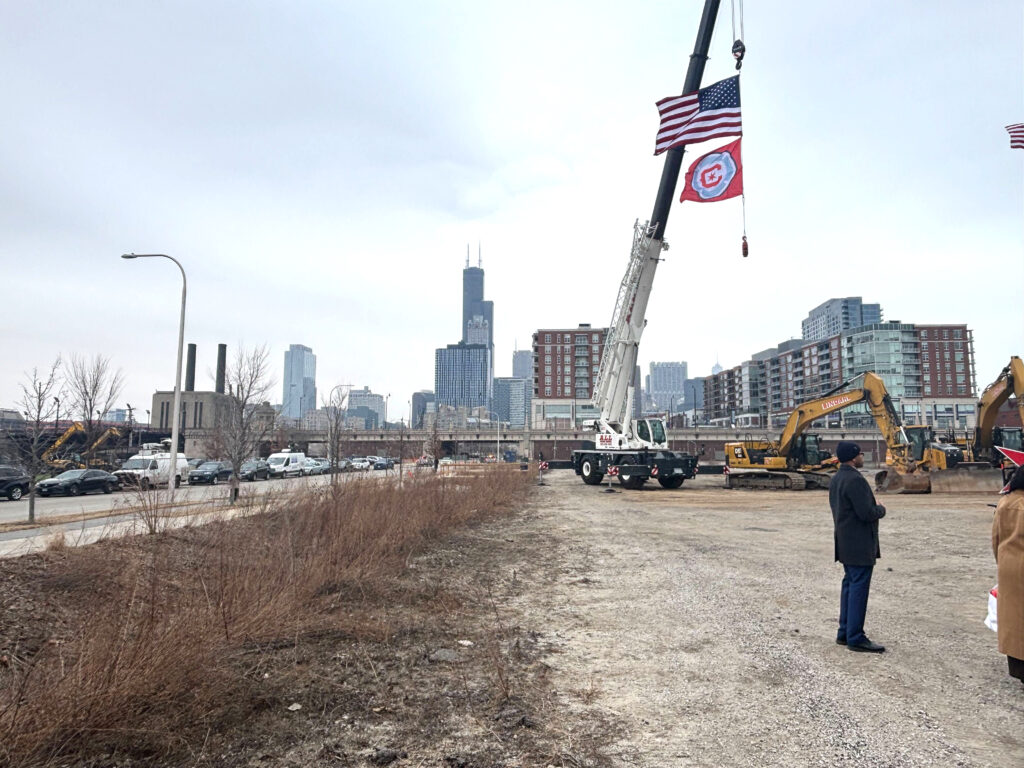
At the groundbreaking, a Chicago Fire flag fluttered below the American stars and stripes on a construction crane, hailing the team’s victory over the White Sox, Bears, and all other would-be occupants of this long-coveted land. Finally, work had begun.
Note 3/13/26: We’ve updated the story to include responses from Related Midwest concerning public infrastructure projects in The 78.
Malachi Hayes is a Bridgeport-based writer and South Side native.